That distinction matters. Low volatility after a rally can signal absorption. Low volatility after a breakdown can signal exhaustion. This setup looks closer to the second case.
The thesis is simple: Bitcoin isn’t proving strength by refusing to move. It’s showing that buyers have not yet forced a meaningful recovery from damaged territory. Calm can be constructive when it forms above support. Here, it is forming beneath the levels bulls needed to hold.
"This is a rather dangerous consolidation for the bulls," Alex Kuptsikevich, chief market analyst at FxPro, told CoinDesk.
The danger is complacency. Markets often look safest when the next move has already started to load.
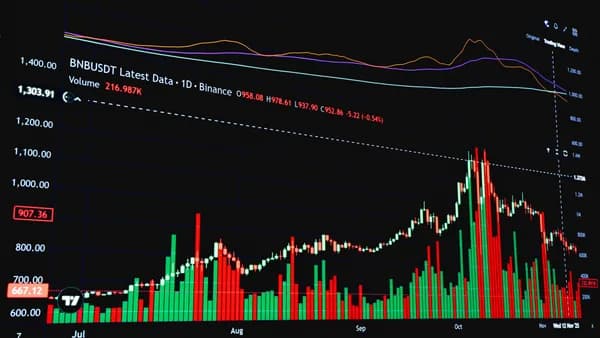
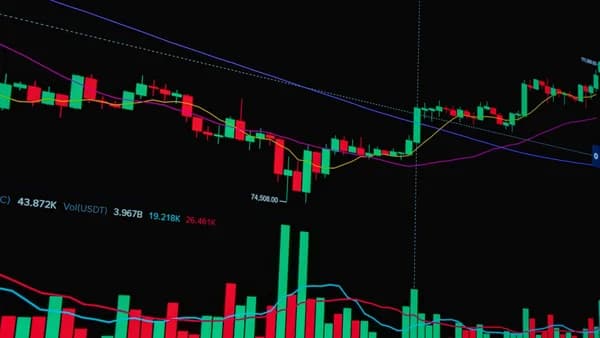
A narrow Bitcoin $59,000 to $60,000 range would feel very different if it were forming above a clear support shelf. It isn’t. CoinDesk reports that the current band sits below the levels that sparked rebounds in February and earlier this month. It also sits below the 50-day and 200-day moving averages, both of which are sloping downward.
That is not a neutral detail. It changes the reading of the entire chart.
When price moves sideways under levels that previously mattered, bulls have to do more than wait. They have to reclaim territory. Until they do, each failed push higher strengthens the view that the market is not building a base, but pausing inside a downtrend.
Here is the contrast that matters:
| Setup |
2024 consolidation |
Current consolidation |
| Price zone |
$55,000 to $70,000 |
$59,000 to $60,000 |
| Duration cited |
March to October 2024 |
Five straight days |
| Trend context |
Formed in a rising market, per Kuptsikevich |
Forming in a falling market |
| Technical position |
Not described as below falling 50-day and 200-day averages |
Below downward-sloping 50-day and 200-day averages |
| Risk flagged |
Normal consolidation |
Possible break toward $40,000 |
That table is the story. The same price behavior can carry opposite meanings depending on structure. A quiet market above support says buyers are absorbing supply. A quiet market below support says buyers have not yet taken control.
The tempting comparison is 2024, when Bitcoin spent much of March to October consolidating between $55,000 and $70,000, with occasional overshoots in both directions. That period trained traders to see broad sideways action near these levels as survivable, even healthy.
This time, that pattern match is lazy.
Kuptsikevich’s point is sharp because it cuts through the visual similarity. The 2024 version formed in a rising market. The current one is forming in a falling one. That means the burden of proof has shifted. Bulls don’t get credit for merely holding a tight range after the market has already slid under watched levels.
The strongest counterargument is fair: consolidation can precede upside. Sellers can run out of force. Long-term holders can absorb pain. CoinDesk also cited pseudonymous CryptoQuant analyst Darkfost, who flagged signs that long-term holders are starting to capitulate, or selling at a loss. In past cycles, that phase has marked attractive entry points, even while signaling near-term pain.
But that doesn’t make the current Bitcoin $59,000 to $60,000 range safe. Capitulation can mark opportunity eventually. It can also mean the market has not finished clearing weak hands yet.
For readers tracking related stress across crypto and macro positioning, XOOMAR’s earlier pieces on Gold, Silver, Bitcoin Sink as Debasement Trade Snaps and Crypto Derivatives Flash Red as $1B Washout Fizzles offer useful adjacent context.
The level that matters now is not abstract sentiment. It is the bottom of the current band. If Bitcoin loses the $59,000 area, the market can start treating this consolidation as failed, not unfinished.
Kuptsikevich told CoinDesk that if the pattern breaks lower rather than resolves higher, the next meaningful step down is around $40,000. That should not be read as a guaranteed target. It should be read as the risk zone that becomes more credible if buyers cannot defend current levels.
There is a difference between prediction and scenario. Prediction says Bitcoin will hit $40,000. Scenario analysis says that once a tight range breaks below support in a falling market, traders have to respect the next visible downside area identified by analysts. The second view is disciplined. The first is theater.
Demand signals don’t help the bullish case much right now. CoinDesk reported that active addresses and transaction activity have hovered near the low end of their recent ranges through the slide. That fits the chart: muted participation, weak recovery attempts, and a market waiting for someone else to bid first.
The bullish case is not dead. It’s just not winning the current argument.
Long-term Bitcoin investors can point to scarcity narratives, prior recoveries, and the tendency for deep stress to create future entry points. CoinDesk’s reference to long-term holder capitulation also cuts both ways. Selling at a loss can signal pain, but in past cycles it has also appeared near periods that later looked attractive.
The problem is timing. A market can become interesting for long-term buyers before it becomes safe for traders. Those are different games.
Bulls need evidence, not slogans. A reclaim of the levels that sparked rebounds in February and earlier this month would matter. A move back above the 50-day and 200-day moving averages would matter more, especially if those averages stopped pointing lower. Stronger activity would help too, since CoinDesk’s report shows demand has stayed soft.
Until then, patience alone is not a strategy. It is an excuse to ignore a chart that has already changed character.
The smartest response to the Bitcoin $59,000 to $60,000 range is not panic. It is discipline.
That means defining risk before the range breaks, not after. If Bitcoin reclaims lost levels and holds them, the bearish read weakens. If it loses the bottom of this range, the case for a deeper slide strengthens quickly, with $40,000 becoming the level analysts have already put on the map.
The macro backdrop is not rescuing the setup. CoinDesk reports that the U.S. dollar has been rising, which typically pressures bitcoin and other dollar-denominated assets. Bitcoin also appears on track to end the second quarter with a 13% loss, while U.S. stocks are closing one of their best quarters in years on optimism over AI spending. That capital rotation has pulled money toward equities and away from crypto this month.
The counterargument is that Bitcoin has survived worse. True. But survival is not the same as a timely entry. Traders don’t get paid for ideological endurance. They get paid for respecting levels, flows, and invalidation.
The watch item now is brutally clear: either Bitcoin turns the $59,000 to $60,000 zone into a launchpad by reclaiming damaged support, or this quiet range becomes the pause traders regret ignoring. Quiet markets don’t forgive sleepy positioning. Bitcoin’s silence near $60,000 is starting to sound loud.
Disclaimer: This XOOMAR analysis is for informational and educational purposes only. It is not financial, investment, legal, tax, or professional advice. It does not provide buy, sell, hold, price-target, portfolio, or personalized recommendations. Verify information independently and consult qualified professionals before making decisions.
- Bitcoin has spent five straight days in a tight range, but the setup may reflect weakness rather than stability.
- The price is sitting below prior support and under the 50-day and 200-day moving averages.
- Traders may be underestimating the risk of another move lower if buyers fail to reclaim key levels.