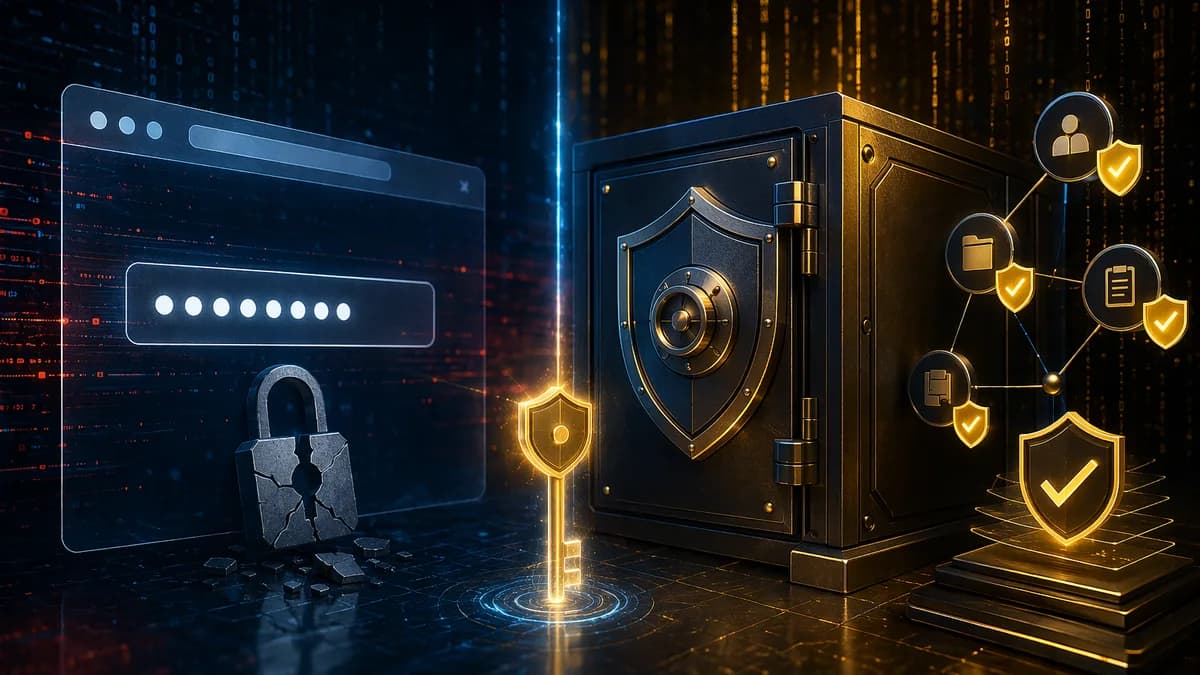
Choosing between a dedicated password app and the one built into your browser is not just a convenience decision—it affects how your everyday logins are stored, synced, shared, audited, and recovered. If you are searching for password manager vs browser password manager, the safest answer depends on your risk level, device habits, and whether you need features beyond basic autofill.
XOOMAR Intelligence
Analyst Take
The short version: browser password managers are much safer than reusing passwords or saving them in notes, but dedicated password managers usually provide stronger separation, broader cross-platform support, better sharing, and more advanced account-security features.
1. What Browser Password Managers and Dedicated Password Managers Actually Do
A browser password manager is the built-in credential tool inside browsers such as Chrome, Safari, Firefox, and Edge. It can save usernames and passwords when you log in, generate new passwords, autofill saved credentials, and sync them through a browser or platform account.
A dedicated password manager is a standalone app or service built specifically around an encrypted vault. Examples mentioned in the source data include 1Password, Bitwarden, Dashlane, Keeper, NordPass, and Proton Pass.
Both options solve the same core problem: most people cannot memorize strong, unique passwords for every account. Consumer Reports notes that security experts recommend password managers because unique passwords reduce the risk of credential stuffing—where attackers take usernames and passwords from the Fortinet firewall hack and try them across other sites.
Key takeaway: Either type of password manager is better than reusing the same password across websites. The real comparison is whether your needs stop at convenient autofill or require stronger vault controls, sharing, portability, and recovery planning.
Browser password managers typically offer
- Password Saving: Save credentials directly when you log in through the browser.
- Password Generation: Consumer Reports found that Chrome, Edge, Firefox, and Safari can generate passwords.
- Autofill: Fill saved credentials on matching websites.
- Sync: Sync passwords across devices when signed into the relevant browser or platform account.
- Basic Security Checks: Chrome, Edge, Firefox, and Safari can check whether saved passwords have been compromised, according to Consumer Reports testing.
Dedicated password managers typically offer
- Encrypted Vaults: Store passwords in a vault protected by a master password or equivalent primary secret.
- Cross-Browser Support: Work across multiple browsers through extensions and apps.
- Cross-Device Sync: Support desktop and mobile platforms more independently of one browser ecosystem.
- Secure Sharing: Share selected passwords or vaults with family members, coworkers, or teams.
- Additional Secure Storage: Store secure notes, documents, identity details, payment cards, recovery codes, and other sensitive items, depending on the product.
- Security Audits: Identify weak, reused, old, or breached passwords across the vault.
Here is the high-level comparison:
| Category | Browser Password Manager | Dedicated Password Manager |
|---|---|---|
| Main strength | Low-friction convenience | Specialized credential security |
| Best fit | Users staying in one browser ecosystem | Users with many accounts, devices, browsers, or sharing needs |
| Password generation | Supported in Chrome, Edge, Firefox, Safari | Commonly supported |
| Breach checks | Supported in Chrome, Edge, Firefox, Safari | Commonly supported with broader vault auditing |
| Secure sharing | Limited; Safari supports sharing, while other tested browsers did not in Consumer Reports testing | Typically stronger, including shared vaults or individual item sharing |
| Cross-browser use | More limited | Designed for multiple browsers |
| Non-password storage | Limited; Chrome can store payment information and addresses | Often supports notes, documents, files, recovery codes, and more |
2. Security Model Comparison: Encryption, Device Access, and Account Recovery
Security is where the password manager vs browser password manager debate gets more nuanced. Modern browser password tools are not automatically “unsafe.” The source data shows that they have improved substantially, especially in Chrome and Safari. But dedicated managers still tend to have a clearer separation between your browsing activity and your credential vault.
Encryption: good encryption is not the whole story
The Wired source notes that Google Password Manager uses AES, described there as “the gold standard for security among password managers.” Google also supports on-device encryption, where passwords are encrypted before being saved on the device and the user manages the key. Wired compares this to a zero-knowledge-style architecture.
Dedicated tools are often built around zero-knowledge encryption, meaning the provider stores encrypted data but does not hold the key needed to decrypt it. Wired gives Proton Pass as an example of a password manager using zero-knowledge encryption.
Online Tool Guides also notes that standalone tools such as NordPass use a zero-knowledge architecture, and says NordPass uses XChaCha20 encryption. The same source describes AES 256-bit encryption as part of standalone password manager security suites.
| Security factor | Browser password manager | Dedicated password manager |
|---|---|---|
| Encryption | Modern browsers encrypt stored passwords; Google uses AES and offers on-device encryption | Often built around zero-knowledge vault encryption |
| Separation from browser account | Usually tied to browser profile, platform account, or OS account | Usually separate vault account and master password |
| Local device risk | A logged-in or unlocked device can expose saved credentials depending on settings | Usually protected by vault lock, master password, biometrics, or auto-lock settings |
| Account takeover risk | Browser sync account compromise can become high-impact | Requires compromising the separate password manager account/vault |
| Recovery | Often tied to browser/platform account recovery | May involve recovery keys, emergency contacts, or provider-specific recovery flows |
Device access: the unlocked computer problem
Wired highlights a major operational-security issue: without extra protection enabled, someone with access to a logged-in PC may be able to go into a browser’s settings and view or export saved passwords in plaintext.
Chrome has added protections such as app-bound encryption, and Google Password Manager can integrate with Windows Hello so a PIN or biometric authentication is required before filling passwords. But Wired notes that the Windows Hello protection is optional and turned off by default.
Firefox’s own warning, quoted in the Wired source, is also important:
“Someone with access to your computer user profile can still see or use them.”
That does not mean Firefox password storage is useless. It means local device security matters. A browser password vault is closely tied to the security of the device profile and browser session.
Account recovery and blast radius
Browser password managers are often linked to high-value accounts such as a Google account or Apple ID. That creates convenience, but also concentration risk.
Wired describes the problem as “putting all your eggs in one basket.” If an attacker takes over the account used for browser sync, they may gain access to email, linked services, and potentially synced credentials depending on protections and settings.
Dedicated password managers do not eliminate risk. A password vault is also a high-value target. But they create a separate layer: compromising your email or browser account does not automatically mean compromising your password vault.
3. Autofill Safety: Phishing Protection, URL Matching, and Risky Login Pages
Autofill is often treated as a convenience feature, but it also has security implications. A good autofill system can help you avoid entering credentials into the wrong website because saved logins should appear only on matching domains.
Threat.news points out that if a saved login does not appear where you expect it, that can be a clue that the site is not the real domain. This is not perfect phishing protection, but it can slow down mistakes.
What both options can do
Both browser password managers and dedicated password managers can autofill credentials. Both can reduce password reuse by generating and storing unique passwords. And both may avoid filling credentials on unrelated domains.
Where the risk remains
The biggest autofill risk is not encryption—it is user behavior. If a login page appears unexpectedly after clicking a link in email, SMS, or social media, you should slow down before entering credentials.
Threat.news specifically warns that many real-world compromises begin with fake login prompts. That applies whether you use Chrome’s built-in password manager, Safari’s iCloud Keychain, or a standalone tool like 1Password or Bitwarden.
Autofill safety comparison
| Autofill issue | Browser password manager | Dedicated password manager |
|---|---|---|
| Convenience | Very high inside the browser | High, but may require extensions/apps |
| Domain matching | Can autofill on saved sites | Can autofill on saved sites and may be stricter depending on tool |
| Phishing signal | Missing autofill can warn you something is wrong | Missing autofill can warn you something is wrong |
| Multi-account clarity | Can become confusing with many accounts | Often better vault organization for multiple accounts |
| Risky behavior | Users may still type credentials manually | Users may still override warnings or copy credentials manually |
Critical warning: Autofill is not a complete anti-phishing system. If a login page appears after a suspicious link, treat the situation as risky even if your password tool behaves normally.
4. Cross-Device Sync: Desktop, Mobile, Work Devices, and Multiple Browsers
Cross-device use is one of the clearest practical differences in the password manager vs browser password manager decision.
Browser password managers work best when you stay in one ecosystem. For example, Chrome password sync is convenient if you use Chrome everywhere. Safari’s iCloud Keychain is convenient across Apple devices. But friction appears when your real life spans multiple browsers, operating systems, and work environments.
Consumer Reports notes that standalone password managers are designed to work across browsers and devices. For example, 1Password can be accessed through its website in any browser, through a browser extension, or through a phone app.
Browser sync is convenient—but ecosystem-bound
Browser tools usually feel effortless when your devices match the ecosystem:
- Chrome: Strong fit for users signed into Google across desktop and mobile.
- Safari: Strong fit for users inside Apple’s ecosystem.
- Edge: Strong fit for users centered on Microsoft’s browser environment.
- Firefox: Useful for users signed into Firefox across devices.
The downside is fragmentation. Threat.news notes that if you use one browser for work, another for personal activity, and mobile apps that do not match desktop behavior, built-in password storage can become fragmented quickly.
Dedicated managers are more portable
Standalone password managers are generally better for mixed environments. Online Tool Guides gives examples of standalone tools with apps across Windows, macOS, Linux, iOS, and Android, plus browser extensions for major browsers.
| User setup | Browser password manager fit | Dedicated password manager fit |
|---|---|---|
| One browser on all devices | Strong | Strong |
| Safari on iPhone, Firefox on desktop | Weaker | Stronger |
| Chrome on Android, Brave or Firefox on laptop | Weaker | Stronger |
| Work browser separate from personal browser | Can fragment credentials | Easier to separate and organize |
| Frequent device/browser switching | Less ideal | Better suited |
For everyday users who never leave one ecosystem, a browser password manager may feel simpler. For freelancers, developers, IT admins, business owners, or people separating work and personal accounts, a dedicated vault is usually more practical.
5. Password Sharing and Family Access: Where Dedicated Tools Pull Ahead
Password sharing is one of the strongest arguments for dedicated password managers.
Consumer Reports explains that standalone password managers typically allow password sharing either through shared vaults or by sharing individual passwords. This lets family members or colleagues keep separate accounts while sharing access to specific credentials.
Browser password managers are more limited.
What Consumer Reports found
Consumer Reports tested Chrome, Edge, Firefox, and Safari. It found that Safari allows password sharing, while the other tested browsers did not offer the same kind of password sharing.
Safari’s sharing flow uses AirDrop. On a Mac, users can go to Safari settings, open Passwords, authenticate, control-click a saved site, and share via AirDrop with a nearby Apple device user who allows discovery.
Wired adds that Google Password Manager and iCloud Keychain can share passwords, but only within their own ecosystems. By contrast, a third-party password manager such as NordPass can share entries more flexibly, including with someone who may not already be in the same browser ecosystem.
Why sharing matters
Many people still share passwords through chat, email, screenshots, or plain text. Threat.news calls this difficult to defend. A purpose-built password manager can provide a safer way to share access without copying secrets into insecure channels.
| Sharing scenario | Browser password manager | Dedicated password manager |
|---|---|---|
| Share one login with spouse/partner | Possible in Safari; limited elsewhere based on Consumer Reports testing | Typically supported |
| Shared family streaming or utility account | Limited or ecosystem-bound | Better suited |
| Help a parent manage accounts | Limited | Better suited with shared vaults or selected sharing |
| Small business shared logins | Not ideal | Better suited |
| Cross-ecosystem sharing | Often weak | Stronger |
Practical rule: If you regularly share passwords with another person, a dedicated password manager is usually the safer and more manageable choice.
6. Breach Monitoring, Password Audits, and Weak Password Alerts Compared
Both browser password managers and dedicated password managers can help detect compromised passwords. The difference is usually depth, organization, and how easily you can clean up a large vault.
Consumer Reports found that Chrome, Edge, Firefox, and Safari allow users to check whether passwords have been compromised. It also found that all tested browser password managers except Firefox’s allowed users to see whether passwords had been reused.
Safari’s behavior had a nuance in testing: it did not show an alert while creating a new account with an identical password, but it did alert to duplicate passwords when viewing stored passwords.
Browser password health checks
Browser password tools can provide meaningful baseline protection:
- Compromised Password Checks: Chrome, Edge, Firefox, and Safari support them.
- Reused Password Warnings: Chrome, Edge, and Safari supported this in Consumer Reports testing; Firefox did not in that test.
- Password Generation: Chrome, Edge, Firefox, and Safari can generate passwords.
Dedicated password manager audits
Dedicated tools often go further by making vault cleanup a core feature. Threat.news notes that dedicated managers often make it easier to audit weak, reused, or old credentials across the full vault.
The Lunyb source describes dedicated password managers as commonly offering dark web monitoring, breach alerts, and security audits. That same source lists built-in two-factor authentication code storage, passkey support, secure notes, and broader vault organization as common standalone-manager features.
| Audit feature | Chrome | Edge | Firefox | Safari | Dedicated managers |
|---|---|---|---|---|---|
| Generate passwords | Yes | Yes | Yes | Yes | Yes |
| Check compromised passwords | Yes | Yes | Yes | Yes | Yes |
| Check reused passwords | Yes | Yes | No, per Consumer Reports testing | Yes | Commonly supported |
| Broad vault cleanup workflow | Limited compared with dedicated tools | Limited compared with dedicated tools | Limited compared with dedicated tools | Limited compared with dedicated tools | Usually stronger |
| Store recovery notes/codes | Limited | Limited | Limited | Limited | Often supported |
For someone with only a few low-risk accounts, browser warnings may be enough. For someone cleaning up years of reused passwords across banking, work, healthcare, and cloud accounts, a dedicated manager usually gives a clearer remediation workflow.
7. Passkeys and 2FA Support: Which Option Is More Future-Proof?
Passkeys are changing the password conversation, but they do not make password managers irrelevant. Threat.news says passkeys complicate the old comparison “in a good way” because both browsers and password managers are evolving to store and sync them.
The practical issue is portability.
Browser and platform passkeys
Browser- or platform-native passkeys can feel seamless if you are committed to one device family or ecosystem. For example, users deeply invested in a single platform may benefit from integrated passkey sync and biometric unlock flows.
The trade-off is ecosystem dependence. Threat.news warns that if passkeys are deeply tied to one platform, the experience may be smooth until you need to move ecosystems.
Dedicated password manager passkeys
Dedicated password managers may offer broader compatibility and easier migration, depending on the product and platform support. The source data does not provide a product-by-product passkey benchmark, so the safest conclusion is directional: dedicated vaults may be more portable for users who switch ecosystems, while platform-native passkeys may be more seamless for users who do not.
Multifactor authentication support
Consumer Reports found that 1Password Families offers multifactor authentication and requires a secret key in addition to the password when logging in from a new device.
Browser-based password managers are more complicated. Browsers may allow multifactor authentication on the associated account, such as a Google account, but some browser functionality may still exist locally without the same account protections. Consumer Reports specifically notes that Chrome can allow passwords to be saved locally in the browser without a password, which it describes as not ideal from a security point of view.
| Future-facing feature | Browser password manager | Dedicated password manager |
|---|---|---|
| Passkey support | Increasingly supported in browser/platform ecosystems | Increasingly supported in password manager ecosystems |
| Best experience | Often best inside one ecosystem | Often better for mixed ecosystems |
| 2FA for vault/account | Usually tied to browser/platform account | Often built into password manager account security |
| Recovery planning | Usually platform-account-based | May include recovery keys, emergency contacts, or other flows |
| Portability | Can be limited by ecosystem | Often stronger across browsers/devices |
Future-proofing insight: Passkeys reduce password-related risks, but they do not remove the need to plan for device loss, account recovery, phishing, and ecosystem lock-in.
8. Privacy Trade-Offs: What Data Your Browser or Password App May Collect
Privacy is not only about whether passwords are encrypted. It is also about who controls the account, what ecosystem the data is tied to, and how much non-password information you store.
Browser privacy trade-offs
Browser password managers are closely tied to browsing activity, browser profiles, operating systems, and sync accounts. That makes them convenient but also integrated into a larger ecosystem.
Chrome, for example, can store more than passwords. Consumer Reports notes that Chrome can store payment information and addresses. This is convenient, but it also centralizes more personal information inside the browser environment.
Wired also raises the operational-security issue of high-value browser accounts. A Google account, for example, may connect email, browser sync, saved credentials, and other services. Wired cites a reported Gmail incident in which no sensitive information was stolen, but Google urged 2.5 billion users to update passwords. The broader point is that major ecosystem accounts are attractive targets.
Dedicated password manager privacy trade-offs
Dedicated password managers often emphasize vault privacy. Proton Pass is described by Wired as using zero-knowledge encryption, where the provider holds encrypted passwords but not the key to decrypt them. Online Tool Guides describes NordPass and Bitwarden as providers using zero-knowledge architecture.
But dedicated managers also concentrate sensitive data. If you store passwords, notes, documents, 2FA codes, identity details, and recovery information in one vault, that vault becomes extremely important to protect.
| Privacy question | Browser password manager | Dedicated password manager |
|---|---|---|
| Is it tied to browsing ecosystem? | Yes, usually | No, usually separate |
| Can provider read vault contents? | Depends on browser/account settings and architecture | Zero-knowledge tools are designed so provider cannot read vault contents |
| Stores non-password data? | Some browser tools store addresses/payment info | Many store notes, files, documents, identities, cards, recovery codes |
| Concentration risk | Browser account may hold many parts of online life | Vault may hold many sensitive secrets |
| Best mitigation | Secure device, enable account MFA, use biometric/PIN protections where available | Strong master password, MFA, recovery planning, auto-lock, device security |
Neither model is privacy-perfect. Browser tools trade separation for convenience. Dedicated tools trade setup effort for stronger specialization and portability.
9. Who Should Use a Browser Password Manager vs a Dedicated Password Manager?
The safest choice depends on your real usage—not an abstract feature checklist. Threat.news recommends comparing options by thinking through failure scenarios: losing a device, switching browsers, getting phished, suffering account takeover, or needing to help a family member recover access quickly.
Use a browser password manager if…
A browser password manager can be a reasonable choice if your login life is simple.
- Single Ecosystem: You use the same browser and account ecosystem across phone, laptop, and desktop.
- Low Sharing Need: You rarely or never share passwords with others.
- Low Account Complexity: You have a small number of accounts and few high-risk logins.
- Strong Device Security: You use a device password, PIN, biometrics, and keep devices locked.
- Realistic Adoption: You would otherwise reuse weak passwords or avoid a separate password tool entirely.
This matters. Wired is clear that using a browser password manager is “leaps and bounds better” than not using one at all. If the alternative is password reuse, the browser tool wins.
Use a dedicated password manager if…
A standalone password manager is the better fit when your account life is more complex or higher risk.
- Multiple Browsers: You use Chrome, Safari, Firefox, Edge, Brave, or different browsers for work and personal accounts.
- Multiple Platforms: You move between Windows, macOS, Linux, iOS, and Android.
- High-Value Accounts: You store banking, healthcare, work, payroll, cloud, or primary email credentials.
- Secure Sharing: You share logins with a partner, family member, coworker, or team.
- Vault Organization: You need to store recovery codes, secure notes, Wi-Fi credentials, software keys, or identity details.
- Stronger Auditing: You want a structured way to clean up weak, reused, or breached passwords.
- Recovery Planning: You want emergency contacts, recovery keys, or clearer account recovery workflows.
At-a-glance recommendation by user type
| User type | Safer practical choice | Why |
|---|---|---|
| Casual user with one browser and few accounts | Browser password manager may be enough | Better than reuse; simple and low-friction |
| Apple-only household using Safari | Browser password manager may be enough | Safari supports sharing and ecosystem sync |
| User with Chrome on phone and desktop only | Browser password manager may be enough with protections enabled | Convenient, especially with account MFA and device security |
| User with multiple browsers or operating systems | Dedicated password manager | Better cross-platform consistency |
| Family sharing multiple accounts | Dedicated password manager | Stronger shared vault and access controls |
| Freelancer or business owner | Dedicated password manager | More accounts, higher risk, better organization |
| IT/admin/developer user | Dedicated password manager | Mixed environments and higher credential exposure |
| User storing banking, healthcare, work, or cloud credentials | Dedicated password manager | Better separation and auditing |
10. Final Recommendation: The Safer Choice for Most Users
For most people comparing password manager vs browser password manager, the safer long-term choice is a dedicated password manager—especially if you use more than one browser, share logins, manage important work or financial accounts, or want a central place for passwords, passkeys, recovery codes, and secure notes.
That said, the recommendation has an important caveat: if you are not currently using any password manager and you reuse passwords, a browser password manager is a major improvement. Chrome, Safari, Edge, and Firefox can generate passwords, save them, autofill them, and check for compromised credentials. That baseline alone can reduce the risk created by password reuse.
Practical setup checklist
Whether you choose a browser tool or a dedicated vault, use these safeguards:
- Use Unique Passwords: Every important account should have its own generated password.
- Secure Your Devices: Use a password, PIN, or biometric login on computers and phones.
- Enable MFA: Turn on multifactor authentication for your primary email, browser sync account, and password manager account where supported.
- Protect Browser Passwords: If using Chrome, consider enabling Windows Hello or biometric authentication for password access where available.
- Review Breach Alerts: Do not ignore compromised-password warnings.
- Avoid Plain-Text Sharing: Do not send passwords through chat, email, or screenshots.
- Plan Recovery: Know how you will regain access if a device is lost or an account is locked.
Cost note for dedicated managers
At the time of writing, the source data lists the following starting prices for several dedicated password managers:
| Tool | Source-stated best fit | Starting price at time of writing | Free tier noted in source |
|---|---|---|---|
| Bitwarden | Open-source, budget users | $1/month | Yes |
| 1Password | Families and teams | $2.99/month | 14-day trial |
| Proton Pass | Privacy-focused users | $1.99/month | Yes |
| Dashlane | All-in-one features | $3.33/month | Limited |
| Keeper | Business compliance | $2.92/month | 30-day trial |
Pricing can change, so verify current plans directly before buying. Also, price should not be the only factor—cross-device support, sharing, recovery options, and vault security matter more.
Bottom Line
Browser password managers are convenient, free, and far safer than password reuse. Consumer Reports found that Chrome, Edge, Firefox, and Safari can generate passwords and check for compromised credentials, and modern browser tools have improved their encryption and security options.
Dedicated password managers usually provide the stronger overall security model for everyday logins because they separate your credential vault from your browser ecosystem, work better across devices and browsers, support safer sharing, and offer broader vault organization. For the average person with banking, email, work, shopping, healthcare, and family accounts, a standalone password manager is usually the safer and more flexible choice.
If you will only use the tool built into your browser, use it well. If you can tolerate a little setup friction for better portability and control, choose a dedicated password manager.
FAQ
Is a browser password manager safe enough?
A browser password manager is generally safer than reusing passwords or saving them in a notes app. Chrome, Edge, Firefox, and Safari can generate passwords and check whether saved passwords have been compromised. However, browser tools are usually more tied to your browser profile, device access, and ecosystem account than dedicated password managers.
Is a dedicated password manager safer than Chrome or Safari?
For many users, yes. Dedicated password managers are built around a separate encrypted vault and often use zero-knowledge architecture. Chrome and Safari have improved substantially, but dedicated tools usually offer better cross-browser support, secure sharing, vault organization, and recovery planning.
What is the biggest risk with browser-saved passwords?
The biggest practical risk is concentration and device access. If someone has access to your unlocked computer or compromises the account used for browser sync, saved passwords may be exposed depending on settings. Wired specifically notes that without extra protections, a person with access to a logged-in PC could view or export browser passwords.
Can browser password managers detect breached passwords?
Yes. Consumer Reports found that Chrome, Edge, Firefox, and Safari can check whether saved passwords have been compromised. It also found that Chrome, Edge, and Safari could flag reused passwords, while Firefox did not in that specific testing.
Do I need a dedicated password manager for passkeys?
Not always. Both browsers and dedicated password managers are evolving to support passkeys. Browser or platform passkeys may be more seamless inside one ecosystem, while dedicated password manager passkeys may be more portable for people who use multiple browsers or device platforms.
Who should definitely consider a dedicated password manager?
You should strongly consider one if you use multiple browsers or operating systems, share passwords with family or coworkers, manage work or financial accounts, store recovery codes, or want stronger auditing for weak, reused, and breached passwords. For those users, the dedicated password manager usually wins the password manager vs browser password manager comparison.
Sources & References
Content sourced and verified on June 17, 2026
- 1Browser Password Managers Are Great, and a Terrible Idea
https://www.wired.com/story/browser-password-managers/
- 2Which Is Better: Your Browser's Password Manager or a Standalone Service? - Consumer Reports
https://www.consumerreports.org/electronics-computers/password-managers/browser-password-manager-or-standalone-password-service-a1214951437/
- 3Password Manager vs Browser Passwords
https://threat.news/password-manager-vs-built-in-browser-passwords-security-tradeoffs
- 4Password Manager vs Browser Passwords: Which Is Safer in 2026?
https://lunyb.com/blog/password-manager-vs-browser-passwords-mq8a0g35
- 5Browser-Based vs. Standalone Password Managers: Which is Best? - Online Tool Guides
https://onlinetoolguides.com/browser-based-vs-standalone-password-managers/
- 6Password Managers vs. Browser-Saved Passwords: Which to Use?
https://techreviewadvisor.com/password-managers-vs-browser-saved-passwords/

Written by
XOOMAR Insights Team
Research and Editorial Desk
The XOOMAR Insights Team pairs automated research with human editorial judgment. We track hundreds of sources across technology, fintech, trading, SaaS, and cybersecurity, cross-check the facts, and explain what happened, why it matters, and what to watch next. We do not just rewrite headlines. Every article is fact-checked and scored for reliability before it goes live, and we link back to the original sources so you can verify anything yourself.