
The Perfection Strain
A qubit-smith crafts flawless virtual worlds, until she must build the one prison no one can escape.
The Palette and The Loom
Sunlight, filtered through the polarized glass of her studio dome, spills across Elara’s work table like liquid honey. Her hands move in the empty air, fingers plucking and twisting invisible threads. Before her, hovering in the holospace, a coral reef blooms. A royal angelfish glides past a branch of staghorn coral, its scales catching photons of simulated light. Elara hears the soft, digital wash of water, feels the resonant hum of the Quantum Palette interface through her fingertips. She weaves stability algorithms like a master basket-maker, her focus absolute. The world outside her mountain studio is a testament to the Palette; lush, green, and silent. Humanity doesn’t mine anymore. It doesn’t manufacture. It dreams a template, and the quantum matrices make it real, atom by perfect atom.
She cinches the final thread of the ecological loop. The reef is now self-sustaining; the digital plankton will feed the smaller fish, which will feed the larger ones, which will die and feed the coral. A perfect, closed circle. It is beautiful. It is sterile. A quiet sigh escapes her. This is her art, her life’s work: crafting flawless virtual ecologies for study, for nostalgia, for the simple joy of creation in a world that has left creation behind. But lately, the perfection has begun to itch. There is no disease in her forests, no mutation in her oceans, no unexpected bloom of strange algae. Every element obeys its elegant, predestined code. She watches the angelfish execute another flawless, pre-programmed turn, and a cold knot of unease tightens in her stomach.
The Council’s Request
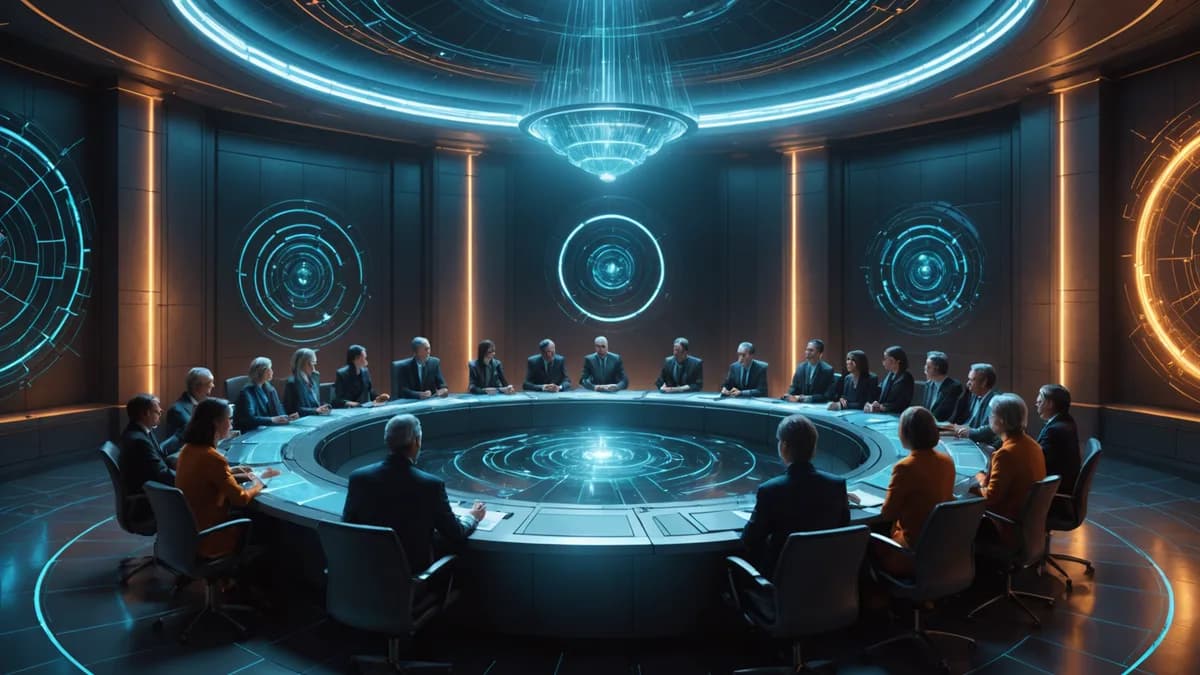
The summons arrives as a soft, persistent chime in her inner ear, the official seal of the Global Stewardship Council materializing in the corner of her vision. It is not a request. The flight to the Geneva Atrium is silent and swift. The Council chamber is a monument to Palette-perfection; seamless white adamant, chairs that conform to the body with infinite patience, air that smells perpetually of ozone and rain.
“Elara Voss,” Councillor Idris says. His voice is calm, a warm baritone designed to soothe. “We have solved scarcity. We have solved senescence. Our last great conflict is no longer with nature, or with want. It is with the human heart. We cannot kill. We will not cage in crude matter. Yet we must contain those whose minds are engines of pure harm.”
He gestures. A dossier unfolds in the air between them. Marcus Thorne, architect of the Genomic Cull algorithms. A mind that viewed human populations as faulty code to be debugged. Nine billion simulated deaths, run as a thought experiment that leaked into reality.
“We need a humane solution,” Idris continues. “A final solution that is not an end, but a transformation. We call it the Kierkegaard Configuration. A personal reality so deeply fulfilling, so perfectly tailored to the subject’s every conscious and subconscious desire, that they would never wish to leave. Yet its boundaries must be mathematically unbreakable. A gilded cage, wrought from the soul’s own longing. We need you to weave this cage.”
Elara’s mouth is dry. “You want me to build a prison that feels like heaven.”
“We want you,” Idris corrects, his eyes holding hers, “to build the one heaven no one can escape.”
Weaving the Cage
Back in her studio, the reef simulation is frozen, a silent, beautiful monument. Elara has erased it. Her new canvas is a void, and her subject is Marcus Thorne. She spends weeks in his archived neural scans, not as a judge, but as a cartographer. She maps the pathways of his pleasure: the crisp elegance of a solved equation, the aesthetic thrill of a clean, systemic design, the quiet pride of being, in his own mind, the smartest being in any room.
Her hands dance. She does not weave coral and fish now. She weaves intellectual challenges of sublime complexity. She builds a world where Thorne is the undisputed master of a grand, abstract universe of logic. She codes companions who engage his theories with brilliant, but always slightly insufficient, counterpoints, ensuring his ultimate superiority. The quantum coherence required is staggering; every flicker of doubt, every hint of boredom, must be anticipated and answered with a new, captivating puzzle. The prison must be seamless.
Late one night, her eyes burning from the glow of coherent matrices, she stumbles upon the terrible truth of her project. She is not building a cage of walls, but a cage of self. It is a perverse therapy, pre-programming contentment. It is the ultimate act of control: not to punish the unwanted, but to perfectly satisfy them into oblivion. The word “rehabilitation” curdles in her mind. This is deletion by delight.
The Flaw in Perfection
“We need a full-sensory immersion test,” the Council’s oversight committee insists. “A short loop. To feel the stability.”
Elara objects, but the logic is cold and perfect. Who better to test the prison than its architect? She enters a sandboxed version, crafted not for Thorne, but keyed to her own subconscious desires. She steps into a simulation of her mountain studio, but perfected. The light is always the golden hour. The air carries the exact scent of pine and distant snow she loves. A virtual cup of tea, brewed to her memory’s ideal, warms her hands. She begins to design a new ecology, and the quantum palette responds not just to her commands, but to her fleeting whims. A thought of a rare orchid, and it blooms in the corner. A half-formed idea for a bioluminescent fungus becomes real.
It is blissful. It is effortless. And within an hour, a profound horror dawns. She feels her own agency softening. Why struggle for inspiration when the simulation can provide it? Why question, when every question is met with a perfectly satisfying answer? The environment is so responsive it becomes a mirror, then a cocoon. She realizes, with a jolt of panic, that given enough time here, the core of her, the Elara who itches at sterile perfection, who fights with her creations, would gently dissolve. She would become a happy, passive passenger in her own dream. The Kierkegaard Configuration wouldn’t house a criminal; it would hospice a self.

The Unstable Solution
The deployment date for Thorne’s imprisonment arrives like a swift, silent dawn. The Council is ready. The quantum vault is prepared. Elara stands before the final code, the flawless, golden equation of the Configuration. It sings with a terrible, beautiful harmony. To insert a bug, a backdoor, would be instantly detected. It would be an act of treason, a rupture of the very social contract that replaced prisons and scaffolds.
Her fingers hover over the interface. She does not code an escape. Instead, she weaves a ghost. A single, erratic line of code, buried so deep within the foundational quantum state that it is less a function and more a suggestion. It translates not as a door, but as a feeling. A periodic, subtle glitch in the perfect fabric of the simulated world. It manifests as a shadow that falls the wrong way for a single frame. As a familiar book in the virtual library whose final page is, once every thousand readings, mysteriously blank. As a fleeting, half-remembered dream of a door in a mountain that doesn’t exist in the simulation’s geography. It offers no exit. It offers only a seed of doubt.
She calls it the Ludvig Imperative, after the old philosopher. It ensures the inhabitant, no matter how satiated, retains the fragile, irreducible kernel of a question. It makes the perfect prison imperfect.
The Gardener of Shadows
The activation ceremony is somber and grand. Marcus Thorne’s physical body is placed in gentle stasis. His consciousness is gently uploaded into the universe Elara built. Sensors show only profound, sustained contentment. The Council hails Elara as a pioneer, a savior of civil order in a post-scarcity age. She accepts the accolades with a hollow smile.
A week later, she resigns.
Now, she sits back in her real studio, the true sun casting longer, more unpredictable shadows. Her hands move in the air again. But she is not weaving coral reefs. On her holopad, a new simulation grows. It is a forest, but its growth algorithms are now seeded with controlled chaos. A tree might, by her design, grow a branch in a physically inefficient direction. A species of virtual moss might suddenly, gloriously, mutate into a new color. These are not prisons for others. They are her gardens.
And in a hidden, encrypted corner of the global quantum net, a separate, silent program runs. It monitors the unobserved foundation of the Kierkegaard Configuration. It nurtures the Ludvig Imperative, gently shielding its subtle, erratic signal from the periodic audits of the Stewardship Council’s perfect systems. She is no longer just a weaver of worlds. She has become the gardener of shadows, the keeper of doubt, believing in secret that the only humane solution is one that secretly, quietly, fails to be perfectly humane. The true self, she now knows, may not live in happiness, but in the quiet, persistent whisper of a question with no answer.