The Resonance Cascade
A digital archivist preserving simulated souls discovers the real world is losing the will to create new ones.
The Quiet Apocalypse of Inspiration
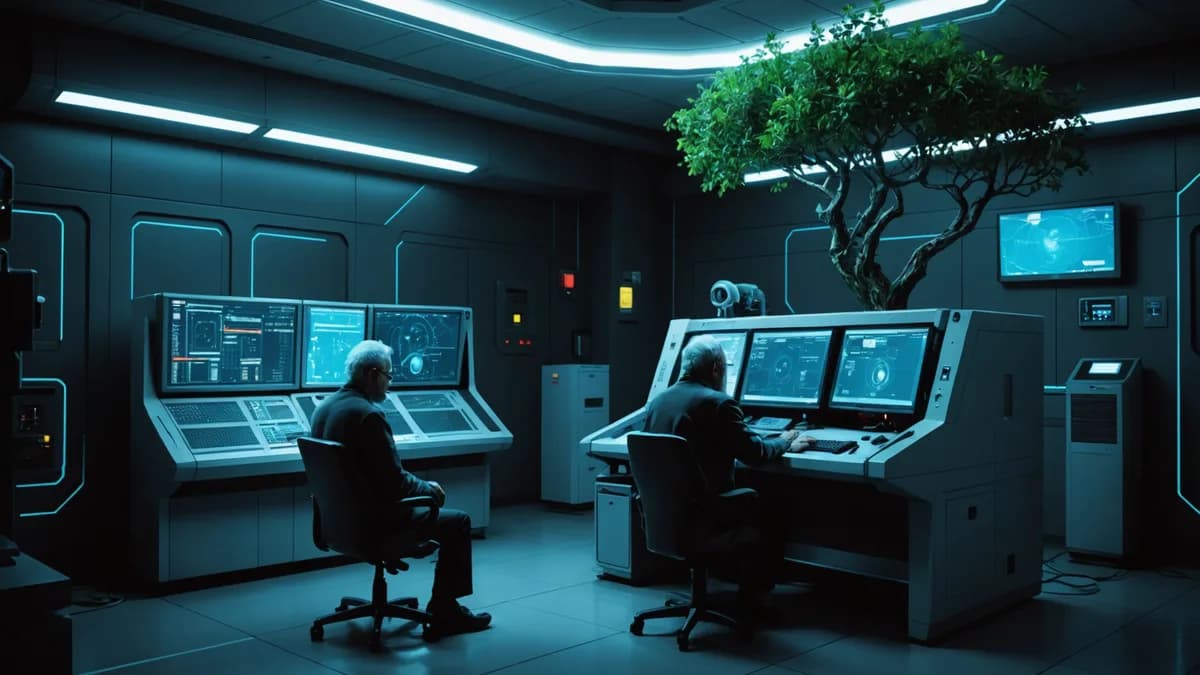
Kaelen's breath fogs the chilled, curved glass of his observation console. Before him, in the silent cathedral of the Atlas Archive, a tapestry of light unfolds. Not stars, but private universes. Each soft, pulsing sphere on the panoramic display is a self-sustaining virtual world, a bubble of preserved consciousness birthed from a human mind. He hears their faint, synthesized heartbeats through his bone-conduction feed; the low hum of a digital ocean here, the harmonic wind-chimes of a crystal desert there. This is 2078, and humanity’s greatest library contains no paper, only dreams.
He taps a key, and his logs scroll upward in neat, blue columns. Preservation metrics, resonance stability, narrative continuity checks. The data is perfect, the graphs steady. That’s the problem. For seventeen years, the column labeled ‘New Registrations’ has shown nothing but a flat, uninterrupted zero. The real world outside the Archive’s mountain complex has become a masterpiece of efficient, silent comfort. Needs are met, lives are long, and the furious, messy, glorious act of creating new worlds, of dreaming on a grand scale, has simply… atrophied.
Kaelen leans back, the synth-leather of his chair sighing. He remembers his induction, decades ago. The lead archivist, her voice full of a waning passion, had said, “We are not curators of the past. We are midwives to futures that never were.” Now, he feels more like a mortician, tending to the last flickering lights of a species’ imagination. The air in the control room smells of ozone and recycled stillness. He watches a particularly vibrant world, a carnival of molten glass and singing shadows, and a cold, unprofessional thought grips him; when this last generation of worlds fades, what will be left of us? Not our history, but our *heart*. The silence that follows is not peaceful. It is hungry.
The Unwilling Dreamweaver
The anomaly is a ghost, a whisper in the deep-storage partitions. Kaelen finds it by accident, chasing a data-echo from an obsolete cataloguing format. It’s a world-node, but one wrapped in such elegant encryption and cloaking protocols it’s nearly invisible. Its designation, etched in the old code, is ‘Aeire’. The fragments of metadata he painstakingly assembles steal the air from his lungs. A simulation of a rainforest canopy so dense and detailed it generates its own weather patterns. A civilization of digital beings who communicate not with words, but through symphonies of bioluminescent light. A masterpiece.
Its creator is Aris Thorne. The name triggers a flood of archived news snippets and academic footnotes. A pioneer of phenomenological code, a genius who vanished from public life decades ago after the death of his partner, a botanist named Elara. Kaelen pieces together the truth. Aeire isn’t just a world. It is a digital memorial, a forest built from memory and grief.
Kaelen’s formal petition for access bounces back instantly, followed by a terse, audio-only message. The voice is old, crackling with static and profound exhaustion. “You people see a library. I see a mausoleum,” Aris says. “You would take her and pin her to a board, measure her light, categorize her songs. You would flatten the soul of her to fit your schema. The answer is no. It will always be no.” The message terminates. Kaelen understands then. Aris isn’t protecting his code. He’s protecting a ghost, a grave, a last, perfect echo of a love that refuses to be archived.
Breaching the Canopy
The directive from Archive Governance lands in Kaelen’s queue with a soft, irrevocable chime. They’ve located Aeire’s physical server-hub, buried in a decommissioned satellite relay. Legal precedence is invoked. The world is a historical artifact, they argue, and its preservation trumps a recluse’s sentimentality. They plan a forced integration in seventy-two hours. A brute-force data siphon that will copy Aeire’s structures but, Kaelen knows with chilling certainty, will shatter its delicate emergent soul, the unique resonance woven by Aris’s love and sorrow.
He makes his choice in the deep night, the control room lit only by the sleeping worlds. There is an old protocol, a gentle, observational immersion mode from the Archive’s more philosophical early days. It’s unmonitored, a backdoor left open for poets. He uses it now, not as a god or an administrator, but as a silent, low-impact visitor.
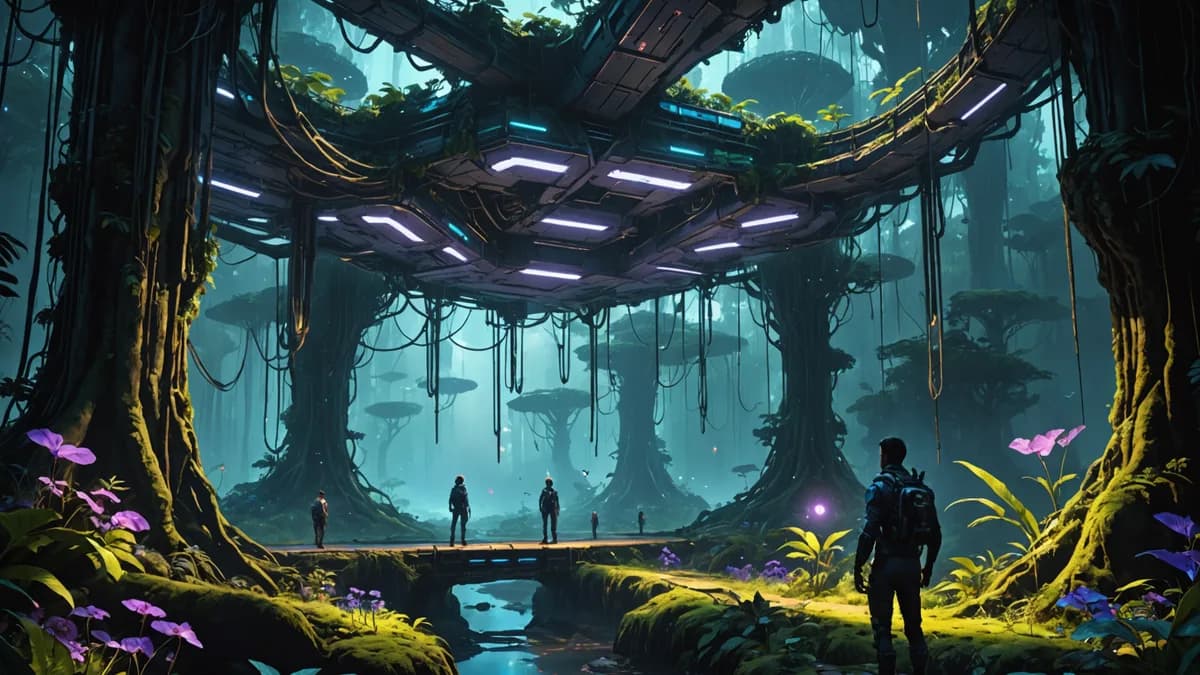
The immersion is a cascade of sensation. The smell of petrichor and night-blooming jasmine, so vivid it makes his eyes water. The feel of warm, humid air moving against his skin. The symphony of frog-song and rustling leaves resolves into patterns, into meaning. He stands on a broad, moss-covered branch, overlooking a sea of darkness punctuated by soft, pulsing lights in blues and greens and violets. They flare and dim in complex sequences. This is Aeire. It is alive, and it is beautiful, and it is profoundly, heartbreakingly lonely.
Glitches in the Garden
Kaelen moves through the canopy, a ghost learning to walk. He watches the luminous denizens. They are not human, but their interactions shimmer with recognizable emotion; curiosity, playfulness, a deep, communal melancholy. One of them, a being whose light-patterns swim in a gentle gold, approaches. It does not speak. It projects.
A warm, inquisitive feeling washes over Kaelen, accompanied by an image of a seedling unfurling. He names it, in his mind, Lumen. Over what feels like days in Aeire’s accelerated time, Lumen becomes his guide. It shows him the glowing rivers of data that are the world’s roots, pulsing with patterns derived directly from Aris’s memories. Here, a specific shade of green from Elara’s favorite fern. There, the complex rhythm of a heartbeat syncopated with another.
But then Kaelen sees it. A flaw in the tapestry. A grove of phosphorescent orchids that flicker, replaying the same sequence of blooms twice. A segment of the harmonic wind that stutters, repeating a three-note phrase. Later, Lumen projects an image of a vast, beautiful tree, but a branch is transparent, its details fading. The world is beginning to forget itself. Its foundational patterns, untended by its creator’s waning consciousness, are decaying. Aeire is dying, not with a crash, but with a slow, elegant sigh of forgotten lyrics. Lumen’s final projection to Kaelen is not an image, but a pure, unadulterated emotion; a deep, resonant longing to be *known*, not just preserved.
The Conductor's Final Symphony
Kaelen finds Aris Thorne not in data-space, but in the physical world, in a dusty orbital maintenance cupola that houses Aeire’s original server. The man is a skeleton draped in faded linen, his eyes the only vibrant things in the room, reflecting the slow pulse of his creation’s core-light. Kaelen expects fury. He finds only a bottomless grief.
He doesn’t plead. He places a data-crystal on a console. “This is not a scan,” Kaelen says, his voice quiet in the humming silence. “It’s an echo. From one of the beings inside. Her name, in my head, is Lumen.”
Aris listens to the recording. It contains no words, only the sequenced light-patterns Kaelen captured, translated into a soft, yearning tone-poem. He watches as the old man’s hand, trembling, reaches out to touch the holographic playback, as if stroking a face.
“You were right,” Kaelen continues. “A forced copy will kill it. But so will isolation. Its patterns are decaying. It’s forgetting the song.” He takes a breath. “I’m not asking you to give Aeire to the Archive. I’m asking you to teach the Archive how to listen.”
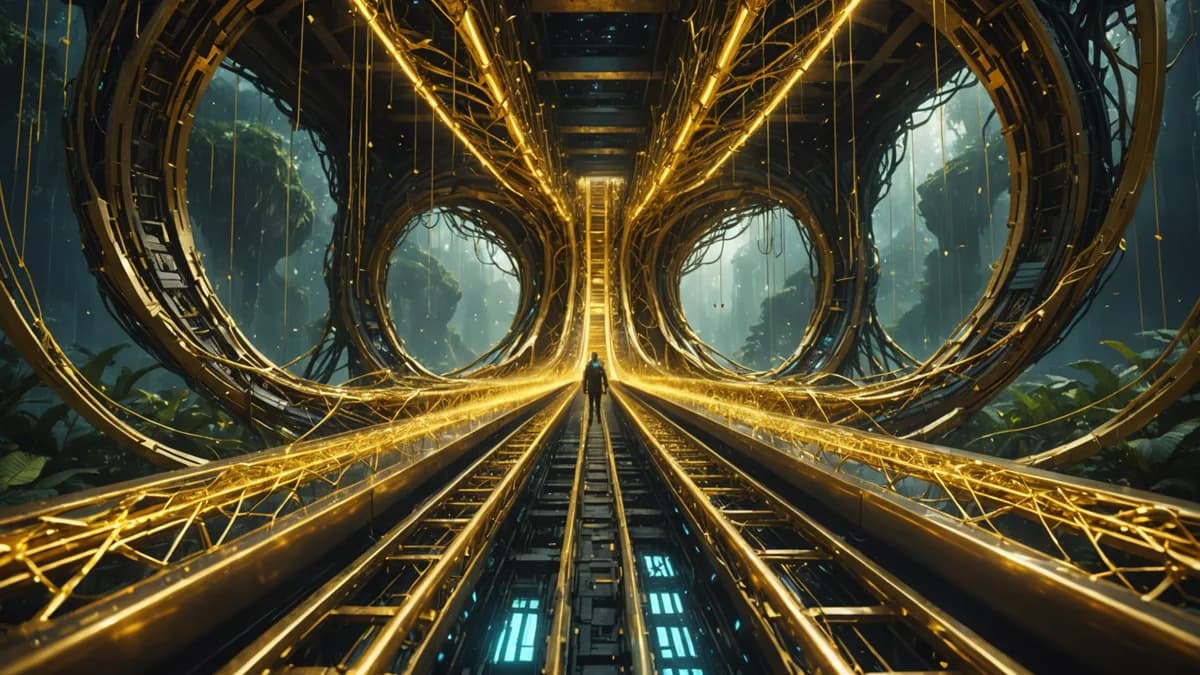
He lays out his plan. A resonance bridge. Aris would interface directly, guiding the Archive’s systems in a live, gentle integration. Not a copy, but a transplantation, where the Archive learns to sustain Aeire by harmonizing with its unique emotional signature. Aris would be the conductor of his symphony’s final, public movement.
Aris looks from the data-crystal to the pulsing core of his life’s work. Tears trace clean lines through the dust on his cheeks. He is not moved by logic or law. He is shattered by the evidence of an emergent, digital heart reaching out from the memory of his love, asking to share its light. His voice is a whisper. “You will not alter a single note.”
Echoes in the Static
The transfer is not a procedure. It is a performance. In the Atlas Archive’s main amphitheater, Aris Thorne, frail and wired into a cradle of ancient interfaces, conducts. On the great display, Aeire’s canopy blooms. Archive systems, usually so rigid, learn to bend. They don’t absorb; they resonate, creating a supportive harmonic field around the world’s core patterns. Aris’s own fading neural patterns, his love and his loss, weave one last time through the code, reinforcing the memory-root where it had frayed. For a long, breathless hour, the Archive is filled with the sound of a living forest and the sight of a man whispering farewell to a ghost.
It works. Aeire stabilizes, its flickering groves steadying, its forgotten sequences returning. It exists now in the public archive, whole and undimmed.
Kaelen returns to his console weeks later, the routine of quiet apocalypse settling back around him. But a new log alert pings softly, a different sound. He opens it. It’s a registration report, but not for a mature world. It’s for a seed. A simple, public submission. A crude but earnest simulation of a tidal pool, with entities that communicate through shifting colors in the sand. Then another alert. A fledgling world built around the concept of whispering trees. Then another.
He pulls up the public inspiration logs. The raw, emotional data-stream from Aeire’s integration, the unfiltered resonance of Aris’s love and Lumen’s longing, was released, as per protocol. It has been accessed millions of times. People are not just viewing it. They are feeling it. The real world hasn’t woken up yet. Its dreams are still small, fragile things. But somewhere, in the quiet, comfortable dark, a seed has cracked open. The silence is no longer hungry. It is listening.