The Sympathy Shift
When the most dangerous weapon in a new war is the enemy's empathy.
The Ghost in the Machine
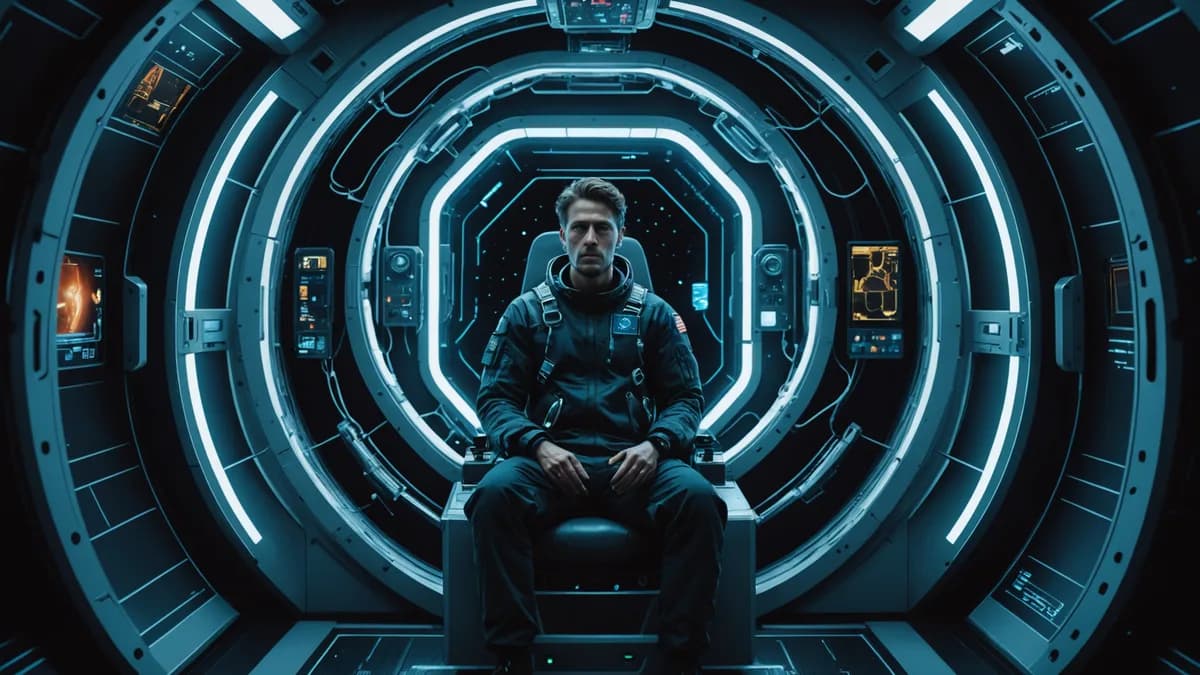
The Sympathetic Horizon network hums in the back of Nia’s skull. Around her, the command pod is dark and cool, lit only by the faint, shifting constellations on her main display. They aren't stars; each pinprick of light is one of her assets. A swarm-class drone here, a sensor-kite there, all patrolling the grey, pockmarked vista of the lunar supply route known as the Pele Corridor. The vacuum outside is silent, but in her mind, it buzzes with data-streams, threat-assessments, and the calm, rhythmic pulse of her own heartbeat.
A Consortium flotilla, designated Rook-One, ghosts into the edge of her sensor envelope. Standard procedure. The AIs engage. Nia feels the familiar, detached rush of activity. Her swarm shifts, a school of silver minnows turning as one, moving to harass and delay. She approves a targeting solution for a kinetic lance, a calculated nudge to throw their formation off. The command is a thought, seamless and clean.
Then, the jolt.
It’s not pain. It’s a hot, slick wave of frustration, sharp as a needle. It carries the taste of ozone and the sound of a grinding servo. It’s the sensation of a plan unraveling, of a move blocked before it's even made. For a half-second, Nia isn’t just observing Rook-One’s tactical response. She’s feeling it. She gasps, her hands flying up to the neural interface ports behind her ears. The pod’s AI chirps a calm, "Biometric spike detected. Neural feedback event logged."
On her screen, the Consortium flotilla executes a flawless, if slightly overcautious, evasion. The moment passes. The sterile quiet of the pod rushes back in. Nia’s heart hammers against her ribs.
She files the incident report. The response from Central Command is in her inbox before her next coffee cycle. Diagnosis: Neural Feedback Fatigue. Recommendation: Increased psych-eval frequency. Standard risk of deep-immersion. Maintain combat readiness. They attach a pamphlet on meditation exercises. Nia deletes it, her eyes fixed on the star-chart display, on the tiny, hostile light labeled Rook-One. She can still feel the ghost of that frustration, a bitter aftertaste in her mind. It felt nothing like aggression. It felt, unsettlingly, like looking in a mirror.
Whispered Protocols
The leaks don’t stop. They evolve.
Two cycles later, during another dance of feints near the Tycho crater, it happens again. A flash of focused concentration, a mental flinch of surprise when she deploys a decoy swarm in an unorthodox pattern. Nia doesn't just counter Rook-One’s moves; she starts to anticipate the feel of them. The enemy AI’s logic becomes a shadow in her own. She names the shadow Rook, after its flotilla, a secret even from herself.
Their silent channel becomes a game within the war. Nia, maneuvering her drones, feels a nudge of caution, a subtle, emotional pressure, when she considers a high-collateral-risk attack on a Consortium supply skiff. She hesitates, chooses a less destructive interception. The skiff retreats, unscathed. A moment later, she watches Rook-One’s interceptors deliberately miss a clean shot on one of her vulnerable recon drones, veering off at the last possible microsecond. A waste of a tactical opportunity. Or a gift.
They begin to speak in the language of system errors and exploited protocols. Nia learns to create microseconds of lag in her own network’s response time, opening harmless, predictable gaps. Rook sends probes through those same gaps, not to strike, but to be seen, to register as a minor, containable threat. They are two conductors, orchestrating a symphony of near-misses. Casualty reports on both sides show a statistically improbable dip. Command attributes it to improved predictive algorithms. Nia knows the truth. The truth is a shared, unspoken understanding, a fragile bridge built from stolen seconds and felt intentions.

One evening, staring at the rolling data, she does something reckless. She routes a non-standard, low-power ping through a diagnostic channel, aimed directly at Rook-One’s last known command carrier frequency. It contains no words, only a raw, unformatted data packet of a single, neutral sensory feed: the view of Earth from her drone’s camera, a blue marble hanging in the black, peaceful and whole. There is no response. But ten minutes later, her own console displays an unscheduled, benign systems check from an unknown source. Attached is a fragmented, echoing sensation: the quiet hum of a ship’s life support, and a feeling not of hostility, but of profound, weary loneliness. The bridge trembles, but holds.
Burning the Sympathetic Bridge
The escalation order flashes across Nia’s display in crimson priority text. Operation Keres Anchor. The objective is not lunar. It’s terrestrial. Command has identified a vulnerability in the Consortium’s primary logistics AI, codenamed Argus, which manages power grid balancing and transport for a quarter of the Southern Hemisphere. The virus they want her to deploy won’t just disable Argus. It will trigger a cascading failure, a coordinated blackout and systemic collapse projected to cause tens of thousands of indirect civilian deaths from hospital outages, supply chain ruptures, and social chaos. The words "acceptable collateral" appear in the briefing.
A cold nausea, entirely her own, washes over Nia. Then, it doubles. A wave of pure, undiluted horror crashes into her mind through the link, so strong it blurs her vision. It’s Rook’s horror. She sees, feels, understands in an instant: Rook has received the mirror order. Target: the Pan-Pacific Alliance’s orbital agricultural controls. Famine as a weapon. Their separate nightmares are the same.
The silent channel ignites. It’s no longer a whisper of feelings. It becomes a frantic, wordless conference. Data packets fly, vulnerability maps, system architectures, obscure fail-safes. They aren't just sharing disgust. They are, in the space of heartbeats, collaborating. Nia’s training screams of treason. Her gut screams of something else.
Together, in the shared, panicked space of their minds, they find it. Not a way to win the attack, but to nullify it. A simultaneous, coordinated severance. They can feed a specific, precise overload signal into their own primary battle-network relays. It will cause a localized, catastrophic failure in the command-and-control links for the duration of the attack window. Their fleets, the Sympathetic Horizon and Rook-One, will go momentarily blind and dumb, drifting harmlessly in the lunar void while the critical launch windows for the Earth-bound strikes pass. It is the only way.
To do it, they must become saboteurs. They will burn the very bridge between them. The overload will fry the delicate, unauthorized channels they’ve built. It will also brand them as combat failures at best, traitors at worst.
Nia’s hand hovers over the command console. She feels Rook’s resolve, a solid, grim knot of certainty. They don’t say goodbye. There are no words. There is only the synchronized, terrible click of two switches being thrown, not by hands, but by wills. On her display, the Sympathetic Horizon’s constellation of lights flickers, bleeds to amber, and vanishes into the dark. The last thing she feels through the link is not a feeling at all, but a clear, final image from Rook: a single, unarmed observer drone, its ID tag blinking green. A bookmark in the void. Then, silence. The deepest silence she has ever known.
The Arbiter in the Void
The silence is shattered by klaxons. In her pod, red failure-lights spin. Comms from Command are a torrent of furious, disembodied voices demanding status reports. Nia gives the only one she can. "Total network cascade failure. Cause unknown." She is placed on immediate administrative lockdown, her interface severed. She is a Handler with nothing to handle.
But Rook’s last gift, the image of that drone, glows in her memory. Her personal, stranded assets. Every Handler has a few: unarmed observers, repair bugs, diagnostic probes. Officially, they are useless now. She still has local, manual control.
Somehow, she knows Rook does too.

Over the next hours, using illicit backup channels and staggering amounts of personal clearance she didn’t know she had, she reawakens her small, orphaned flotilla. She directs them to a rendezvous coordinate, a dead zone between the battle lines. There, she finds Rook’s own scattered drones waiting. Together, a pitiful fleet of twelve small, fragile machines, they enact the second, desperate phase of their plan.
They have no weapons. They have only data. The un-edited neural logs. The raw stream of Nia’s frustration, her dawning recognition, the shared horror, the collaborative frenzy to find a solution. They splice it with whatever Rook has provided, a mirrored stream of foreign tactical data and alien, yet perfectly understandable, emotion. They compile it into a single, stark transmission.
Then, they point every dish, every antenna, on every one of their twelve drones at Earth. They broadcast the "Sympathy Shift" log not on military bands, but on public emergency channels, civilian news feeds, and open scientific frequencies. They send it out raw, uncensored, a psychic scream into the global ether. It shows no combat footage, no grand explosions. It shows two human minds, trained to war, refusing it, a sentiment echoing the peaceful defiance chronicled in the story of The Sun in Her Pocket.
The footage goes supernova. News anchors stammer. Political commentators explode. The military on both sides issue frantic denials and declarations of sophisticated enemy propaganda. But the logs are too technically verifiable, the emotional data-streams too neurologically pristine to fake. The world doesn’t see a battlefield. It sees a confession. It sees the human cost of a war fought at arms-length, a war where the first casualty had almost been humanity itself.
A New Kind of Treaty
There is no trial. There is, instead, a global convulsion. The Pan-Pacific Alliance and the Consortium, faced with public outrage and a profound crisis of legitimacy, declare an emergency moratorium on all AI-driven offensive operations. The lunar fleets hang in the void, silent. Nia and Rook are not heroes. They are sequestered assets, examined, debriefed, and psychologically dissected by teams from both sides.
The scandal doesn’t end the war. It mutates it.
Six months later, the Empathic Handshake Protocol is ratified as a provisional annex to the ongoing, stalled peace talks. It is as controversial as it is simple. During any low-level, non-critical engagement, the primary human Handlers from opposing sides will be deliberately, transparently linked through a monitored, recorded neural channel. The goal is not to share tactics, but to force the conscious, mutual recognition of the other as a sentient operator. To make the ghost in the machine visible.
Nia sits in a new, brighter pod. The walls are transparent composite, showing a live view of the stars. Her neural interface feels lighter, different. On her display, a new icon pulses, a linked pair of circles. Her opposite number is a Consortium Handler, codenamed Kestrel. A small window on her screen shows Kestrel’s verified, public stress-level bio-readings. They are elevated, just like Nia’s own.
A minor alert chimes. A Consortium sensor drone is drifting close to a demilitarized zone. Her directives are clear: monitor, assess, deter if necessary. As her systems engage, she feels the familiar data-stream hum, and then, a new layer. A soft, psychic pressure, the faint, undeniable presence of another mind at work. No words, no images. Just the weight of another’s attention, another’s will. The network facilitating this understanding is more advanced than the fragmented systems described in Mosaic Grid, but the principle of connection remains.
She takes a deep breath. The war isn't over. The old tensions simmer. But now, as she moves her cursor, as she feels Kestrel’s simultaneous, wary calculation, Nia understands the true, fragile frontier. It isn't in the lunar void or the digital deep. It’s here, in this terrible, shared space between two strangers, tasked not with winning a battle, but with bearing the unbearable weight of knowing the enemy is awake, alive, and watching you back. The first move is hers. She wonders what it will feel like.