
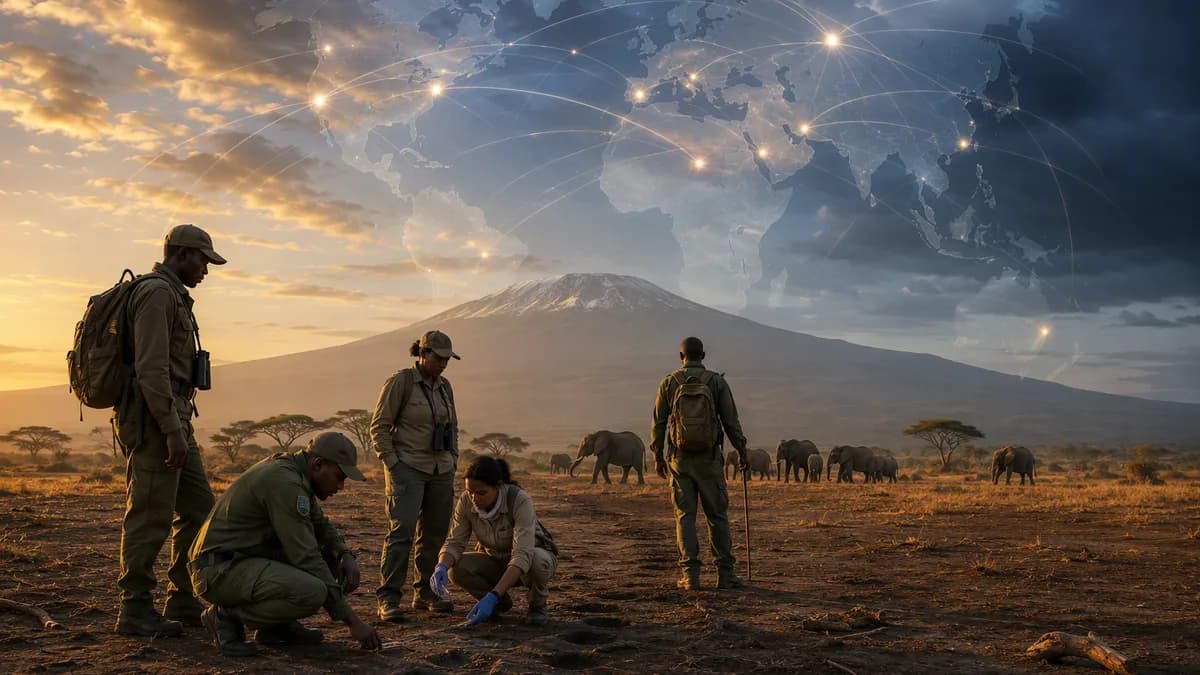
Fifteen elephants have died near Amboseli National Park in a month, a toll Kenyan officials say has not been recorded at this scale in the region for decades. The immediate pressure falls on the Kenya Wildlife Service, laboratory teams, conservation monitors, and communities living around one of Kenya’s best-known wildlife areas.
Global TrendsAugust 1, 2026· 8 min read· By XOOMAR Insights Team
15 Amboseli Elephant Deaths Force Kenya Wildlife Probe
Updated on August 1, 2026
XOOMAR Intelligence
Analyst Take
57/ 100
4 sources analyzedLow confidenceTrend10Freshness94Source Trust92Factual Grounding86Signal Cluster20
The Amboseli elephant deaths are now the subject of an urgent inquiry, according to BBC World. KWS told the BBC that experts are examining the carcasses and that tissue samples have been sent to laboratories to test whether disease, poisoning, or another factor caused the deaths.
There is a number problem in some headlines around this story, with references to 14 carcasses, but the BBC’s reported figure in the source material is 15 elephant deaths. That is the figure this analysis uses.
Fifteen Dead Elephants Put Southern Kenya’s Conservation Record on Trial
The most unsettling part of the case is not only the death toll. It is where it happened.
The elephants died near Amboseli National Park, in the wider Amboseli area that straddles the border with Tanzania and is known for wildlife. Officials told the BBC this is the first time in decades that elephant mortalities on this scale have been recorded in the region, where they say poaching has been successfully cracked down on.
That makes the Amboseli elephant deaths more than a conservation tragedy. They test whether field surveillance, veterinary response, and laboratory follow-up can move fast enough when the cause is not obvious.
KWS says there is currently no evidence pointing to a single cause of death.
That sentence matters. It rules out easy certainty. It also makes the investigation harder for everyone involved, because the deaths are not being attributed to one known threat yet.
The key question now is simple: can investigators separate coincidence from a shared cause before more animals are exposed?
The Numbers Behind Kenya’s Elephant Death Inquiry
KWS said the deaths occurred between 24 June and 24 July 2026. Wildlife authorities also confirmed to the BBC that all the deaths were recorded outside Amboseli National Park.
Earlier, KWS head of communication Duncan Wanyama told local media the bodies had been found at different locations around the park, about 15km (nine miles) to 30km from its boundaries.
Those details shape the inquiry. A single elephant carcass can often be assessed through age, injury, condition, and location. Multiple deaths over a month, spread across different locations, force investigators to ask whether the animals encountered the same hazard, moved through the same risky area, or died from unrelated causes that only look connected because they were found close in time.
The BBC reports that the carcasses include elephants of different ages and sexes. That weakens any simple explanation based on one family group or one demographic category.
The Amboseli Trust for Elephants, which monitors the animals’ movements, estimated that more than 2,000 elephants were in the Amboseli area as of 2025. Against that population, 15 deaths may sound numerically small. Concentration changes the meaning. When deaths cluster in time and geography, investigators have to treat them as a signal until evidence proves otherwise.
What data will matter most? Carcass locations, age and sex, timing of death, condition of the bodies, signs of injury, sample quality, and lab results.
Investigators Must Test Poison, Disease, and Other Environmental Triggers Without Guessing
The BBC source names three broad categories under review: disease, poisoning, or another factor. That is the right frame, because public speculation can outrun evidence quickly in wildlife mortality cases.
For poisoning, investigators would need toxicology results from tissue samples and, where relevant, material from the surrounding area. The BBC confirms tissue samples have been sent to laboratories. It does not report any confirmed toxin, suspect, motive, or contaminated source.
Disease is equally unresolved. KWS has not named a pathogen in the source material. The fact that elephants of different ages and sexes died does not prove disease, but it does mean investigators cannot limit the inquiry to one narrow family or age class.
The “another factor” category is where the hard work sits. It could include environmental exposure, localized hazards, or circumstances not yet visible from carcass inspection alone. XOOMAR analysis: because all deaths were recorded outside the park, investigators will likely need to reconstruct where the elephants moved before death, not just where bodies were found.
The dangerous question for officials is this: if the cause lies outside the park boundary, how quickly can they identify the risk zone?
Rangers and Scientists Need Evidence Before the Story Hardens
KWS has the toughest communications job here. It must show urgency without implying a cause before the labs report back.
That matters because the case sits in a region officials describe as a poaching enforcement success. If poaching were suspected, investigators would be expected to look for field evidence from the carcasses and surrounding areas. The BBC source, however, does not state that poaching caused the deaths, nor does it report tusk status, arrests, or security findings.
Scientists and conservation monitors need clean samples and a clear timeline. Delays can weaken evidence, especially when carcasses are discovered in open terrain and decomposition advances. The BBC confirms experts are examining carcasses and that tissue samples went to laboratories, but it does not say when results are expected.
Local communities around the park also sit close to the inquiry, although the BBC source does not report any community statements or incidents linked to the deaths. XOOMAR analysis: because the carcasses were found outside the park, any credible investigation will need cooperation beyond formal park boundaries.
Who benefits most from a cautious process? Everyone. A rushed conclusion could miss the true cause and leave elephants exposed.
Communities and Tourism-Linked Businesses Need Clarity, Not Assumptions
The BBC does not report damage to tourism, local livelihoods, or safari operations. That absence should be respected. There is no evidence in the supplied material of cancellations, revenue loss, operator warnings, or visitor risk.
Still, Amboseli’s reputation is tied to wildlife visibility, and the BBC describes the park and its surrounding area as famous for wildlife. XOOMAR analysis: for guides, lodges, conservation groups, and local workers who depend on that reputation, the credibility of the inquiry matters even before the cause is known.
Communities near the park need a different kind of clarity. If the deaths were caused by a hazard in the surrounding area, people need to know whether it affects livestock, water points, crops, or movement routes. The source does not say any such risk exists. That is exactly why lab evidence matters.
The practical question is uncomfortable: how do authorities keep people informed without creating fear around a cause they have not confirmed?
The Amboseli Elephant Deaths Could Reshape Monitoring Priorities
The strongest conclusion supported by the source is narrow but important: 15 elephant deaths over one month, outside the park, across different ages and sexes, are unusual enough to require laboratory-backed investigation.
XOOMAR analysis: if the inquiry identifies disease, poisoning, or another shared cause, Kenya’s conservation response may have to focus less on the park boundary and more on the wider movement area used by elephants. The source already points in that direction by placing every recorded death outside the park.
The case also exposes the limits of success narratives. Officials say poaching has been cracked down on in the region. That is important. But fewer poaching deaths do not remove other mortality risks. The Amboseli elephant deaths show why conservation systems need multiple forms of detection: field reports, carcass examination, movement monitoring, and lab capacity.
For now, the most useful public stance is disciplined patience. The deaths are serious. The cause is not known. The investigation has begun.
Kenya’s Next Move Should Be Faster Evidence, Wider Mapping, and Clear Updates
The next meaningful development will be laboratory results. Those findings could confirm or weaken the main lines of inquiry around poisoning, disease, or another factor. Until then, the best evidence is still circumstantial: timing, location, carcass distribution, and the fact that different ages and sexes were affected.
KWS and its partners will also need to map whether the carcasses share any geographic pattern beyond being outside Amboseli National Park. If the deaths cluster around a route, a water point, or another shared area, that would sharpen the investigation. If they remain widely dispersed with no common exposure, the inquiry becomes harder.
The signal to watch is whether officials move from explanation to prevention. Lab results will answer only the first question. The larger test is whether Kenya can turn those results into faster detection, clearer public updates, and tighter monitoring around the areas elephants actually use.
If the evidence points to a shared hazard, the response will need to be immediate. If it does not, the mystery deepens, and the Amboseli area will need even closer watching.
Impact Analysis
- The deaths mark an unusually large elephant mortality event near Amboseli, a key Kenyan wildlife area.
- Investigators have not identified a single cause, raising concern over disease, poisoning, or another threat.
- The case tests Kenya’s wildlife surveillance and emergency response systems in a region known for conservation success.
Reported Amboseli Elephant Death Toll
Elephant deaths near Amboseli
elephants15
Sources

Written by
XOOMAR Insights Team
Research and Editorial Desk
The XOOMAR Insights Team pairs automated research with human editorial judgment. We track hundreds of sources across technology, fintech, trading, SaaS, and cybersecurity, cross-check the facts, and explain what happened, why it matters, and what to watch next. We do not just rewrite headlines. Every article is fact-checked and scored for reliability before it goes live, and we link back to the original sources so you can verify anything yourself.
Explore More Topics
Related Articles
 Global Trends
Hamas Disarmament Plan Forces Gaza’s Hardest Trade
Hamas disarmament offers rare hope for Gaza, but sequencing, trust and enforcement could break the deal fast.
Jul 31, 20268 min
 Global Trends
Singapore Straw Licking Fine Makes Teen Pay for Prank
A French teen paid $465 after licking a vending-machine straw and posting it, turning a gross Instagram joke into a Singapore court warning.
Jul 30, 20267 min
 Global Trends
16-Year-Old Lifeguard Saves Boy in Santa Cruz Ocean Rescue
A 16-year-old rookie lifeguard saved a boy swept offshore, then a viral video pushed the rescue into the national spotlight.
Jul 29, 20265 min
 Global Trends
Ghana’s Tallest Man Dies at 33 After Leg Infection
Sulemana Abdul Samed, Ghana’s tallest man, died at 33 after hospitalization for infected leg sores, sparking grief in Gambaga.
Jul 28, 20266 min
 Global Trends
Epstein Files Scout Daniel Siad Dies Before Questioning
Daniel Siad died before French investigators could question him, leaving a key Epstein files thread unresolved.
Jul 27, 20267 min
 Fintech
PEX Funding Bets $160M on Fierce Corporate Card Fight
PEX raised $160 million to scale its charge card, payments capacity, and spend management platform after triple-digit growth.
Aug 1, 20266 min
 Technology
Smartphone Subscriptions Turn iPhone Upgrades Into Habit
Apple Upgrade makes the phone a monthly habit, using leases and resale value to pull users into the next device.
Aug 1, 20268 min
 Technology
Rubberz AI Suspicions Shake Billboard Hot 100 Credibility
Rubberz hit No. 58 while AI doubts swirled, turning one song into a bigger test of chart credibility and disclosure.
Aug 1, 20268 min
 Trading
Yen Intervention Shock Knocks USD/JPY Into BOJ Test
A five-yen USD/JPY plunge put intervention risk back on the table and left the BOJ one night to make the yen bounce stick.
Aug 1, 20268 min
 Trading
One QQQ Token Hijacks Tokenized Stock Trading Boom
Tokenized stock trading hit $11.3B in July, but QQQB supplied 82%, turning the boom into a concentration warning.
Aug 1, 20267 min
Don't miss the signal
Get our weekly roundup of the stories that matter across tech, fintech, and trading. No noise, just signal.
Free forever. No spam. Unsubscribe anytime.