
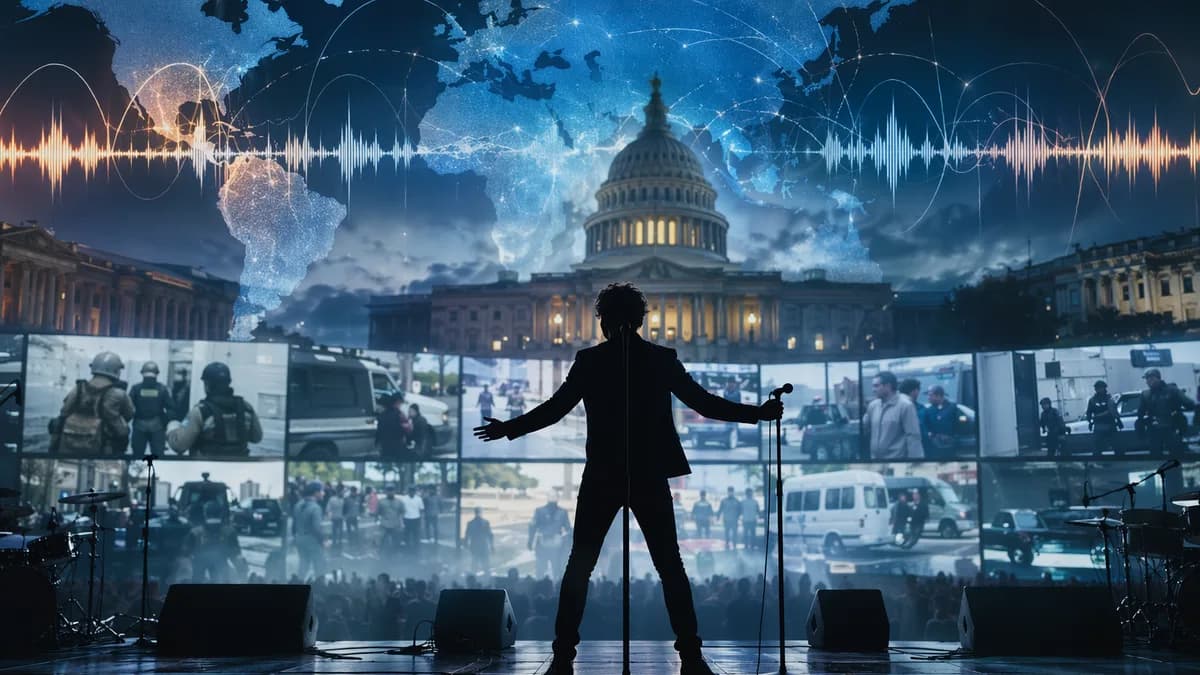
Ariana Grande’s clash with the White House signals a sharper phase in political messaging: official accounts are not just borrowing pop music, they can also create disputes that extend the reach of the original post. The White House posted an ICE detention montage set to Grande’s 2024 song “Bye”, captioned, “Bye-bye 👋 President Trump has delivered the most secure border in history,” according to Guardian World.
Global TrendsJune 12, 2026· 8 min read· By XOOMAR Insights Team
ICE Video Hijacks Ariana Grande’s ‘Bye’ and Sparks Fury
Updated on June 12, 2026
XOOMAR Intelligence
Analyst Take
66/ 100
4 sources analyzedMedium confidenceTrend10Freshness95Source Trust90Factual Grounding92Signal Cluster20
Grande’s response was blunt. She wrote: “Please do not use my music in relation to this barbaric, inhumane, heinous nonsense.” The music was later removed, per the Guardian. That sequence matters. The dispute isn’t celebrity oversensitivity. It’s a fight over whether an artist’s work can be made to decorate state force, then pulled into the controversy that follows.
“Please do not use my music in relation to this barbaric, inhumane, heinous nonsense.”
Grande’s “Bye” became an ICE soundtrack, and the backlash quickly followed
The White House video paired footage of ICE agents handcuffing and detaining people with a pop song whose title gave the caption its taunt. The post did not simply announce an enforcement position. It staged one. The caption, “Bye-bye 👋 President Trump has delivered the most secure border in history,” turned detention footage into a social-media punchline.
That is the core of Grande’s objection. Her complaint was not framed as a narrow licensing dispute in the supplied reporting. It was a moral boundary. She did not want her music attached to what she called “barbaric, inhumane, heinous nonsense.”
The strongest counterpoint is that official accounts often use platform-native formats because that is where audiences are. A government account can argue it is communicating policy in the style of the medium. But this clip, as described in the reports, was not a neutral policy explainer. It used familiar music, arrest visuals, and a mocking caption to provoke.
The broader context is that other artists, including Sabrina Carpenter and SZA, have also been pulled into White House music disputes, while supplementary context has also noted Olivia Rodrigo. That does not prove the same intent in every case, but it does show how quickly pop songs can become contested political material once official accounts use them.
The ICE montage uses pop grammar to make enforcement shareable
XOOMAR analysis: the production logic is clear from the supplied description. A short montage, recognizable music, arrest footage, and a caption built around a pop hook are the ingredients of viral political content. The format asks supporters to read toughness and asks critics to react with anger. Both responses can move the post.
That is why the music choice matters. A major pop song carries emotional charge before the viewer processes the policy message. In this case, the audio gave the White House a ready-made phrase: “Bye-bye.” The song became a rhetorical tool.
The available reporting supports a narrower but still significant point: the video used the language of pop culture to frame immigration enforcement as a shareable social-media moment. SZA has also been reported as criticizing the administration after a separate music-use dispute, though the supplied material does not provide the exact wording of her criticism.
The counterpoint is that outrage can also backfire. Grande has a large public platform, and her rebuke forced attention onto consent, detention imagery, and the ethics of using pop music in enforcement content. Even if intent is not established, the practical effect was that a government video became a broader argument about music, politics, and endorsement.
For readers following how governments turn enforcement into political messaging, XOOMAR has examined adjacent pressure points in 802,000 Cases Expose EU Asylum Rules’ Border Gamble. We’ve also tracked how Trump’s political style extends into hard-power confrontations in A Near Iran Deal Cracks as Trump Threatens Payback. Those stories are not evidence in the Grande dispute, but they show why state messaging now travels through conflict as much as through formal statements.
The missing metrics matter more than the viral noise
The supplied reports do not give the video’s views, likes, reposts, or comment totals. That absence matters. Without platform metrics, the safest conclusion is not that the post “went viral,” but that it produced enough friction to trigger coverage, artist response, and removal or muting of the audio.
The available timeline is still meaningful:
| Element | Reported detail |
|---|---|
| White House post | ICE detention montage using Grande’s 2024 song “Bye” |
| Caption | “Bye-bye 👋 President Trump has delivered the most secure border in history” |
| Grande response | Called the use “barbaric, inhumane, heinous nonsense” |
| Audio status | Guardian says the music has since been removed |
| Pattern | Similar objections reported from Sabrina Carpenter, SZA, and Olivia Rodrigo |
The “most secure border in history” claim is also not substantiated by the supplied material. The article can report that the White House used the phrase. It cannot verify it from these sources. That distinction is important because political captions are designed to harden into perceived fact once repeated enough.
The available reports also do not establish broader commercial context around Grande’s current release cycle, streaming position, or chart performance. Without those details, the strongest claim is narrower: the White House attached an immigration-enforcement montage to music by one of pop’s most visible artists, and Grande objected publicly after the fact.
Artists, rights holders, platforms, and immigrant advocates are fighting different battles
Grande is the public face of the objection, but she may not control every lever needed to remove the audio. The supplied reporting says the music has since been removed. The Independent also reported that the TikTok video displayed, “This sound isn’t available,” and that a source close to Grande said her team was exploring how to remove the song from the video.
That points to a split between moral objection and technical enforcement. An artist can condemn a use instantly. Rights holders, platform systems, and account-level permissions determine what happens next. The public sees the comment. The real fight may move through takedown tools and platform rules.
A practical effect for the White House can run in the opposite direction. A rebuke from Grande keeps the immigration message in circulation among audiences that would never seek out an ICE promotional clip. The administration can then frame the backlash as another clash with liberal celebrity culture, even if the supplied material does not establish that this was the original motive.
White House spokesperson Abigail Jackson responded in a statement reported by The Independent and Us Weekly:
“We’ll say this one last time: what’s actually barbaric, inhumane, and heinous are the criminal illegal aliens who have injured and murdered innocent American citizens.”
That response does two things at once. It rejects Grande’s framing and turns her own words back into the administration’s message. It also shows why artists may see silence as costly. Once a song is tied to government messaging, non-response can look like consent, even if no endorsement exists.
The next fight sits inside platform audio libraries
The supplied material does not establish the exact licensing path for “Bye” in the White House video. That’s the unresolved legal and operational question. Was the track selected through a platform audio tool? Was it uploaded with the video? Did rights holders trigger removal? The reports don’t say.
But the direction of travel is visible. Political accounts can attach popular songs to official messaging faster than artists, labels, publishers, or platforms can react. Once the post is live, the controversy becomes content of its own.
For campaigns, agencies, labels, and platforms, the Grande incident is a warning. Viral political content borrows emotional power from music, and that borrowing can blur consent, endorsement, and propaganda. The next escalation would be more aggressive monitoring by artist teams and rights holders, faster audio takedowns, and tighter limits on official or political accounts using commercial music.
The thesis weakens if future White House posts avoid disputed music after artist objections, or if platforms quietly block repeat uses before they publish. It strengthens if more artists object, more audio gets removed after the fact, and official accounts appear to treat backlash as proof that a post worked.
Impact Analysis
- The dispute highlights how government social media can turn pop culture into political messaging.
- Grande’s objection frames the use of her music as a moral issue tied to immigration enforcement imagery.
- The incident shows how controversy over music use can amplify the reach of official political posts.
Sources

Written by
XOOMAR Insights Team
Research and Editorial Desk
The XOOMAR Insights Team pairs automated research with human editorial judgment. We track hundreds of sources across technology, fintech, trading, SaaS, and cybersecurity, cross-check the facts, and explain what happened, why it matters, and what to watch next. We do not just rewrite headlines. Every article is fact-checked and scored for reliability before it goes live, and we link back to the original sources so you can verify anything yourself.
Explore More Topics
Related Articles
 Global Trends
Trump Tariffs Twist Court Loss into Checkout Tax Fight
Trump recast his tariffs after a court loss. Democrats see an opening, calling them a sales tax on squeezed Americans.
Jul 25, 20269 min
 Global Trends
50% Trump Canada Tariff Blindsides USMCA Importers
Trump’s 50% Canada tariff can hit some USMCA goods on Aug. 19, shifting the first pain to importers before Ottawa moves.
Jul 21, 20267 min
 Global Trends
Trump Canada Tariffs Drag US Buyers Into a 50% Trade Fight
Trump's 50% Canada tariffs test USMCA, hit odd targets and risk making American buyers pay for a political fight.
Jul 21, 20268 min
 Global Trends
16-Year-Old Lifeguard Saves Boy in Santa Cruz Ocean Rescue
A 16-year-old rookie lifeguard saved a boy swept offshore, then a viral video pushed the rescue into the national spotlight.
Jul 29, 20265 min
 Global Trends
Israel Withdrawal From Lebanon Corners Trump and Aoun
Aoun wants Trump to force an Israeli pullback, but Hezbollah disarmament could leave Lebanon paying the price.
Jul 21, 202610 min
 Trading
$83 Oil Traps USD/CAD Before Pivotal Fed Rate Call
USD/CAD is boxed near 1.4093 as oil supports the loonie, but Fed risk keeps traders from calling a breakout.
Jul 29, 20265 min
 Technology
DoorDash Drone Delivery Seizes FAA Clearance to Fly
DoorDash won FAA clearance for DoorDash Air, signaling a bigger bet on owning delivery from couriers to bots to drones.
Jul 29, 20269 min
 Fintech
Credit Card Installments Crush BNPL as Usage Hits 33%
Credit card installment use hit 33%, more than double BNPL's 14%, as issuers turn Pay Later into a card feature.
Jul 29, 20267 min
 Technology
Fast Metals Mines Toxic Red Mud for Critical Minerals
Fast Metals raised $4.3M to mine critical minerals from red mud. Now it has to prove the leftover waste is safer.
Jul 29, 202612 min
 SaaS & Tools
Nearly 60 Webinar Tools Expose the Best Webinar Software
Webinar platforms are now judged by pipeline, not polish. Zapier’s 2026 picks show marketers which tools turn attendance into action.
Jul 29, 20268 min
Don't miss the signal
Get our weekly roundup of the stories that matter across tech, fintech, and trading. No noise, just signal.
Free forever. No spam. Unsubscribe anytime.