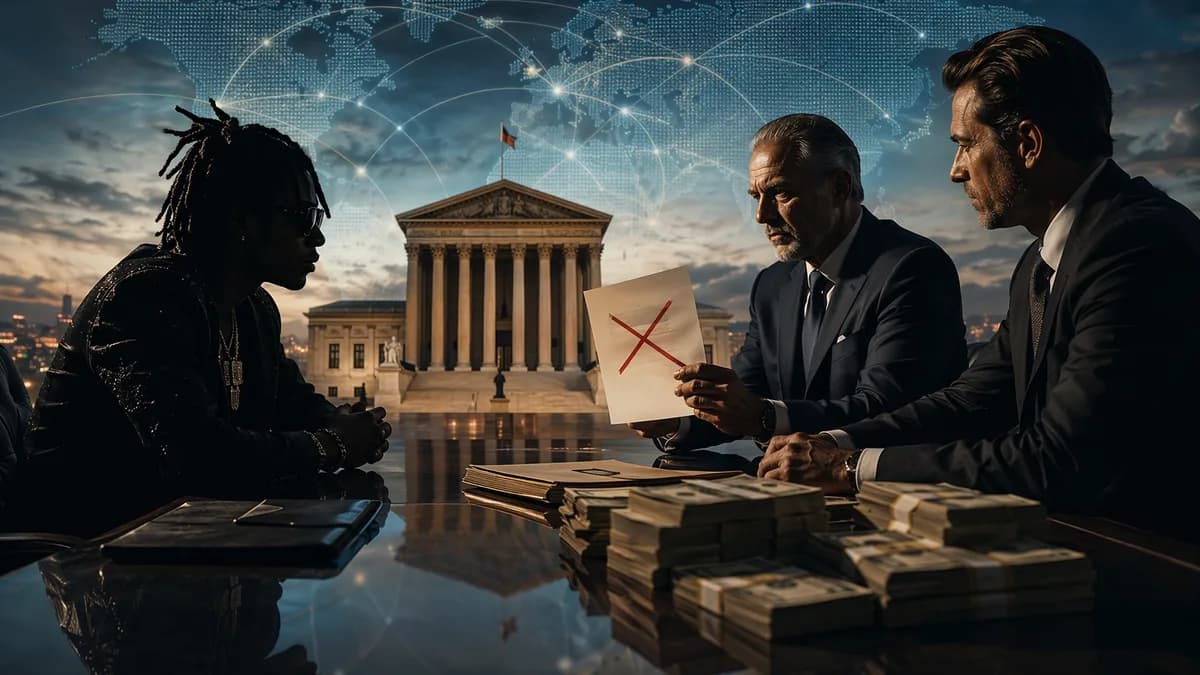
$600,000 bought Boosie Badazz a failed push for a Donald Trump pardon, and now the fight is over whether $300,000 of that money should come back.
XOOMAR Intelligence
Analyst Take
The Boosie Trump pardon refund dispute turns a celebrity clemency bid into a sharper question about Washington access: when clients pay huge sums to people selling proximity to power, are they buying advocacy, influence, or an implied result? The Louisiana rapper, whose legal name is Torence Hatch, paid JM Burkman & Associates in 2025 to pursue a pardon tied to his federal gun conviction, according to Guardian World. No pardon arrived.
Boosie Badazz's $600,000 pardon gamble turns political access into the story
Hatch is now reportedly pursuing the matter through arbitration, after the lobbying effort failed to remove his conviction. The firm says no partial refund was promised. That moves the story beyond a celebrity legal setback and into the murkier zone where lobbying, clemency advocacy, legal strategy, and political access blur.
The dispute centers on JM Burkman & Associates, run by Jack Burkman and Jacob Wohl. Federal lobbying records cited in the source show the firm registered to contact the White House, the US justice department, and Congress on Hatch’s behalf.
The most damaging factual tension is simple. Notus reported that the lobbyists told Hatch’s attorneys that Trump had signed the pardon and that they were waiting for the White House to announce it. The clemency was never announced. Notus also reported that the Trump White House told Hatch’s attorney it had not received such a request.
That gap is the story. Not whether lobbying can fail. It can. The question is whether the client was led to believe the result was already secured.
The numbers behind Boosie's failed Trump pardon bid: $600,000 paid, $300,000 disputed, one conviction still standing
The reported financial structure is stark:
| Item | Reported detail |
|---|---|
| Client | Boosie Badazz, legal name Torence Hatch |
| Firm hired | JM Burkman & Associates |
| Fee paid | $600,000 upfront |
| Refund sought | $300,000 |
| Underlying case | Federal conviction for possessing a loaded pistol despite being a convicted felon |
| Sentence | Three years of supervised release, 300 hours of community service, and a $50,000 fine |
Fox 8, citing Notus, reported that a signed agreement said $300,000 was nonrefundable and that the other $300,000 would be returned if Hatch did not receive a pardon by a set deadline and requested the refund in writing. JM Burkman & Associates disputes that it agreed to return half.
The Advocate added another wrinkle: the contract reportedly listed Jan. 31st, 2025 as the refund deadline, even though both signatures were dated Sept. 30, 2025. Hatch’s attorney, Jill Craft, described that date as a typo and said the intended deadline was Jan 31, 2026.
That paperwork problem matters because the Boosie Trump pardon refund fight may be decided less by Trump-world politics than by contract interpretation. If the refund clause is valid and enforceable, Hatch has a cleaner claim. If the firm can persuade an arbitrator that the provision was never agreed to or that the date defect voids it, the dispute becomes much harder for him.
How Trump's pardon style created room for a paid clemency lane
The Guardian frames this case inside what it calls the so-called “clemency economy”, where money has flowed to lobbyists, lawyers, and pardon advocates claiming access to Trump.
The source specifically ties the dispute to Trump’s habit during his second presidency of granting pardons in bulk to people he considers aligned with him and who were convicted of federal crimes. That matters because it changes the incentives around clemency. If access appears to matter, intermediaries become more valuable.
That does not mean a pardon can be bought. Laura Loomer, one of the figures Hatch publicly asked to confirm whether she had been contacted, rejected that idea directly online.
“You can’t pay for a pardon … not sure who told you that’s how it works.”
Her response also undercut one reported part of the lobbying story. She said she didn’t get “involved in this type of work” and had “no idea” what Hatch was talking about. Representative Nancy Mace said her office received an email requesting a phone call, staff took one phone call last October, and “Our office promised nothing, and they never followed up. To our knowledge. More than willing to assist.”
For Hatch, those denials cut straight to value received. For the lobbyists, they raise a different problem: if their claimed campaign was as extensive as described, the paper trail will need to show it.
Boosie, the lobbyists, and the missing guarantee
A pardon advocacy contract should never read like a purchase order for clemency. That would create obvious ethical and legal danger. But a best-efforts lobbying engagement is different: the firm promises work, outreach, strategy, and advocacy, not the result.
The fight here sits between those poles.
Burkman told Notus the firm conducted “a massive, highly tailored advocacy campaign across Congress, the executive branch and leading political influencers and media figures.” The firm also said:
“We continue to believe that Boosie very much deserves a pardon.”
That statement defends the mission, not the outcome. Hatch’s side is attacking the expectations. He told Notus that when the lobbyists were first contacted, “they were real aggressive” and “they were talking like they had Trump on speed dial.”
XOOMAR analysis: the phrase “Trump on speed dial” is not evidence by itself. But paired with reported assurances that a pardon had been signed, it becomes relevant to whether the firm sold realistic advocacy or overstated access.
The documents that matter now are practical, not theatrical:
- Engagement letter: What exactly did the firm promise?
- Refund language: Was the $300,000 return clearly agreed?
- Deadline clause: Can the reported Jan. 31st, 2025 date be reformed as a typo?
- Status updates: Did written messages claim the pardon was signed or imminent?
- Lobbying records: Do disclosures match the claimed campaign?
Who carries the risk: Boosie, Burkman and Wohl, or the pardon market itself
Hatch’s position is easy to understand. He paid $600,000 for a concrete political objective. He did not get the pardon. His conviction still stands, along with supervised release, community service, and the fine.
The firm’s defense is also recognizable. Political consulting can fail. Lobbying does not guarantee action by the president. A clemency campaign may involve calls, meetings, outreach, and influence attempts that still produce nothing.
The reputational asymmetry is brutal. Boosie risks looking like he paid for access that didn’t work. Burkman and Wohl risk looking like they sold access they could not deliver.
Their prior record sharpens that scrutiny. The Guardian notes that Burkman and Wohl pleaded guilty in Ohio in 2022 to running an illegal robocall campaign that allegedly targeted Black voters. They later settled the case, paying $1.25m to New York authorities and $5m to the FCC.
For readers tracking how criminal cases become public-pressure events, XOOMAR has covered separate public-safety stories such as Teens Seized After East St Louis Shooting Kills Family and Suspect on Run After Toronto Festival Shooting Kills 2. Hatch’s dispute is different. It is about clemency and contract terms, not an active shooting investigation. But the common thread is that legal facts quickly become reputational facts.
The Boosie Trump pardon refund fight is a warning label for clemency clients
The practical lesson is blunt: anyone hiring lobbyists for clemency needs contract discipline before the first invoice is paid.
That means written terms covering:
- Scope: Who will be contacted and for what purpose?
- Deliverables: Memos, filings, meetings, calls, status reports.
- Refunds: Exact triggers, dates, and written notice requirements.
- Disclosures: Lobbying registrations and updates.
- No guarantee clause: Clear language that no official outcome is promised.
For lobbying firms, the market signal is just as clear. Big upfront fees tied to high-profile pardon campaigns invite press scrutiny when results fail. The higher the fee, the less convincing vague “we worked hard” defenses become without documents.
The justice concern is larger. Clemency is supposed to correct unfairness or grant mercy. If the public sees it as a paid access channel, confidence erodes, especially when wealthy or famous petitioners can spend sums ordinary defendants could never assemble.
Paperwork, not politics, will likely decide the next move
The Boosie Trump pardon refund dispute now appears likely to turn on records: the signed agreement, refund clause, date issue, written updates, and any communications saying the pardon was already signed or moving through the White House.
Evidence that would strengthen Hatch’s side includes a clear refund provision, written assurances of a signed pardon, and proof that the firm failed to pursue the work it described. Evidence that would weaken his claim includes contract language limiting the firm’s duty to best-efforts advocacy, a defective refund clause, or records showing substantial outreach.
The broader watch item is whether this case makes future clemency clients demand milestone payments and written proof of work instead of paying large retainers for implied access. The pardon economy may not vanish. But after Boosie’s $600,000 gamble, vague influence will be harder to sell without sharper questions attached.
The Stakes
- The dispute highlights the risks of paying large sums for political access without a guaranteed result.
- It raises questions about transparency in clemency lobbying and claims of proximity to presidential power.
- The arbitration could clarify whether failed advocacy crosses into misrepresentation when a client is told a pardon is secured.
Boosie Pardon Refund Dispute
| Issue | Boosie Badazz / Torence Hatch | JM Burkman & Associates |
|---|---|---|
| Payment | Paid $600,000 for a Trump pardon push | Accepted payment to pursue clemency advocacy |
| Outcome | No pardon was granted and the conviction remains | Says no partial refund was promised |
| Core dispute | Seeking arbitration over a reported $300,000 refund | Disputes refund obligation |
Money at Stake in Boosie's Failed Pardon Bid
Primary Sources & Disclosures

Written by
XOOMAR Insights Team
Research and Editorial Desk
The XOOMAR Insights Team pairs automated research with human editorial judgment. We track hundreds of sources across technology, fintech, trading, SaaS, and cybersecurity, cross-check the facts, and explain what happened, why it matters, and what to watch next. We do not just rewrite headlines. Every article is fact-checked and scored for reliability before it goes live, and we link back to the original sources so you can verify anything yourself.