
NCERT’s restoration of the Dancing Girl textbook image signals more than a quick retreat from a bad edit. It shows how fragile visual accuracy becomes when ancient art is forced through modern discomfort about the body.
Global TrendsJune 21, 2026· 12 min read· By XOOMAR Insights Team
Dancing Girl Textbook Censorship Forces NCERT U-Turn
Updated on June 21, 2026
XOOMAR Intelligence
Analyst Take
56/ 100
4 sources analyzedLow confidenceTrend10Freshness93Source Trust92Factual Grounding86Signal Cluster20
The controversy began when a newly released grade nine Indian school textbook showed the famous Dancing Girl from Mohenjo-daro with dark shading over her bare torso, obscuring anatomical details of the bronze figurine. After criticism from historians and educationists, officials said the original image had been restored in the digital version and would appear in new print editions, according to BBC World.
The National Council of Educational Research and Training, or NCERT, drafted the textbook. NCERT sits under India’s federal education ministry and oversees syllabus changes and textbook content for children taking exams under the government-run Central Board of Secondary Education. That makes this more than a formatting dispute. A textbook image can become the first museum object a student ever studies, and often the most authoritative one.
"Following consultations with experts, the department is replacing the image of the Dancing Girl with its original version," NCERT director Dinesh Saklani told ANI news agency.
The primary issue in the Dancing Girl textbook controversy is not whether one classroom picture was poorly edited. It is who gets to decide how students encounter cultural heritage: historians, curriculum officials, parents, teachers, or the loudest backlash cycle.
A shaded torso turned the Dancing Girl textbook into a censorship test
The altered image did something small on the page and large in meaning. It covered part of a bronze figurine. It also suggested that an ancient artifact could be made classroom-safe by visually disciplining it.
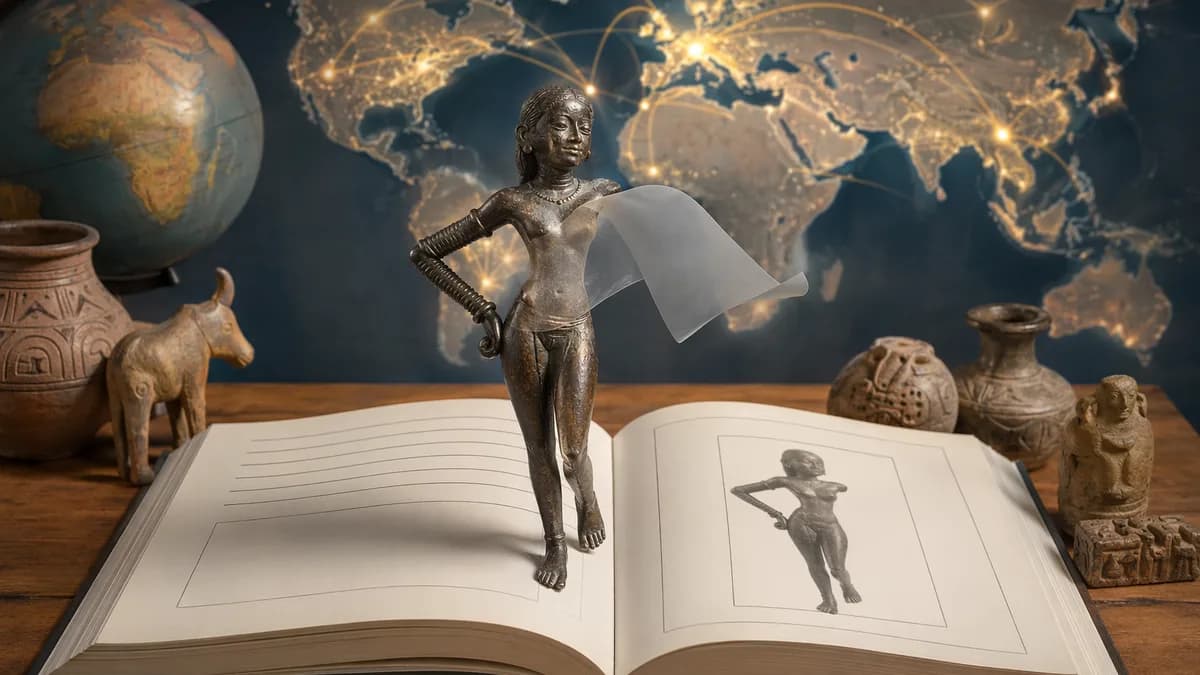
The figurine, known as the Dancing Girl, comes from Mohenjo-daro, one of the largest settlements of the Indus Valley Civilisation. The BBC reports that it dates back to 2600 BCE. It shows a girl standing with one hand on her hip, adorned with ornaments, her hair tied in a bun. The sculpture is now housed in the National Museum in Delhi.
That object has appeared in Indian school material for decades, including earlier NCERT textbooks, without the torso being censored, according to the BBC. The sudden change in the new grade nine book is why the backlash landed so hard. This was not a case of introducing a difficult image into schools for the first time. It was a familiar image, altered without a public explanation from NCERT.
The NCERT has not shared a reason for introducing the modified image. Media reports have speculated that the edit may have been linked to concerns over nudity. That absence of explanation matters. When an official textbook modifies an artifact and does not clearly say why, the edit looks less like pedagogy and more like concealment.
The result was predictable. Historians accused NCERT of disfiguring an iconic artifact. Educationists questioned what students are being taught when the past is corrected for present-day modesty norms.
The numbers make the edit look smaller and the stakes larger
The Dancing Girl textbook dispute has a sharp proportional imbalance. The artifact is physically small, but symbolically heavy. The edit covered only part of a classroom image, yet it touched archaeology, gender, museum ethics, and state-approved history.
Here is the factual spine of the episode:
| Item | Source-supported detail |
|---|---|
| Artifact | Bronze figurine known as the Dancing Girl from Mohenjo-daro |
| Date | Dating back to 2600 BCE |
| Civilisation | Indus Valley Civilisation |
| Textbook level | Newly released grade nine textbook |
| Edit | Dark shading covered the figurine’s torso |
| Institution | NCERT, under the federal education ministry |
| Correction | Original image restored in the digital version, new print editions to carry the unedited photo |
| Current location | National Museum in Delhi |
There is one number the supplied reporting does not give: how many students will encounter this textbook. So it would be wrong to quantify its reach. But NCERT’s role in syllabus and textbook content for CBSE students gives the edit national significance.
This is why textbook design can become political so quickly. A museum label reaches visitors who choose to enter the museum. A schoolbook enters the classroom as a sanctioned version of knowledge. For many students, the image does not appear as one interpretation among many. It appears as the version.
XOOMAR analysis: the controversy also shows how institutions now face scrutiny across domains when their editorial choices become visible. The pattern is familiar in business and markets coverage too, whether the issue is corporate restructuring such as Hundreds Axed in Rivian Layoffs After R2 SUV Debut, or market narratives under pressure as in DXY Spike Pins EUR/USD Below 1.15 After Hawkish Fed. The lesson is not that education is finance. It is that institutional decisions now travel fast once documents circulate publicly.
Why the bare torso carries more than artistic detail
The Dancing Girl is not significant because it is nude. It is significant because it is evidence.
The sculpture has long been considered by archaeologists to have great artistic value. The BBC notes that its posture captures the human body in motion, and that it is seen as evidence of the civilisation’s advanced knowledge of metallurgy. The object belongs in a discussion about craft, urban culture, bodily representation, and the social imagination of the Indus Valley Civilisation.
Covering the torso changes the terms of study. It shifts attention from the artifact to the editor’s discomfort. Students are no longer simply asked to look at what survived from Mohenjo-daro. They are trained to see the ancient body through a modern filter of embarrassment.
That is a bad educational trade. It replaces inquiry with avoidance.
The Free Press Journal’s agency-based account adds that the chapter in Madhurima, NCERT’s new Class 9 arts education textbook, included a prompt asking students what they thought was portrayed by the figure’s pose. Another activity asked students to mimic the posture and sketch it while imagining different foot positions. Those classroom exercises make the torso edit even stranger. The lesson asks students to study motion and posture, while the image itself suppresses part of the body being studied.
The gender layer is unavoidable. The figure’s confident stance, ornaments, and uncovered torso have long invited questions about performance, status, beauty, labor, and representation in early urban society. The textbook edit narrowed that field of inquiry into a single concern: whether the body should be hidden.
The Indian Express, which the BBC says first broke the news, put the criticism bluntly:
"The Dancing Girl has been significant not because it conforms to a blindfolded standard of modesty but because it embodies poise, confidence and unmistakable presence. If the task of education is to equip young people to engage with the world as it is, then NCERT would do better to trust both students, and women - both contemporary and millennia old - with a little more agency."
That quote captures the core educational failure. The edit did not protect the artifact. It diminished it.
Historians, parents, officials, and students are measuring different risks
The backlash was led by historians and educationists, and their concern is straightforward: accuracy matters. Altering an artifact without transparent labeling weakens trust in the textbook. If a primary cultural object can be visually modified for comfort, students are left unsure where documentation ends and editorial preference begins.
That does not mean every parental concern is unserious. Some families may expect school material to fit contemporary ideas of age-appropriate presentation, especially when images involve nudity. Curriculum boards do have to make judgment calls about classroom readiness. Those calls are not inherently illegitimate.
But the Dancing Girl case shows the risk of overcorrection. A textbook board trying to avoid discomfort can create a larger controversy by appearing to falsify heritage. In this case, the artifact had already appeared in textbooks for decades without such censorship, according to the BBC. That history made the new edit look less like caution and more like regression.
Students are the least heard group in the dispute, but they sit at the center of it. Young readers can handle historical context when teachers and textbooks treat them seriously. Avoiding discomfort often makes the subject feel more taboo, not less.
A better classroom approach would have been simple:
- Show the original artifact: Use the image as it appears in museum and archaeological contexts.
- Explain the context: Make clear that the object comes from the Indus Valley Civilisation and is studied as art, material culture, and evidence of metallurgy.
- Guide the discussion: Give teachers language to handle nudity in ancient art without moral panic.
- Label editorial changes: If an image is reconstructed, cropped, shaded, or artistically interpreted, say so directly.
NCERT restored the image. That corrects the immediate problem. It does not answer why the altered version entered the textbook in the first place.
India’s ancient past keeps getting pulled into present-day fights
The Dancing Girl is especially sensitive because the Indus Valley Civilisation occupies a prized place in South Asian cultural memory. It is studied as an early urban civilisation, with Mohenjo-daro among its largest settlements. The artifact’s value is not decorative alone. It is a compact piece of evidence about skill, taste, movement, and social life from a distant period.
That is why the edit felt larger than a classroom design choice. It touched the politics of inheritance. Who owns the past? Who gets to sanitize it? And what happens when an object from 2600 BCE is made to answer to current standards of modesty?
There is an irony here. The Dancing Girl is often discussed as evidence of artistic sophistication and metallurgical knowledge. Yet in this textbook episode, a work valued for its confidence and form was filtered through discomfort with the human body. A civilization studied partly for its urban sophistication was presented through a present-day anxiety.
XOOMAR analysis: this is the deeper signal beneath the headline. The restored image shows that public backlash can force correction, but the original edit reveals the pressure on curriculum institutions to make the past less awkward. That pressure does not always announce itself as censorship. Sometimes it appears as shading, cropping, captioning, omission, or a safer illustration.
The supplied reporting does not prove who ordered the edit or what reasoning was used inside NCERT. That remains unclear. But the visible outcome was enough to produce a strong reaction because the artifact is not obscure. It is one of the most recognisable objects from the Indus Valley Civilisation.
Restoration fixes the image, not the classroom problem
Restoring the original Dancing Girl image is a win for visual accuracy. It is not a full solution.
The Dancing Girl textbook episode exposes a gap between artifact accuracy and classroom interpretation. A correct image still needs a correct frame. If students see the unedited figurine but receive no explanation of why it matters, the lesson can still collapse into awkwardness. If teachers are left without guidance, they may skip the discussion or treat the image as an exception that needs apology.
The textbook is part of NCERT’s new Arts Education Series, introduced under the latest National Education Policy to integrate visual, performing, and literary arts into mainstream schooling. That makes the controversy more consequential. An arts education textbook should be especially careful about visual integrity. If an art object is modified without explanation inside an arts curriculum, the credibility problem is obvious.
The standard should be clear across textbooks, museums, archives, and digital learning materials: original artifacts should be shown accurately. If an image is reconstructed, edited, cropped, enhanced, or interpreted, the material should disclose that choice. Students do not need a cleaned-up past. They need to know when they are looking at evidence and when they are looking at editorial mediation.
There is also a teacher-training issue. Ancient art, religious imagery, bodily representation, and cultural difference can all create classroom discomfort. Avoiding that discomfort is not education. Managing it with context is.
The most practical fix is not a culture-war posture from either side. It is a better editorial protocol:
- Accuracy first: Show the artifact as documented.
- Context next: Explain period, place, material, and scholarly significance.
- Age-appropriate language: Do not infantilize students, but do not leave teachers stranded.
- Transparent edits: Any visual change should be labeled.
- Expert review: Archaeologists, art historians, and educators should examine sensitive material before publication, not after backlash.
NCERT’s reversal suggests the institution understood the reputational cost of the altered image. The next test is whether it treats the problem as a one-off embarrassment or as a process failure.
The next textbook fight will be about captions as much as censorship
The next flashpoint may not be a shaded torso. It may be a caption, a missing paragraph, a softened phrase, or an activity that steers students away from difficult interpretation.
That is where curriculum disputes are headed. Deleted or altered images are easy to see once a textbook page circulates online. Framing choices are subtler. A caption can shrink an artifact’s meaning. A prompt can narrow inquiry. An omission can teach as powerfully as an inclusion.
For NCERT and other textbook bodies, the lesson is blunt: quiet edits are no longer quiet. Parents, scholars, teachers, and activists can circulate pages quickly, and a small visual decision can become a national argument if it appears to distort heritage.
The better model is not complicated. Preserve original images. Add historical explanation. Tell students why ancient bodies, artifacts, and artistic conventions should not be judged only by contemporary modesty codes. Disclose editorial choices instead of hiding them inside the image.
The Dancing Girl episode will likely be remembered less as a dispute over one bronze figurine and more as a warning. Heritage education cannot survive if accuracy is treated as optional. The evidence to watch now is whether future NCERT editions apply that lesson beyond this one restored image, in captions, classroom prompts, and the handling of other artifacts that do not fit neatly into modern comfort zones.
Impact Analysis
- Textbook images shape how students first understand cultural heritage.
- The backlash highlights tensions between historical accuracy and modern discomfort with the body.
- NCERT’s reversal shows public and expert criticism can influence official curriculum decisions.
Dancing Girl Textbook Image Versions
| Version | What Changed | Significance |
|---|---|---|
| Altered textbook image | Dark shading obscured the figurine’s bare torso | Raised concerns about censorship and historical distortion |
| Restored original image | Original depiction reinstated in digital and future print editions | Reaffirmed visual accuracy in teaching ancient art |
Sources

Written by
XOOMAR Insights Team
Research and Editorial Desk
The XOOMAR Insights Team pairs automated research with human editorial judgment. We track hundreds of sources across technology, fintech, trading, SaaS, and cybersecurity, cross-check the facts, and explain what happened, why it matters, and what to watch next. We do not just rewrite headlines. Every article is fact-checked and scored for reliability before it goes live, and we link back to the original sources so you can verify anything yourself.
Explore More Topics
Related Articles
 Global Trends
98,000-Tonne Oil Cargo Snares Russian Shadow Fleet Captain
Ajay Pant was remanded after UK forces seized MV Smyrtos, a Russian shadow fleet tanker carrying 98,000 tonnes of oil.
Jun 16, 20266 min
 Technology
$234M Turns Sarvam AI Into India's New Unicorn Test
Sarvam hit a $1.5B valuation after HCLTech led a $234M round, putting India's sovereign AI dream under real revenue pressure.
Jun 20, 20267 min
 Fintech
Fake Betting Videos Drag Polymarket Into Trust Crisis
Reported fake betting videos put Polymarket’s trust problem front and center, raising doubts about whether its market signals reflect real conviction.
Jun 21, 20268 min
 Global Trends
Iran War Jolts Southeast Asia Energy Security Gamble
The IEA says Southeast Asia’s fuel import bill could triple to $245 billion by 2035 unless it diversifies fast.
Jun 21, 20268 min
 Technology
Bose Records Turns a Headphone Giant Into a Media Gamble
Bose Records looks less like a cultural breakthrough than a risky distraction from the audio products customers actually trust Bose to make.
Jun 21, 20269 min
 Global Trends
Israel Defies Sanctions With West Bank Settlements Cash
Allies sanctioned settler networks while Israel advanced $388m for 69 West Bank settlements, deepening the split over annexation.
Jun 21, 20265 min
 Global Trends
False Posts Flood Makerfield Facebook in Burnham Race
False news hit one in six Makerfield Facebook posts during the byelection, turning local groups into a front line against Andy Burnham.
Jun 21, 20268 min
 Global Trends
Canal Dips Reveal France Red Heatwave Alert Crisis
France's top heat alert covers half the country, pushing Parisians into Canal St Martin as record-level heat looms.
Jun 21, 20265 min
 Global Trends
$14M Flop May Force Lincoln Reflecting Pool Drain
A $14.2M Lincoln Reflecting Pool makeover may be drained again after algae, peeling paint and vandalism claims embarrassed Trump's America 250 push.
Jun 21, 20267 min
 Trading
SpaceX Valuation Rockets Past Amazon in $2.7T Frenzy
SpaceX briefly topped Amazon after a thin float, options trading, and the Cursor deal turned its IPO into a $2.7T spectacle.
Jun 21, 20266 min
Don't miss the signal
Get our weekly roundup of the stories that matter across tech, fintech, and trading. No noise, just signal.
Free forever. No spam. Unsubscribe anytime.