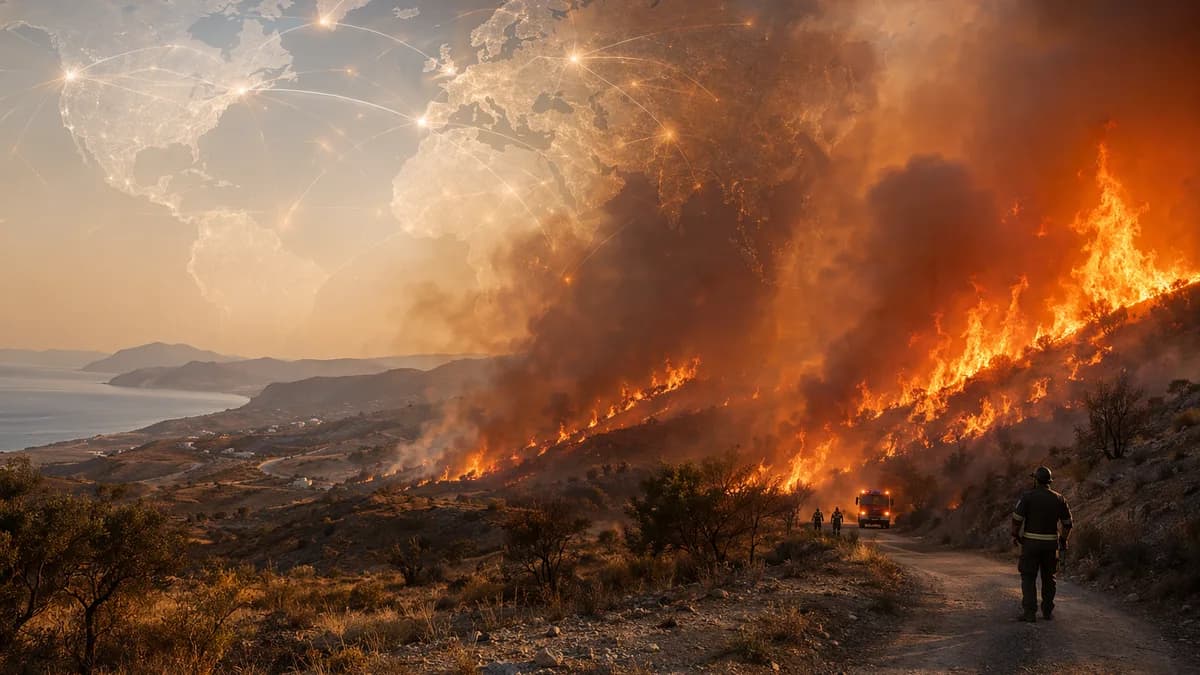
On Thursday afternoon, the Los Gallardos wildfire turned lethal as a heatwave kept southern Spain near 40C (104F), with at least 12 people dead and 23 missing in Almería province.
XOOMAR Intelligence
Analyst Take
Twelve killed as wildfire hits Los Gallardos during Spain heatwave
The fire spread through a wooded area around Los Gallardos, in the province of Almería, after what Andalusia's regional leader Juanma Moreno said appeared to be a downed power line, according to BBC World. That cause has not been confirmed, and electricity company Endesa disputed Moreno's account, saying the fallen line was inactive and did not belong to the company.
The bodies were found in and around Bédar, a small village just outside Los Gallardos. Andalusia officials said four of the victims may be British.
Antonio Sanz, Andalusia's health and emergencies minister, said the fire was complex and fast-moving. He said four people were found trapped in a car, while eight others were found elsewhere and appeared to have been trying to escape the flames.
"Our hearts are heavy and we are devastated by grief," Moreno posted on social media.
The injury count has also been grim. BBC's report says four people were taken to hospital with serious burns, while another four suffered minor burns and respiratory problems from heavy smoke. The outline for this breaking update cited six injuries, but the detailed official figures in the supplied reporting describe eight injured.
The Los Gallardos wildfire is now among the deadliest in Spanish history. BBC cited earlier disasters including 20 deaths in a 1984 fire on La Gomera and 21 deaths, including nine children, near Lloret de Mar in 1979.
Almería blaze exposes southern Europe's extreme heat and wildfire risk
The immediate disaster in Almería landed during a sustained southern European heatwave that has already driven major wildfire incidents in France, Portugal and Spain. Temperatures of around 40C (104F) have strained firefighting across the region, with thousands forced from homes, according to the BBC report.
In this case, emergency services said 1,000 residents were evacuated and roads were closed. Spain's Military Emergency Unit (UME) deployed 220 soldiers and 70 vehicles to the Almería region. The civil guard added 160 law enforcement personnel for evacuations, traffic control and the search for the fire's origin.
Sanz said victims had tried to leave by a "different route than that designated for evacuation". That detail matters. In fast-moving fire conditions, the gap between an official route and an improvised escape can become fatal within minutes.
"Everything appears to point to the collapse of a power line pole, although this will still need to be investigated," Moreno said on Cadena Ser radio.
That line is now contested. Endesa said the fallen power line was inactive and did not belong to it. The investigation will have to establish whether a line fell, whether it sparked the blaze, who owned or maintained it, and whether any failure contributed to the fire's spread.
The human toll is still not fully known. The UK Foreign Office has contacted Spanish authorities, a Downing Street spokesperson told PA. Belgian Foreign Minister Maxime Prévot said many Belgians have second homes in Spain and consular officials were trying to reach "Belgians with whom they have not been able to get in touch".
For readers following the human impact of the Almería fire, XOOMAR has more context in Spanish Wildfire Traps Britons as Holiday Turns Deadly. For the wider heat stress hitting Europe and nearby regions, see UK Marine Heatwave Pushes Britain's Seas 5C Hotter.
A local holiday-home owner, Peter Chapman, told the BBC he and his wife initially thought the smoke was a storm because the sky darkened so quickly.
"The only way I can describe it is by thinking of how my mother used to describe the London bombings during the Second World War. It was surreal," Peter Chapman said.
His second comment carried the sharper point: "People come away for a holiday and don't imagine something like this happening."
Fire crews in Almería face containment push as heatwave continues
The next priority is containment. BBC reported that dozens of aircraft were trying to control the blaze around Los Gallardos, while hundreds of people were involved in the response.
The operational list is brutal and immediate:
- Containment: Stop the fire spreading through wooded terrain around Los Gallardos and Bédar.
- Casualties: Treat the seriously burned and those affected by smoke inhalation.
- Identification: Confirm the identities and nationalities of the dead.
- Search: Locate the 23 people still missing.
- Cause: Determine whether the fire began with a fallen power line or another ignition source.
The weather remains the threat multiplier. Spain reached its highest daily average temperature for June since 1950, and some parts of the country were forecast to hit 42C (107.6F), according to the BBC's sourcing. Last year, 393,000 hectares (971,000 acres) burned in Spain, more than six times the Spanish average between 2006 and 2024, according to the European Forest Fire Information System (EFFIS).
BBC also cited Copernicus climate service data that Europe is the fastest-warming continent, heating at twice the global average. The source material links that warming to more summer heatwaves, pressure on water supply and more intense wildfires.
For Almería, the next official updates will matter more than broad climate context. Readers should monitor casualty revisions, evacuation orders, road closures, consular notices for foreign nationals, and any finding on the disputed power-line claim. If the heat holds and winds complicate suppression, the Los Gallardos wildfire could remain an active emergency even after the first phase of rescue gives way to investigation.
Impact Analysis
- The wildfire has become one of Spain’s deadliest, with at least 12 confirmed deaths and 23 people missing.
- Extreme heat near 40C is worsening wildfire danger across southern Europe.
- Disputed claims over a downed power line highlight the need for a clear investigation into the fire’s cause.
Deadliest Spanish wildfires cited
| Wildfire/location | Deaths | Context |
|---|---|---|
| Los Gallardos/Bédar, Almería | 12 | Current wildfire during southern Europe heatwave |
| La Gomera fire, 1984 | 20 | Earlier deadly Spanish wildfire cited by BBC |
| Near Lloret de Mar, 1979 | 21 | Included nine children among the dead |
Human toll from the Los Gallardos wildfire
Primary Sources & Disclosures

Written by
XOOMAR Insights Team
Research and Editorial Desk
The XOOMAR Insights Team pairs automated research with human editorial judgment. We track hundreds of sources across technology, fintech, trading, SaaS, and cybersecurity, cross-check the facts, and explain what happened, why it matters, and what to watch next. We do not just rewrite headlines. Every article is fact-checked and scored for reliability before it goes live, and we link back to the original sources so you can verify anything yourself.