
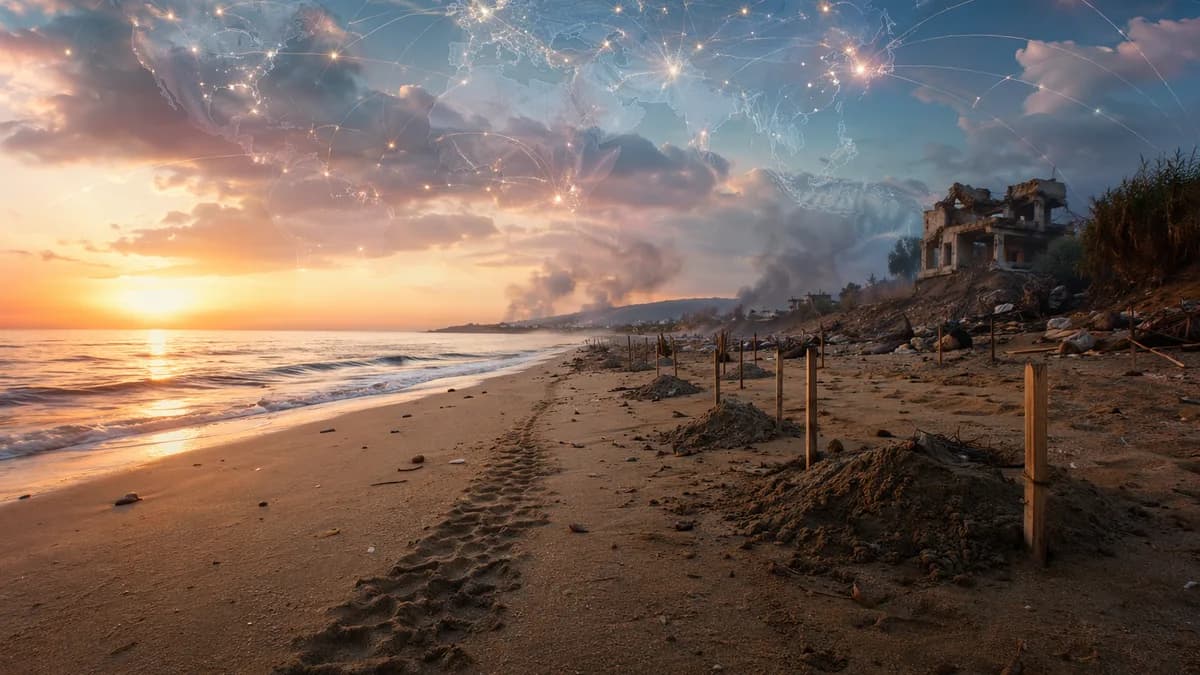
25 years of turtle conservation on Lebanon’s southern coast ended with one Israeli strike that hit the home of Mona Khalil, the activist who refused to leave the beach she had spent much of her life protecting.
Global TrendsJune 20, 2026· 9 min read· By XOOMAR Insights Team
Israeli Strike Kills Mona Khalil, Lebanon's Turtle Guardian
Updated on June 20, 2026
XOOMAR Intelligence
Analyst Take
61/ 100
4 sources analyzedLow confidenceTrend20Freshness94Source Trust92Factual Grounding90Signal Cluster20
Khalil, 76, died Friday after several days in hospital from injuries sustained when her house on Mansouri beach, near Tyre, was hit during Israeli attacks in southern Lebanon two weeks earlier, according to BBC World. Her death turns a local conservation story into a harder warning: war does not only kill people. It can sever the human continuity that keeps fragile habitats alive.
Mona Khalil’s killing turns a turtle beach into a warning about war’s reach
Mona Khalil was not a distant NGO figure. She lived beside the nesting beach. She monitored it, defended it, explained it to visitors, and built the Orange House Project into a conservation and eco-tourism hub overlooking Mansouri beach.
That matters because turtle protection is not a campaign slogan. It is repetitive, place-bound work. Nests have to be watched. Beaches have to be defended from pollution, destructive fishing practices, and coastal development. Visitors and residents have to be persuaded that a patch of sand has value beyond construction or leisure.
Khalil’s choice to stay should not be flattened into martyrdom. Friends described her as determined, not reckless. Environmental activist Maha Joumaa told local media that Khalil had “barricaded herself inside her house, receiving no visitors and believing she was safe because she is a civilian.”
“She absolutely refused to be displaced, which was fitting for someone so determined,” Joumaa said.
The central tension is brutal. Conservation depends on patience, memory, and the same people returning to the same place year after year. Conflict destroys all three at once. In Khalil’s case, the strike did not only wound an individual. It hit a living archive of one beach’s ecology.
For readers following the wider regional pressure around southern Lebanon, XOOMAR’s coverage of Rare Convoy Exposes Israeli-Occupied Southern Lebanon provides relevant context on how contested terrain shapes civilian movement and reporting access.
25 years of conservation, one strike, and the numbers that now define Mansouri beach
The verified timeline is stark:
| Marker | Source-supported detail |
|---|---|
| 1999 | Khalil encountered a green turtle laying eggs on Mansouri beach, an event loved ones described as life-changing |
| 2000 | She helped establish the Orange House Project |
| More than 25 years | She worked to protect endangered loggerhead and green sea turtles along Lebanon’s southern coast |
| 2006 | Her home had previously been damaged during the war between Israel and Hezbollah |
| Two weeks before her death | Her house was hit during Israeli attacks in southern Lebanon |
| Friday | She died after several days in hospital, according to a local environmental group |
The BBC reports that Israeli air strikes had intensified across southern Lebanon, raising concerns about renewed violence despite diplomatic efforts to maintain a fragile regional peace. The BBC also said it had reached out to the Israeli military for a response.
Other supplied reporting adds more detail. The Guardian reported that Khalil ran a sanctuary near Tyre and hosted volunteers who cleaned and monitored a mile-long beach. It also reported that her assistant, an Ethiopian woman, suffered burns but was recovering. Al Jazeera reported that Israel escalated air attacks on southern Lebanon the same day Khalil died, killing at least 50 people and injuring dozens. Those figures should be read as attributed reports, not a consolidated official casualty record.
The conservation numbers are less like a death toll and more like a calendar. Turtle nesting work depends on seasonal cycles, repeat monitoring, and accumulated knowledge of where turtles return. The supplied sources do not provide hatchling survival rates or nest counts for Mansouri beach, so those should not be invented. But the practical point is still clear: when the person who tracks a beach for decades is killed, the loss cannot be replaced by a database alone.
How Mona Khalil’s beach work fit Lebanon’s fight to protect Mediterranean turtles
Khalil’s conservation story began after displacement. A refugee of the Lebanese civil war, she had been living in the Netherlands when she returned to visit her family’s seaside home. In 1999, she saw a green turtle laying eggs on the beach. After learning that sea turtles in Lebanon were under threat, she committed herself to protecting them and later returned permanently.
The Orange House Project started as a small guesthouse. It grew into a center for environmental education, wildlife protection, and marine research, attracting volunteers and visitors from around the world, according to the BBC.
Khalil’s targets were specific: coastal development, pollution, and destructive fishing practices. The Guardian reported that some local people initially resented her work, including property developers and fishers who used dynamite fishing, a practice she fought against.
This is where her work becomes larger than one beach. Lebanon’s southern coast sits at the intersection of ecology, tourism, private property, and armed conflict. Khalil’s achievement was to make turtle nesting visible enough that parts of the coastline gained protected status, according to the BBC.
That kind of protection is never self-executing. A protected beach still needs someone to notice tire tracks, lights, waste, nets, damage, and human disturbance. Khalil supplied that human layer.
“She used to talk about the beach like it was a person. Her bond to the sunset, her bond to the water and the turtles….she was really into conservation, and into the soul, the spirit of conservation,” Hisham Younes, founder and president of Green Southerners, told the BBC.
Conservationists, residents, aid workers, and military officials will not read this death the same way
Different groups will see different parts of Khalil’s death.
Conservationists will see the loss of a field leader whose authority came from time on the ground. Hisham Younes called her “a deeply committed environmental defender.” Terre Liban president Paul Abi Rached recalled visiting Khalil in 2017 with his children, helping release baby sea turtles and watching them move toward the Mediterranean.
“Her love for the turtles was evident in every word and every action, but so was her love for people,” Abi Rached told the BBC. “That, perhaps, is Mona’s greatest legacy - she did not only protect turtles; she inspired people to care about them.”
Residents may see another signal that civilian life near contested zones is becoming impossible. Khalil believed she was safe because she was a civilian, according to Joumaa. Her death cuts directly against that assumption.
Humanitarian and legal observers, as a matter of analysis, will likely focus on the circumstances of the strike: whether civilians were warned, what target was intended, whether proportionality was assessed, and whether the incident can be independently investigated. The supplied sources do not provide those answers.
Israeli military officials had not provided a response in the BBC story. If they do, the key analytical test will be whether any military explanation addresses the civilian and environmental consequences, rather than treating them as collateral detail.
For a separate but related look at how Israel-linked disputes are spilling into civilian and political arenas abroad, see XOOMAR’s Settlement Sales Furor Hits London Israeli Real Estate Event.
Khalil’s death exposes a blind spot in conservation planning
XOOMAR analysis: Khalil’s death highlights a weakness in conservation models that depend heavily on a few trusted local figures, especially in militarized regions. That is not a criticism of her work. It is a recognition of how such work actually survives.
NGOs and donors often fund projects, training, visitor programs, and monitoring. But the supplied reporting shows that Khalil herself was the connective tissue: activist, host, educator, protector, documentarian, and neighbor.
When that person is gone, the risk is not only emotional. It is operational.
Practical pressure points now include:
- Staff safety: Conservation workers in conflict zones need plans that assume civilian status may not protect them.
- Continuity: Field notes, nesting records, volunteer contacts, and site knowledge need backups beyond one person or one house.
- Succession: Local projects need trained teams, not only charismatic founders.
- Emergency funding: A damaged home can also be a damaged field station, guesthouse, archive, and volunteer base.
- Remote monitoring: Where access becomes dangerous, groups may need alternative ways to track beaches, though the sources do not say whether such systems exist at Mansouri.
The deeper point is uncomfortable. Biodiversity work in unstable regions is often treated as separate from conflict risk. Khalil’s death shows that separation can collapse in one strike.
Khalil’s legacy now moves from beach patrols to a fight over memory and protection
Environmental groups said Khalil’s legacy would endure through the movement she helped build and through the generations of turtles that continue to return to Lebanon’s shores. That is a tribute, but it is also a test.
If conservation groups can keep volunteers engaged, preserve her records, and maintain pressure against pollution, destructive fishing practices, and unchecked coastal development, Khalil’s work may survive the loss of its central figure. If violence deepens around southern Lebanon, the network she built will become more fragile.
The next evidence to watch is concrete: whether the Orange House Project continues operating, whether Mansouri beach remains monitored during nesting periods, whether environmental groups document damage alongside human casualties, and whether authorities or donors step in to support the people taking over the work.
Khalil’s death will likely bring new attention to a cause that usually disappears during war. Attention is not protection. But for a beach whose survival has always depended on people noticing what happens there, it is a start.
Impact Analysis
- Mona Khalil’s death shows how war can destroy the people and local knowledge sustaining long-term conservation work.
- Her 25 years protecting Mansouri beach made her central to preserving a fragile turtle nesting habitat in southern Lebanon.
- The strike highlights how conflict damages ecosystems indirectly by disrupting monitoring, education, and community stewardship.
Sources

Written by
XOOMAR Insights Team
Research and Editorial Desk
The XOOMAR Insights Team pairs automated research with human editorial judgment. We track hundreds of sources across technology, fintech, trading, SaaS, and cybersecurity, cross-check the facts, and explain what happened, why it matters, and what to watch next. We do not just rewrite headlines. Every article is fact-checked and scored for reliability before it goes live, and we link back to the original sources so you can verify anything yourself.
Explore More Topics
Related Articles
 Global Trends
Israeli Strikes Rattle Hamas Disarmament Deal as 8 Die
Israeli strikes killed at least eight in Gaza, putting Hamas’s new disarmament pledge under immediate pressure.
Aug 2, 20268 min
 Global Trends
Complaint Drags Reform Into Richard Tice Investigation
A standards probe puts Richard Tice under scrutiny over a possible undeclared interest, adding pressure on Reform UK.
Aug 3, 20266 min
 Global Trends
Uganda Recasts Entebbe with Yonatan Netanyahu Statue
Uganda’s new Yonatan Netanyahu statue turns Entebbe into a message about memory, power and Israel ties.
Aug 2, 20267 min
 Global Trends
Trump Shelves Iran Strikes Unless a Deal Lands Fast
Trump says Iran strikes are shelved only if a rapid deal opens Hormuz and ends the nuclear threat. The pressure hasn't vanished.
Aug 2, 20265 min
 Global Trends
Hamas Disarmament Plan Forces Gaza’s Hardest Trade
Hamas disarmament offers rare hope for Gaza, but sequencing, trust and enforcement could break the deal fast.
Jul 31, 20268 min
 Technology
TechCrunch Dangles $400 Discount as Disrupt Loyalty Test
TechCrunch's $400 flash sale for Disrupt 2026 is a high-pressure tactic to lock in founders and investors early, testing their confidence in the event's future
Aug 6, 20266 min
 Technology
DeepSeek Demands $8bn as China's AI Plays Catch-Up
DeepSeek is pushing to close an $8 billion funding round at a $74 billion valuation, a massive jump just weeks after its last raise, underscoring China's aggres
Aug 6, 20264 min
 Global Trends
Watch Every NFL Preseason Game Free Legally
A complete guide to legally watching the entire 2026 NFL preseason for free using official trials, the DAZN platform, and VPNs, covering every game without a ca
Aug 6, 20266 min
 Technology
Google Pixel 11 Unveil Targets AI Gripes on August 12
Google will unveil its Pixel 11 smartphones at a live event on August 12. This guide shows you how to watch the keynote and analyze the real upgrades in chips,
Aug 6, 20266 min
 Technology
How Her's AI Dream Stalled in Consumer Apathy
Despite billions in investment and inspiration from the movie 'Her,' mainstream consumers aren't adopting AI agents, viewing them as unreliable solutions to pro
Aug 6, 20267 min
Don't miss the signal
Get our weekly roundup of the stories that matter across tech, fintech, and trading. No noise, just signal.
Free forever. No spam. Unsubscribe anytime.