
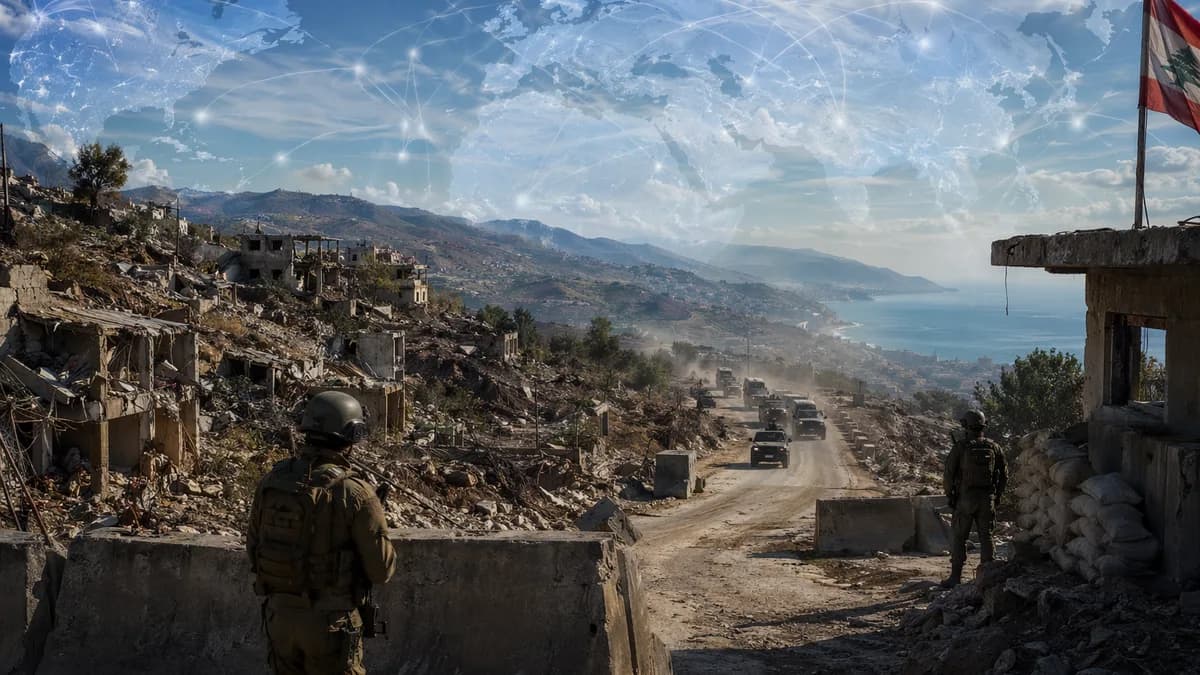
BBC reporters entered Israeli-occupied southern Lebanon with a humanitarian convoy and saw destroyed villages in an area where independent access has been rare. That access matters because the war is no longer visible only through air-strike footage, military statements, or displacement figures. It is now being documented inside territory where Israel says it does not intend to withdraw and wants a Hezbollah-free security zone along the border.
Global TrendsJune 20, 2026· 9 min read· By XOOMAR Insights Team
Rare Convoy Exposes Israeli-Occupied Southern Lebanon
Updated on June 21, 2026
XOOMAR Intelligence
Analyst Take
74/ 100
4 sources analyzedLow confidenceTrend10Freshness98Source Trust92Factual Grounding90Signal Cluster100
The BBC’s Hugo Bachega and video journalist Neha Sharma travelled with an Order of Malta convoy delivering aid to isolated Christian villages, according to BBC World. The mission took place on Thursday, one day before a new ceasefire was announced in the conflict between Israel and Hezbollah. The BBC team saw an Israeli military presence but was not allowed to film much of the journey.
XOOMAR analysis: the core signal is not just that journalists got in. It is that humanitarian access, media access, and military access now overlap in southern Lebanon. That makes every image partial, every absence political, and every claim about “security” inseparable from the question of who can return, rebuild, and be seen.
Rare convoy access exposes the hard facts of Israeli-occupied southern Lebanon
The phrase Israeli-occupied southern Lebanon can sound abstract from outside the region. The BBC report makes it concrete: a humanitarian convoy moving through territory under Israeli control, aid reaching isolated villages, and journalists constrained in what they could record.
The source material says mainly Shia villages in occupied areas have been “completely destroyed” by Israeli air strikes or demolitions. Human rights groups say some of the destruction may amount to deliberate destruction of civilian infrastructure, a possible war crime. Israel’s stated rationale is different. It says it wants a security zone along the border, free of Hezbollah, to protect northern Israeli communities from rockets and drones.
Israel says it has “no intention of withdrawing its troops from Lebanon,” and that its plan is to create a security zone along the border, Hezbollah-free.
That sentence is the hinge of the story. A ceasefire may pause fighting, but it does not answer who controls the land the morning after. If Israeli forces remain, the conflict shifts from battlefield tempo to territorial administration, access, aid, evidence, and legitimacy.
This also follows the pattern XOOMAR tracked in New Strikes Shake Israel Hezbollah Ceasefire Claim, where ceasefire language did not settle the underlying military contest. The BBC convoy report adds a rare ground-level view of what that unresolved contest looks like.
Convoy restrictions show how control works on the ground
The BBC account is careful about what it can verify. The team travelled with a humanitarian convoy. It saw Israeli military presence. It was not allowed to film much of the journey. Those details are enough to show how visibility itself is being controlled.
That does not prove every movement in the area follows the same rules. The sources do not document a full permission system for civilians, farms, clinics, or local commerce. But they do show that parts of southern Lebanon are isolated by war, that aid groups are trying to reach communities, and that journalists can only document a narrow slice of the territory.
XOOMAR analysis: that narrowness is the point. When access depends on armed conditions on the ground, outside audiences see fragments. A destroyed village appears. A military position appears. A road, a family, or a demolished house may remain unseen because the camera cannot go there.
The humanitarian signal is sharper when paired with displacement data. The BBC report describes aid reaching Christian villages that have been isolated by the war. Other parts of the occupied area, especially mainly Shia villages, have seen extensive destruction. That split does not make one community’s suffering more real than another’s. It shows how patchy visibility can become during war.
The numbers behind southern Lebanon’s displacement and destruction
The BBC’s rare access sits inside a much larger crisis. Al Jazeera reported, citing Lebanese authorities, ACLED, the Norwegian Refugee Council, and other sources, that Israeli attacks and evacuation orders have driven mass displacement across Lebanon.
| Measure | Reported figure | Source context |
|---|---|---|
| Registered displaced people | 1,049,328 | Lebanon’s Disaster Risk Management Unit, cited by Al Jazeera |
| People in collective shelters | 132,742 | Lebanon’s Disaster Risk Management Unit, cited by Al Jazeera |
| Israeli attacks recorded by ACLED | at least 394 | Across Lebanon, concentrated in the south and southern Beirut suburbs |
| Deaths between March 2 and March 16 | at least 886 | Lebanon’s Ministry of Public Health, cited by Al Jazeera |
| Wounded between March 2 and March 16 | 2,141 | Lebanon’s Ministry of Public Health, cited by Al Jazeera |
| Evacuation-order area | more than 1,470sq km | Norwegian Refugee Council, cited by Al Jazeera |
| Residential damage estimate | approximately $2.8bn | World Bank estimate cited by Al Jazeera |
| Homes damaged or destroyed | about 99,000 | World Bank context cited by Al Jazeera |
These figures do not all measure the same thing. Some describe current displacement. Others describe accumulated damage since earlier phases of cross-border fighting. The strongest reading is also the simplest: southern Lebanon’s problem is not only active fire. It is the physical loss of housing, the mass movement of people, and the restricted ability to verify conditions in areas under military control.
The data also has limits. Access restrictions, active military zones, and wartime reporting constraints mean counts may lag conditions on the ground. The BBC convoy adds evidence, but it does not close the information gap.
Israel, civilians, Hezbollah, and aid groups are fighting different battles over the same villages
Israel frames its presence as a border-security necessity. Its stated aim is to keep Hezbollah away from positions near Israeli communities and protect those communities from rockets and drones. That rationale is central to how Israel justifies staying in Lebanon.
Lebanese civilians face a different reality in the same geography: destroyed homes, displacement, isolated communities, and uncertainty over return. Al Jazeera reported that Israeli Defence Minister Israel Katz said he would not allow people to return to southern Lebanon until Israeli safety is guaranteed. That places civilian return inside a security calculation controlled by Israel.
Hezbollah’s role cannot be separated from this. The BBC describes the conflict as between Israel and the Shia Muslim armed group Hezbollah. Al Jazeera reported that Hezbollah fired rockets and drones at Israel and that Israel continued attacks on Lebanon. XOOMAR analysis: Israeli occupation may strengthen Hezbollah’s political narrative, but Hezbollah’s military activity also places civilians in the path of Israeli retaliation. Both facts can be true at once.
Aid groups occupy a narrower lane. The Order of Malta convoy did not solve the political problem. It delivered aid to villages isolated by war. Humanitarian convoys can keep communities alive, but they cannot decide who governs territory or when displaced families can safely return.
That distinction matters for policymakers. A ceasefire can reduce immediate fire. It does not, by itself, answer the hard questions: withdrawal timelines, verification, reconstruction access, and whether southern Lebanon becomes a temporary military zone or a more durable occupation.
Southern Lebanon’s past makes “security zone” language hard to treat as temporary
The supplied sources note that Hezbollah was established in response to Israel’s 1982 invasion of Lebanon. That history matters because current Israeli language about a border security zone lands in a place where occupation is not theoretical.
The BBC report does not provide a full historical account, and this article should not pretend it does. But even the limited source material is enough to show why words like “withdrawal,” “security zone,” and “Hezbollah-free” carry weight. They are not just operational terms. They shape whether displaced families believe they are waiting days, months, or something longer.
XOOMAR analysis: the comparison has limits. The current conflict includes mass displacement, destroyed infrastructure, Hezbollah’s armed presence, Israeli security concerns in the north, and a regional crisis that extends beyond the border. Still, the political risk is clear. If a ceasefire freezes Israeli forces inside Lebanon rather than producing a withdrawal path, the ceasefire becomes less a settlement than a holding pattern.
That is why the BBC’s rare access is more than a media event. It gives outside audiences a glimpse of the territory at the center of the argument, but also shows how much remains hidden.
Three paths now shape Israeli-occupied southern Lebanon
The first path is a negotiated pullback tied to monitoring arrangements and limits on Hezbollah’s presence near the border. That would reduce immediate tension, but it would still leave open whether displaced residents can return safely and whether destroyed villages can be rebuilt.
The second path is a prolonged Israeli buffer zone. Israel may present that as necessary security for northern communities. For Lebanese civilians, it would deepen uncertainty over return and keep aid access tied to military realities on the ground.
The third path is renewed escalation. If ceasefire terms, convoy access, civilian returns, or military deployments collide, the conflict can move quickly from controlled access to open fighting. XOOMAR has already tracked how fragile the ceasefire frame looked in 16 Dead as Israel Lebanon Ceasefire Cracks Overnight.
The evidence to watch is specific: whether Israel sets or rejects a withdrawal timeline, whether aid convoys gain broader access, whether journalists can document more than escorted fragments, and whether displaced residents begin returning in meaningful numbers. If those indicators do not move, Israeli-occupied southern Lebanon will remain a fight over land, evidence, and legitimacy, not only rockets and air strikes.
Impact Analysis
- Rare media access gives readers a clearer view of conditions inside Israeli-occupied southern Lebanon.
- The overlap of humanitarian, military, and media access shapes what can be documented and verified.
- Claims about security are now tied to whether displaced civilians can return, rebuild, and be seen.
Competing Views of Israeli-Occupied Southern Lebanon
| Actor | What the article reports | Why it matters |
|---|---|---|
| BBC journalists | Entered with an Order of Malta humanitarian convoy and saw destroyed villages under Israeli control. | Provides rare independent observation from an area with limited access. |
| Israel | Says it does not intend to withdraw and wants a Hezbollah-free security zone along the border. | Frames the occupation as a security measure. |
| Human rights groups | Say some destruction may amount to deliberate destruction of civilian infrastructure and a possible war crime. | Challenges Israel’s rationale and raises accountability questions. |
Sources

Written by
XOOMAR Insights Team
Research and Editorial Desk
The XOOMAR Insights Team pairs automated research with human editorial judgment. We track hundreds of sources across technology, fintech, trading, SaaS, and cybersecurity, cross-check the facts, and explain what happened, why it matters, and what to watch next. We do not just rewrite headlines. Every article is fact-checked and scored for reliability before it goes live, and we link back to the original sources so you can verify anything yourself.
Explore More Topics
Related Articles
 Global Trends
Israeli Strikes Rattle Hamas Disarmament Deal as 8 Die
Israeli strikes killed at least eight in Gaza, putting Hamas’s new disarmament pledge under immediate pressure.
Aug 2, 20268 min
 Global Trends
Uganda Recasts Entebbe with Yonatan Netanyahu Statue
Uganda’s new Yonatan Netanyahu statue turns Entebbe into a message about memory, power and Israel ties.
Aug 2, 20267 min
 Global Trends
Trump Shelves Iran Strikes Unless a Deal Lands Fast
Trump says Iran strikes are shelved only if a rapid deal opens Hormuz and ends the nuclear threat. The pressure hasn't vanished.
Aug 2, 20265 min
 Global Trends
Hamas Disarmament Plan Forces Gaza’s Hardest Trade
Hamas disarmament offers rare hope for Gaza, but sequencing, trust and enforcement could break the deal fast.
Jul 31, 20268 min
 Global Trends
Trump Bets on Hamas Disarmament Deal No One Has Confirmed
Trump claims a Hamas disarmament deal exists, but Hamas and Israel haven't backed it. Gaza talks now hinge on a glaring confirmation gap.
Jul 31, 20267 min
 Technology
DeepSeek Demands $8bn as China's AI Plays Catch-Up
DeepSeek is pushing to close an $8 billion funding round at a $74 billion valuation, a massive jump just weeks after its last raise, underscoring China's aggres
Aug 6, 20264 min
 Global Trends
Watch Every NFL Preseason Game Free Legally
A complete guide to legally watching the entire 2026 NFL preseason for free using official trials, the DAZN platform, and VPNs, covering every game without a ca
Aug 6, 20266 min
 Technology
Google Pixel 11 Unveil Targets AI Gripes on August 12
Google will unveil its Pixel 11 smartphones at a live event on August 12. This guide shows you how to watch the keynote and analyze the real upgrades in chips,
Aug 6, 20266 min
 Technology
How Her's AI Dream Stalled in Consumer Apathy
Despite billions in investment and inspiration from the movie 'Her,' mainstream consumers aren't adopting AI agents, viewing them as unreliable solutions to pro
Aug 6, 20267 min
 Technology
AirPods Pro Plunge to $189 in Rare $60 Sale
The AirPods Pro have dropped to $189.99, their lowest price since June, in a coordinated sale across Amazon, Walmart, and Best Buy signaling a final pre-holiday
Aug 6, 20266 min
Don't miss the signal
Get our weekly roundup of the stories that matter across tech, fintech, and trading. No noise, just signal.
Free forever. No spam. Unsubscribe anytime.