
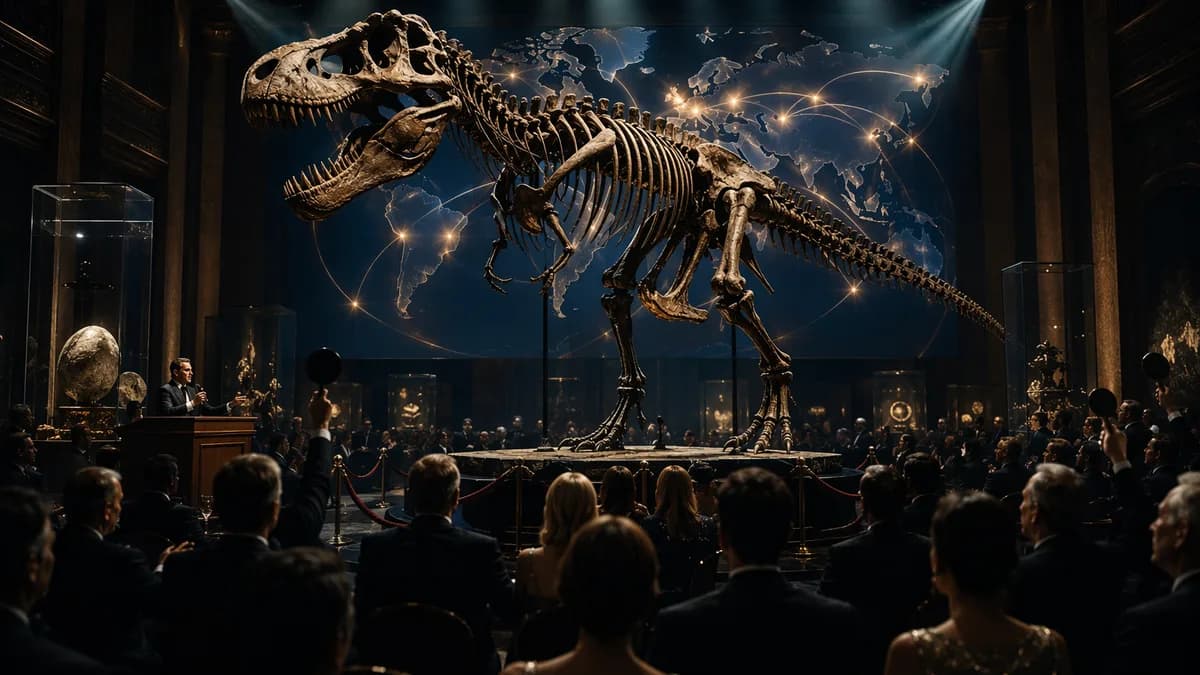
On Tuesday, a 67-million-year-old Tyrannosaurus rex nicknamed Gus sold for £37.4m ($50.1m) at Sotheby’s in New York, making the Tyrannosaurus rex the most expensive dinosaur ever sold and pushing fossil auctions past a new psychological line: $50m.
Global TrendsJuly 20, 2026· 6 min read· By XOOMAR Insights Team
$50M T. Rex Sale Crowns Most Expensive Dinosaur Ever
Updated on July 20, 2026
XOOMAR Intelligence
Analyst Take
57/ 100
4 sources analyzedLow confidenceTrend10Freshness94Source Trust92Factual Grounding90Signal Cluster20
The buyer has not been disclosed, according to BBC World. That anonymity now matters almost as much as the price, because the next owner will decide whether one of the most complete T. rex specimens ever found becomes public science, private trophy, or something in between.
Tuesday’s $50.1m sale turns Gus into the most expensive dinosaur ever sold
Gus stands more than 12 feet (4m) tall and contains over 60% of its bones, according to Sotheby’s, which described it as one of “the most complete” Tyrannosaurus rex specimens ever found.
The fossil was discovered in 2021 on a remote ranch in South Dakota. Its bones were excavated across three summers, from 2021 to 2023, when the ground had thawed enough for fieldwork. After that came another three years in the lab to clean, prepare, and mount the skeleton.
That timeline helps explain the sale price. This was not a fossil pulled from storage and sent to market. Sotheby’s is selling the record as much on preparation and documentation as on rarity.
“This result has been years in the making,” said Cassandra Hatton, Sotheby’s worldwide head of science and natural history. “Gus is not only an exceptional find, but a specimen that's been excavated, documented, prepared, and cared for with real excellence.”
The skeleton also carries signs of a violent life. Lab work revealed bite marks on the skull and previously broken ribs that had healed while the animal was alive. Those injuries may have come from scavenging or from fights with other dinosaurs, the BBC reported.
That physical record is part of the appeal. For collectors, Gus is a spectacular object. For scientists, the trauma preserved in the bones is data.
The record price in context
| Fossil | Sale detail | Price | Public access status cited in sources |
|---|---|---|---|
| Gus, T. rex | Sold at Sotheby’s in New York on Tuesday | £37.4m ($50.1m) | Buyer not disclosed |
| Apex, stegosaurus | Previous record, sold in 2024 | Nearly $45m, per AP | Loaned to the American Museum of Natural History |
| Stan, T. rex | Sold in 2020 | Nearly $32m, per AP | On display at Natural History Museum Abu Dhabi |
| Sue, T. rex | First dinosaur fossil sold at auction in 1997, per AP | Price not provided in supplied source | Centerpiece of the Field Museum in Chicago |
The headline is simple: Tyrannosaurus rex most expensive dinosaur ever sold. The harder question is what that record now does to the market for fossils that museums and researchers also need.
The 2024 stegosaurus record fell, and fossil auctions moved into a pricier tier
Gus beat the previous dinosaur auction record set by Apex, a stegosaurus sold in 2024. The BBC said Gus is also the first dinosaur fossil sale to exceed the $50m benchmark.
That threshold changes the tone of the category. A fossil auction at this level is no longer just a natural history sale with wealthy bidders in the room. It is a contest over scarce scientific material that can also function as a prestige asset.
Some scientists told the BBC the sale may signal a new era in fossil collecting by the ultra-rich. That concern is not abstract. If a major specimen lands in a private collection and stays there, researchers may lose access to bones that preserve information about growth, injury, anatomy, and the environment in which the animal lived.
The Society of Vertebrate Paleontology made the public-access case directly after the sale, according to AP News.
“Our hope is that the new owner recognizes the extraordinary scientific and educational value of Gus the T. rex and that they aim to keep it in the public trust by immediately donating it to an accredited natural history museum,” Kristi Curry Rogers, the society’s president-elect, said in a statement Tuesday.
That is the central tension in this sale. Sotheby’s argues the price reflects excavation, documentation, preparation, and care. Scientists are focused on whether that care continues after the hammer falls.
For readers tracking science beyond the fossil market, XOOMAR has also covered how rare discoveries can shift public imagination and research priorities, including 48 Light-Years Away, Earth-Like Exoplanet Tempts Scientists. The common thread is access: discoveries matter more when researchers can keep studying them.
Three years in the lab made Gus a cleaner auction prize, but access is still undecided
The work on Gus did more than make the skeleton presentable. It surfaced evidence of survival: a damaged skull, healed ribs, and a body assembled from a majority of recovered bones.
That makes the fossil valuable in two different ways.
- Scientific value: The injuries and completeness give researchers material to study how this individual animal lived and recovered.
- Display value: A more-than-12-foot T. rex is a public magnet if a museum gets access.
- Collector value: The record price shows how far private bidders may go for elite dinosaur specimens.
- Market signal: Future sellers of headline fossils now have a new benchmark above $50m.
The immediate issue is the undisclosed buyer. The BBC reported that it may be some time before the buyer is revealed. That delay leaves open the question of whether Gus will be donated, loaned, displayed, stored privately, or made available for scientific study.
There is precedent for a public outcome. Apex, the stegosaurus that held the prior record, was loaned to the American Museum of Natural History for four years by billionaire owner Kenneth Griffin, according to the BBC. That does not guarantee the same path for Gus, but it gives museums and scientists a plausible scenario to push for.
The bigger pattern is institutional pressure. High-value physical assets, whether fossil specimens or public structures, often force uncomfortable questions about stewardship, accountability, and who gets access. XOOMAR has examined that public-trust angle in other contexts, including 43 Deaths Land Genoa Bridge Disaster Boss 12 Years, where private and institutional responsibility came under harsh scrutiny after a disaster.
The next decision belongs to a mystery buyer
For now, the record is settled and the future is not. Gus is the most expensive dinosaur ever sold, but nobody outside the sale process yet knows where the skeleton will ultimately go.
The next meaningful development will be disclosure, or at least action. A museum loan would blunt the strongest scientific criticism. A private placement with no research access would sharpen it.
This sale confirms that rare dinosaur fossils now sit at a difficult intersection: scientific evidence, cultural spectacle, and extreme private wealth. The watch item is not whether another record will eventually be attempted. It is whether Gus remains visible and studyable after becoming a $50.1m asset.
The Stakes
- The $50.1m sale sets a new record for any dinosaur fossil auction.
- The anonymous buyer will determine whether Gus remains accessible to scientists and the public.
- The sale highlights growing tension between private collecting and scientific preservation.
Gus T. rex Auction Price
Gus sale price
$m50.1
Sources

Written by
XOOMAR Insights Team
Research and Editorial Desk
The XOOMAR Insights Team pairs automated research with human editorial judgment. We track hundreds of sources across technology, fintech, trading, SaaS, and cybersecurity, cross-check the facts, and explain what happened, why it matters, and what to watch next. We do not just rewrite headlines. Every article is fact-checked and scored for reliability before it goes live, and we link back to the original sources so you can verify anything yourself.
Explore More Topics
Related Articles
 Global Trends
Court Freezes $110B Paramount Warner Bros Merger Deal
A judge froze the $110B Paramount Warner Bros deal for 14 days, giving 12 states room to press their antitrust case.
Jul 20, 20269 min
 Global Trends
600 Attacks Turn Ukraine Military Recruiters Into Targets
More than 600 attacks on Ukraine's recruiters reveal a manpower crisis turning violent as conscription collides with public fear.
Jul 20, 20268 min
 Global Trends
Flash Flooding Swamps New York, New Jersey Weekend
Torrential rain flooded New York and New Jersey, stranding drivers, swamping subway entrances and forcing rescues across the region.
Jul 19, 20266 min
 Global Trends
Dropped Treason Case Frees Koroma to Return to Sierra Leone
Sierra Leone dropped treason charges against Ernest Bai Koroma, clearing his return but leaving coup politics unresolved.
Jul 19, 20268 min
 Global Trends
116 Aboard in Guyana Ferry Sinking, Rescuers Race On
The MV Barima sank off Guyana with 116 aboard. Officials say 53 are rescued, but the missing count remains unclear.
Jul 19, 20265 min
 Technology
$857,600 Buzz Aldrin Pen Auction Sells Apollo 11 Fix
Aldrin’s Apollo 11 felt-tip sold for $857,600, proving collectors pay top dollar for mission-saving drama.
Jul 19, 202611 min
 Global Trends
Trump Forces Defense Contractors to Expose Risky Suppliers
Trump's order puts defense contractors on notice: map hidden supplier tiers and cut adversary-linked parts or face tougher scrutiny.
Jul 21, 20268 min
 Global Trends
Five Scioto River Deaths Haunt Ohio Rescue Attempt
Five people died in the Scioto River after a swimmer struggled and others jumped in to help near Powell, Ohio.
Jul 20, 20264 min
 Technology
Chris Fall Resignation Throws CAISI Into Fresh Chaos
Chris Fall quit CAISI after three months, deepening turmoil at the federal office meant to set AI standards and test frontier models.
Jul 20, 20267 min
 Global Trends
50% Trump Canada Tariff Punches Through USMCA Shield
Trump’s 50% Canada tariff pierces USMCA protections, giving Ottawa and companies 30 days to blunt the hit.
Jul 20, 20268 min
Don't miss the signal
Get our weekly roundup of the stories that matter across tech, fintech, and trading. No noise, just signal.
Free forever. No spam. Unsubscribe anytime.