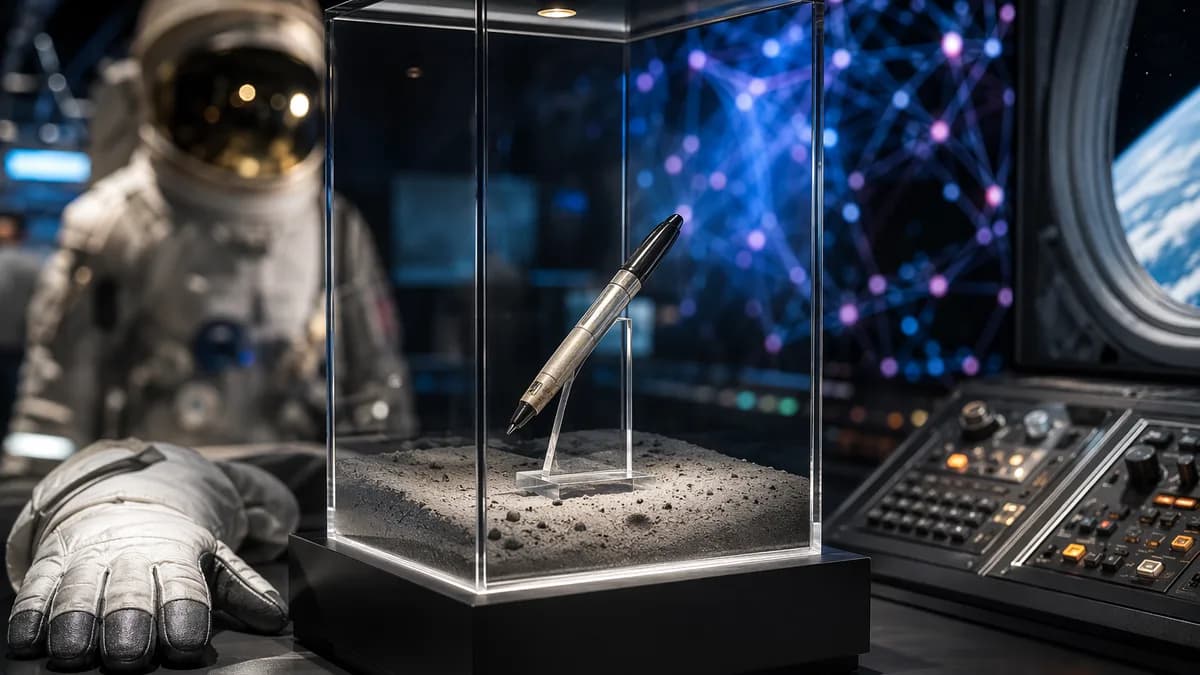
On Wednesday, July 15, 2026, a dented plastic marker sold for $857,600 because, for a few tense hours in July 1969, it was the difference between Apollo 11 leaving the moon and becoming a permanent monument to failure.
XOOMAR Intelligence
Analyst Take
That is the real story behind the Buzz Aldrin pen auction. The object was not a gleaming instrument panel, a spacesuit, or a command module relic. It was a silver plastic Duro Rocket felt-tip pen, paired with the broken circuit breaker piece it helped overcome, sold at Sotheby’s in New York after five bidders pursued it, according to Guardian World.
The sale says something sharp about the market for space history. Collectors are not just buying flown hardware. They’re buying a story that can be explained in one sentence: Buzz Aldrin used this pen to help get himself and Neil Armstrong off the moon.
That kind of provenance is hard to beat.
July 15 sale turns Buzz Aldrin’s Apollo 11 pen into a survival artifact
The Buzz Aldrin pen auction tested what the top end of the space memorabilia market now rewards: rarity, direct astronaut ownership, mission drama, and a clean chain of meaning.
Sotheby’s had estimated the pen at $800,000 to $1.2m. It landed inside that range at $857,600, with the broken piece of circuit breaker included in the lot. Both came from Aldrin’s personal collection.
That pairing matters. A pen alone could invite mythmaking. A snapped-off breaker alone could look like plastic debris. Together, they form a complete incident: the failure and the fix.
The ordinary nature of the object is the point. Apollo 11 is usually remembered through huge images: the Saturn V, the lunar module Eagle, Neil Armstrong stepping onto the surface, Earth hanging in black space. This artifact shrinks the myth down to something human. A pocket pen. A broken switch. A choice not to stick a finger into a live circuit.
XOOMAR analysis: that compression is why the price works. The pen carries no obvious material value. Its value comes from being both modest and consequential. It turns Apollo from a state-scale engineering triumph into a story about improvisation inside a cramped machine, far from any repair crew.
That tension now follows the object to its new owner. Should mission-critical public history become a private trophy? Or is the auction market now one of the main forces assigning value, preserving provenance, and keeping these objects visible, at least when they come up for sale?
The answer is uncomfortable because both sides have a case.
After the moonwalk, one broken switch threatened the ascent engine
The incident unfolded after Armstrong and Aldrin had landed on the lunar surface during the Apollo 11 mission in July 1969 and completed their first moonwalk. Back inside the lunar module, Aldrin noticed a small black switch on the cabin floor.
In his 2009 autobiography Magnificent Desolation, Aldrin described the moment plainly:
“My heart jolted a bit … The broken switch had snapped off from the engine-arm circuit breaker, the one vital breaker needed to send electrical power to the ascent engine that would lift Neil and me off the moon.”
The problem was brutal in its simplicity. The astronauts needed the ascent engine to leave the lunar surface and rendezvous with Michael Collins, who was orbiting the moon in the command module Columbia. The damaged breaker was tied to that chain of survival.
Aldrin and Armstrong reported the issue to Mission Control. Houston tried to find a way around it. By morning, the answer came back with no cushion:
“There is no way to reroute the power.”
Aldrin then looked for something inside the lunar module that could press into the circuit without creating a new danger. He considered the electrical risk and ruled out using his finger or anything with metal on the end.
The solution came from a black felt-tip pen he had brought in his personal preference kit, the small set of personal items each astronaut was allowed to carry. In his 2016 book No Dream Is Too High, Aldrin wrote that the pen was not on the official list of items taken to the moon, but it was in the shoulder pocket of his spacesuit.
He used it carefully.
“I gingerly pressed the pen against the engine arm circuit breaker. For a long moment, I didn’t want to remove the tip from the circuit breaker, hoping against hope that it would hold. Slowly, almost reluctantly, I eased the pressure on my hand and lifted the pen’s tip.
“The pen did the trick; the circuit breaker held. We could return to Earth after all!”
The psychological stakes are easy to flatten with hindsight. They made it back, so the story becomes an anecdote. But inside Eagle, the failure was not symbolic. It was a live systems problem on another world.
There was no second lunar module parked nearby. No service bay. No technician. Just two astronauts, a broken breaker, and a plastic pen that happened to fit.
The $857,600 price shows how provenance beats material value
The Apollo 11 pen auction price looks absurd only if the object is judged as a pen. Judged as a documented mission artifact tied to a near-catastrophic moment, it fits a different pricing model.
Sotheby’s expected $800,000 to $1.2m. The final $857,600 sale price, after five bidders, shows demand was strong enough to clear the estimate but not strong enough to push the lot into the top tier of space artifact prices cited by specialist coverage.
The material object is almost comically slight: a dented silver plastic Duro Rocket felt-tip pen. The economic value sits almost entirely in the chain of association.
| Artifact factor | Why it mattered in this sale |
|---|---|
| Mission | Apollo 11 was the first lunar landing |
| Use case | The pen was tied to the ascent engine circuit breaker fix |
| Ownership | The lot came from Aldrin’s personal collection |
| Narrative clarity | The story is instantly understandable |
| Paired evidence | The broken circuit breaker piece was included |
That last point is crucial. Collectibles with clean stories often trade better than objects that require long explanation. Here, the buyer gets the tool and the damaged part. The artifact has a built-in before-and-after structure.
XOOMAR analysis: this is the same pricing psychology we see across other technology assets, though the asset class is different. Scarcity and narrative can overwhelm input cost. In software and hardware markets, pricing power often depends on whether users believe a product owns a distinctive role, as we’ve covered in Kimi K3 Forces Anthropic’s AI Price Premium Into Doubt and AppleCare+ Squeezes Mac and iPad Buyers After Price Hikes. With Aldrin’s pen, the premium rests on provenance rather than performance.
The buyer did not pay nearly $858,000 for plastic. They paid for a claim on one of the cleanest survival stories in the Apollo record.
From 1969 keepsake to 2026 blue-chip space collectible
Apollo artifacts have moved through several lives: government equipment, astronaut keepsakes, museum exhibits, private holdings, and auction lots.
The Aldrin pen sits at the intersection of those categories. It was carried on Apollo 11, retained by Aldrin, and later surfaced as part of his personal collection. Related reporting says the pen and circuit breaker had been exhibited at the Seattle Air & Space Museum and the Smithsonian’s National Air and Space Museum in Washington, D.C.
That history strengthens the object’s public identity. It was not a forgotten drawer item suddenly dressed up for sale. It had already been treated as an artifact.
The pen also differs from many flown collectibles. Some objects matter because they were present. This one matters because it did something.
| Apollo collectible type | Typical value driver | How Aldrin’s pen differs |
|---|---|---|
| Mission patches | Flown status, crew association | The pen had operational use |
| Checklists | Direct mission workflow | The pen became an improvised tool |
| Personal items | Astronaut ownership, lunar travel | The pen affected the return sequence |
| Spacesuits or garments | Visibility, identity, scarcity | The pen has a sharper incident narrative |
| Spacecraft hardware | Engineering role, rarity | The broken breaker and pen tell one complete story |
That is why the Aldrin lot is unusually marketable. It is modest enough to feel intimate, but consequential enough to carry historical weight. It also belongs to Apollo 11, the unique tier of lunar collecting because it was the first landing.
A later Apollo artifact can be rare, beautiful, and important. Apollo 11 adds another premium: first contact with the moon as a human achievement. Even minor objects from that mission absorb some of that symbolic force.
Five bidders, one buyer, and a public-history problem
Collectors will see the Aldrin pen as a near-perfect acquisition: compact, documented, dramatic, and tied to one of the defining technological escapes in modern history.
Museums and historians may see the same sale with mixed feelings. An object this central to a public mission has educational power. If it disappears into a private vault, that public value narrows. If it is loaned, displayed, or digitized well, private ownership does not have to mean public disappearance.
Aldrin’s position also deserves more nuance than reflexive outrage. These objects came from his personal collection. Astronauts preserved, gifted, sold, and donated mission items across complicated traditions and rules. Related reporting notes that a 2012 law reconfirmed Apollo-era astronauts’ title to certain spacecraft hardware and crew equipment they had kept as mementos.
That law matters because it frames the sale not as a rogue disposal of government property, but as the monetization of legally held mission material. The ethical discomfort remains. The legal ownership is not the same question as cultural stewardship.
The public reaction is likely to split three ways:
- Fascination: The story is irresistible because the tool is so ordinary.
- Sticker shock: $857,600 for a marker will sound obscene to many readers.
- Unease: A survival tool from a publicly funded mission becoming a luxury asset feels strange, even when ownership is clear.
Aldrin himself captured the practical focus of the original moment in Sotheby’s provenance letter:
“In the end, what mattered most was that we had to figure out how to solve the problem of the broken switch so that we could leave the lunar surface and get home to Earth.”
That sentence is why the auction worked. It strips away nostalgia and leaves the operational truth.
The next moon era will make Apollo provenance even more valuable
The Buzz Aldrin pen auction sends a clear signal to the memorabilia industry: the strongest space artifacts will combine airtight provenance, mission-critical use, direct astronaut association, and a story simple enough for non-specialists to grasp.
That matters now because the moon is back in the public frame. The Guardian source notes that NASA is planning a return trip to the lunar surface as early as 2028, and that in April it sent four astronauts around the moon and back for the first time since 1972. It also notes that China is planning a crewed landing, with an apparent target of 2030.
Renewed lunar attention can lift interest in Apollo-era objects because Apollo remains the benchmark. New missions create comparison. Comparison sends collectors back to origin stories.
Aldrin, now 96, has pushed for NASA to aim beyond another lunar race. In 2013, he wrote in the New York Times:
“A second ‘race to the moon’ is a dead end … In my view, US resources are better spent on moving toward establishing a human presence on Mars.”
That view adds another layer to the sale. The pen is not only a relic of the first moon landing. It is a reminder that exploration history often turns on mundane failures and improvised fixes, not just national ambition.
For buyers, the risks are practical and reputational. XOOMAR analysis: high-end artifacts need strong documentation, careful storage, insurance, and a plan for visibility if the owner wants cultural legitimacy along with private possession. The cleaner the provenance, the lower the authenticity risk. The more central the artifact, the higher the scrutiny.
The next evidence to watch is not whether another Apollo object sells for a high price. That already happens. The sharper test is whether future astronaut-held material with direct operational significance comes to market, and whether buyers keep those objects visible through museum loans or pull them fully into private collections.
If the Aldrin pen resurfaces publicly, the sale will look less like history being locked away and more like a transfer of custody at a spectacular price. If it vanishes, the auction will still have proved the market’s appetite, but at a cost: one of Apollo 11’s most human artifacts will become a story most people can read about, but no longer see.
The Bottom Line
- The $857,600 sale shows how strongly collectors value Apollo artifacts with direct mission-saving stories.
- The pen’s provenance from Buzz Aldrin’s personal collection helped turn an ordinary object into a historic survival artifact.
- The auction highlights growing demand for space memorabilia tied to clear, dramatic moments in human spaceflight.
Buzz Aldrin Apollo 11 Pen Auction Price vs Estimate
Primary Sources & Disclosures

Written by
XOOMAR Insights Team
Research and Editorial Desk
The XOOMAR Insights Team pairs automated research with human editorial judgment. We track hundreds of sources across technology, fintech, trading, SaaS, and cybersecurity, cross-check the facts, and explain what happened, why it matters, and what to watch next. We do not just rewrite headlines. Every article is fact-checked and scored for reliability before it goes live, and we link back to the original sources so you can verify anything yourself.