
Has New Zealand’s first H5N1 bird flu case been caught at the shoreline, or is one dead seabird the first sign of wider coastal spread?
Global TrendsJuly 16, 2026· 6 min read· By XOOMAR Insights Team
Dead Skua Shatters New Zealand H5N1 Bird Flu Shield
Updated on July 16, 2026
XOOMAR Intelligence
Analyst Take
66/ 100
4 sources analyzedMedium confidenceTrend10Freshness98Source Trust90Factual Grounding92Signal Cluster20
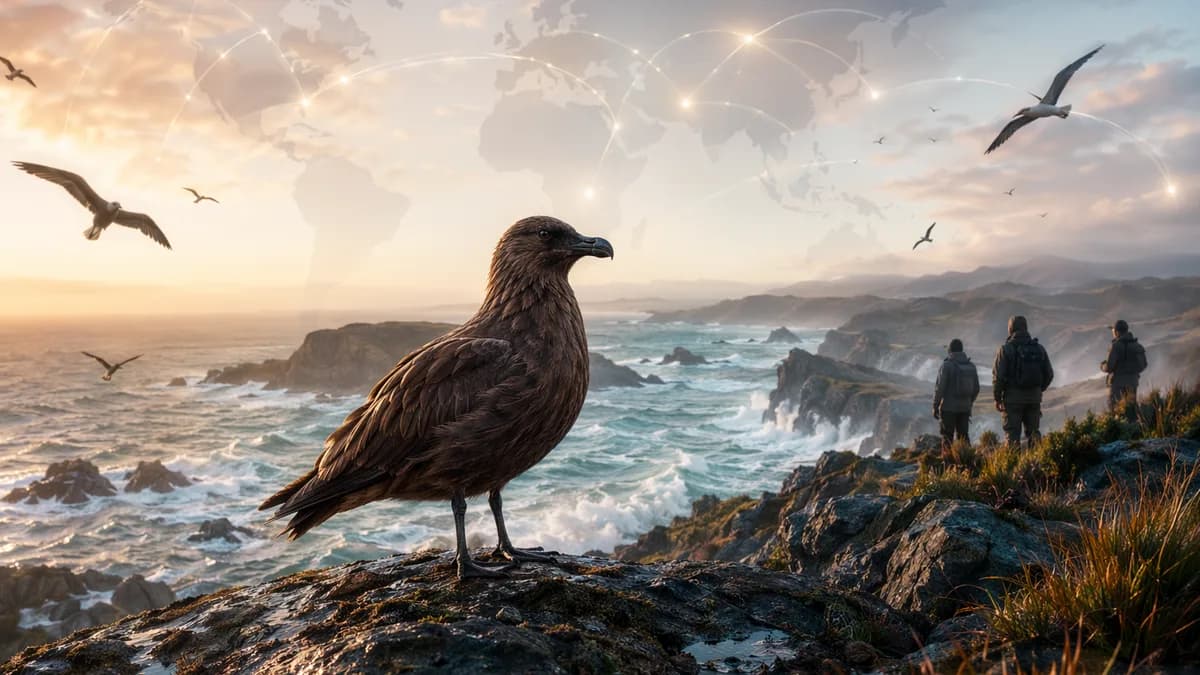
A brown skua, an ocean-going seabird, tested positive after being found on Petone beach in Wellington on 10 July, Biosecurity Minister Andrew Hoggard said, according to Guardian World. The confirmed result came on Wednesday, making it New Zealand’s first detected case of the deadly strain.
How did New Zealand’s first H5N1 bird flu case surface on Petone beach?
The case is still limited to one confirmed bird. That matters. Officials have not reported a poultry infection, a wild-bird die-off, or confirmed spread between wild birds in New Zealand.
Hoggard said the infected bird was a brown skua, a seabird capable of long-distance movement across marine environments. That makes the discovery different from a farm-contained outbreak. A wild coastal bird can’t be fenced off like a shed of poultry.
“There is no evidence of any mass mortality in wildlife or transmission between wild birds in New Zealand,” Hoggard said.
The strain identified is H5N1 avian influenza clade 2.3.4.4b, the globally circulating form of H5 bird flu, 1News reported. Hoggard said there had been “no detection in poultry.”
For now, the official posture is containment through surveillance, not panic. MPI staff have checked Petone Beach and, according to Hoggard, found “no other issues” so far.
That calm is tactical. H5N1 has killed millions of birds worldwide, and Guardian World reported that in some areas it has reduced bird populations by 75%. New Zealand has avoided this strain until now. That streak is over.
Which native birds are most exposed if H5N1 escapes the single seabird case?
The reason this single New Zealand H5N1 bird flu case has triggered such concern is simple: New Zealand’s birds are unusually vulnerable.
The country’s only endemic mammals are bats and marine mammals. Its birds evolved in isolation, often in ways that left them poorly prepared for introduced threats. New Zealand has more species of flightless birds, living and extinct, than any other place in the world, and it has the most diverse population of seabirds globally, Guardian World reported.
About 80% of native birds are already considered endangered, with more than a dozen close to extinction. The confirmed case is not in a kākāpō, takahē, kiwi, penguin, or other native icon. But if H5N1 starts circulating broadly, those species become part of the risk map.
James Russell, professor of conservation biology at the University of Auckland, put it bluntly:
“Bird flu is an unwelcome threat to our bird species who are already under more extreme and multiple pressures than ever before.”
Russell added that New Zealand may have limited power to stop the virus once it reaches wild populations. His argument is not defeatist, it is practical: reduce other pressures so bird populations have a better chance of recovering after infection waves pass through.
Species at greatest concern include:
- Colonial shorebirds: Species that gather in dense groups could face higher exposure if the virus spreads through coastal sites.
- Scavenging birds: Birds that contact carcasses may face added risk.
- Critically small populations: Nigel French of Massey University pointed to the fairy tern, with a population of 50, as one example of the danger.
- Marine mammals: New Zealand’s nationally endangered sea lions could also be at risk of catching the virus.
French called it a “big unknown” because species do not respond equally to H5N1. That uncertainty is the hard part. A virus can be a manageable wildlife event in one species and a conservation emergency in another.
Can surveillance and vaccination hold the line before poultry or colonies are hit?
New Zealand has been preparing for H5N1 for years. The Ministry for Primary Industries says it has surveillance across wildlife sanctuaries, zoos, the poultry industry, vets, and the public.
The Department of Conservation began vaccinating some of the country’s most threatened birds this month after H5N1 was detected in migratory seabirds in Australia, according to DOC. The programme covers about 300 core breeding birds across five species:
- Kākāpō
- Takahē
- Tchūriwat’/tūturuatu/shore plover
- Kakī/black stilt
- Kākāriki karaka/orange-fronted parakeet
DOC said a world-first trial last year found vaccination safe and effective in those five native bird species. Hoggard said officials had seen no adverse side effects, but could not be certain how effective the vaccine would be because the birds had not been exposed to the virus.
That distinction matters. A vaccine programme can protect a core breeding population. It cannot cover every wild bird on every coast, island, wetland, or colony.
Hoggard also stressed that the public health risk remains low unless people have direct, close, and prolonged contact with large numbers of sick birds.
“I don’t want to get anyone alarmed that this is suddenly a human health issue, it is not a human health issue,” Hoggard told reporters, according to 1News.
Eggs and poultry remain safe to eat, Hoggard said. The Egg Producers Federation of New Zealand also said properly cooked poultry, eggs, and egg products are safe.
For XOOMAR readers tracking how fast narrow incidents can become national risk tests, this fits a familiar breaking-news pattern across unrelated beats, from Dead Suspect Blows Open Monaco Bombing Case in Ukraine to Trump White House Renovation Turns Repair Into Power Play: the first confirmed fact is small, but the response has to assume the stakes may not be.
Will this remain one infected skua, or become a months-long coastal test?
Officials are asking the public to report three or more sick or dead birds in a group to MPI’s exotic pest and disease hotline: 0800 80 99 66. People should not touch sick or dead birds, and DOC has urged outdoor users to keep gear clean and keep distance from dead wildlife.
Hoggard said New Zealand will continue surveillance and testing, including reports from the public and targeted wildlife monitoring. MPI will also keep working with industry, veterinarians, and wildlife carers.
The next signal will not be one press conference. It will be patterns: more sick seabirds, clusters along the coast, positive tests in different species, or any move into poultry.
If this remains a single infected brown skua, New Zealand gets a warning shot with time to tighten surveillance. If more cases appear around the coast, the country’s conservation agencies face the harder question: how to protect rare native birds from a virus that moves with wildlife, not paperwork.
Impact Analysis
- New Zealand has detected H5N1 for the first time, ending its previous avoidance of the globally circulating strain.
- The case involves a wild seabird, making containment more difficult than a poultry-farm outbreak.
- Native coastal and seabird species could face serious risk if the virus spreads beyond the single confirmed case.
Reported bird population reduction in some affected areas worldwide
Some affected areas worldwide
%75
Sources

Written by
XOOMAR Insights Team
Research and Editorial Desk
The XOOMAR Insights Team pairs automated research with human editorial judgment. We track hundreds of sources across technology, fintech, trading, SaaS, and cybersecurity, cross-check the facts, and explain what happened, why it matters, and what to watch next. We do not just rewrite headlines. Every article is fact-checked and scored for reliability before it goes live, and we link back to the original sources so you can verify anything yourself.
Explore More Topics
Related Articles
 Trading
Fed Scare Cracks as NZD/USD Price Forecast Holds 0.5820
NZD/USD is holding near 0.5820 as Fed hike odds fall, but US PPI and a firmer dollar could decide the next breakout.
Jul 15, 20266 min
 Technology
$20M Plant AI Bet Sends Applied Computing Into Big Oil
Applied Computing raised $20M to sell Orbital, a plant-wide AI model for oil and gas operators drowning in unused sensor data.
Jul 16, 20267 min
 Global Trends
103 Democrats Revolt Against Military Aid to Israel
A failed $3.3bn aid cutoff exposed a real Democratic revolt, with 103 House members voting to end military aid to Israel.
Jul 16, 20268 min
 Technology
838 Stores Flee VMware as Sheetz Breaks With Broadcom
Sheetz is moving 838 stores and 11,000 VMs off VMware after Broadcom's licensing overhaul made long-term costs feel too risky.
Jul 16, 20268 min
 Technology
Agent Orchestration Runs Ahead of Real Enterprise AI
Enterprises have bought the agent orchestration stack, but most 'agents' are still chatbot wrappers, not production workflows.
Jul 16, 20268 min
 Global Trends
R Kelly Commutation Plea Pulls Trump Into Spotlight
R Kelly is asking Trump to commute his 31-year sentence, shifting from failed court relief to a politically explosive clemency bid.
Jul 16, 20267 min
 Technology
Steam Deck Battery Scare Ends as Valve Reopens Supply
Valve says iFixit will restock Steam Deck LCD batteries next week, keeping the key DIY repair route alive for aging handhelds.
Jul 16, 20266 min
 Fintech
Dubai Nod Puts Revolut UAE Crypto License on the Clock
Revolut’s Dubai crypto push cleared a preliminary VARA hurdle, but its UAE launch still depends on final approval.
Jul 16, 20266 min
 Global Trends
Nova Scotia Bunker Condos Sell Fear as a Status Symbol
A Cold War shelter in Nova Scotia is being pitched as 50 luxury crisis condos, turning disaster anxiety into a private asset class.
Jul 16, 20268 min
 Technology
Microsoft AI Models Turn on OpenAI in Risky Sales Push
Microsoft is reportedly arming sellers to pitch its AI stack against OpenAI and Anthropic, turning a partnership hedge into a direct fight.
Jul 16, 20267 min
Don't miss the signal
Get our weekly roundup of the stories that matter across tech, fintech, and trading. No noise, just signal.
Free forever. No spam. Unsubscribe anytime.