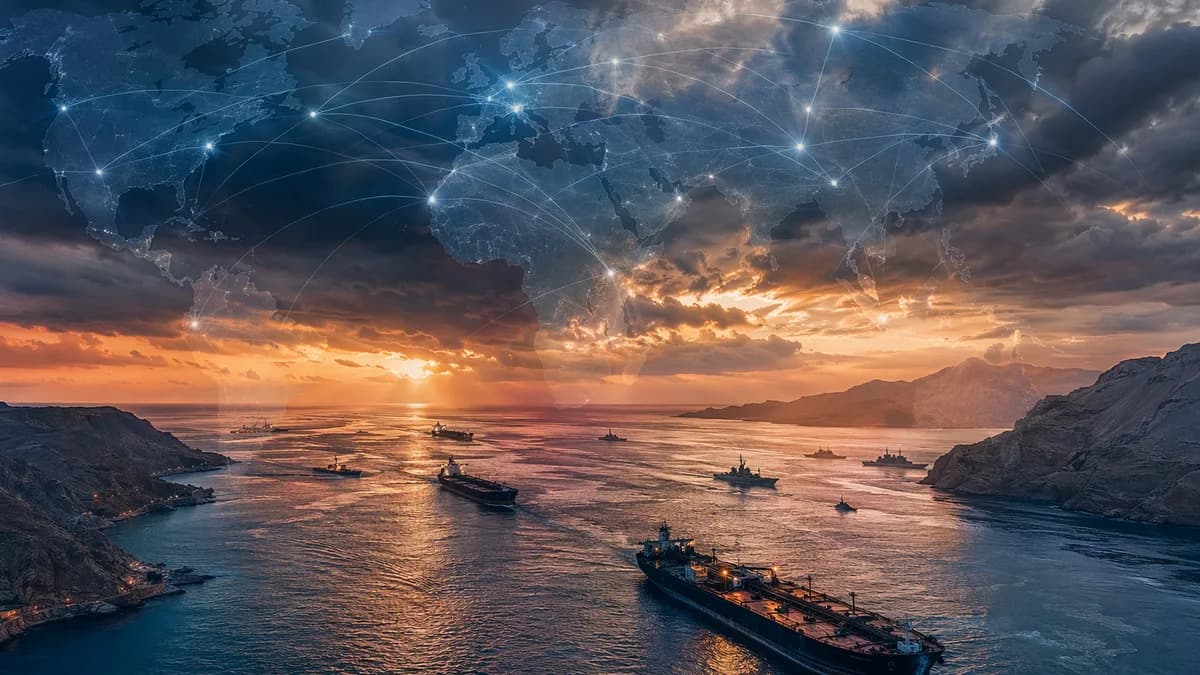
Three weeks after the US and Iran signed a June 17 memorandum of understanding, the fight has narrowed to one combustible question: who gets to set the rules in the Strait of Hormuz.
XOOMAR Intelligence
Analyst Take
That is why the fragile “no war, no peace” phase now looks closer to open conflict, according to BBC World. The ceasefire dispute is no longer only about Iran-US strikes, sanctions, or Iran’s nuclear programme. It is about whether Tehran can convert wartime disruption into lasting control over the waterway that carries a major share of Gulf energy exports.
June 17 made the Strait of Hormuz the ceasefire’s pressure point
The June deal was drafted in haste. Its most contested language sits in point five of the 14-point plan:
“The Islamic Republic of Iran will make arrangements using its best efforts for the safe passage of commercial vessels.”
Iran reads that as permission to manage traffic through the Strait of Hormuz. Washington reads it as an obligation to reopen the waterway to the free flow of oil, gas, and other commodities.
That gap is not cosmetic. It is the deal’s structural flaw.
“You can drive a truck through those clauses,” an Arab oil executive working in the region told the BBC.
Tehran’s public line has hardened. Mohammad Bagher Ghalibaf, Iran’s lead negotiator, posted: “We told you: keep your word or pay the price,” quoting the agreement.
XOOMAR analysis: Neither side needs to want a full war for the Strait of Hormuz to become the trigger. If Iran treats routing authority as a sovereign red line, and the US treats free passage as non-negotiable, every vessel becomes a test case.
The traffic numbers show why partial disruption is enough
Before the war, roughly 20 million barrels of oil and petroleum products moved through the Strait of Hormuz each day, about one-fifth of global oil consumption, according to the supplied Al Jazeera context. Ship traffic was about 100 vessels a day before the war by that account, while the AP context cites about 130 ships daily.
After the June 17 agreement reopened the waterway, traffic did not return to normal. PortWatch data cited in the supplied context showed 513 ships transited between June 18 and July 5, an average of 28 ships a day.
That matters because Hormuz does not need to be fully closed to strain energy flows. If tankers wait, divert, move under escort, switch off AIS transponders, or avoid routes believed to be mined, the result for global shipping is slower trade and higher operational risk. The sources do not quantify insurance costs, so any claim about premiums would go beyond the record. But the operational disruption is already documented.
At least 6,000 seafarers remain stranded in the Gulf, according to the International Maritime Organization figure cited in the supplied context. That is the human side of a chokepoint crisis: crews stuck while governments argue over clauses.
Iran’s Hormuz playbook is routing control plus plausible deniability
Iran does not need to announce a formal blockade to exert pressure. The supplied reporting points to a narrower toolkit:
| Tool | Source-supported detail |
|---|---|
| Route mandates | Iran says vessels must use Tehran-designated routes. |
| Vetting | Ships have been told to register with the Persian Gulf Strait Authority. |
| Drone and projectile attacks | Several vessels have been struck since the ceasefire. |
| Mined waters | The central section of the strait is described as largely unused because the seabed is believed to be mined. |
| Ambiguous command links | A regional diplomatic source described recent attacks on three vessels as the work of a “rogue unit” within the IRGC. |
The BBC reports recent Iranian attacks on three vessels, including a Qatari-flagged liquefied natural gas tanker, near the shipping corridor close to Oman’s coastline. The supplied Al Jazeera context lists at least five commercial vessels attacked in and around the strait since the ceasefire.
XOOMAR analysis: Ambiguity helps Tehran. It raises costs for the US and Gulf states without always creating the clean trigger that would justify a broader military response. But that tactic has limits. A prolonged shutdown would also hurt Iran’s own trade position and intensify the risk of US retaliation.
This is the same escalation channel XOOMAR has tracked in Trump Turns Iran Strikes Into Strait of Hormuz Blockade and US Strikes Iran as Strait of Hormuz Crisis Threatens Oil, where maritime pressure turned into direct military signaling.
Washington’s deterrence problem is now measured ship by ship
The US position is simple in principle: Hormuz should remain open for international passage. The hard part is execution.
US and Iran-backed pressure are no longer separated by a neat line. The supplied context says the US struck Iranian coastal cities after earlier vessel attacks, then later hit Tehran, while Iran fired missiles and drones at multiple Gulf nations. That means deterrence is not an abstract doctrine here. It is a chain of decisions made after each ship strike, escort operation, missile launch, or failed interception.
Respond too softly, and Iran’s route system becomes the default. Respond too hard, and the ceasefire collapses into the “drawn out, all-out war” both sides have reasons to avoid.
Robert Malley of the International Crisis Group sees the internal Iranian split clearly:
“Some want to cash in on battlefield gains through diplomacy and some believe the ceasefire came too soon before Iran had inflicted enough pain on the US.”
That split is dangerous. If Tehran’s political leadership wants bargaining room while IRGC-linked actors keep testing the waterway, Washington may not know which signal to answer.
Gulf mediators are being squeezed by the same clause
The Strait of Hormuz dispute is also straining Iran’s regional relationships.
Qatar is one of the main mediators, yet a Qatari-flagged LNG tanker was among the vessels recently attacked. Oman, long a discreet diplomatic middleman, objected to Iran’s attempt to include language about future administration and maritime services in the agreement, according to the BBC’s source.
Ebrahim Azizi, head of Iran’s national security commission, has been blunt. He previously called control of the waterway Iran’s “inalienable right.” Asked when Iran would cede control, he replied: “never.” He described it as an “asset to face the enemy.”
The United Arab Emirates has also made clear that Iranian plans to charge some form of “service fees” are unacceptable and would set a dangerous precedent.
Former senior British diplomat Simon Gass sees one possible compromise:
“I don’t think there are any great solutions out there but the sweet spot could be in some sort of arrangement in which no tolls were charged for ships passing through the strait but there could be some sort of shipping fees which allow Iran to show it retains its authority.”
That is a narrow landing zone. It depends on Washington accepting some Iranian face-saving mechanism and Tehran accepting that it cannot turn Hormuz into a toll gate.
The 60-day window is closing on the wrong issue
The memorandum included a 60-day window for intensive negotiations. The BBC calls that timeline another weakness. The core dispute over Iran’s nuclear programme has been pushed aside by the fight over the strait.
Iran is under severe pressure. The BBC reports inflation at around 80 percent, millions of jobs lost, one of the longest internet blackouts in history, two wars in less than a year, and major anti-government protests crushed with lethal force. The US side has its own political and economic pressures, which could pull President Trump’s team back toward talks.
The useful signals now are concrete, not rhetorical: whether vessel traffic rises from the post-reopening average of 28 ships a day, whether Iran enforces its designated routes, whether attacks near Oman continue, and whether mediators can turn point five from a battlefield clause into a workable maritime arrangement.
If those indicators worsen, the thesis hardens: the Strait of Hormuz is no longer just a pressure point in the US-Iran conflict. It is becoming the mechanism by which the ceasefire fails.
The Stakes
- The Strait of Hormuz carries about one-fifth of global oil consumption, making even partial disruption globally significant.
- Ambiguous ceasefire language leaves every commercial vessel vulnerable to becoming a flashpoint.
- The dispute could shift from a fragile pause in fighting to open conflict if neither side accepts the other’s interpretation.
US and Iran positions on the Strait of Hormuz ceasefire clause
| Issue | Iran | US |
|---|---|---|
| June 17 agreement language | Reads “safe passage” as permission to manage Strait traffic | Reads it as an obligation to restore free commercial passage |
| Core demand | Greater control over routing through the Strait of Hormuz | Unrestricted flow of oil, gas, and other commodities |
| Conflict risk | May treat routing authority as a sovereign red line | May treat free passage as non-negotiable |
Pre-war oil flow through the Strait of Hormuz
Primary Sources & Disclosures
- [1]BBC World
- [2]Strait of Hormuz: What has happened since the US-Iran MoU on June 17?
- [3]FACT FOCUS: A Look at US and Iranian Claims of Control Over the Strait of Hormuz
- [4]Iran is forcing the U.S. into an escalation trap as a 'shadow war' over the Strait of Hormuz heats up that could kill the tenuous ceasefire | Fortune

Written by
XOOMAR Insights Team
Research and Editorial Desk
The XOOMAR Insights Team pairs automated research with human editorial judgment. We track hundreds of sources across technology, fintech, trading, SaaS, and cybersecurity, cross-check the facts, and explain what happened, why it matters, and what to watch next. We do not just rewrite headlines. Every article is fact-checked and scored for reliability before it goes live, and we link back to the original sources so you can verify anything yourself.