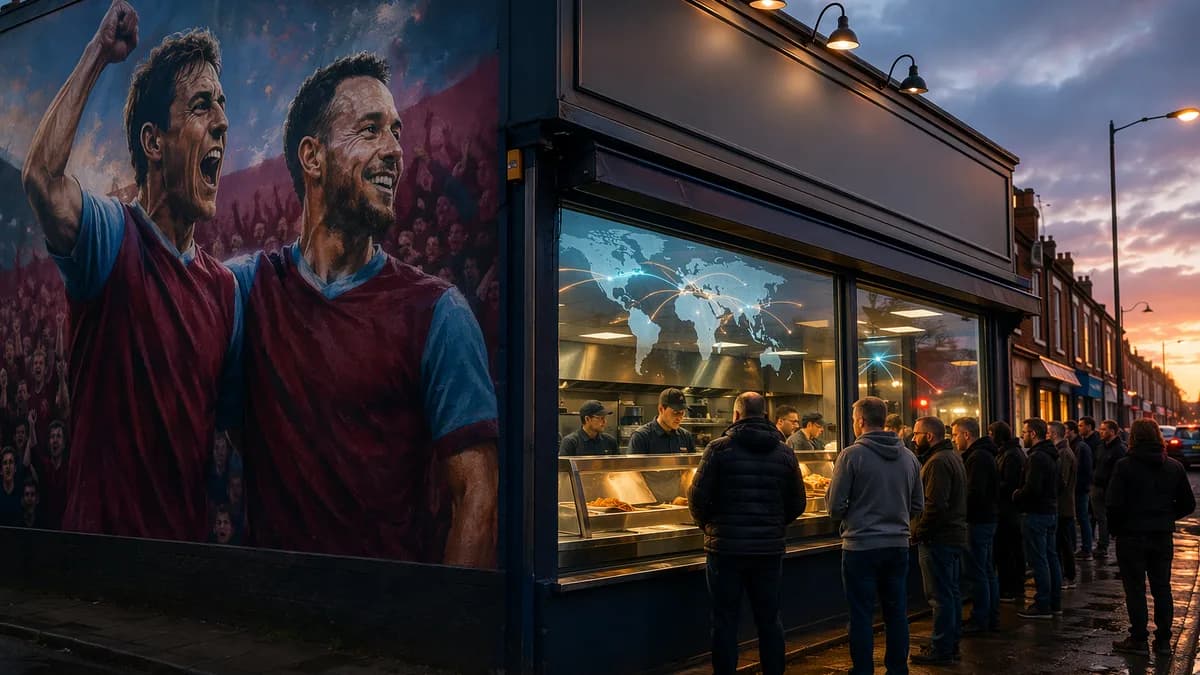
A chip shop in Quinton has become a local landmark because a mural of Jude Bellingham and Morgan Rogers eating orange chips turned football pride into footfall.
XOOMAR Intelligence
Analyst Take
The Bellingham and Rogers mural was pasted on the side of Classic Fryer on Friday afternoon by Dudley artist Dion Kitson, and the response has been strong enough that owner Ramesh Natwadia is opening two hours early and has hired two extra staff members, according to Guardian World.
This is not just a feel-good football image. XOOMAR analysis: the mural works because it makes an elite global sport feel physically local again. Bellingham and Rogers are not shown under floodlights or in a national-team poster template. They’re on a suburban chip shop wall, holding a food marker that people in the West Midlands recognize instantly.
A Quinton chip shop turned Jude Bellingham and Morgan Rogers into a West Midlands billboard
The Bellingham and Rogers mural sits on a busy junction in Quinton, a Birmingham suburb between Birmingham and Stourbridge. That location matters. It gives the artwork a daily audience beyond football obsessives: commuters, school runs, nearby residents, pensioners on excursions, children visiting in groups, and people who saw the image online and decided to come in person.
Kitson told the Guardian he chose the junction partly because of its position between Birmingham and Stourbridge. His stated logic was local and emotional:
“I quite like the idea that as a school kid or something he would have came through here.”
That sentence carries the whole project. Bellingham may now play on football’s biggest stages, but the mural pulls him back into a route a local school kid might have taken. Rogers, born in Halesowen, gets folded into the same regional claim. Who gets to claim a football star when fame makes him national property?
The answer, on this wall, is blunt: the place that made him.
The image also makes a sharper claim about cultural prestige. A fish and chip shop is not a museum, stadium, or council-branded tourism site. Yet it has become the place people are visiting. That shift matters because it shows how civic pride now often travels through ordinary commercial spaces, especially when the image feels native to the area rather than imposed on it.
XOOMAR analysis: this is local myth-making in real time. The mural turns Bellingham and Rogers into symbols of West Midlands self-recognition. It says the region does not need permission from football institutions, broadcasters, or tourism boards to celebrate itself.
Orange chips give the Bellingham and Rogers mural its real power
The most important object in the mural may not be either player. It may be the chips.
Orange chips, also called battered chips in the BBC’s related report, are a West Midlands food marker. The Guardian describes them as a “distinctive neon battered” local delicacy. That detail gives the mural its charge. Without the chips, the image would still be a tribute to two England players. With them, it becomes a local password.
Kitson’s choice makes Bellingham and Rogers feel reachable. They are not presented in expensive cars, hotel lobbies, or elite training facilities. They are eating something familiar from a local chippy. Why does that matter? Because food collapses distance faster than most symbols.
Football fame creates separation. A player becomes a screen image, a transfer asset, a brand, a chant. Food brings the body back into the picture. Everyone understands eating chips. Locals understand orange chips differently, because they carry regional memory and mild defensiveness. Outsiders may not get them. That is part of the point.
The Guardian says the mural has drawn a “steady stream of passersby,” including pensioners from a local old person’s home and a group of children with Down’s syndrome. That range is telling. Public art tied to food does not require specialist knowledge. You do not need to know Bellingham’s club career or Rogers’ appearance count to understand two local lads eating local chips.
Kitson framed the project as a response to something darker. He said he wanted to challenge “the dark side of patriotism” he had seen online and “try to channel the correct side of that, with football, sport, local pride, heritage culture and chips – and not to be a statement politically, it’s just about feeling good”.
That is a careful distinction. The mural is patriotic, but not in the flag-waving abstract. It is rooted in food, accent, streets, and shared pleasure.
The numbers behind a wall that made a chip shop open two hours early
The clearest business signal is not the social media attention. It is the trading behavior.
Classic Fryer is opening two hours early and has hired two extra staff members because the mural is pulling people to the shop. That is where attention becomes economically meaningful. A viral image is nice. Extra staffing is evidence that the crowd has become operational.
Kitson, who has 27,700 followers on Instagram, said the mural had generated the biggest response he had experienced, including posts from Bellingham and Rogers.
“My phone’s been on fire,” he said.
The mechanics are easy to trace from the source material:
- Installation timing: The mural was pasted up on Friday afternoon, giving it a weekend and match-cycle runway.
- Location: It sits on a busy junction, making it visible even to people who did not seek it out.
- Social loop: People photograph the wall, post the image, and send more visitors back to the shop.
- Product hook: Visitors can pose with orange chips, turning the food into part of the image.
- Local press amplification: The Guardian, BBC, and regional outlets all covered the work.
One question matters for small businesses watching this: when does a photo stop become a real customer engine?
In Quinton, it has already crossed that line. Natwadia said customers had asked him to take pictures of them posing with orange chips in front of the mural. The shop is not just beside the artwork. It is inside the ritual.
That is the difference between passive publicity and direct commercial lift. The mural does not point people toward a vague sense of place. It points them toward a counter where they can buy the thing in the image.
From Bellingham’s Birmingham roots to Rogers’ rise, the mural rewrites who gets celebrated
Football murals usually honor club legends, local heroes, or national icons. This one borrows from that tradition but updates it for the feed. It is physically pasted onto a wall, yet built to circulate through Instagram posts, local news images, and fan photos.
The BBC reported that Bellingham was born in Stourbridge, started at Stourbridge Juniors, joined Birmingham City’s youth side, moved to Borussia Dortmund, then signed for Real Madrid in 2023. Rogers, also 23, was born in Halesowen, attended Sandwell Academy, came through West Bromwich Albion, joined Manchester City in 2019, had loan spells at Lincoln City, Bournemouth, and Blackpool, moved to Middlesbrough in 2023, then signed for Aston Villa, where the BBC says he has made 85 appearances and scored 21 goals.
Those career paths matter because the mural compresses them into one local image. Bellingham represents the global superstar with Stourbridge roots. Rogers represents the continuing Midlands production line, a player whose rise is still legible to local fans through schools, academies, and nearby clubs.
Here is the contrast the mural creates:
| Usual England star imagery | Quinton mural imagery |
|---|---|
| National colors and official campaigns | Chip shop wall on Hagley Road |
| Stadium, shirt, sponsor polish | Orange chips and local food culture |
| Player as national symbol | Player as “local lad” |
| Designed for mass audience | Built from regional recognition |
The phrase “local lads” is doing heavy work. Local resident Gerdas told the Guardian:
“They’re local lads. We’re just really proud of them. And it gives Birmingham and the Black Country a big boost.”
The mural also exposes a familiar tension over identity. Some residents have been frustrated by Bellingham being described as from Birmingham when Stourbridge is in the Black Country. Gerdas put it neatly: “When somebody becomes famous, everybody wants to claim them. So it’s a credit to him, really, that people are fighting over it.”
That fight is not petty. It is about who gets visibility. Kitson said he wanted to challenge stigma around the Black Country and its industrial legacy, adding:
“I’m quite protective over the Black Country. I grew up here, and I’ve been in the art world since I was 18, and I’ve had to put up with people thinking I’m an idiot and I’m not educated, and I have more degrees than them.”
XOOMAR analysis: the mural uses football to contest class and regional assumptions without making a lecture of it. It lets the wall do the arguing.
For more on how national football narratives can turn quickly around individual stars, see XOOMAR’s coverage of England banishing Erling Haaland’s World Cup dream to the bench.
Shopkeepers, fans, artists, and players all get something different from the Quinton mural
The mural has different value depending on where you stand.
For Natwadia, it has become practical. He told the Guardian the artwork had become “a local attraction” and had reversed his business’s fortunes at a difficult time. Customers are happier, traffic is up, and the chip shop now has a story that competitors cannot copy by changing a menu board.
For residents, the payoff is recognition. Joan Ingram came after seeing the mural in the newspaper and on social media. She said:
“It gives a sense of pride and not everyone knows about it – there needs to be more attention for it.”
She also said she had heard chants of “Hey Jude” around local pubs and that the mural was “bringing people together.”
For Kitson, the mural is a civic intervention. The Guardian calls him a local guerilla artist, and his own comments show that he is thinking beyond decoration. Other local businesses are now asking him for Bellingham murals on their walls. That is a sign of how quickly symbolic capital can spread once one wall proves the concept.
What do the players get from it?
Careful answer: the source does not show direct involvement in making the mural. It does say Kitson received posts from Bellingham and Rogers. Their images are now part of a local identity economy, one that may strengthen the emotional connection between player and home without any formal campaign.
Stakeholder by stakeholder, the mural’s value looks different:
- Shopkeeper: More visitors, more publicity, more pressure to serve demand.
- Fans: A place to gather, pose, chant, and claim proximity.
- Artist: Visibility, validation, and a bigger public role.
- Players: A stronger symbolic tie to home, even at global scale.
- Nearby businesses: A sign that a wall can become a destination if the reference is authentic.
The same logic appears outside sport too. Public symbols often become battlegrounds for identity and legitimacy, as XOOMAR examined in Hungary President Ouster Puts Magyar's Mandate on Trial, though Quinton’s version is warmer, smaller, and built around chips rather than power.
What the Bellingham and Rogers chip shop mural means for local businesses and football culture
The Bellingham and Rogers mural gives local businesses a clean lesson: authentic cultural references beat generic football marketing.
A poster saying “Come on England” can hang anywhere. Two West Midlands footballers eating orange chips on a Quinton chippy wall can only really work there. That specificity is the asset. It gives people a reason to travel, photograph, share, and buy.
There is a risk inside the opportunity. Once a shop becomes a photo stop, it inherits new expectations. Staff have to handle visitors who may be there for the wall as much as the food. Queues can build. Regular customers may find their routine disrupted. The business has to decide whether the moment is a short spike or the start of a longer identity.
Natwadia’s response, opening early and hiring two extra staff members, shows he is treating it as more than a novelty. Still, the source does not tell us how long the demand will last or whether the mural has changed revenue in measurable terms. Those are the missing numbers.
Football culture is moving in the same direction. Supporters want closeness to players, especially during national tournaments. Official media can provide access, but local symbols provide belonging. A mural on a chip shop wall can make a Real Madrid player feel closer to Stourbridge than a polished interview ever could.
The place-branding implication is obvious. Cities and suburbs compete for attention. Often they do it through slogans that feel interchangeable. Quinton now has something better: a vivid image, a food tradition, and a reason for people to say they went there.
Quinton’s orange-chip mural points to the next wave of football-fuelled street art
Expect more local murals around rising football stars when tournaments create a burst of attention. That is XOOMAR analysis, not a source-reported fact, but Quinton gives the template: pick the right wall, use a real local reference, move quickly, and let fans do the distribution.
Small businesses will notice. The Guardian says other local businesses are already asking Kitson to put up a Bellingham mural on their walls. That does not mean every wall becomes a landmark. Copying the image without the local logic would weaken it.
Authenticity is the dividing line. The Quinton mural travels because the details are specific: Bellingham, Rogers, orange chips, Classic Fryer, Quinton, Stourbridge, Halesowen, Black Country pride. Strip those away and the work becomes generic fan decoration.
The evidence to watch is simple. If Classic Fryer keeps drawing visitors after the immediate tournament emotion cools, the mural has become durable local infrastructure. If the crowds fade quickly, it was still a successful burst of cultural attention, but not a lasting destination.
Either way, the wall has already changed the shop. It has given a Birmingham suburb a sharper place in England’s football imagination, and it did so with paste, pride, and a tray of orange chips.
The Bottom Line
- The mural has turned local football pride into real footfall for a Quinton small business.
- It shows how public art can make global sports stars feel connected to their hometown roots.
- The response was strong enough for Classic Fryer to open two hours early and hire two extra staff members.
Primary Sources & Disclosures

Written by
XOOMAR Insights Team
Research and Editorial Desk
The XOOMAR Insights Team pairs automated research with human editorial judgment. We track hundreds of sources across technology, fintech, trading, SaaS, and cybersecurity, cross-check the facts, and explain what happened, why it matters, and what to watch next. We do not just rewrite headlines. Every article is fact-checked and scored for reliability before it goes live, and we link back to the original sources so you can verify anything yourself.