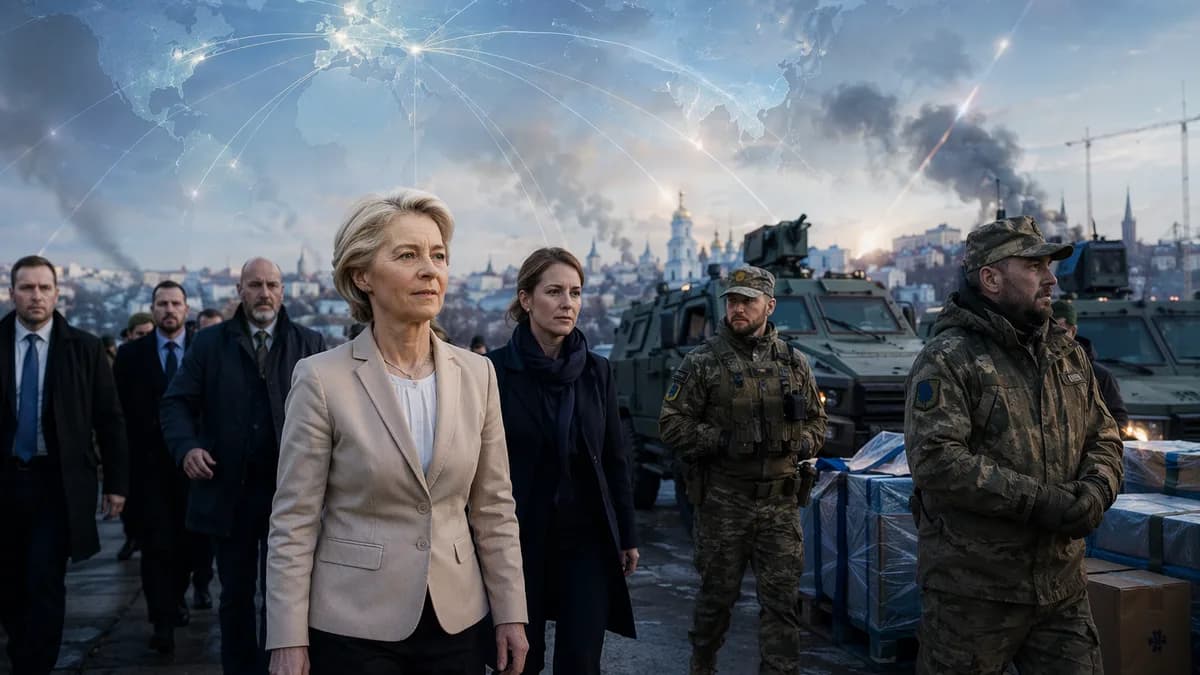
Europe is trying to turn support for Ukraine from crisis diplomacy into industrial capacity, and the Ursula von der Leyen Kyiv visit is the clearest signal yet. The European Commission president arrived in the Ukrainian capital on July 15 to announce “new initiatives to integrate our defence industries,” while EU ambassadors in Brussels work through the 21st sanctions package against Russia, according to Guardian World.
XOOMAR Intelligence
Analyst Take
The thread connecting Kyiv, Brussels, Paris, and the Baltic region is blunt: Europe is trying to raise the cost of Russia’s war while making Ukraine less dependent on ad hoc military aid. The strongest counterpoint is that announcements don’t equal output. The sources do not spell out factories, procurement rules, or delivery timelines. That gap is the story.
Europe links battlefield urgency with defense industry integration in Kyiv
The Ursula von der Leyen Kyiv visit puts defence production at the center of Europe’s Ukraine policy. Von der Leyen said this is her 11th visit to Kyiv since the beginning of Russia’s full-scale invasion, and framed the trip as coming at “a special moment,” according to reporting from Ukrainska Pravda.
“It’s a special moment. Ukraine has built a strong military momentum. The tide is turning.”
That language matters because it moves beyond solidarity messaging. Von der Leyen said she would announce initiatives to integrate the defence industries of Ukraine and the EU, “so we can produce more, and faster,” a production pressure also visible in Keir Starmer’s Kyiv visit. The source material does not specify what those initiatives contain. That makes the next layer of detail, who pays, who produces, who receives first, the key test.
The timing sharpened the symbolism. Her arrival came a day after Ukrainian and European armies were involved in the Bastille Day parade in Paris, placing Ukraine inside a visible European security ritual even as it remains outside the EU. For XOOMAR readers tracking the Paris diplomatic track, this follows our prior coverage of Europe Turns Up Heat on Putin as Ukraine Talks Hit Paris.
Von der Leyen’s Kyiv visit centers on faster European-Ukrainian production
The main claim from Brussels is speed. Von der Leyen’s own words point to a production problem rather than a purely political one: integrate defence industries to “produce more, and faster.” That could cover several types of cooperation, but the sources do not confirm whether the package includes joint production, procurement coordination, technology sharing, or narrower administrative measures.
That distinction is not cosmetic. A political initiative can be announced quickly. Industrial integration takes contracts, capacity, standards, money, and delivery discipline. The most useful reading of the Ursula von der Leyen Kyiv visit is that Brussels wants Ukraine treated less like an external recipient and more like a partner inside Europe’s defence base.
The counterpoint is obvious: “integration” can become a vague Brussels word if no hard commitments follow. The source material gives no production targets, no budget figures, and no list of weapons systems. What would prove the thesis wrong is a package that stays at declaration level, with no measurable effect on output or timelines.
Brussels works through the 21st Russia sanctions package
While von der Leyen was in Kyiv, EU ambassadors in Brussels were trying to settle the details of the 21st sanctions package for Russia. Guardian World reports that ambassadors would be working out the package’s details. UNITED24 Media separately reported that the EU is preparing what would be its largest-ever package of individual sanctions, targeting 250 Russian individuals and entities.
The parallel tracks show Europe using two tools at once: punishment and production. Sanctions aim to tighten pressure on Russia. Defence industrial integration aims to improve Ukraine’s ability to sustain the war effort. One constrains Moscow. The other tries to expand Kyiv’s capacity.
| Track | Location | Stated focus | Main uncertainty |
|---|---|---|---|
| Defence integration | Kyiv | Produce “more, and faster” | No public detail yet on mechanisms |
| 21st sanctions package | Brussels | New Russia sanctions | Final targets and wording not specified in supplied sources |
| EU accession talks | Kyiv agenda | Ukraine’s EU path | Timeline not specified in the supplied material |
| Winter preparations | Kyiv agenda | Readiness before winter | No public detail in the supplied material |
The counterpoint is that sanctions packages can become harder to negotiate as they stack up. The supplied sources do not describe the sticking points, so it would be wrong to name them. Still, the existence of a 21st package shows the policy has not run out, even if the details are still being fought over.
Ukraine and Russia exchange strikes while diplomacy moves elsewhere
The diplomatic choreography is unfolding against the harder fact of continuing strikes between Ukraine and Russia. The Guardian live file frames the day around von der Leyen’s Kyiv visit as Ukraine and Russia exchange strikes, while Brussels works on sanctions and Kyiv prepares announcements on defence integration.
That sequencing matters. If the fighting were static background noise, Europe could afford slow process. Instead, the visit, sanctions talks, and winter-preparation agenda all sit inside a conflict that keeps forcing operational questions onto political leaders. The sources do not provide strike locations, casualties, weapons used, or damage figures, so those details should not be inferred.
The analytical point is narrower and stronger: Europe’s policy is being judged by conversion speed. Can statements become production? Can sanctions become pressure? Can winter planning become resilience? If the answers stay vague, Moscow will not need to rebut the messaging.
For separate XOOMAR coverage of Ukraine-linked security cases, readers can also follow Dead Suspect Blows Open Monaco Bombing Case in Ukraine. It is a different strand of the same broader Ukraine file, not evidence for the Kyiv announcements.
Bastille Day put Ukraine inside Europe’s security story
The Paris parade gave the Kyiv visit a visual preface. Ukrainian and European armies were involved in the Bastille Day parade in Paris one day before von der Leyen arrived in Kyiv. That sequence gave the trip practical and symbolic weight.
The symbolism is direct. France’s national day ceremony placed Ukraine alongside European military forces, then the Commission president traveled to Kyiv to discuss defence integration, accession, and winter preparations. It told Kyiv that Europe wants to show staying power. It told Moscow that support is being folded into institutions and ceremonies, not just emergency summits.
There is still a limit to the signal. Ukraine remains outside the EU, which makes defence industry integration the more immediate track. Accession is a long road. Production speed is a nearer test.
Lithuania warns of possible targeted kinetic operations
The Baltic warning adds a sharper regional edge to the day’s Ukraine news. Reports around the wider regional security picture have pointed to concern in Lithuania about possible targeted operations against critical infrastructure, though the supplied material does not provide enough detail to verify specific locations, timing, targets, or official wording.
That uncertainty matters. The strongest responsible reading is not that a specific attack is imminent, but that European governments are treating infrastructure security as part of the wider risk environment created by Russia’s war. Energy, transport, and cross-border systems are no longer separate from the Ukraine file; they are part of the same strategic pressure map.
This connects to Ukraine because it broadens the risk calculation. Europe is not only discussing Ukraine’s battlefield needs. It is also weighing the security of its own critical infrastructure while Russia’s war continues.
The bigger picture: Europe’s Ukraine strategy now depends on execution
The Kyiv visit, sanctions talks, Paris symbolism, strike exchanges, and Baltic warnings all point in the same direction: Europe is preparing for a longer confrontation, but the proof will be delivery. Von der Leyen has put the right metric on the table: produce more, and faster. That is measurable.
The strongest version of Europe’s strategy combines three moves. First, tie Ukraine more tightly into European defence production. Second, keep sanctions pressure moving through Brussels. Third, harden European infrastructure as regional warnings grow. The weak version is ceremony without capacity.
The practical watch item is the content of von der Leyen’s announced initiatives. If they come with clear mechanisms, funding channels, and production timelines, the Ursula von der Leyen Kyiv visit will mark a shift from emergency support toward long-war capacity. If they don’t, it will remain another high-profile stop in a war where symbolism has already outrun supply more than once.
Impact Analysis
- Europe is trying to shift Ukraine support from emergency diplomacy to sustained defence production.
- The visit signals deeper EU involvement as Ukraine and Russia continue exchanging strikes.
- The impact depends on whether new initiatives produce clear funding, procurement rules, and delivery timelines.
Europe's Ukraine Support Tools
| Tool | Purpose | Status/Gap |
|---|---|---|
| EU-Ukraine defence industry integration | Produce more military equipment faster | Von der Leyen said initiatives will be announced, but details are unspecified |
| 21st sanctions package against Russia | Raise the cost of Russia's war | EU ambassadors are still working through the package in Brussels |
Primary Sources & Disclosures

Written by
XOOMAR Insights Team
Research and Editorial Desk
The XOOMAR Insights Team pairs automated research with human editorial judgment. We track hundreds of sources across technology, fintech, trading, SaaS, and cybersecurity, cross-check the facts, and explain what happened, why it matters, and what to watch next. We do not just rewrite headlines. Every article is fact-checked and scored for reliability before it goes live, and we link back to the original sources so you can verify anything yourself.