
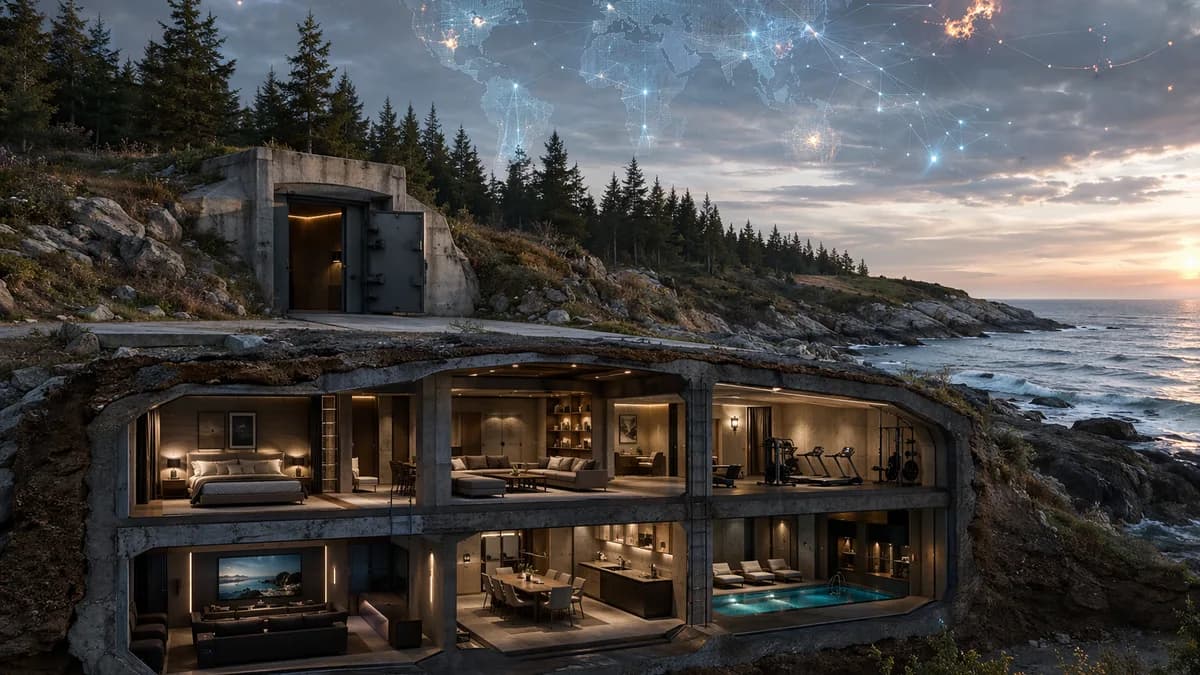
Nova Scotia bunker condos are turning a Cold War shelter built for nuclear catastrophe into a private luxury product for people who want comfort, control, and exclusivity when public systems fail.
Global TrendsJuly 16, 2026· 8 min read· By XOOMAR Insights Team
Nova Scotia Bunker Condos Sell Fear as a Status Symbol
Updated on July 16, 2026
XOOMAR Intelligence
Analyst Take
58/ 100
1 source analyzedLow confidenceTrend10Freshness93Source Trust92Factual Grounding94Signal Cluster20
The project centers on a 64,000 square-foot former Canadian government nuclear bomb shelter in Debert, Nova Scotia, about 113km (70 miles) north of Halifax, according to BBC World. Canadian crypto entrepreneur Jonathan Baha'i plans to convert the site into 50 crisis-proof condo units through Fallout Complex Inc, with gourmet dining from a “self-sustaining” food source, biometric access, constant surveillance, onsite medical services, a spa, yoga room, cigar lounge, and an expanded data centre.
The sharper signal is not that wealthy buyers fear disaster. That’s old. The signal is that fear itself is being packaged as real estate, hospitality, security, and lifestyle in one asset.
Nova Scotia bunker condos turn Cold War fear into a private luxury product
The Debert bunker was built for state survival. Now it is being repositioned for private survival.
Former Canadian Prime Minister John Diefenbaker had seven bunkers built from the late 1950s to the mid-1960s to house a small group of government officials in the event of nuclear war. The Debert site was designed to withstand a near-hit from a nuclear explosion and sustain 329 people for at least 30 days. It later became a provincial emergency warning centre before being shuttered in 1996 as a cost-cutting measure.
That history gives the project its power. A luxury bunker built from scratch is a wealthy person’s fortified basement. A real government nuclear shelter carries a different signal: legitimacy, scarcity, and Cold War mythology.
Baha'i rejects the “doomsday bunker” label.
“It's not about the end of the world, it's about smart, practical storm preparedness, whatever kind of storm,” he told the BBC.
That distinction matters. The sales language is not panic. It is preparedness, family protection, continuity, and insulation from disruption. XOOMAR analysis: the project’s commercial logic depends on converting a public fear into a private amenity without sounding paranoid.
Inside the Canadian doomsday condo model: privacy, comfort, and security
The proposed Canadian doomsday condo model blends hardened infrastructure with hospitality. According to the BBC, the project will include biometric access, around-the-clock surveillance, onsite medical services, gourmet dining, OLED lights designed to replicate natural light, and an adjacent overground bunker to grow food. Tenants with private planes can land at the nearby Debert Airport.
The company is working with German firm Bespoke Home and Yacht Security. Project co-owner Paul Mansfield told the local council that Bespoke had provided security for US Vice-President JD Vance and Kim Kardashian, though the firm’s client list is not public. Mansfield said recommended measures include drones to survey the perimeter.
The strongest counterpoint comes from Baha'i himself. He presents the project less as apocalypse chic and more as storm readiness. When Hurricane Fiona hit Nova Scotia in 2022, he opened the bunker to coworkers and their families.
“If a massive storm hits our condo, the condo owners know they have a guaranteed warm, safe place with power, food, and everything they need,” Baha'i said.
That is the practical version of the pitch. The luxury version adds privacy, exclusivity, and a place to wait out crisis without surrendering comfort.
The survival real estate math starts with scarcity
The economics are striking because the asset started cheap and became rare. Baha'i bought the site in 2013 for C$31,300 ($22,000; £16,500). The bunker currently costs about C$60,000 a year to run. The price to buy or rent one of the planned units remains secret, though the BBC reports 11 units have already sold.
There are no official figures for the cost of building the Debert bunker. The similarly sized Nanaimo shelter cost C$2m-3m at the time, about C$30m in today’s currency, according to the BBC.
| Asset or metric | Figure from source |
|---|---|
| Debert bunker size | 64,000 square feet |
| Planned condo units | 50 |
| Units already sold | 11 |
| Purchase price in 2013 | C$31,300 |
| Current annual running cost | About C$60,000 |
| Planned data centre expansion | 15,000 square feet |
| Original Debert capacity | 329 people for at least 30 days |
Scarcity is central. Other Canadian bunkers have limited reuse potential: Borden, Ontario is locked up, Shilo, Manitoba is buried, Nanaimo, British Columbia was intentionally flooded, and Penhold, Alberta was demolished over fears the Hells Angels would buy it for a clubhouse.
XOOMAR analysis: that limited supply gives authentic Cold War sites a different pricing story than ordinary luxury renovations. But the risk cuts both ways. A bunker condo is a highly specialized property. Its value depends on a buyer believing both the site and the threat narrative.
Cold War infrastructure has found a second market
The Debert project fits a broader reuse pattern described in the BBC report. The Wessex Institute of Technology, which advocates for the heritage of British Cold War bunkers, has said practical reuse options are often limited to tourism, high-security facilities, and data centres.
Baha'i has already tried parts of that playbook. Before the condo proposal, the site hosted laser tag, historical tours, and a small data centre. The new plan keeps the data centre angle and upgrades the rest into a luxury survival and hotel model. When owners are not using units, they can be rented for hotel stays, with profits shared.
The US examples in the BBC report show the same asset conversion logic. In the Black Hills of Virginia, a former Air Force base became the Vivos condominium complex, described as a “survivalist gated community.” In Kansas, the Atlas survival condo was built inside a repurposed Army missile silo.
This is where the symbolism flips. The bunker once represented state protection under nuclear threat. In its new form, it represents private exit planning. For a separate XOOMAR lens on how physical infrastructure becomes a risk story, see our report on warm rivers forcing French nuclear power plants to flinch.
Debert sees jobs, lost history, and luxury most locals may never use
The local reaction is not one-note. Baha'i argues the project will bring Debert a tourist destination and a “world-class” data centre. The project is expected to require more than 40 hotel staff, along with people who can run the expanded 15,000 square-foot data centre, ideally locals.
Some residents see upside. Fady Farah, owner of Angelina's Pizzeria, hopes the project brings traffic like the bunker’s laser tag days did. Debert Mayor Blair said constituents are not pushing back against the condo project.
“They don't have any problem with it, that we know of. We haven't had any people saying 'no, we don't want this here,'” Blair said.
The critique is sharper from the heritage side. Annette Sharpe, secretary of the Debert Military Museum, said the privatization of the site hurts.
“As a museum, it breaks my heart to say, I'm sorry, that piece of history is now private property, and they're refurbishing it for I don't know what,” she said.
Councillor Marie Benoit also questioned whether locals could access the boutique hotel if rates exceed most hotels in Halifax, as estimated. Sharpe added that nearby apartments cost only C$2,000 to rent and asked, “Who's gonna afford to buy one of those Hollywood pretend scenes?”
That tension is the story. The project may bring jobs and attention. It also turns a public Cold War relic into a private refuge.
Luxury survival shelters sell calm, not catastrophe
The next phase of bunker living will likely avoid the language of apocalypse. Baha'i already does. He frames the site as off-grid storm preparedness, a secure Airbnb, a data centre, and a tourism draw.
That softer pitch is commercially smarter. “Doomsday” attracts headlines, but “resilience” sells to people who do not want to sound extreme. The BBC cites projections that the US disaster “prepping” industry is worth at least $500m, with estimates ranging from 20 million to more than 70 million Americans preparing for disaster. The Debert project is Canadian, but the business logic is similar: sell certainty in a period defined by uncertainty.
XOOMAR analysis: the practical test will be less glamorous than the renderings. Watch whether Fallout Complex Inc completes the project by early next year, fills the remaining units, staffs the hotel and data centre locally, and keeps community support once prices and operating details become clearer. Evidence that would weaken the thesis: weak sales after the initial 11 units, local resistance, or a pivot back toward tourism and data services.
The Nova Scotia bunker condos say less about the odds of the world ending tomorrow than about how quickly fear can become a luxury amenity. For another XOOMAR read on how risk perception can move from headlines into planning decisions, see Strait of Hormuz Standoff Pulls Iran and US Toward War.
The Bottom Line
- The project shows how disaster preparedness is being transformed into a luxury real estate product.
- A former public survival asset is being repositioned for private buyers seeking security and exclusivity.
- The bunker’s Cold War history gives the development scarcity and credibility that new-build shelters lack.
Debert Bunker: From Public Emergency Shelter to Private Luxury Survival Property
| Original Cold War bunker | Planned luxury condo project |
|---|---|
| Built to house government officials during nuclear war | Marketed as private crisis-proof condo units |
| Designed to sustain 329 people for at least 30 days | Planned conversion into 50 condo units |
| Part of seven bunkers built from the late 1950s to mid-1960s | Developed by Fallout Complex Inc under Jonathan Baha'i |
| Later used as a provincial emergency warning centre before closing in 1996 | Includes biometric access, surveillance, medical services, spa, yoga room, cigar lounge, and data centre |
Key Debert Bunker Numbers
Site size (thousand sq ft)
count64
Planned condo units
count50
Original emergency capacity
count329
Minimum sustainment days
count30
Sources

Written by
XOOMAR Insights Team
Research and Editorial Desk
The XOOMAR Insights Team pairs automated research with human editorial judgment. We track hundreds of sources across technology, fintech, trading, SaaS, and cybersecurity, cross-check the facts, and explain what happened, why it matters, and what to watch next. We do not just rewrite headlines. Every article is fact-checked and scored for reliability before it goes live, and we link back to the original sources so you can verify anything yourself.
Explore More Topics
Related Articles
 Global Trends
Toronto Shooting Leaves 2 Dead as Shooter Escapes Festival
Two people are dead and four are injured after gunfire near Salsa on St Clair. The shooter remains at large.
Jul 12, 20266 min
 Global Trends
Suspect on Run After Toronto Festival Shooting Kills 2
At least two people were killed and four wounded at Salsa on St Clair, with Toronto police still searching for whoever opened fire.
Jul 12, 20266 min
 Cybersecurity
Fairlife Ransomware Attack Freezes US Dairy Production
A ransomware attack forced Coca-Cola to halt Fairlife's U.S. dairy production, with no restart date and Canada spared so far.
Jul 16, 20265 min
 Technology
Meta AI Teen Suicide Alerts Drag Parents into Chatbot Crisis
Meta will alert parents when teens discuss suicide or self-harm with Meta AI, showing chatbots are now teen crisis interfaces.
Jul 16, 20268 min
 Technology
Watch The Open 2026 Without Getting Blacked Out Early
The Open 2026 streams vary by country, with NBC, Sky, TSN, Kayo and others carrying coverage from Royal Birkdale.
Jul 16, 20268 min
 Global Trends
Kardashians Mourn Mary Jo Campbell After Her Death at 91
Mary Jo Campbell, Kris Jenner's mother and a familiar Kardashian family figure, has died at 91.
Jul 17, 20266 min
 Global Trends
Marines Board Tanker as US Blockade Grips Iran Ports
US forces boarded the M/T Wen Yao and struck Iranian bridges, turning a port blockade into a hotter fight near Hormuz.
Jul 17, 20267 min
 Global Trends
530 Rohingya Disappear at Sea as Rescue Vacuum Deepens
Two boats carrying about 530 Rohingya vanished after leaving Myanmar, exposing a deadly rescue vacuum across Southeast Asian waters.
Jul 17, 202613 min
 Global Trends
1,200 DOJ Alumni Put Todd Blanche Nomination on Trial
More than 1,200 DOJ alumni are urging senators to reject Blanche after Liz Oyer alleged a political firing.
Jul 17, 20268 min
 Global Trends
CD Sales Roar Back as Gen Z Buys Cheap Proof of Fandom
CD sales rose 16% as young fans buy cheap, visible proof of loyalty, often without owning players.
Jul 17, 20268 min
Don't miss the signal
Get our weekly roundup of the stories that matter across tech, fintech, and trading. No noise, just signal.
Free forever. No spam. Unsubscribe anytime.