
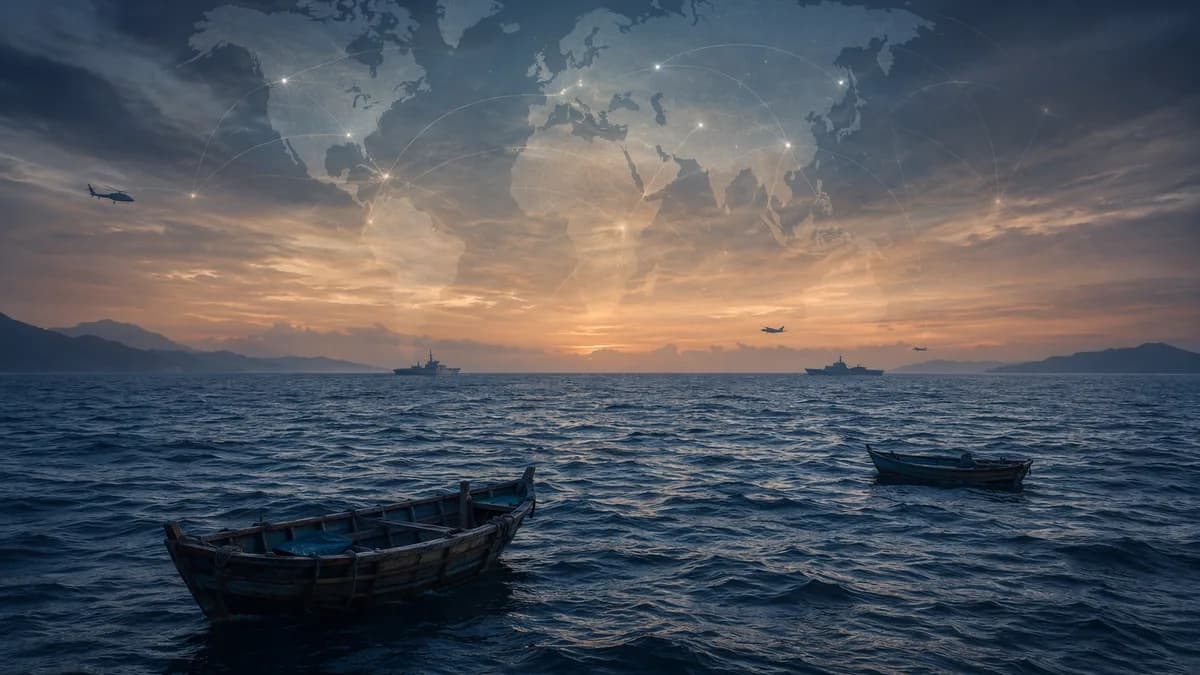
Two boats carrying an estimated 530 Rohingya asylum seekers have disappeared after leaving Myanmar’s Rakhine state on 29 June, turning a smuggling route into a mass-casualty mystery with almost no official trail. The people hurt first are their families, who expected word within a week or 10 days and, nearly three weeks later, have received silence.
Global TrendsJuly 17, 2026· 13 min read· By XOOMAR Insights Team
530 Rohingya Disappear at Sea as Rescue Vacuum Deepens
Updated on July 17, 2026
XOOMAR Intelligence
Analyst Take
60/ 100
4 sources analyzedLow confidenceTrend10Freshness94Source Trust92Factual Grounding92Signal Cluster40
The boats likely left from Sin Tet Maw, an Arakan Army-controlled village, one in the morning and one later in the day, according to BBC World. Chris Lewa, who runs the Arakan Project, has been piecing together the route through indirect contacts because communications in Rakhine have been largely cut.
XOOMAR analysis: the missing Rohingya boats expose more than a criminal smuggling network. They expose a regional system in which governments can treat Rohingya passengers as border-control problems until they become bodies, or vanish without confirmation.
A 530-person disappearance exposes Southeast Asia's rescue vacuum
The central fact is brutal: two boats, roughly the size of a full jumbo jet in human terms, left Myanmar and have not been heard from since. BBC World reports that both boats very likely capsized, with few or no survivors, though certainty may never come.
That uncertainty is the story. If a vessel carrying tourists or crew disappeared in busy regional waters, the default expectation would be search, tracking, jurisdictional clarity, and public pressure. For Rohingya vanished at sea, the first obstacle is often proof that the trip happened at all.
The operational question is blunt: who owns the rescue when every state can claim the boat was someone else's problem?
The geography deepens the ambiguity. The Bay of Bengal and Andaman Sea sit between countries that have long resisted large Rohingya arrivals. Smugglers exploit that gap. Passengers are moved through a chain of boats, brokers, beaches, roads, forest transit camps, and payment demands. Every handoff creates another place where responsibility can disappear.
The result is a rescue system that reacts late, if it reacts at all.
UNHCR and IOM said they are “gravely concerned by the potentially devastating loss of life.”
That warning, cited in related reporting from UN agencies, matters because the casualty figures remain unconfirmed. But the risk factors are not hypothetical: monsoon seas, overloaded fishing trawlers, unreliable engines, limited communication, and passengers with almost no legal protection.
For readers tracking how maritime routes become instruments of political pressure, XOOMAR has covered another version of sea-lane vulnerability in Iran’s Red Sea Threat Traps Global Shipping in Proxy War. The Rohingya case is different in cause and scale, but it shows the same hard truth: when politics governs sea access, human life becomes conditional.
The 29 June route from Rakhine turned two boats into a black box
The known timeline is narrow. The boats reportedly left Rakhine state on 29 June with about 530 Rohingya on board. Lewa believes one departed in the morning and the other later the same day. Families have not heard from them.
BBC World says the boats were likely heading for the southern coast of Myanmar, where passengers would be transferred to smaller boats, taken back to land, then moved by road through rough forest transit camps, through Thailand, and onward toward the Malaysian border.
The obvious question is also the hardest one: did the boats sink, get intercepted, get abandoned by smugglers, or simply fall out of contact before disaster?
Some evidence points toward capsizing. Bangladesh authorities recovered the body of one woman washed up from the sea. Fishermen between the Irrawaddy delta and the coast of Mon state found several other bodies nine days later. Lewa believes this suggests one boat capsized several hours after leaving Sin Tet Maw, while the other may have gone down after several days sailing south east.
Still, the record is incomplete.
Known from the source material:
- Departure: Two boats left Myanmar’s Rakhine state on 29 June.
- Estimated passengers: About 530 Rohingya asylum seekers.
- Likely origin: Sin Tet Maw, under Arakan Army control.
- Expected contact window: Families would normally hear within a week or 10 days.
- Current status: Nearly three weeks later, no contact has been reported.
- Physical evidence: One woman’s body recovered by Bangladesh authorities, with several more bodies found by fishermen nine days later.
Still unconfirmed:
- Distress signal: No confirmed report that either boat sent one.
- Interception: No confirmed report that a navy or coast guard stopped either vessel.
- Survivors: No confirmed survivor accounts.
- Exact route: The intended route is inferred from smuggling patterns and Lewa’s contacts.
This is how a mass disappearance happens without a clean incident file. The passengers are undocumented or under-documented. The boats are part of illicit networks. The departure zone is in a war-hit area where telecommunications have been cut. The people with the most information, smugglers, have the strongest reason not to talk.
Why one missing Rohingya convoy can become a mass casualty event
A missing boat with 530 people is not a small maritime accident. It is a mass disappearance involving stateless passengers, likely including many women and children. BBC World reports that half of those on board may have been women and children, though that cannot be confirmed.
The data show why one convoy can become a disaster.
| Figure | Source-supported meaning |
|---|---|
| 530 | Estimated Rohingya passengers on the two missing boats |
| 250 | Approximate number reportedly on one boat that lost contact shortly after departure, per UN-linked reporting |
| 280 | Approximate number reportedly on the second boat, believed to have sunk off Myanmar’s Ayeyarwady coast on 8 July, per UN-linked reporting |
| 4,700 | UNHCR estimate of Rohingya who have left in 74 boats so far in 2026 |
| 10,000 | Lewa’s estimate of departures since September last year |
| Nearly 300 | People reported missing or dead in the Andaman Sea and Bay of Bengal so far this year, per UN agencies |
| Nearly 900 | Rohingya refugees reported missing or dead at sea in the northern Indian Ocean last year, out of more than 6,500 who attempted crossings, per UNHCR reporting cited in related coverage |
The deeper question is this: how can a boat carry hundreds of people and still leave almost no trace?
Smuggling economics help explain it. BBC World describes boats as old fishing trawlers converted to carry as many people as possible. They are barely seaworthy and have unreliable engines. The business model depends on density: more passengers mean more fees, but also more weight, less space, less water, weaker odds in rough seas.
The timing was also dangerous. UN agencies said the journeys took place outside the regular sailing season, when maritime conditions are typically more hazardous. Recent torrential rain and flooding across the region increased the risk.
Passengers face stacked threats:
- Weather: Monsoon conditions create rough seas and poor visibility.
- Boat quality: Converted fishing trawlers often lack safety systems.
- Navigation: Smugglers may rely on limited equipment and informal coordination.
- Fuel and engines: Mechanical failure can turn a route into a drift.
- Disembarkation risk: Nearby states may block landings or push boats back.
- Documentation gaps: Families may not have formal passenger lists or legal channels to trigger a response.
This is why the phrase Rohingya vanished at sea carries a second meaning. They are not only missing from the water. They are missing from the systems that usually make loss visible.
Myanmar war, Bangladesh camp pressure, and Malaysia's pull keep boats moving
The push from Myanmar is severe. BBC World reports that 600,000 Rohingyas remain in Rakhine state, with one quarter confined to internally displaced people camps and the rest living in precarious communities caught between the warring sides.
Rakhine is now a battlefield. The Arakan Army has driven the Myanmar military out of most of the state and is besieging the military’s last stronghold in Sittwe, which BBC World says is accessible only by air and sea. Almost all telecommunications have been cut.
The human question is unavoidable: what level of danger on land makes a monsoon boat look like the better choice?
For Rohingya in Rakhine, the pressure comes from multiple directions. The military junta has subjected them to forced conscription, according to BBC World. The Arakan Army, which claims to represent the ethnic Rakhine population, distrusts Rohingya and is accused of serious human rights violations against them.
Bangladesh adds another layer. More than a million Rohingyas live in overcrowded camps in southern Bangladesh, where aid is drying up, jobs are almost nonexistent, organised crime gangs operate freely, and residents are not allowed to leave. Related UN reporting says some passengers on the missing boats had travelled from the camps in Cox’s Bazar.
Malaysia remains the draw. BBC World reports that 200,000 Rohingyas already live there, making it the most appealing destination. Diaspora networks matter. So does the perception that Malaysia offers more safety and opportunity than permanent confinement in camps or war zones.
Smugglers convert that desperation into revenue. Fees range from $2,000 to $4,000 (£1,500 to £3,000), according to BBC World. Families who cannot pay face coercion. The source describes passengers being detained and beaten, or worse, with videos sent to relatives to force payment.
That business will not stop because two boats vanished. Death is part of the smuggling model’s risk calculation. It is not necessarily a deterrent when the alternatives remain blocked.
Navies, traffickers, aid groups, and families are not asking the same question
Coastal states often read Rohingya boats through border control, trafficking, and security. Humanitarian groups read them through rescue duties and protection. Smugglers read them through profit and exposure. Families read them through dread.
The same boat creates four competing priorities.
| Stakeholder | Main concern | Likely effect |
|---|---|---|
| Navies and coast guards | Border control, interception, disembarkation politics | Delayed or contested rescue decisions |
| Aid groups and rights advocates | Search and rescue, asylum access, protection from pushbacks | Calls for coordinated regional action |
| Traffickers | Payment extraction, route secrecy, avoiding scrutiny | Blame shifts to weather, passengers, or authorities |
| Families | Confirmation, bodies, survivors, accountability | Prolonged uncertainty and no clear agency to contact |
The practical question is stark: when a Rohingya boat disappears, who has both the incentive and the authority to search?
Families are trapped at the bottom of that chain. If relatives are in Bangladesh camps, Myanmar villages, or Malaysian diaspora networks, they may know a departure happened but not the route, broker, vessel name, or exact passenger list. They may also fear authorities or traffickers.
Aid groups can raise alarms, but they cannot compel states to open ports or disclose interceptions. UNHCR and IOM called for “enhanced search and rescue efforts, access to asylum and protection, and actions against smuggling and trafficking networks.” The phrase is restrained. The implication is not.
Without predictable rescue and landing arrangements, smugglers keep control of the route. They decide when boats depart, where passengers are transferred, and who gets information. When something goes wrong, silence protects them.
For a financial and geopolitical audience, the lesson resembles other maritime risk stories: control over sea movement determines who bears loss. XOOMAR’s analysis of Red Sea shipping risk and proxy conflict focused on commercial lanes. Here, the cargo is human, and the absence of accountability is deadlier.
The 2015 Andaman Sea lesson was never turned into a rescue system
The current disappearance echoes the 2015 Andaman Sea crisis. BBC World reports that Thailand, embarrassed by its poor human-trafficking reputation, began blocking road routes used by smugglers and closing primitive transit camps in mangrove swamps and rubber plantations. The discovery of mass graves in those camps added urgency.
Routes shifted. Many boats heading south from the Myanmar-Bangladesh border went instead to Aceh, Indonesia, where fishing communities initially welcomed Rohingya as fellow persecuted Muslims. BBC World reports that this welcome has since been withdrawn, with hostile social media campaigns in Indonesia directed against Rohingya.
The hard question from 2015 still applies: did regional action reduce trafficking, or just push it into harder-to-monitor corridors?
Some tactics changed. Lewa says smugglers have gone back to using Thailand as the main transit route. Larger mother ships pick up Rohingya off the coasts of Rakhine or Teknaf in Bangladesh, avoiding long stops to reduce exposure to authorities. They now carry satellite phones and coordinate with smuggling teams in Thailand or Indonesia, paying local fishermen to move Rohingya to beaches in southern Thailand or eastern Sumatra.
Some passengers are dropped on Myanmar’s southern coast, then transported to Thailand through land border crossings and by road to the Malaysian border. But BBC World makes the core constraint clear: with all land routes cut from Rakhine to the rest of Myanmar, escape must begin by sea.
That is the unresolved failure since 2015. Regional governments took anti-trafficking actions and blocked routes. They did not create a reliable mechanism for search, rescue, safe disembarkation, and burden-sharing.
The 2017 mass displacement from Myanmar increased the number of Rohingya living with no durable status. The political problem stayed unresolved. Smugglers adapted.
The missing Rohingya boats are a warning for Asia's next sailing window
The fate of the 530 missing Rohingya will be judged by more than whether the boats capsized. It will be judged by whether any government is willing to establish what happened, search for survivors or bodies, and disclose what it knows.
The policy problem is no longer divisible into clean boxes. Maritime surveillance, refugee protection, anti-trafficking enforcement, aid funding, and disembarkation politics now sit on the same route map. If one fails, the others weaken.
The watch item is clear: will Southeast Asian states build a predictable rescue and landing process before the next large boat disappears?
Evidence that would support a shift includes coordinated search operations, public incident reporting, shared intelligence on smuggling networks, and agreed landing arrangements that do not strand passengers at sea. Evidence against it would be more familiar: silence after departures, ad hoc pushbacks, disputed casualty figures, and no official passenger accounting.
Departures are likely to continue during safer sailing windows because the source conditions remain intact. Rohingya in Rakhine face war, coercion, and severe restrictions. Rohingya in Bangladesh camps face overcrowding, shrinking aid, limited work, and no freedom to leave. Malaysia remains attractive because of its existing Rohingya population.
Smugglers will adjust routes. States will face pressure after each high-profile disappearance. Families will keep paying because hopelessness has already priced in death.
That is the sharpest lesson from the missing Rohingya boats: people do not vanish at sea only because the weather turns. They vanish because the route was designed to keep them unseen until it was too late.
Impact Analysis
- An estimated 530 Rohingya asylum seekers have vanished with little official confirmation or accountability.
- The case exposes a regional rescue gap across the Bay of Bengal and Andaman Sea.
- Families are left without answers as governments and smugglers operate in a zone of ambiguity.
How maritime disappearances are treated differently
| Scenario | Expected response | Problem highlighted |
|---|---|---|
| Tourist or crew vessel disappears | Search, tracking, jurisdictional clarity, and public pressure | Clearer accountability |
| Rohingya asylum seeker boats vanish | Uncertainty over proof, responsibility, and rescue ownership | Governments can treat passengers as someone else’s problem |
Estimated Rohingya missing at sea
People aboard two missing boats
people530
Sources

Written by
XOOMAR Insights Team
Research and Editorial Desk
The XOOMAR Insights Team pairs automated research with human editorial judgment. We track hundreds of sources across technology, fintech, trading, SaaS, and cybersecurity, cross-check the facts, and explain what happened, why it matters, and what to watch next. We do not just rewrite headlines. Every article is fact-checked and scored for reliability before it goes live, and we link back to the original sources so you can verify anything yourself.
Explore More Topics
Related Articles
 Global Trends
Rohingya Camp Landslide Buries School, Kills 5 Children
A monsoon landslide buried a school in Cox's Bazar, killing five Rohingya children as rescuers searched for more victims.
Jul 10, 20264 min
 Global Trends
Kardashians Mourn Mary Jo Campbell After Her Death at 91
Mary Jo Campbell, Kris Jenner's mother and a familiar Kardashian family figure, has died at 91.
Jul 17, 20266 min
 Global Trends
Marines Board Tanker as US Blockade Grips Iran Ports
US forces boarded the M/T Wen Yao and struck Iranian bridges, turning a port blockade into a hotter fight near Hormuz.
Jul 17, 20267 min
 Global Trends
1,200 DOJ Alumni Put Todd Blanche Nomination on Trial
More than 1,200 DOJ alumni are urging senators to reject Blanche after Liz Oyer alleged a political firing.
Jul 17, 20268 min
 Global Trends
CD Sales Roar Back as Gen Z Buys Cheap Proof of Fandom
CD sales rose 16% as young fans buy cheap, visible proof of loyalty, often without owning players.
Jul 17, 20268 min
 Global Trends
Live TV Fractures Over Trump Election Speech Claims
TV networks split on airing Trump live as he revived unproven 2020 election claims, testing newsroom judgment.
Jul 17, 20268 min
 Fintech
Brokerage Profits Hit $115B as Branch Networks Vanish
FINRA firms made nearly $115B pretax in 2025, proving brokerages can get richer even as branches and advisor registrations thin out.
Jul 17, 20269 min
 Technology
US Blocks Force South Korea to Build Security AI Model
US restrictions on Anthropic's Mythos pushed Seoul to build its own security AI, aiming for a bug-hunting model by late 2026.
Jul 17, 202611 min
 Fintech
Payments Hand U.S. Bancorp a $7.7B Revenue Record Quarter
Payments now make up 23% of U.S. Bancorp revenue, turning a record $7.7B quarter into a bigger bet on fees and digital banking.
Jul 17, 20267 min
 Global Trends
Six Nights of US Strikes Pound Iran's Hormuz Lifeline
Six straight nights of US strikes have pushed the Iran conflict into Hormuz trade routes, with bridges hit and tankers stopped.
Jul 17, 20268 min
Don't miss the signal
Get our weekly roundup of the stories that matter across tech, fintech, and trading. No noise, just signal.
Free forever. No spam. Unsubscribe anytime.