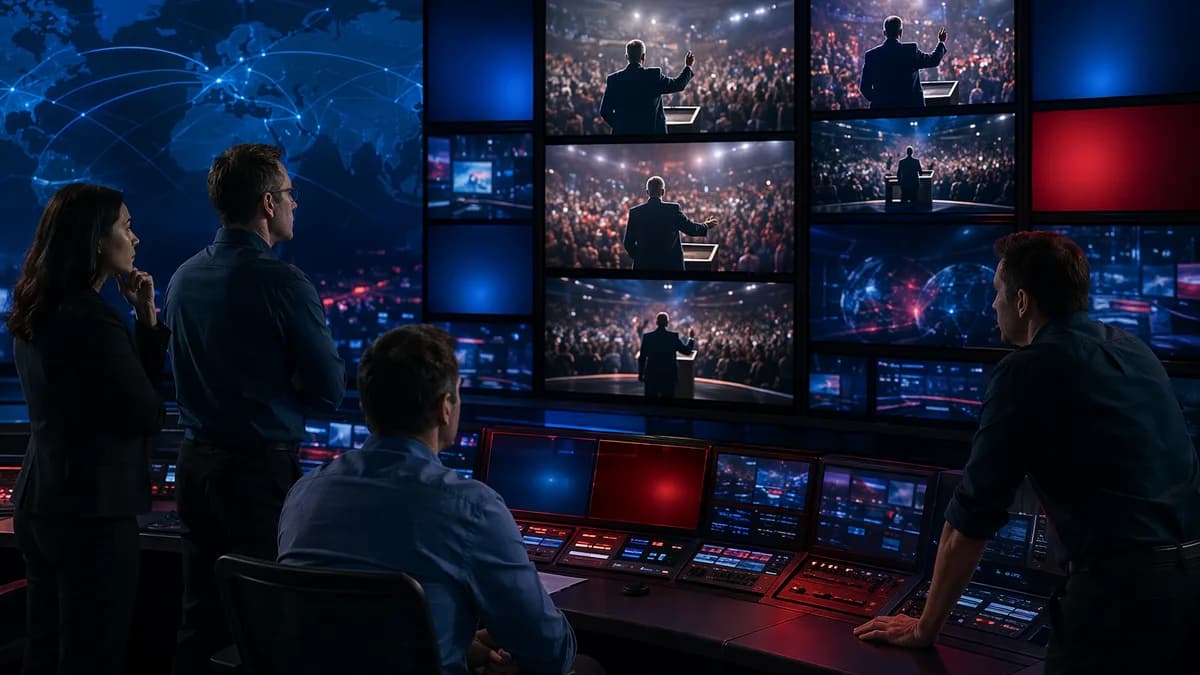
When the Trump election speech revived unproven claims about the 2020 election, why did any network still treat a live White House feed as the default?
XOOMAR Intelligence
Analyst Take
My view is blunt: refusing to air the address live was the responsible editorial call. Donald Trump deserved coverage. He did not deserve an unfiltered national broadcast pipeline for allegations about an election won by Joe Biden that the source material describes as unproven. The split among CNN, NBC, ABC, CBS, Fox News, MS Now, and local affiliates was not a routine programming dispute. It was a stress test for political journalism, Guardian World reported.
Presidents get attention because the office matters. But the office does not suspend editorial judgment. If the format itself makes verification impossible in real time, the format becomes part of the problem.
Why did the Trump election speech force newsrooms to choose between access and accuracy?
Live presidential remarks usually carry public interest. That is the strongest argument for airing them. The harder question is whether public interest survives when the remarks are expected to center on unsubstantiated election claims.
That was the bind on Thursday night. The address was heavy on unproven accusations about the integrity of the 2020 election, according to the Guardian. Trump’s remarks focused on “the deep state” and efforts by China to “meddle” in the US election system.
The networks split sharply:
| Network or outlet | Live broadcast choice | What viewers got |
|---|---|---|
| CNN | Did not air live on its main channel | Panel discussion and monitoring |
| NBC | Did not air live on broadcast | Continued airing The Americas, then covered after |
| ABC | Did not air as a must-run broadcast | Streaming and radio coverage, some affiliates aired it |
| CBS | Aired large portions live | Cut in just more than 20 minutes in |
| MS Now | Aired about half | Jen Psaki interrupted about 15 minutes in |
| Fox News | Aired at least large portions live | Live carriage of significant remarks |
That table shows the real issue. Editorial independence is not just deciding what deserves coverage. It is deciding whether live, uninterrupted coverage distorts the news before journalists can test it.
Can live TV correct election misinformation fast enough?
No. Not reliably.
Live television gives a claim its first impression before evidence catches up. Clips travel. Partisans cut them. Corrections arrive later, usually with less force and a smaller audience. That gap matters most when the claim attacks election legitimacy.
Real-time chyrons and anchor interruptions help. CNN’s on-air graphic told viewers: “Trump Gives Address On Elections After Years of False Claims.” Kaitlan Collins said the network would monitor the remarks but would not take them live “given the president has a well-documented history of saying blatantly false things about elections.”
That is the right instinct. It treats the speech as news without granting it the aura of unchecked authority.
MS Now tried a different path. Jen Psaki warned viewers before airing part of the speech:
“When you’re in the White House, these are selective moments a president typically takes to speak to the American public,” she said. “We are not in normal times, as you all know. And this speech is not going to be about this country, and it is not going to be about the American people and the challenges people face.”
Then, about 15 minutes into Trump’s comments, she cut in and challenged his assertions about the electoral system. That was better than passive carriage. But it still let the claims land first.
Why did CBS, Fox News, MS Now and ABC affiliates leave viewers with different realities?
Because there was no shared newsroom playbook for election denial rhetoric.
CBS made the case for airing a large portion of the speech. Tony Dokoupil told viewers:
“It’s a speech expected to address safety and security of American elections, a topic, of course, that the president has talked a lot about for years now,” he said. “At times, almost constantly, and honestly, much of what the president has said on this topic has been false. Most notably, of course, the claim that he won the 2020 election, when of course he did not. Because of this, there is an argument that it’s irresponsible to air the president’s speech tonight. But this speech will be made. It will be news. And it’s our job to cover the news. And so we are.”
That is an honest explanation. It is also the weaker call.
CBS did cut in just more than 20 minutes into the speech, bringing on Dokoupil and Major Garrett. Still, the network accepted the premise that the public needed the live event first and the context second.
The affiliate picture made the split messier. ABC did not air the speech as a must-run broadcast, but some station affiliates did, including the Washington DC station owned by Sinclair, which the Guardian describes as right-leaning. That matters because local discretion can undercut national standards. Viewers do not experience “affiliate discretion” as a media governance issue. They experience it as one channel showing the president live while another refuses.
This same pressure sits inside broader media power fights. Reuters’ context around Paramount, Warner Bros. Discovery, and FCC approval makes ownership pressure impossible to ignore, and readers tracking that thread can read our earlier coverage of the Paramount Warner Bros deal fight.
Why were CNN and NBC right to keep the live camera off?
Because not airing a speech live is not censorship. It is editing.
CNN still covered the address. NBC aired it on streaming and broadcast a special report after it ended. ABC put it on ABC News Live and ABC News Radio. The public was not denied information. The public was denied the most dangerous format: live, official, and difficult to correct at speed.
NBC’s choice was especially telling. Instead of a special report, it kept the previously scheduled nature documentary The Americas on air. That sounds almost comic until you see the principle underneath it. A president does not get automatic command of broadcast television simply by choosing prime time and the White House as a stage.
Trump also briefly mentioned the U.S.-Israeli war on Iran, a topic connected to our prior analysis in Strait of Hormuz Erupts as Trump’s New Iran War Lever. But the address, by the source accounts, stayed focused on election-security allegations. That focus justified caution.
Doesn’t the free speech argument for airing Trump deserve a serious answer?
Yes. A sitting president making claims about elections is newsworthy. Audiences can reasonably say they want to hear the words directly, not filtered through anchors they may distrust.
Newsrooms also create their own problem when they refuse live coverage without explaining why. If viewers only see silence, the decision can look paternalistic. Worse, it gives Trump an opening to frame editorial judgment as suppression.
He took that opening. Trump said ABC and NBC were part of “a plot” and suggested they should lose their broadcast licenses. Steven Cheung, his communications director, wrote on X:
“Cowards. NBC and ABC don’t want you to hear the truth. All they want to do is hide the facts from YOU,” he wrote earlier in a post on X. “Tune in @WhiteHouse at 9:00pm EDT, where we always get bigger ratings than any of the networks.”
The answer is simple. Free speech protects speakers from government suppression. It does not require private news organizations to air unverified election claims without editorial control. In fact, Trump’s license threat strengthens the case for independent judgment. A broadcaster that airs a speech because it fears retaliation is not serving the public. It is yielding power.
What rules should newsrooms set before the next election-focused address?
Networks need public standards, not improvisation under pressure.
A workable playbook would be direct:
- Delay: Use a short delay when election-integrity claims are expected.
- Verify: Put evidence checks on screen immediately, not in a segment 20 minutes later.
- Limit: Avoid full unedited replays of speeches built around unsupported claims.
- Explain: Tell viewers before the event why the network is or is not carrying it live.
- Separate: Treat election legitimacy as a democracy beat, not just another partisan programming fight.
CBS deserves credit for explaining its decision. CNN deserves more credit for making the better one. NBC and ABC showed that coverage can happen without surrendering the main broadcast feed.
Which habits will survive until the next contested election night?
That is the question that will not be answered for months.
The habits built now will shape the next high-pressure election moment. If networks normalize live carriage of unsupported election claims, they will enter the next contested vote with bad muscle memory. If they build verification-first rules, they will be ready when the pressure spikes.
Executives, producers, anchors, and affiliate owners should choose now. Not when the speech starts. Not when the chyron is already chasing the claim. Not when a president is threatening licenses from the podium.
Democracy does not need quieter journalism. It needs tougher editors who know when the live camera should stay off.
Impact Analysis
- The split shows how newsrooms are reassessing live coverage when claims cannot be verified in real time.
- It highlights the tension between covering a president and avoiding amplification of unproven election allegations.
- The decisions could shape future standards for broadcasting high-stakes political speeches.
How US TV Networks Handled Trump’s Election-Focused Speech
| Network or outlet | Live broadcast choice | What viewers got |
|---|---|---|
| CNN | Did not air live on its main channel | Panel discussion and monitoring |
| NBC | Did not air live on broadcast | Continued airing The Americas, then covered after |
| ABC | Did not air as a must-run broadcast | Streaming and radio coverage; some affiliates aired it |
| CBS | Aired large portions live | Live coverage of significant portions |
Primary Sources & Disclosures

Written by
XOOMAR Insights Team
Research and Editorial Desk
The XOOMAR Insights Team pairs automated research with human editorial judgment. We track hundreds of sources across technology, fintech, trading, SaaS, and cybersecurity, cross-check the facts, and explain what happened, why it matters, and what to watch next. We do not just rewrite headlines. Every article is fact-checked and scored for reliability before it goes live, and we link back to the original sources so you can verify anything yourself.