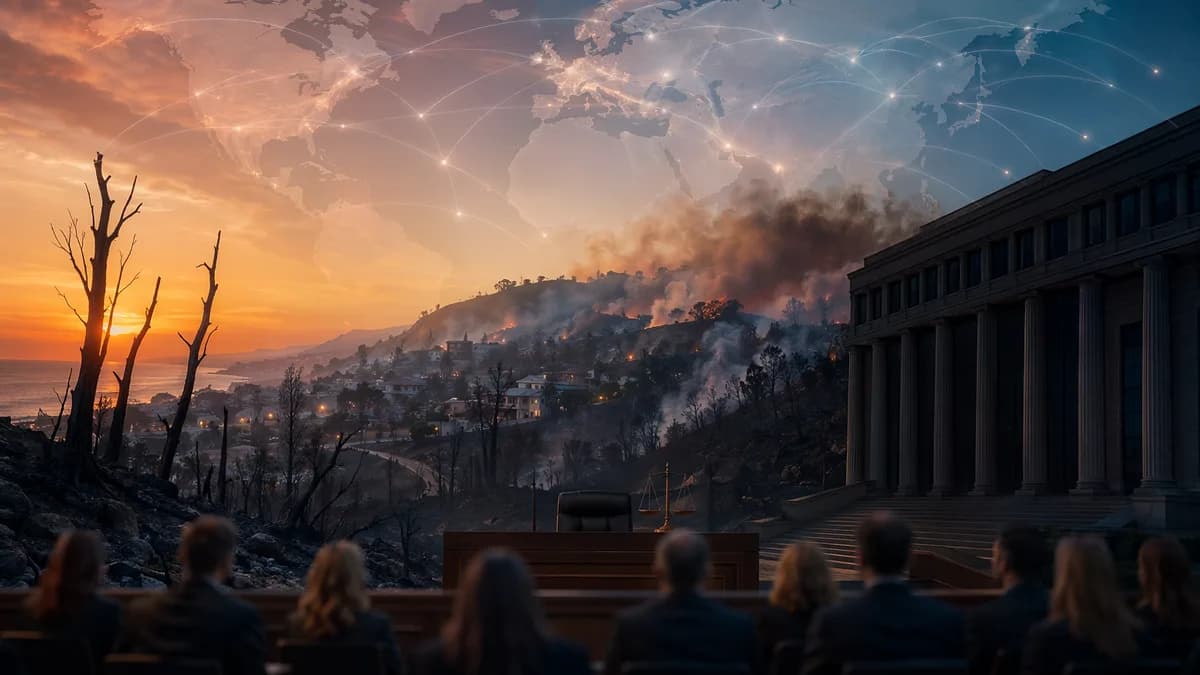
Ten of 12 jurors reportedly believed Jonathan Rinderknecht was innocent, yet he remains jailed and faces a new federal trial over the Palisades Fire arson case on October 19.
XOOMAR Intelligence
Analyst Take
That split is the real story beneath Friday’s mistrial. The Palisades Fire killed 12 people, destroyed entire coastal neighbourhoods north of Los Angeles, and became one of California’s deadliest wildfire disasters. But criminal court does not convict on devastation. It requires proof. A federal judge declared the mistrial after the jury failed to reach unanimity, according to Al Jazeera.
The case now becomes a sharper test of wildfire accountability in California: how prosecutors prove individual intent and causation when a small alleged ignition becomes a mass-casualty catastrophe through underground smouldering, wind, drought, and development in fire-prone terrain.
A 10-2 jury split turns the Palisades Fire arson case into a test of proof, not anger
Judge Anne Hwang declared a mistrial Friday morning after jurors said they could not reach a unanimous decision. Reuters reported the deadlock as 10-2 in favor of acquittal, with jurors unable to agree on any of the charges.
Federal prosecutors immediately said they would try again.
“The evidence is strong that Jonathan Rinderknecht is responsible for igniting the fire on January 1, 2025, which eventually became the Palisades fire. We fully intend to retry this case before a new jury and obtain guilty verdicts on all charged counts,” Bill Essayli, US attorney for the Central District of California, said in a social media post.
That statement shows the government is treating the mistrial as a tactical setback, not a collapse. The defense reads the same result differently. Defense lawyer Steve Haney said outside court that “Ten to two (for not guilty) is an overwhelming message from the jury that the government failed and did not have enough evidence to prove their case,” according to Reuters.
Both can be true in narrow legal terms. A mistrial is not an acquittal. But a jury leaning heavily toward not guilty is not a small warning sign for prosecutors.
This follows a broader pattern in high-stakes California accountability fights, where public pressure and legal proof do not always move together. XOOMAR has tracked that tension in policy disputes such as California Billionaire Tax Puts Tech Fortunes on Trial, 5% Wealth Fight Forces California Billionaire Tax Vote, and California billionaire tax ballot fight. The Palisades case is different, it is criminal and tied to deaths, but the same core question sits underneath: who can legally be made to bear responsibility?
Why jurors could see disaster and still reject the prosecution’s chain of causation
The prosecution alleged that Rinderknecht used a barbecue lighter to start a fire on January 1, 2025. Firefighters initially believed they had suppressed it. Prosecutors said the fire kept burning undetected in the root system, then reignited on January 7 as fierce winds pushed flames across dry terrain and into populated areas.
That theory depends on a long chain:
- Initial ignition: Did Rinderknecht start the January 1 fire?
- Intent: If he did, was it intentional arson?
- Continuity: Did that fire keep smouldering underground for nearly a week?
- Reignition: Did it become the January 7 Palisades Fire?
- Criminal causation: Can one alleged act be tied beyond reasonable doubt to the deaths and destruction that followed?
The government did not offer direct proof that Rinderknecht lit the initial blaze, Al Jazeera reported. It argued he was in the area and portrayed him as angry enough to seek revenge through arson.
A juror identified as Syrena told The Associated Press that the case lacked enough proof.
“There just isn’t enough proof,” she said.
“Shouldn’t the firemen, shouldn’t they have known?”
That second question matters. It points to the defense’s opening: even if Rinderknecht was nearby, jurors may have wondered whether fire suppression decisions, underground burning, and later wind conditions made the prosecution’s causal story too stretched for a criminal conviction.
The numbers are huge, but the courtroom question stayed narrow
The scale of the disaster is brutal. Reuters reported that nearly 7,000 homes and other structures burned and property losses were estimated at $150 billion. The Palisades Fire killed 12 people. Reuters also reported that Rinderknecht faced three felony counts: destruction of property by means of fire, arson affecting property used in interstate commerce, and burning timber on public land. If convicted as charged, he would face up to 45 years in prison.
Those figures raise the stakes. They do not lower the burden of proof.
| Issue | Prosecution position | Defense pressure point |
|---|---|---|
| Origin | January 1 fire allegedly lit by Rinderknecht | Defense challenged whether he caused it |
| Mechanism | Fire survived as a holdover fire in roots | Jurors could question the continuity of the fire |
| Evidence | Location data and presence near the area, per Reuters reporting | No direct proof reported by Al Jazeera that he lit the blaze |
| Motive | Prosecutors portrayed him as resentful and aggrieved | Motive is not ignition proof |
| Outcome | 12 deaths and massive destruction | Damage scale does not prove identity or intent |
A “holdover fire” is central here. In this context, it means a fire that appears extinguished but continues burning at low intensity below the surface before reemerging. Prosecutors said that is what happened between January 1 and January 7.
For jurors, that may have been the hardest bridge. The prosecution had to prove not just that a fire happened, or that Rinderknecht was nearby, but that his alleged act survived through time, terrain, fire response, and extreme weather to become the deadly Palisades Fire.
Prosecutors, defense attorneys, jurors, and families are not seeing the same mistrial
The mistrial produced four different readings.
Prosecutors see a case worth retrying. Essayli’s statement says they believe the evidence remains strong and that a new jury can return guilty verdicts on all charged counts. Their task in October is to make the timeline cleaner and the causation theory harder to fracture.
The defense sees reasonable doubt validated. Haney ruled out a plea agreement, saying, “Absolutely no deal. They're not going to offer one. We're not going to have any conversations. He didn't do it,” according to Reuters.
At least one juror saw the government’s case as incomplete. Syrena’s comments show the jury room may have wrestled not with the fire’s horror, but with whether blame had been assigned too narrowly.
Rinderknecht’s family saw the result as a victory undercut by continued detention.
“This is a big victory, and it feels so unfair that, given the circumstances, the government maintains my son in jail,” said Joel Rinderknecht, the suspect’s father.
Judge Hwang ordered Rinderknecht detained until the retrial begins on October 19, according to Al Jazeera.
Climate, drought, wind, and development made causation harder to fit inside one defendant
Al Jazeera reported that drought worsened by climate change, along with more people living in fire-prone areas at the edge of wildlands, has contributed to the increased lethality of wildfires in the Western US.
That context does not absolve anyone if arson is proved. But it complicates the story prosecutors must tell.
The Palisades Fire theory asks jurors to accept that one alleged ignition expanded into mass destruction because of later conditions: underground burning, dry terrain, fierce winds, and populated coastal development. Criminal law can handle that kind of causation, but jurors still need a clear path from act to outcome.
Analysis: this is where wildfire prosecutions become uniquely difficult. A gunshot or a bank transfer usually has a tighter evidentiary trail. A wildfire mutates. It moves through weather, vegetation, suppression decisions, and time. The bigger the disaster becomes, the more alternative explanations enter the courtroom.
That does not mean prosecutors cannot win in October. It means their second case cannot lean mainly on the scale of loss. They will need to make the first flame matter more than every intervening condition.
October 19 will test whether prosecutors can shrink a $150 billion disaster into provable intent
The next trial is set for October 19. Between now and then, prosecutors have an obvious roadmap from the mistrial: tighten the timeline, make the holdover-fire explanation easier to follow, and confront the jury’s apparent doubts about direct proof.
The defense has an equally clear path. It can press the 10-2 split as evidence that the first jury saw reasonable doubt, challenge the fire-origin narrative, and keep asking whether investigators turned one man into the face of a disaster shaped by many forces.
The strongest version of the prosecution case will be technical and disciplined. The strongest version of the defense case will be simple: proximity is not proof, motive is not ignition, and catastrophe is not guilt.
For Palisades residents still rebuilding, the retrial keeps legal accountability unresolved. For federal prosecutors, it raises the cost of losing again. The evidence that would confirm their thesis is not more outrage over the fire’s damage. It is a cleaner, tighter causal chain from January 1 to January 7. The evidence that would weaken it is already visible: jurors who believe the tragedy was real, but the proof against Rinderknecht was not enough.
Impact Analysis
- The mistrial highlights how difficult it is to prove individual criminal responsibility in complex wildfire disasters.
- The reported 10-2 split in favor of acquittal raises questions about the strength of the federal case.
- A retrial keeps the Palisades Fire case central to California’s debate over accountability after deadly wildfires.
Reported Jury Split in Rinderknecht Arson Case
Primary Sources & Disclosures

Written by
XOOMAR Insights Team
Research and Editorial Desk
The XOOMAR Insights Team pairs automated research with human editorial judgment. We track hundreds of sources across technology, fintech, trading, SaaS, and cybersecurity, cross-check the facts, and explain what happened, why it matters, and what to watch next. We do not just rewrite headlines. Every article is fact-checked and scored for reliability before it goes live, and we link back to the original sources so you can verify anything yourself.