
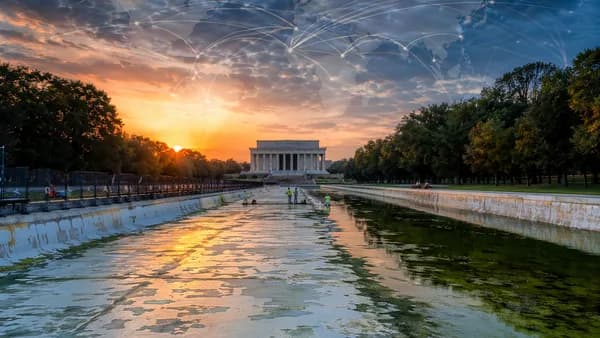
Can the Trump administration prove the Lincoln Memorial reflecting pool failed because of sabotage, not because its renovation went wrong?

Global TrendsJune 25, 2026· 8 min read· By XOOMAR Insights Team
Knife-Cut Claim Throws Reflecting Pool Fight Into Court
Updated on June 25, 2026
XOOMAR Intelligence
Analyst Take
85/ 100
4 sources analyzedMedium confidenceTrend10Freshness98Source Trust90Factual Grounding91Signal Cluster100
That is the question now sitting beneath a legal fight over one of Washington’s most visible public spaces. A senior National Park Service official said in a court filing that part of the pool liner was “cut with a sharp knife or razor” earlier this month, according to Guardian World. The claim gives the administration a more formal version of Donald Trump’s public vandalism argument, but it does not yet answer the harder questions about proof, responsibility, repair costs, or whether work at the site should continue while a lawsuit proceeds.
Why does a court filing matter more than Trump’s vandalism claim?
Political remarks can frame a controversy. A court filing has to survive scrutiny.
Frank Lands, deputy director for operations at the National Park Service, made the allegation in a filing tied to a lawsuit brought by The Cultural Landscape Foundation, a nonprofit seeking to stop the president’s renovation of the site. Lands said that on 9 June, after the reflecting pool renovation was “substantially complete”, US Park Police responded to an NPS report of damage.
The key language is direct:
“a caulk over the foam sealant that was cut with a sharp knife or razor and destruction of delaminating surface material”
Lands also said “approximately 70 fence post tops” were “thrown” into the water.
That is materially different from a campaign-style claim that “vandals” caused the mess. It places the allegation inside the record of a federal case. It names an agency official. It provides a date. It identifies a type of damage.
Still, the filing does not settle causation. The supplied reporting says Trump has claimed unidentified vandals caused problems at the site, including a 350ft “gash”, but the administration has not released photos or videos substantiating that specific claim. The filing describes cuts and thrown fence post tops. It does not, based on the supplied material, prove that vandalism caused the visible peeling blue coating or the algae bloom.
That distinction matters. The case is not only about whether damage occurred. It is about whether the damage justifies more federal action at the Lincoln Memorial reflecting pool while opponents argue the renovation process itself should be halted or reviewed.
What exactly is being alleged at the reflecting pool?
The allegation has three parts: a cut, surface damage, and debris thrown into the pool.
| Issue | Source-supported detail | What it does not yet prove |
|---|---|---|
| Cut material | Caulk over foam sealant was “cut with a sharp knife or razor” | Who did it, or whether it caused the broader coating failure |
| Surface damage | Filing cites “destruction of delaminating surface material” | Whether delamination came from vandalism, installation, water chemistry, or another cause |
| Fence post tops | “approximately 70 fence post tops” were thrown into the water | Whether the same person or group caused all reported damage |
| Algae bloom | Water turned green after completion | Whether sabotage had any role |
| Peeling coating | Large flakes of blue coating were seen peeling and floating | Whether the cut sealant explains the peeling |
The function of the liner is not cosmetic. AP-sourced reporting in the supplied material says the 2,000-foot-long basin was drained, a tinted plastic-like rubber lining was installed to waterproof and protect the concrete pool surface, and the pool was refilled. If that lining is compromised, the repair question becomes practical: drain the pool, inspect the damage, and determine what must be fixed.
Lands said NPS plans to begin draining the pool after the Independence Day celebration to conduct repairs, including assessing and repairing any lining damage. That timing is telling. The agency is not saying it will drain immediately before the holiday. It is preserving the ceremonial schedule, then moving to inspection and repair.
Which numbers sharpen the dispute, and which numbers are still missing?
The known numbers are attention-grabbing but incomplete.
Known from the supplied reporting:
- 9 June: NPS reported damage to US Park Police after the project was “substantially complete.”
- Approximately 70: fence post tops allegedly thrown into the pool.
- 2,000 feet: reported length of the basin in AP-sourced material.
- After Independence Day: NPS’s planned timing for draining and repair assessment.
Those numbers help map the dispute, but they don’t close it.
The missing figures are the ones that would let taxpayers judge scale and responsibility: repair estimates, inspection documentation, contract terms, warranty obligations, police evidence, and any technical finding linking the alleged cut to the peeling coating or algae. The source material says the administration has faced pressure to release photographic and video evidence supporting sabotage claims. That evidence remains central.
For readers tracking how legal procedure can decide public fights before the broader facts are fully aired, XOOMAR’s coverage of Supreme Court Locks RLUIPA Damages Door for Prisoners and Supreme Court Blocks Damages Over Rastafarian Dreadlocks is useful context on how much turns on what a court is actually being asked to do.
Who gets to define the public interest at the Lincoln Memorial reflecting pool?
The fight is now about stewardship, not just maintenance.
The Cultural Landscape Foundation sued in May to halt work on the project. In the AP-sourced material, the group urged the administration to “engage with experts and the public, and make an informed decision about what is best based on the consultations mandated by the law, instead of once again rushing ahead with half-baked ideas.”
That is the preservation argument in plain terms: slow down, document the process, and do not let urgency override required review.
The administration’s position, as reflected through the Lands filing, is that physical damage occurred after the project was substantially complete and must be repaired. That gives officials a maintenance rationale for action. But XOOMAR analysis: the strength of that rationale depends on whether the government can connect the alleged cuts to the visible failures now driving public scrutiny.
The public stake is direct because the Lincoln Memorial reflecting pool is a federal asset, a tourist site, and a ceremonial backdrop for the country’s 250th birthday celebrations. Taxpayers are also now being asked to evaluate a renovation that has produced green water, peeling coating, and claims of sabotage within days of completion.
That leaves the political pressure pointed toward documentation rather than rhetoric: what work was authorized, what failed, what damage was deliberate, and who should pay to fix the pool. Until those records are clear, procurement, accountability, and repair responsibility remain part of the same public-interest question.
How does symbolism make a damaged liner a national fight?
The Lincoln Memorial reflecting pool is not treated like ordinary federal infrastructure because it does not function like ordinary federal infrastructure.
The supplied reporting calls it a century-old site and ties the renovation to the country’s 250th birthday celebrations. Trump described the planned color as “American flag blue.” That phrasing alone turns a coating decision into a symbolic act.
XOOMAR analysis: when officials alter a landmark tied to national memory, small physical changes invite outsized scrutiny. A liner, a coating color, algae, or a strip of peeled material becomes evidence in a larger argument about authority. Who has the right to alter the appearance of a shared civic space? How fast can they move? Who reviews the work? Who verifies claims when damage appears?
The danger for the administration is that every unreleased photo or unexplained contract detail feeds suspicion. The danger for challengers is that documented damage can make a pause look less like preservation and more like delay in the face of needed repair.
Both sides now need evidence more than rhetoric.
What evidence would decide the next phase?
The next phase turns on proof, repair urgency, and how much restraint the judge wants to impose while the lawsuit proceeds.
The most important evidence would include:
- Photos and video: especially anything supporting or weakening Trump’s claim of a 350ft “gash.”
- Police records: reports tied to the 9 June incident and any later arrests or citations.
- Inspection findings: technical assessments of the cut sealant, delaminating material, algae, and peeling coating.
- Repair documents: estimates, schedules, contractor responsibility, and whether any fixes fall under prior work.
- Contract records: procurement details tied to the renovation work.
XOOMAR analysis: if the court treats the alleged cutting as enough reason to let work continue, future disputes over federal landmarks may lean more heavily on emergency repair narratives. If the judge demands more documentation before allowing further work, agencies could face a higher practical burden when they claim damage requires speed.
For now, the unresolved issue is narrow but decisive: whether the government can show that sabotage, rather than a troubled renovation process, explains the failures now visible in the water.
Impact Analysis
- The court filing turns a political vandalism claim into a formal allegation subject to legal scrutiny.
- The dispute could affect whether renovation work at the Lincoln Memorial reflecting pool continues during the lawsuit.
- The case raises unanswered questions about responsibility, repair costs, and proof of damage at a major public landmark.
Competing Explanations for Reflecting Pool Damage
| Claim | Basis | Unresolved Issues |
|---|---|---|
| Sabotage or vandalism | National Park Service filing says caulk over foam sealant was cut with a sharp knife or razor, and about 70 fence post tops were thrown into the water. | The filing does not identify who caused the damage or fully prove causation. |
| Renovation failure | The Cultural Landscape Foundation is suing to stop the president’s renovation of the site. | The article does not establish whether construction work contributed to the pool’s problems. |
Sources
- [1] Guardian World
- [2] Reflecting Pool liner was cut with knife or razor, National Park Service official says in court filing
- [3] Reflecting Pool liner was cut with a sharp knife or razor, National Park Service says
- [4] Reflecting Pool liner was cut with a sharp knife or razor, National Park Service says

Written by
XOOMAR Insights Team
Research and Editorial Desk
The XOOMAR Insights Team pairs automated research with human editorial judgment. We track hundreds of sources across technology, fintech, trading, SaaS, and cybersecurity, cross-check the facts, and explain what happened, why it matters, and what to watch next. We do not just rewrite headlines. Every article is fact-checked and scored for reliability before it goes live, and we link back to the original sources so you can verify anything yourself.
Explore More Topics
Related Articles
 Global Trends
Reflecting Pool Algae Turns Trump's Iran Boast Green
Green water at the Lincoln Memorial is turning Trump's $14.2m blue-pool promise into a very public credibility test.
Jun 19, 20267 min
 Global Trends
Reflecting Pool Algae Spoils Trump's $14M Blue Makeover
A $14M blue makeover for the Lincoln Memorial Reflecting Pool went green within a day, turning algae into a July 4 optics mess.
Jun 20, 20269 min
 Global Trends
$14M Flop May Force Lincoln Reflecting Pool Drain
A $14.2M Lincoln Reflecting Pool makeover may be drained again after algae, peeling paint and vandalism claims embarrassed Trump's America 250 push.
Jun 21, 20267 min
 Global Trends
Iran Nuclear Inspectors Claim Throws Vance Into Access Fight
Vance says Iran will let inspectors return, but the real fight is access. A 60-day roadmap now hinges on verification.
Jun 22, 20268 min
 Global Trends
Trump Meloni G7 Photo Claim Erupts Into Alliance Fight
Trump turned Meloni's denied photo plea into a fight over Iran, status and whether Italy owes Washington deference.
Jun 20, 20268 min
 Technology
Slate Auto Pickup Truck Bets $24,950 Will Hook Buyers
Slate priced its stripped-down EV pickup at $24,950, opening preorders as fees and the lost tax credit cloud the real cost.
Jun 24, 20265 min
 Technology
Anthropic Access Ban Drags EU Into White House Fight
Europe's fight for Anthropic access is now a Washington problem, turning frontier AI models into strategic infrastructure.
Jun 25, 20267 min
 Trading
Pump Pain Turns Gasoline Price Gouging Into DOJ Showdown
Trump wants a DOJ probe into gasoline price gouging, but experts say pump prices may lag crude's drop for weeks.
Jun 25, 20268 min
 Technology
Base Power Undercuts ComEd to Dodge PJM's Grid Jam
Base Power is using home batteries to undercut ComEd by 25% and bypass PJM's clogged interconnection queue.
Jun 25, 20268 min
 Technology
Free Windows 10 ESU Spares Holdout PCs From Risk Until 2027
Free Windows 10 ESU now lasts until October 2027, giving consumer PCs another year of critical patches.
Jun 25, 20265 min
Don't miss the signal
Get our weekly roundup of the stories that matter across tech, fintech, and trading. No noise, just signal.
Free forever. No spam. Unsubscribe anytime.