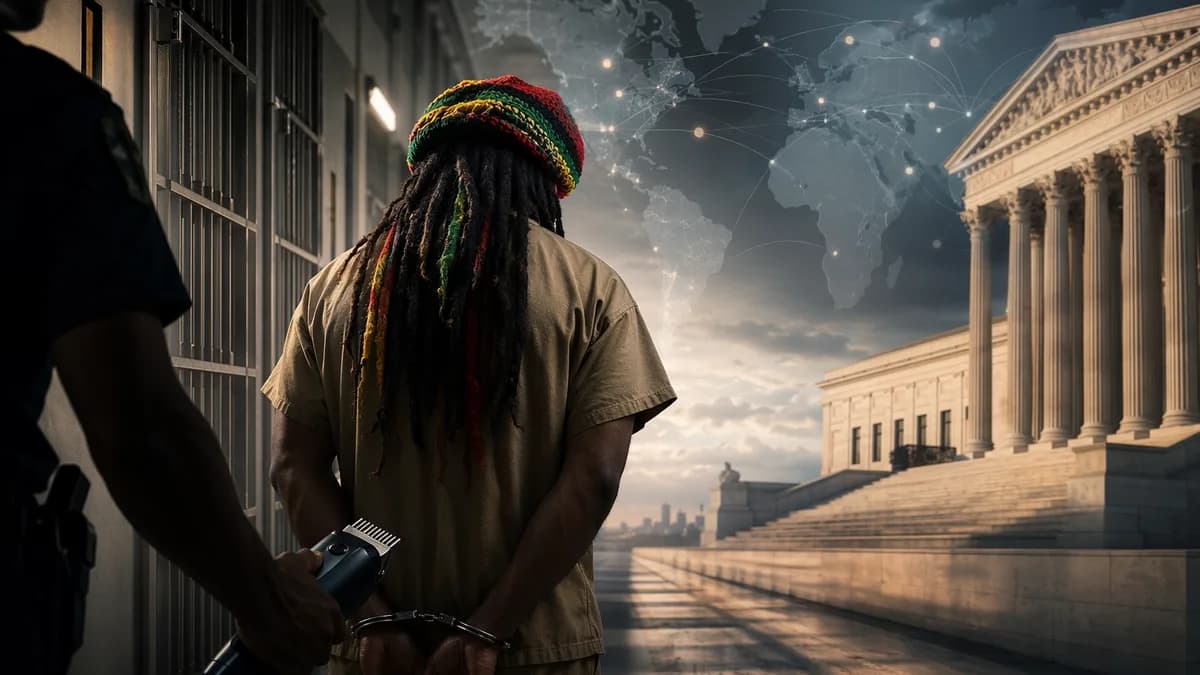
If prison officials violate a prisoner’s faith in a way that can’t be undone, what federal remedy is left after the Supreme Court’s RLUIPA damages ruling?
XOOMAR Intelligence
Analyst Take
That’s the real question behind Tuesday’s 6-3 decision blocking Damon Landor, a Rastafarian man in Louisiana, from suing individual prison officials for money damages after guards held him down and shaved his dreadlocks, according to Guardian World.
The court did not bless the forced shaving. It did something narrower, and more consequential for future prison cases: it held that RLUIPA, the federal law Landor invoked, does not let him sue individual state prison employees personally for damages.
That distinction matters. A forced haircut is over in minutes. A lawsuit takes years. If the only available remedy arrives after the religious violation is complete, the legal right can become more theory than protection.
For a shorter case brief on the ruling, see XOOMAR’s Supreme Court Blocks Damages Over Rastafarian Dreadlocks.
What happened to Damon Landor before the case reached the Supreme Court?
Damon Landor had grown his hair for more than 20 years as part of his Rastafarian faith. By the time he was incarcerated in Louisiana in 2020, his locks reached his knees.
Near the end of a five-month sentence for drug possession, Landor was transferred to the Raymond Laborde correctional center in Cottonport, Louisiana. He told officials that the fifth US circuit court of appeals had already ruled in 2017 that Louisiana’s policy of cutting Rastafarian prisoners’ hair violated RLUIPA.
He also handed over a copy of that ruling. According to court documents cited in the source material, a guard threw it in the trash.
Landor was then handcuffed to a chair, held down and shaved bald.
“When I was strapped down and shaved, it felt like I was raped,” Landor said in a statement during the case, as reported by ABC and cited in the source material.
For Landor, the injury was not cosmetic. The source material describes Rastafari as a religion dating back almost a century to Jamaica, with uncut dreadlocks integral to the faith. The case forced the justices to confront a blunt problem: what happens when prison control collides with a religious practice that cannot be restored after officials act?
Why did RLUIPA matter in a prison head-shaving case?
The Religious Land Use and Institutionalized Persons Act of 2000, known as RLUIPA, protects people confined in institutions such as prisons and jails from religious discrimination by state and local governments. It also applies in land-use disputes, but Landor’s case concerned the prison side of the statute.
Landor sued under that law because his claim was direct: Louisiana prison officials violated a federal religious-protection statute when they forcibly cut hair his faith required him to grow.
The supplied record makes clear that the case did not turn on whether Landor’s treatment was admirable or defensible. Even the lower-court record included sharp condemnation. A fifth circuit panel, according to additional source material, said it “emphatically condemn[ed] the treatment that Landor endured,” while still ruling against him on the damages question.
That is why the case became a remedies fight.
RLUIPA gave Landor a right. The question was whether it also gave him a way to collect money damages from the individual officials who allegedly violated that right.
The difference between a right and a remedy is not academic in prison. Transfers happen. Sentences end. Hair is cut. Once the violation is complete, an order telling officials not to do it again may do little for the person already harmed.
Why did the justices say Louisiana guards couldn’t be personally sued?
Justice Neil Gorsuch wrote the majority opinion, joined by Chief Justice John Roberts and Justices Clarence Thomas, Samuel Alito, Brett Kavanaugh and Amy Coney Barrett.
The majority held that Landor “does not have a federal RLUIPA cause of action against the officers.” Its reasoning focused on the Spending Clause, consent and the difference between government recipients of federal funds and individual employees.
“Under the Spending Clause, Congress lacks regulatory authority to impose liability on them directly and must depend instead on consent. And because they never agreed to answer suits like this one, Mr Landor’s case cannot proceed against them any more than a breach of contract action might proceed against a defendant who never formed a contract,” Gorsuch wrote.
In plain terms: RLUIPA is tied to federal funding conditions. The majority treated those conditions as binding the state or covered institutions, not as automatically exposing individual state employees to personal damages suits.
That reading shut down Landor’s case against the officers.
The court’s ruling also drew a contrast with a 2020 Supreme Court case under the Religious Freedom Restoration Act, or RFRA, where the justices allowed monetary damages claims against federal officials. That case involved three Muslim Americans who said FBI agents placed them on the government’s anti-terrorism “no-fly list” after they refused to become informants.
| Law | Source material describes it as | Damages outcome in cited Supreme Court cases |
|---|---|---|
| RLUIPA | A 2000 law protecting religious rights in state and local institutions, including prisons and jails | No individual-capacity damages against Louisiana prison officials in Landor’s case |
| RFRA | A 1993 law prohibiting religious infringement by the federal government | Monetary damages claims allowed in the 2020 no-fly list case |
The split matters because Landor’s lawyers argued the statutes were similar. The majority disagreed where state prison employees and RLUIPA were concerned.
Why did the dissent say this leaves prisoners exposed?
Justice Ketanji Brown Jackson dissented, joined by Justices Sonia Sotomayor and Elena Kagan.
Her objection went straight to enforcement. If prisoners cannot recover damages from individual officials after a completed violation, she warned, many religious-rights injuries will have no practical federal remedy.
Prisoners “like Landor who suffer violations of their religious freedom in state prisons – no matter how blatant – will often be left remediless. And encroachments on prisoners’ statutory rights are likely to happen with fair frequency, as state-empowered prison officials will have little incentive to abide by federal law, even if it is handed to them on a piece of paper.”
That last phrase lands because it tracks Landor’s allegation: he gave prison staff the relevant court ruling, and it was thrown away.
The dissent’s core point is not that every prisoner should automatically win damages. It is that a statutory protection loses force when officials can violate it quickly, irreversibly and without personal financial exposure under the law Congress wrote.
XOOMAR analysis: this is the decision’s sharpest practical edge. The majority framed the case through consent and federal funding doctrine. The dissent framed it through deterrence. Both were answering different questions, and prisoners will live with the answer that controls the judgment.
How could this change prison religious-rights disputes after forced shaving?
The Supreme Court’s RLUIPA damages ruling may push future prisoners toward remedies that work only if they arrive before the harm.
A prisoner who knows a grooming rule will be enforced against him might seek an injunction. A lawyer might sue for a policy change. Prison systems may also revisit training so staff understand what RLUIPA requires before an irreversible act happens.
But Landor’s facts show the weakness in that model. He was near the end of his sentence. He had already been transferred. He carried legal papers with him. The alleged violation happened anyway.
That makes completed harms the hard category.
Practical consequences include:
- Timing: A court order can be too slow when the disputed act happens on intake or transfer.
- Transfers: Moving prisoners can complicate claims for forward-looking relief.
- Deterrence: If officers do not face personal damages under RLUIPA, plaintiffs may argue the statute has less bite after the fact.
- Policy pressure: States may still face litigation over institutional policies, even if individual damages claims are blocked under this ruling.
This case also fits a broader courts-and-government-power thread. For readers tracking how judicial remedies shape public institutions, XOOMAR has covered related court-power fights in 1,400 Jobs Hang On as Court Blocks CFPB Layoffs Again and Eight-Year Cap Blocks Orbán in Hungary Term Limit Fight.
What options remain after the RLUIPA damages door closes?
The ruling closes one route: individual-capacity money damages under RLUIPA against the Louisiana prison officials in Landor’s case.
It does not, based on the supplied material, resolve every possible legal theory a prisoner might try after a religious-rights violation. Nor does it say prisons are free to ignore RLUIPA. The statute still exists. The question is how it can be enforced when the harm is already done.
The clearest remaining path under RLUIPA is forward-looking relief against unlawful policies or practices before an irreversible violation occurs. That is useful when prisoners have notice, access to counsel and enough time to get before a judge. Landor’s case shows how fragile those assumptions can be.
Congress also has a decision to make if it dislikes the result. The majority’s opinion turned on the absence of consent and the limits it saw in the statute. A more explicit damages provision would test a different statutory design, though the supplied ruling does not answer how the court would treat such an amendment.
The watch item now is how prisons respond. If departments treat this as a narrow damages ruling and train staff to avoid RLUIPA violations, the decision may stay contained. If officials read it as reduced litigation risk for fast, irreversible acts, the next fight will not be over whether the right exists. It will be over whether anyone can enforce it in time.
Impact Analysis
- The ruling limits prisoners’ ability to seek money damages from individual state officials under RLUIPA.
- Religious-rights violations that are irreversible may leave affected prisoners with little practical remedy.
- The decision could shape future prison litigation over faith-based grooming and religious accommodation policies.
Supreme Court Vote
Primary Sources & Disclosures

Written by
XOOMAR Insights Team
Research and Editorial Desk
The XOOMAR Insights Team pairs automated research with human editorial judgment. We track hundreds of sources across technology, fintech, trading, SaaS, and cybersecurity, cross-check the facts, and explain what happened, why it matters, and what to watch next. We do not just rewrite headlines. Every article is fact-checked and scored for reliability before it goes live, and we link back to the original sources so you can verify anything yourself.