
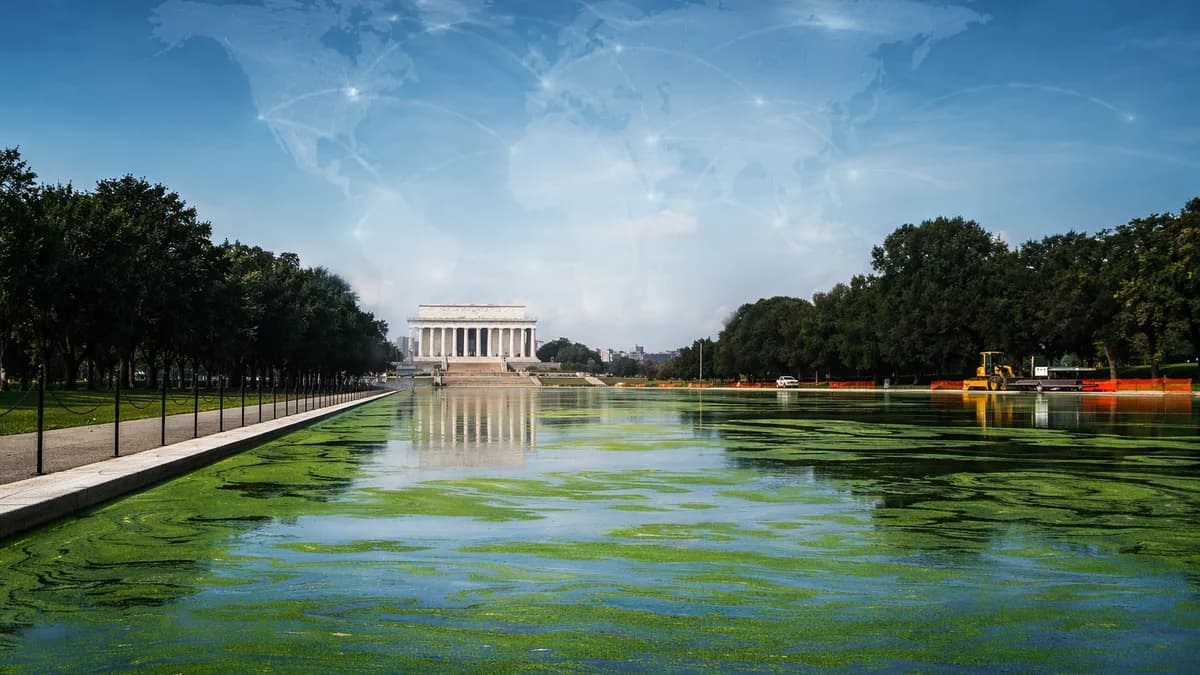
More than $14 million was spent to make the Lincoln Memorial Reflecting Pool “American flag blue,” yet Reflecting Pool algae began turning it green less than a day after the renovated pool was unveiled.
Global TrendsJune 20, 2026· 9 min read· By XOOMAR Insights Team
Reflecting Pool Algae Spoils Trump's $14M Blue Makeover
Updated on June 20, 2026
XOOMAR Intelligence
Analyst Take
59/ 100
4 sources analyzedLow confidenceTrend10Freshness96Source Trust88Factual Grounding88Signal Cluster40
That is the awkward core of the story: a highly visible federal beautification project collided with summer water biology right before July 4 planning season. Workers poured hydrogen peroxide into the pool on Wednesday morning, while the Interior Department is also using nanobubble ozone technology to fight the bloom, according to Wired.
The stakes are mostly visual and operational. The source material does not say the algae makes the National Mall unsafe for visitors. But the pool is one of Washington’s most photographed civic spaces, and a bright green basin undercuts the very point of a renovation built around national symbolism.
This is also why the story has spread beyond monument maintenance. As we reported in Reflecting Pool Algae Turns Trump's Iran Boast Green, the pool has become a small but vivid optics problem for an administration that promoted the renovation heavily.
Why a $14 million renovation still met green water in less than a day
The Trump administration spent more than $14 million updating the pool before celebrations tied to the nation’s 250th anniversary, according to Wired. CNN put the renovation cost at $14.2 million. The work included painting the pool blue and fixing leaks, according to the source material.
But renovation work does not remove every condition that lets algae grow. The Interior Department told CNN the bloom came from startup conditions after construction:
“What you are seeing is residual algae from the supply lines, which have been sitting dormant for eight weeks while construction has been taking place. It’s part of the normal startup process. We are removing the algae, and the nanobubblers will maintain the pool and keep it algae free,” communications director Kate Martin said.
That explanation fits one part of the timeline: the algae appeared after the pool was refilled following construction. It does not settle every question. Wired reported that one issue appears to be the water source. The Reflecting Pool usually draws from the nearby Tidal Basin, which is often filled with algae. During periods with high algae levels, the supply switches to municipal drinking water. Wired said the Interior Department did not immediately answer which source was feeding the pool.
So the simplest answer is also the least politically satisfying: the renovation changed the pool’s surface and presentation, but it did not make the basin immune to algae, dormant supply lines, weather, or water-source problems.
Hot weather gives Reflecting Pool algae exactly what it needs
The strongest science-based explanation in the source material is heat. Hans Paerl, a former professor at the University of North Carolina's Institute of Marine Sciences, told Wired that high temperatures create “a perfect storm for [algae] to bloom.”
Stagnant water makes it worse, Paerl said.
“Lakes and reservoirs around the world—they all have this problem during this time of year.”
The Reflecting Pool is not a fast-moving treatment plant. It is a long, shallow, open civic basin built to mirror the Lincoln Memorial and Washington Monument. That design is excellent for images. It is less forgiving when water sits through hot weather.
Paerl tied the problem to a broader temperature trend:
“It’s just getting hotter, and these blooms are expanding globally—they’re moving up into higher latitudes,” he says. “It’s clearly a temperature effect allowing them to optimize their growth.”
That does not mean climate change alone caused this specific bloom. The source material points to several overlapping factors: hot weather, stagnant water, possible algae in supply lines, and uncertainty around the water source. The relevant lesson is narrower and more useful: a green pool does not require one dramatic failure. It can happen when routine controls lag behind summer conditions.
| Factor cited in source material | How it connects to the green pool |
|---|---|
| Dormant supply lines | Interior said “residual algae” remained after eight weeks of construction |
| Hot temperatures | Paerl said heat creates “a perfect storm” for algae growth |
| Stagnant water | Paerl said stagnant water makes algae problems worse |
| Tidal Basin water | Wired reported the pool usually draws from a source often filled with algae |
| Startup after renovation | CNN described visible algae a day after the pool was filled |
What Trump’s renovation changed, and what it did not solve
The renovation became politically charged because Trump personally promoted it. Wired reported that he touted work that included painting the pool blue and fixing leaks. CNN reported he had initially said the project would cost $1.8 million, then the figure rose to $13.1 million, before “seemingly settling at $14.2 million.”
The Obama administration spent $34 million on a two-year renovation of the pool in the early 2010s, according to Wired. CNN cited a contract summary putting Obama-era renovation costs at $35.3 million. The Biden administration did not do any major renovations, Wired reported.
Trump has falsely said both administrations spent “hundreds of millions of dollars” on the pool, according to Wired. The Interior Department also criticized the Obama-era work, saying those renovations “resulted in massive algae clumps taking over the pool’s surface following years of construction that cost taxpayers millions upon millions only to be broken and disgusting days later.”
The current renovation may still matter if it improves leaks, surface conditions, or maintenance access. But the algae bloom exposes the limit of cosmetic certainty. A blue coating can change how the pool looks when the water is clear. It cannot guarantee clear water when algae survives in pipes, heat rises, or treatment systems need time to catch up.
That distinction matters for accountability. The fair test is not whether the Reflecting Pool can avoid algae forever. It is whether the new work makes recurring maintenance easier, faster, and more reliable.
Hydrogen peroxide and nanobubbles are the fast cleanup tools before July 4
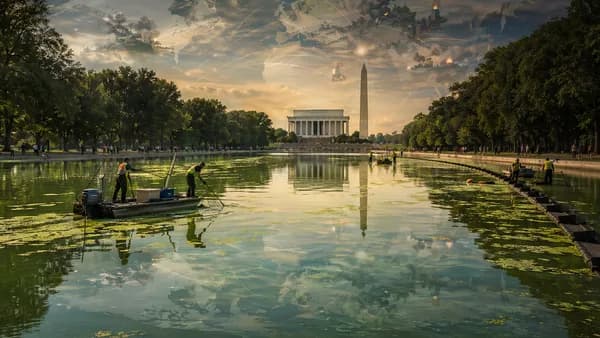
National Park Service workers are trying to clear visible Reflecting Pool algae quickly. Wired reported that workers poured hydrogen peroxide into the pool on Wednesday morning. The Interior Department also told Wired it is “deploying high-tech nanobubble ozone technology” to keep algae at bay.
The source material gives more detail on the nanobubble system than on the peroxide treatment. The New York Post, citing online federal contracting records, reported that the Trump administration spent $1.7 million on an upgraded ozone nanobubbler filtration system intended to disperse tiny oxygen bubbles to undercut algae’s food supply.
The practical challenge is timing. A national landmark does not need a perfect lab result before July 4. It needs the pool to look clear enough for tourists, ceremonies, cameras, and White House messaging.
That is why the visible cleanup matters as much as the technical treatment. The Post reported that National Park Service workers were pushing algae toward an aeration area on June 14, 2026. CNN spotted a worker clearing algae from the bottom of the recently filled pool on Wednesday.
The administration says the technology is working. The Interior Department told The Post:
“The nanobubbler technology has successfully destroyed the algae bloom that has plagued every pool reopening since 1922, most infamously, the Obama pool reopening that resulted in massive algae clumps taking over the pool’s surface.”
That claim is sweeping, and the public test is simple: whether visitors see blue water or green water.
A backyard pond explains the problem, but the National Mall raises the pressure
A small shallow pond can turn green after several hot days if water sits and organic material builds up. The scale is different in Washington, but the source-backed mechanics overlap: heat, stagnant water, and algae already present in the system can move faster than managers want.
The Reflecting Pool is much larger than a backyard pond. The Post described it as a 6.7 million-gallon artificial basin constructed in the early 1920s. That size makes cleanup more public and more complex. Crews are not just treating a private water feature. They are maintaining a federal landmark bordered by heavy foot traffic and constant photography.
The analogy also shows why a one-day cleanup is hard. If algae is visible across parts of a large basin, crews need treatment, physical removal, and time for systems to work. CNN reported that officials did not want to speculate on timing because of rain. Wired reported hotter-than-normal weather was expected to hit Washington, DC, near the end of the week, which could make control more challenging.
That is the operational reality behind the political joke. The pool can be repainted in a patriotic color. The water still has to be managed every day.
Future heat waves will judge the renovation more than opening week did
The next serious test is not a press release. It is the next stretch of hot weather.
If the renovated pool stays clearer through Washington heat, the administration can argue the repairs and nanobubble system improved day-to-day maintenance. If Reflecting Pool algae keeps returning, the blue coating will look more like branding than a fix.
Several watch items now matter:
- Water source: Whether the pool is drawing from the algae-prone Tidal Basin or municipal drinking water during blooms.
- Treatment performance: Whether hydrogen peroxide and nanobubble ozone technology clear visible algae fast enough for public events.
- Leak repairs: The Post reported the pool had leaked about 16 million gallons of water every year, according to the Interior Department, and that pipe repairs are planned for the fall.
- Heat resilience: Paerl’s warning suggests hotter weather will keep raising the maintenance burden.
The algae bloom is embarrassing because it happened at the center of the National Mall after a costly renovation. But it is also predictable for a shallow outdoor pool in hot weather. The practical takeaway is blunt: judge the project by whether it reduces repeat failures, not by whether it can suspend biology through July 4.
And politically, the pool is now part of a larger pattern of visible tests for Trump’s second-term messaging, from infrastructure optics to foreign-policy claims covered in Trump's Iran Peace Deal Erases US Red Lines at Versailles. The Reflecting Pool may be a maintenance problem. On camera, it has become something sharper.
Impact Analysis
- A high-profile $14.2 million federal renovation quickly ran into a visible algae problem.
- The green water undermines the project’s symbolic goal of presenting the Reflecting Pool as “American flag blue.”
- The episode creates an optics challenge ahead of July 4 planning and the nation’s 250th anniversary celebrations.
Reported Reflecting Pool Renovation Cost
CNN estimate
$ millions14.2
Sources

Written by
XOOMAR Insights Team
Research and Editorial Desk
The XOOMAR Insights Team pairs automated research with human editorial judgment. We track hundreds of sources across technology, fintech, trading, SaaS, and cybersecurity, cross-check the facts, and explain what happened, why it matters, and what to watch next. We do not just rewrite headlines. Every article is fact-checked and scored for reliability before it goes live, and we link back to the original sources so you can verify anything yourself.
Explore More Topics
Related Articles
 Global Trends
Reflecting Pool Algae Turns Trump's Iran Boast Green
Green water at the Lincoln Memorial is turning Trump's $14.2m blue-pool promise into a very public credibility test.
Jun 19, 20267 min
 Global Trends
Trump Seizes America's 250th Anniversary Rally Stage
Trump’s June 24 rally puts him at the center of America’s 250th anniversary launch before the state fair and July 4 events.
Jun 16, 20268 min
 Global Trends
Trump's Iran Peace Deal Erases US Red Lines at Versailles
Trump's Versailles deal accepts what Washington once rejected: Iran keeps leverage, and US red lines from 2025 are gone.
Jun 20, 20268 min
 Global Trends
Trump's US-Iran Agreement Masks a Nuclear Deadline
Trump sells a US-Iran breakthrough, but the text only buys 60 days, reopens Hormuz, and leaves the nuclear fight unresolved.
Jun 17, 20268 min
 Global Trends
Vance Exposes Major Blanks in Trump's US-Iran Agreement
Vance says Trump's US-Iran agreement is still a framework, giving GOP hawks an opening to demand details on sanctions, Hormuz and Iran cash.
Jun 16, 20268 min
 Technology
Brazil Cracks Apple's App Store Fortress Wide Open
Brazil forced open another gate in Apple’s iPhone economy, widening the global antitrust fight over apps and payments.
Jun 20, 20268 min
 Technology
AI Data Centers Grab a Federal Fast Lane to the Grid
FERC wants faster grid access for AI data centers, but it won't create new power. Prices and reliability are the next fight.
Jun 20, 20268 min
 Technology
Retail Data War Pits Amazon Against Walmart for Ad Cash
Amazon and Walmart are racing to turn shopper data into retail’s new power center, where ads, AI and grocery habits decide who wins.
Jun 20, 20268 min
 Trading
STRC Preferred Stock Breaks Par as Saylor’s Bet Wobbles
STRC’s drop below $83 turned Strategy’s preferred stock into a stress test for Saylor’s bitcoin-funded balance sheet.
Jun 20, 20269 min
 Global Trends
16 Dead as Israel Lebanon Ceasefire Cracks Overnight
A Trump-backed Israel Lebanon ceasefire was shaken within hours after strikes killed at least 16 in southern Lebanon.
Jun 20, 20265 min
Don't miss the signal
Get our weekly roundup of the stories that matter across tech, fintech, and trading. No noise, just signal.
Free forever. No spam. Unsubscribe anytime.