
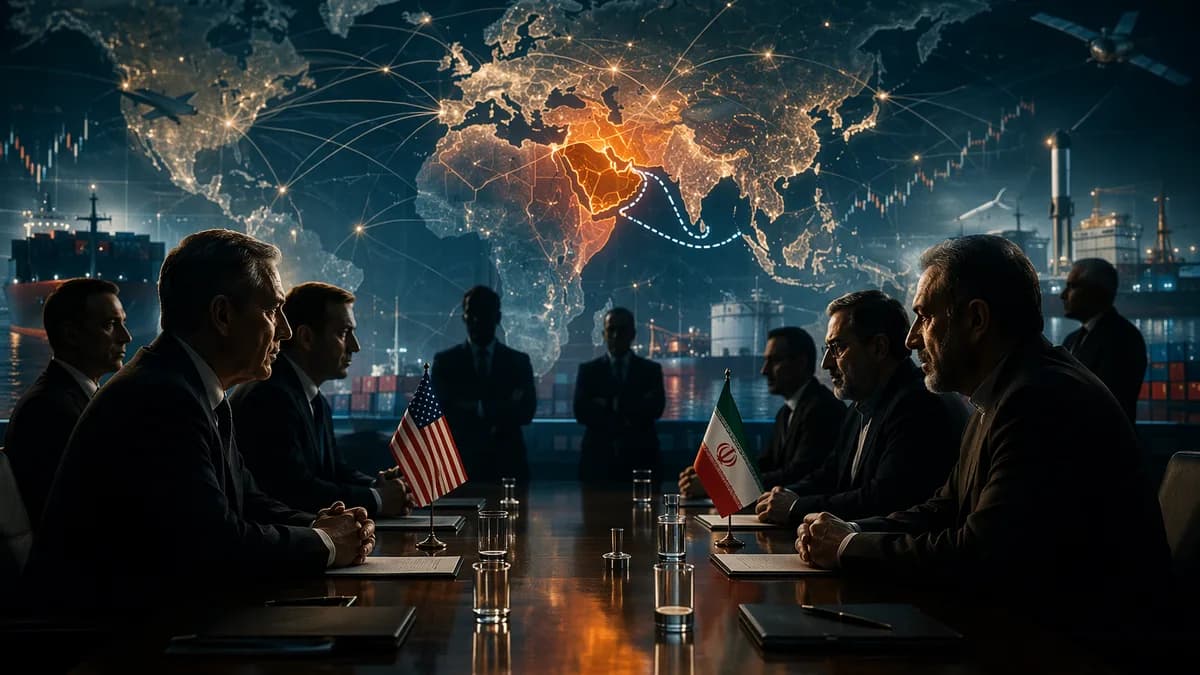
The US-Iran agreement was pitched as a breakthrough to end the war in Iran, but JD Vance is now describing it as a document with major blanks still waiting to be filled.
Global TrendsJune 16, 2026· 8 min read· By XOOMAR Insights Team
Vance Exposes Major Blanks in Trump's US-Iran Agreement
Updated on June 16, 2026
XOOMAR Intelligence
Analyst Take
72/ 100
4 sources analyzedMedium confidenceTrend10Freshness98Source Trust90Factual Grounding93Signal Cluster40
That contradiction is the story. The memorandum of understanding announced Sunday by Donald Trump is meant to reopen the Strait of Hormuz, lift the United States’ naval blockade in the region, and offer Iran financial incentives if it meets benchmarks, according to Guardian World. Yet Senate Republicans returned to Washington asking a basic question: what, exactly, has the White House agreed to?
Trump's Iran MOU puts Republican hawks in the awkward role of demanding transparency
The White House wants the US-Iran agreement read as strength: war winding down, Hormuz reopening, Tehran bound to conditions. Senate Republicans are not yet buying it.
Vance, in a CNN interview Monday, called the MOU “a very general document” and said the specifics would be handled later. That matters because the agreement is not being sold as a narrow ceasefire note. It touches nuclear compliance, sanctions relief, frozen funds, naval posture, and shipping through one of the world’s most sensitive waterways.
“The MOU … is about a page,” Vance said. “On a number of issues, we are going to have to figure this stuff out during the technical negotiation phase.”
That is a revealing admission. XOOMAR analysis: this looks less like a settled peace deal than a political framework designed to stop the immediate bleeding, then push the hardest questions into follow-up talks.
That approach creates a problem for Trump. Reopening Hormuz and ending a blockade sound decisive. But once the deal includes financial incentives for Iran, the political burden shifts. Republicans now want to know whether the White House has traded pressure for promises it cannot verify.
The Geneva signing could expose how thin the US-Iran agreement really is
The known structure is simple. The MOU was announced Sunday. A ceremonial signing is set for Friday in Geneva. It is centered on reopening the Strait of Hormuz, lifting the US naval blockade, and linking financial benefits for Iran to benchmarks.
The unknowns are larger than the knowns.
Senate majority leader John Thune said he had not been personally briefed. His concern was enforcement: “I think the issues are going to be compliance, and how are you going to enforce that.”
Thom Tillis was blunter: “If it’s a secret deal then how can I take it seriously?”
The missing pieces now define the fight:
- Verification: Who determines whether Iran is complying?
- Nuclear material: Who handles highly enriched uranium believed to be buried under damaged nuclear sites?
- Sanctions relief: Which restrictions are lifted, waived, or delayed?
- Funds: What conditions apply before Iran receives any benefit?
- Enforcement: What happens if Iran breaches the benchmarks?
The political risk sits in the format. An MOU can move faster than a treaty or a full congressional approval process. That speed is useful in a crisis. It also gives critics room to argue that the administration is making security and financial commitments before Congress has seen the text.
For readers tracking how Hormuz became the central pressure point, XOOMAR’s earlier coverage on Strait of Hormuz Risk Surges as Trump Torches Iran Leak and Trump’s 60-Day Iran Deal Stakes Oil and Credibility gives useful context on why the waterway dominates this deal.
Hormuz, blockade relief, and Iranian incentives will shape the fight
The Strait of Hormuz is not a symbolic clause. The BBC reported that one-fifth of the world's liquefied natural gas and oil normally pass through the strait, and that its closure has hit global fuel trade. That is why markets and governments care less about ceremony than traffic.
A deal that reopens Hormuz and lifts the blockade can reduce immediate pressure. But the financial side will dominate Capitol Hill scrutiny.
US officials told reporters Monday that the MOU includes the possibility of releasing Iran’s frozen funds, sanctions relief, and a $300bn fund to help rebuild Iran if Tehran meets benchmarks. Vance appeared to confirm the reconstruction fund in interviews, while saying it would be paid for by neighboring Gulf states.
His core defense was conditionality.
Vance said the White House would release the text this week, “and what everybody will see is that Iran doesn’t get a dime of money unless they perform their obligations”.
That line is now the standard the administration has set for itself. If the text is vague, Republican skepticism will harden. If the benchmarks are specific, the White House gets a stronger argument that the deal is pressure with conditions, not relief up front.
Before the MOU, the logic was military pressure first. After the MOU, the argument becomes performance first.
- Before: Blockade, conflict, pressure on Hormuz.
- After: Reopening, sanctions questions, benchmark fights.
- Before: Iran judged mainly by military threat.
- After: Iran judged by compliance tests that have not been released.
Republicans, the White House, Iran, and markets want different things
The Republican divide is not yet a full rebellion, but it is real. Lindsey Graham, a close Trump ally and longtime Iran hawk, said he wants to see the memorandum and expects Congress to review and vote on it.
“The way Iran describes it, it’s awful. The way we describe it, it makes sense to me,” Graham said. “Let’s look at it and see what it actually is.”
Vance pushed back, telling ABC he would “caution Lindsey Graham and anybody else not to believe the hardliner propaganda in Iran, but to believe what’s actually in the agreement.”
That exchange captures the core tension. The White House wants trust until disclosure. Republicans want disclosure before trust.
| Stakeholder | Immediate priority | Pressure point |
|---|---|---|
| Trump White House | Sell the MOU as a diplomatic win | Must release text and defend benchmarks |
| Senate Republicans | Review enforcement and money terms | Lack of briefing fuels suspicion |
| Iran | Gain relief while limiting pressure | Compliance terms may define actual benefit |
| Energy markets | Safe movement through Hormuz | Ceremony matters less than ships moving |
XOOMAR analysis: the White House benefits if the agreement quickly reopens Hormuz and delays nuclear disputes into technical talks. Iran benefits if relief begins before the hardest verification questions are settled. Congress benefits politically by forcing those details into public view.
From the 2015 nuclear deal to Trump's new Iran bargain, Washington is relitigating trust
The comparison with the 2015 Iran nuclear deal is unavoidable, but the agreements are not identical.
Iran agreed in 2015 to sharply curtail its nuclear program under a deal signed with the Obama administration. Trump withdrew the US from that accord during his first term. That earlier agreement allowed Iran to regain billions of dollars in frozen assets, which Trump has long attacked as sending “pallets of cash” to Iran.
Now Trump faces a version of the argument he once used against his predecessors. If Iran receives sanctions relief, access to frozen funds, or reconstruction support, Republicans will ask whether Tehran changes behavior first or gets paid for promises.
The administration’s answer is benchmarks. The weakness is that the benchmarks are not public yet.
That is why Vance’s “about a page” comment matters. A short MOU can state intent. It cannot, by itself, settle every dispute over enriched uranium, inspections, sanctions sequencing, and enforcement triggers.
For energy buyers, defense planners, and investors, the MOU trades military risk for policy risk
The US-Iran agreement may reduce immediate military risk around Hormuz. It may also replace that risk with policy uncertainty.
For energy buyers, the key test is practical: can vessels move through the strait without the blockade and without fresh disruption? For defense planners, the issue is whether lifting pressure reduces escalation or weakens US leverage before Iran’s nuclear obligations are nailed down.
For investors, the headline risk is obvious from the structure of the deal. A signed ceremony in Geneva may calm nerves only if the text answers the enforcement questions now coming from Trump’s own party.
This is where the market angle and the political angle meet. If compliance is measurable, the MOU can become a bridge from war to negotiation. If compliance is discretionary, each briefing, leak, Iranian statement, or congressional objection can become a fresh stress point.
The next phase will be decided by disclosures, benchmarks, and the first breach
The immediate fight moves to Capitol Hill. Republicans will demand briefings, the text of the MOU, and clarity on any frozen funds, sanctions relief, or reconstruction money tied to Iran.
The pressure points after Geneva are already visible: benchmark definitions, timing of blockade relief, inspection rights, enriched uranium, and who gets to certify compliance. The first alleged breach will test whether the MOU has enforcement power or only diplomatic language.
Vance says the text will come this week. That release is the next real event, not the ceremony.
If the administration publishes a disciplined framework with verifiable obligations, the deal could hold long enough to stabilize Hormuz and move the nuclear dispute into technical talks. If it relies on vague promises and private assurances, Republican skepticism will become the first serious threat to Trump’s new Iran bargain.
Impact Analysis
- The agreement could affect shipping through the Strait of Hormuz, one of the world’s most strategically important waterways.
- Republican skepticism signals potential political trouble for Trump if the deal is seen as too soft on Iran.
- Unresolved details on sanctions, nuclear compliance, and financial incentives could determine whether the MOU becomes a durable deal or a temporary pause.
US-Iran MOU: Administration Framing vs Republican Concerns
| Issue | White House Position | Republican Concern |
|---|---|---|
| Overall deal | Presented as a breakthrough to wind down the war in Iran | Seen as too vague, with major details unresolved |
| Strait of Hormuz | Aims to reopen the key waterway | Questions remain over what the US conceded to secure reopening |
| Iran incentives | Financial incentives tied to Iranian benchmarks | Fear that pressure is being traded for promises that may be hard to verify |
| Negotiation status | Framework to be refined in technical talks | Lawmakers want transparency before details are finalized |
Sources

Written by
XOOMAR Insights Team
Research and Editorial Desk
The XOOMAR Insights Team pairs automated research with human editorial judgment. We track hundreds of sources across technology, fintech, trading, SaaS, and cybersecurity, cross-check the facts, and explain what happened, why it matters, and what to watch next. We do not just rewrite headlines. Every article is fact-checked and scored for reliability before it goes live, and we link back to the original sources so you can verify anything yourself.
Explore More Topics
Related Articles
 Global Trends
Trump Iran Talks Turn Paused U.S. Strike Into Leverage
Trump paused U.S. strikes to force Iran back to talks, but the threat could deepen the Hormuz and nuclear standoff.
Aug 3, 20267 min
 Global Trends
Trump Shelves Iran Strikes Unless a Deal Lands Fast
Trump says Iran strikes are shelved only if a rapid deal opens Hormuz and ends the nuclear threat. The pressure hasn't vanished.
Aug 2, 20265 min
 Global Trends
US-Escorted Tankers Hit as Strait of Hormuz Shuts Down
Iran says it struck two US-escorted tankers, nearly closing Hormuz and forcing Trump to weigh war strategy as energy prices jump.
Jul 31, 20267 min
 Global Trends
Iran Seizes Control Over Strait of Hormuz Via Secret Oman Deal
Iran formalized a temporary shipping route with Oman, cementing Tehran's administrative control over the Strait of Hormuz while keeping blame for insecurity on
Aug 5, 20266 min
 Global Trends
Oil Shock Exposes Germany Energy Drag Behind Ifo Jump
Germany’s Ifo jump may be stale. Commerzbank sees oil costs capping 2026 growth at just 0.6%.
Jul 28, 20267 min
 Trading
Iran Demands Shipping Toll To Reopen Oil Chokepoint
Global markets rallied on news of the Strait of Hormuz reopening, but the deal would grant Iran unprecedented control to collect transit tolls.
Aug 6, 20266 min
 Trading
WTI Crude Paralyzed at $74 Amid Hormuz Showdown
WTI crude prices are stuck near three-week lows, not due to calm but to paralysis as traders await a binary outcome for the Strait of Hormuz that could detonate
Aug 6, 20267 min
 Trading
Gold's Lockstep Surge Hints at Dollar Replay
Gold is rallying alongside oil, breaking its traditional inverse relationship. This reveals a market shift—bullion is pricing a tangible inflation premium from
Aug 6, 20266 min
 Technology
OpenAI's Doughnut Speaker Builds Moving AI Personality
OpenAI's first hardware is a portable, $300 'doughnut' speaker with moving parts, engineered to be an 'AI-first computer' that learns your personality, not just
Aug 7, 20265 min
 Global Trends
Trump Slaps 15% Tariff on China's Chip Silicon
A new US policy levies a 15% tariff and minimum price on imported polysilicon, directly targeting Chinese control over the foundational material for chips and s
Aug 7, 20268 min
Don't miss the signal
Get our weekly roundup of the stories that matter across tech, fintech, and trading. No noise, just signal.
Free forever. No spam. Unsubscribe anytime.