
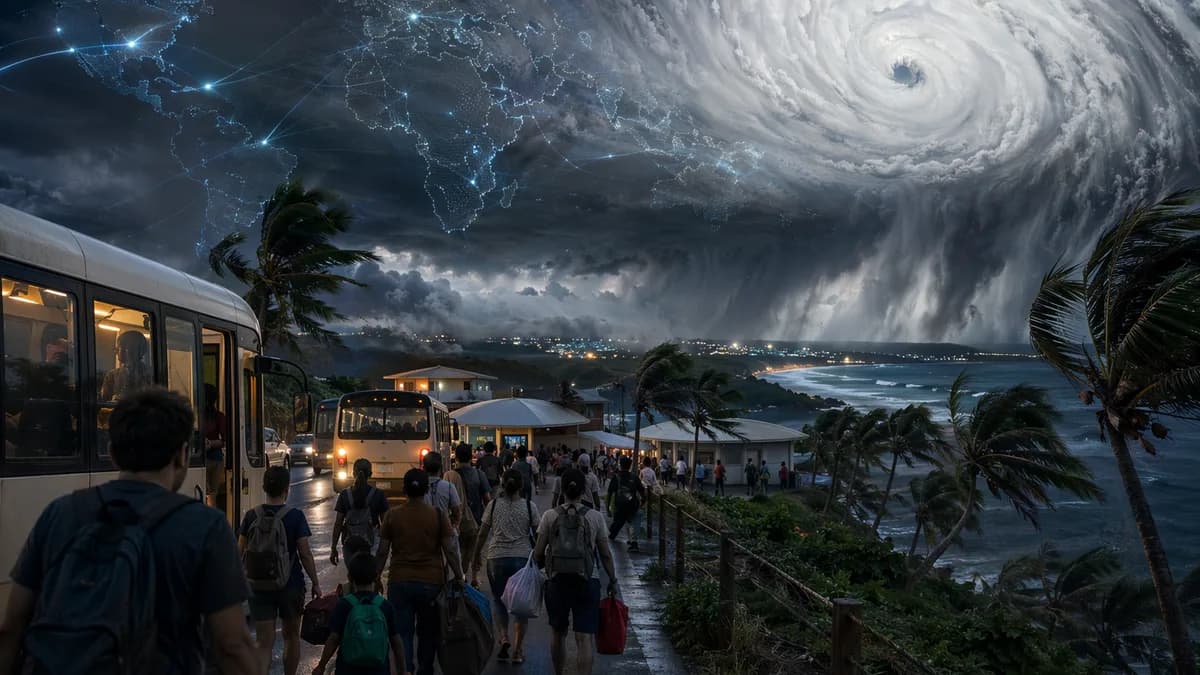
Super Typhoon Bavi is forcing Guam to test whether its evacuation shelters and emergency systems can move faster than a storm forecast to arrive with 160mph winds and waves nearly 11m high.
Global TrendsJuly 5, 2026· 8 min read· By XOOMAR Insights Team
160mph Super Typhoon Bavi Throws Guam Into Evacuation Race
Updated on July 5, 2026
XOOMAR Intelligence
Analyst Take
59/ 100
4 sources analyzedLow confidenceTrend10Freshness99Source Trust92Factual Grounding91Signal Cluster20
Emergency evacuations are under way in Guam and the Northern Mariana Islands as Bavi bears down on the US Pacific territories, according to BBC World. The US National Weather Service has called the storm “very dangerous” and warned of “catastrophic” damage, with “significant flooding from torrential rains” possible on Monday.
Guam's evacuations turn Super Typhoon Bavi into a resilience test
The immediate story is evacuation. The deeper test is timing.
Guam has opened five evacuation centres in schools, with total capacity of around 1,700 people. The island has a population of about 170,000. These centres are aimed primarily at vulnerable people, and Guam’s civil defence office said that by 13:00 local time (03:00 GMT) on Sunday, one site had already reached capacity and people were being redirected.
That gap between total population and shelter capacity does not mean every resident needs public shelter. It does show why official triage matters. People in weaker homes, flood-prone areas, or places exposed to high winds have less room for delay.
“The window is rapidly closing to evacuate if directed to do so by local officials, or if your home is vulnerable to high winds or flooding,” the NWS said, adding that winds “will pose a deadly threat to those venturing outside”.
XOOMAR analysis: the success of Guam’s response will not hinge on dramatic rescues during peak winds. It will hinge on whether residents who need to move can do so before movement becomes unsafe.
The numbers behind Bavi: 160mph winds, 11m waves, and little slack
The forecast is severe by any standard. The NWS expects Bavi to make landfall early Monday morning with winds of up to 257km/h (160mph). The storm is expected to pass directly over Guam and the Northern Mariana Islands by Monday afternoon.
The warning window is wider than the eye of the storm. The NWS said destructive conditions could arrive eight to 10 hours before or after the storm centre reaches the islands. That matters because a resident who waits for landfall on a clock may already be too late.
| Forecast marker | Source detail |
|---|---|
| Landfall timing | Early Monday morning |
| Expected path | Directly over Guam and the Northern Mariana Islands by Monday afternoon |
| NWS wind forecast | Up to 257km/h (160mph) |
| Wave forecast | Potentially nearly 11m (35ft) high |
| JTWC intensity forecast | 150 knots (173mph), with gusts up to 180 knots (207mph) |
The Joint Typhoon Warning Center, part of the US Navy, has classified Bavi as a super typhoon. A super typhoon has winds above 130 knots (150mph). The NWS says storms of that strength carry destructive potential comparable to a category four or five hurricane.
Forecast uncertainty still matters. A small track shift can change which communities receive the worst wind, rain, or surge. It does not erase the island-wide warning.
Why Guam is exposed when a super typhoon targets the western Pacific
Guam’s vulnerability starts with geography. It is a small island, so evacuation is not about leaving the region. For most people, the realistic choice is moving from a vulnerable structure into a safer building before conditions deteriorate.
The western Pacific is especially prone to tropical cyclones. The BBC report also cites scientists saying climate change is making powerful typhoons more common. Warmer sea surface temperatures drive more moisture into the atmosphere, which can intensify storms.
The local government has already moved beyond routine readiness. Gov. Lou Leon Guerrero declared a state of emergency for Guam, according to Pacific Island Times reporting included in the source material. The declaration authorizes emergency procurement and response spending, while Guam lawmakers approved $8 million in funding for Bavi preparedness and response efforts.
Port risk is also in the emergency frame. The US Coast Guard set Port Heavy Weather Condition X-Ray for the Ports of Guam and the CNMI, requiring shoreside facilities, terminals, and larger commercial vessels to prepare for worsening conditions. That is not a damage forecast. It is a sign that officials are trying to reduce exposure before the storm arrives.
Residents, emergency crews, tourists, and businesses face different versions of Bavi
For residents and small businesses, Bavi is already economic pain before landfall.
Pinky Cubacub, 55, told AFP she had spent $500 (£373) on plywood to board up the windows of her eatery in Guam.
“I cannot afford to lose so many days. It hurts,” she said. “Because I just started, whatever we're making right now is just for rent, utilities, and my people, and supplies. I don't even pay myself yet.”
That quote captures the household-level problem. Preparation costs money. Closure costs money. Waiting too long can cost more.
Tourists face a different constraint: they may not know the island, may not control their travel timing, and may be dependent on hotels for shelter. Miku Sakurai, 25, a Japanese tourist, told AFP that her return flight to Tokyo on Sunday had been cancelled.
“We will stay in the hotel when the storm comes. I am scared,” she said.
Emergency managers have a narrower job than the public often imagines. They need people to act while roads and shelters can still be used safely. Once winds become life-threatening, response shifts from prevention to survival.
XOOMAR has tracked similar pressure points in other emergencies, including Deadly Antwerp Apartment Fire Forces High-Rise Rescues. The hazard is different, but the operational lesson overlaps: the moment conditions trap people, response options shrink. For readers following our broader global accountability file, E Jean Carroll Demands $5M From Trump After High Court Snub sits in a different category, but the common thread is institutional follow-through under pressure.
Guam's recent typhoon history makes complacency costly
Bavi is not arriving in a quiet season. Guam and the Northern Mariana Islands already experienced Super Typhoon Sinlaku in April, which killed 17 people and caused about $1.5bn (£1.1bn) in damage, according to the BBC source material.
The broader count is stark. Bavi will be the 11th category four or five tropical cyclone to hit US territory in the past decade, one more than the total recorded in the prior 57 years.
A strong El Niño event is expected to push more tropical storms into higher intensities. The source describes El Niño as periodic warming of a Pacific surface-water area that contributes to weather patterns.
XOOMAR analysis: repeated storms create two opposite effects. They can improve preparedness because residents know the drill. They can also breed fatigue, especially when each new warning demands time off work, fuel, supplies, and money before damage is certain.
Families and officials now face a narrow practical checklist
The immediate household implications are concrete.
- Evacuation: Move if directed by local officials, or if the home is vulnerable to high winds or flooding.
- Shelter capacity: Public shelter space is limited and aimed mainly at vulnerable people.
- Timing: Destructive conditions may arrive many hours before the storm centre.
- Business losses: Small operators may absorb preparation costs and lost operating days before claims or aid are clear.
- Tourism disruption: At least one reported Tokyo-bound flight was cancelled, leaving visitors to shelter in place.
Insurers, utilities, and public agencies will not know the full claims and repair burden until after landfall. The source supports the risk of catastrophic damage, flooding, severe wind, and high waves. It does not yet establish the scale of actual property losses from Bavi.
That distinction matters. Forecasts guide preparation. Damage data will define the recovery.
Bavi's next phase will be measured in access, outages, and shelter demand
The next evidence to track is simple: where Bavi’s centre crosses, how long destructive winds last, whether shelters can absorb demand, and how quickly officials can assess flood and wind damage after the storm passes.
A direct hit would test structures, emergency shelters, and public services under the worst part of the forecast. A track shift could spare some communities the strongest winds, while still leaving Guam and the Northern Mariana Islands exposed to flooding, dangerous seas, and damaging gusts.
The policy signal is already visible. Super Typhoon Bavi is no longer just a weather event for Guam. It is a live test of whether the island can move vulnerable people before the window closes, fund emergency operations before the bill arrives, and treat super typhoon readiness as a standing requirement rather than a last-minute scramble.
Impact Analysis
- Guam’s five public evacuation centres can hold about 1,700 people, making prioritisation critical for the most vulnerable residents.
- Forecast 160mph winds and waves nearly 11m high could make movement deadly once the storm arrives.
- The response will test whether emergency systems can move people before evacuation windows close.
Guam Public Shelter Capacity vs Population
Evacuation centre capacity
people1,700
Guam population
people170,000
Sources

Written by
XOOMAR Insights Team
Research and Editorial Desk
The XOOMAR Insights Team pairs automated research with human editorial judgment. We track hundreds of sources across technology, fintech, trading, SaaS, and cybersecurity, cross-check the facts, and explain what happened, why it matters, and what to watch next. We do not just rewrite headlines. Every article is fact-checked and scored for reliability before it goes live, and we link back to the original sources so you can verify anything yourself.
Explore More Topics
Related Articles
 Global Trends
Supreme Court Throws Assault Weapons Bans Into Peril
The Supreme Court will test whether AR-15-style rifle bans in about a dozen states can survive the Second Amendment.
Jun 30, 20268 min
 Global Trends
Trump Turns USMCA Renewal Into a Trade Pressure Trap
Trump kept USMCA alive but refused long-term renewal, turning trade certainty into leverage over Canada and Mexico.
Jul 1, 202611 min
 Global Trends
Felony Charge Snares Olympian in Reflecting Pool Vandalism
Ex-Olympian Davey Hearn faces a felony over alleged Reflecting Pool vandalism, a $1,000 case now tangled in Trump restoration politics.
Jul 5, 20266 min
 Global Trends
Obesity Study Upends Heart Risk Assumptions After 40
Statins and blood pressure drugs have made obesity look less risky in over-40s data, but BMI still misses the full picture.
Jul 5, 20268 min
 Global Trends
EU Steel Quota Slams China While UK Wins Softer Blow
Brussels is halving duty-free steel access, but the UK and FTA partners face a smaller cut than China-linked exporters.
Jul 4, 202611 min
 Fintech
Undeclared Crypto Gifts Pull Nigel Farage into Trust Storm
Farage faces a widening disclosure fight after gifts from George Cottrell and a £5m crypto-linked donation raised trust questions.
Jul 5, 20268 min
 Fintech
BNY USDC Custody Pulls Stablecoins Into Wall Street
BNY is turning USDC into bank-grade infrastructure, letting institutions mint, hold and redeem stablecoins inside its custody platform.
Jul 5, 20267 min
 Technology
277 Americans Put AI Collective Intelligence on Trial
A 277-person birthday debate tested whether AI can structure civic judgment at scale without drowning out human voices.
Jul 5, 20267 min
 Cybersecurity
Opera Paste Protect Stops ClickFix Attacks at the Brink
Opera's new Paste Protect blocks dangerous copied commands before they reach system tools, targeting the fast-rising ClickFix scam.
Jul 5, 20268 min
 Technology
Bill Gates AI Jobs Warning Collides With His Misses
Gates warns only four jobs look AI-safe, but his old tech misses show workers shouldn't treat the forecast as fate.
Jul 5, 20268 min
Don't miss the signal
Get our weekly roundup of the stories that matter across tech, fintech, and trading. No noise, just signal.
Free forever. No spam. Unsubscribe anytime.