
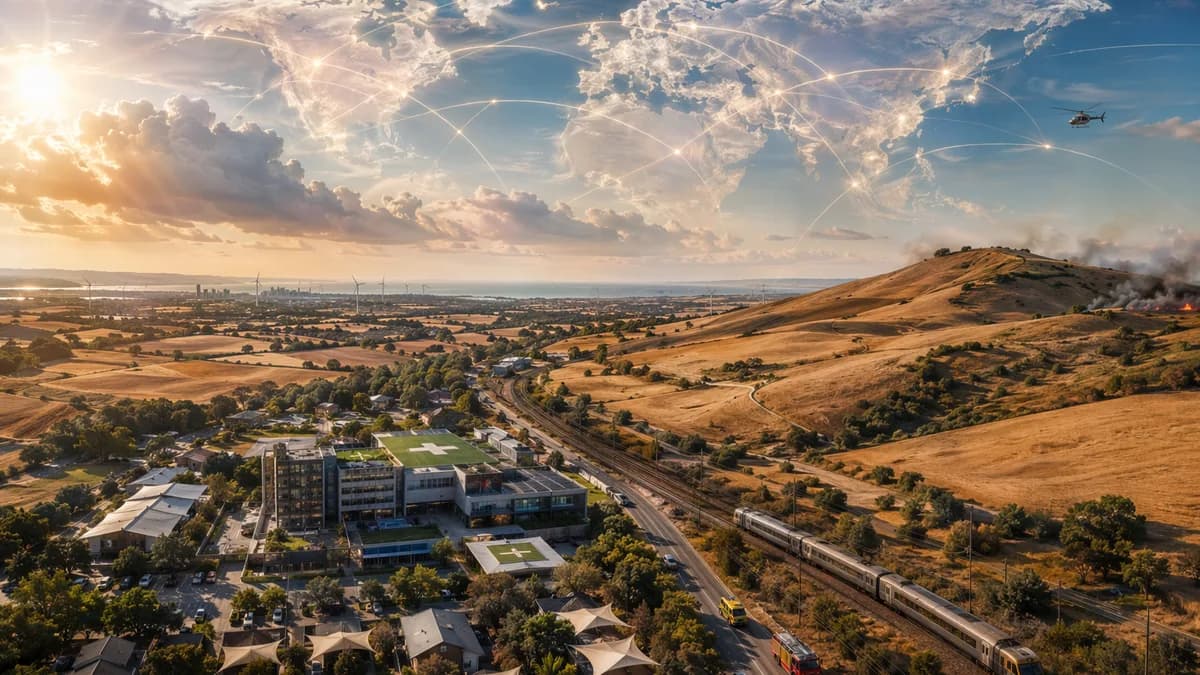
The UK heatwave has turned climate adaptation from a policy debate into a live stress test for homes, hospitals, railways, water networks, and the countryside. The people hit first are those with the least room to maneuver: patients in strained services, schoolchildren in overheated buildings, rail passengers facing disruption, and households stuck in properties built for cooler summers.
Global TrendsJune 24, 2026· 8 min read· By XOOMAR Insights Team
Red Alert UK Heatwave Exposes Britain's Climate Gap
Updated on June 24, 2026
XOOMAR Intelligence
Analyst Take
73/ 100
4 sources analyzedMedium confidenceTrend10Freshness96Source Trust90Factual Grounding88Signal Cluster40
The Met Office has issued a rare red weather warning from 9am today across parts of southern Wales, central England, and southern England, while the UK’s June temperature record of 35.6C is expected to be broken, according to Guardian World. Bristol is forecast to reach 39C tomorrow.
That makes this briefing bigger than weather. It’s a roundup of systems under pressure: climate resilience, party leadership, Gulf security, public safety in France, and political finance.
Extreme heat turns Britain’s adaptation gap into a daily crisis
The connecting thread is institutional strain. The UK heatwave is testing whether public systems can absorb shocks before they become emergencies.
The Climate Change Committee concluded last month that the UK is built for a climate that “no longer exists,” and it has now warned on the country’s policies towards achieving net zero. That sentence lands harder during a red warning, because it links two problems that governments often separate: adapting to heat already here, and cutting the future heat still being locked in.
The live pressure map
| Pressure point | What the source says | Stakeholder most exposed |
|---|---|---|
| Homes | Millions are overheating | Residents with limited cooling options |
| Rail | Operators warned against all but essential travel | Commuters, workers, operators |
| Hospitals | Admissions are set to surge | Patients and clinical staff |
| Schools, water, transport | Struggling to cope with extreme temperatures | Families, local services, utilities |
| Landscapes | Ecosystems are being pushed beyond evolutionary limits | Communities relying on resilient nature |
The question now is simple: can the UK treat heat resilience as basic infrastructure rather than seasonal damage control?
UK homes, rail lines, hospitals, and water networks buckle under record June heat
The UK heatwave is moving through the systems people rely on every day. Schools, hospitals, transport networks, and water companies are struggling to cope with extreme temperatures caused by climate breakdown, the Guardian briefing says.
Rail operators have warned against all but essential travel. That is not a minor inconvenience when work, care, appointments, and supply chains depend on predictable movement. Heat does not need to destroy infrastructure to disrupt it. It only has to make normal operating assumptions unsafe.
Millions of homes are overheating, which exposes a long-running mismatch between the UK’s housing stock and the climate now arriving. The same mismatch shows up in hospitals, where admissions are expected to rise just as buildings and staff face their own heat burden.
For related European heat coverage, XOOMAR has tracked how deadly heat can create secondary risks in 40 Drowning Deaths Drag France Heatwave Into Crisis.
Britain’s landscapes face heat stress beyond their evolutionary limits
The Guardian’s central environmental warning is stark: Britain’s ecosystems are being pushed beyond their evolutionary limits as heatwaves intensify.
That matters because landscapes are not just scenery. In the climate and nature briefing material supplied for this story, Prof Nathalie Seddon framed nature as a core resilience asset, not an amenity.
“Nature is not a ‘nice to have’; it is critical national infrastructure.”
That quote came from the National Emergency Briefing, which set out climate and nature risks to 1,200 national decision-makers, according to the Nature-based Solutions Initiative. The follow-up People’s Emergency Briefing is now being shared with communities and MPs, with over a 1,000 screenings planned so far.
This is where the landscape question becomes practical. If nature is infrastructure, then damage to ecosystems becomes a public risk issue, tied to health, food systems, national security, and the economy. The open question is how quickly ministers, councils, landowners, and communities can turn that framing into funded protection.
Climate policy warnings sharpen pressure on ministers over net zero plans
The Climate Change Committee’s warning on net zero policy arrives at a brutal moment. Heat is no longer an abstract future cost. It is already forcing rail warnings, school disruption, overheating homes, water stress, and hospital pressure.
Analysis: weak mitigation and weak adaptation compound each other. If emissions policy slips, future heat risk rises. If adaptation is delayed, the present-day cost of heat falls on public services and households least able to absorb it.
The National Emergency Briefing material adds a sharper risk frame. It says climate and nature breakdown has implications for health, food systems, national security, and the economy. That makes the policy test broader than whether the UK hits a target. It is about whether the state can keep essential systems functioning under hotter conditions.
One question should dominate the policy file: are ministers budgeting for the climate the UK has, or the cooler one it used to have?
Starmer and Burnham hold a frosty meeting after the Makerfield byelection
Keir Starmer has met Andy Burnham for the first time since the Makerfield byelection, in what sources described to the Guardian as a “frosty” meeting to thrash out a transition of power.
The wording matters. “Frosty” signals that Labour’s internal management remains tense at the same time the country is facing immediate pressure from heat, public services, and infrastructure strain. Leadership bandwidth is finite, and crises punish distraction.
This story connects to the broader briefing because political authority is being tested in real time. Voters do not experience climate, transport, hospitals, and party discipline as separate files. They experience them as competence or failure.
For more context on the Labour pressure point, see XOOMAR’s coverage of the Makerfield byelection and Burnham-Starmer tensions.
Rubio seeks to reassure Gulf allies after the Iran ceasefire deal
Marco Rubio is set to meet Gulf allies to reassure them that the US remains committed to their security after a 60-day ceasefire deal with Iran last week.
The Guardian briefing frames the mission plainly: Washington wants Gulf partners to believe the ceasefire will not embolden Tehran. That is a narrow diplomatic objective, but a difficult one, because temporary ceasefires carry their own uncertainty.
This item sits beside the climate stories because both are about trust in systems under stress. Gulf allies are asking whether US commitments still hold. UK citizens are asking whether domestic infrastructure can handle heat. Different arena, same test: do institutions perform when risk rises?
The key question is whether reassurance changes behavior, or simply buys time.
France’s heatwave brings a deadly surge in unsupervised swimming deaths
Forty people have drowned while swimming in unsupervised areas across France in recent days, as people sought relief from a record-breaking heatwave.
That figure shows how extreme heat creates second-order dangers. The immediate threat is high temperature, but the response to heat can also become dangerous when people move toward rivers, lakes, canals, or other unsupervised water without safety controls.
The link to Britain is direct enough. The UK heatwave is already straining schools, hospitals, transport, water companies, and homes. France shows another layer: emergency risk can spread into behavior, recreation, and rescue demand.
The practical question for public agencies is how to warn people without sounding abstract when the heat itself feels urgent and physical.
Farage defends £5m crypto billionaire gift amid campaign finance scrutiny
Nigel Farage has said his £5m gift from a crypto billionaire is “not any of your business,” saying it was given unconditionally and could be spent on anything from Ferraris to gambling on horses.
That response turns the donation into a trust story. The issue is not only the size of the gift, but the posture toward scrutiny. At a time when public systems are under stress, voters tend to look harder at who funds political actors and what access that money may imply.
The crypto detail also matters because it places new wealth inside old questions about influence, transparency, and accountability. The source does not say the gift came with conditions. It says Farage called it unconditional. The political risk is perception.
A sharper question follows: when public confidence is already stretched, how much opacity can politics absorb?
The bigger picture: institutions need to absorb shocks before they become emergencies
This briefing is about heat, money, and power arriving together. Climate impacts are no longer distant. Geopolitical reassurance is fragile. Domestic politics is being shaped by leadership tension and unusually large private funding.
For the UK, the landscape question is now a governance question. Protecting countryside, cities, homes, hospitals, and public health requires faster adaptation, credible net zero policy, and political honesty about what the current climate is already doing.
The watch item is whether this week’s red warning becomes another short-lived emergency, or a forcing event that moves heat resilience into the same category as transport, health, water, and national security planning.
Impact Analysis
- The heatwave is exposing how far UK infrastructure lags behind current climate risks.
- Homes, hospitals, railways, and schools are already facing disruption from extreme temperatures.
- The crisis links immediate adaptation needs with longer-term net zero policy decisions.
UK Heatwave Pressure Points
| Pressure point | What the source says | Stakeholder most exposed |
|---|---|---|
| Homes | Millions are overheating | Residents with limited cooling options |
| Rail | Operators warned against all but essential travel | Commuters, workers, operators |
| Hospitals | Admissions are set to surge | Patients in strained services |
UK Heat Benchmarks
UK June temperature record
°C35.6
Bristol forecast tomorrow
°C39
Sources

Written by
XOOMAR Insights Team
Research and Editorial Desk
The XOOMAR Insights Team pairs automated research with human editorial judgment. We track hundreds of sources across technology, fintech, trading, SaaS, and cybersecurity, cross-check the facts, and explain what happened, why it matters, and what to watch next. We do not just rewrite headlines. Every article is fact-checked and scored for reliability before it goes live, and we link back to the original sources so you can verify anything yourself.
Explore More Topics
Related Articles
 Global Trends
UK Drought Hits Early as July Rainfall Vanishes in South
England and Wales face an early drought after record heat and near-zero July rain, while winter-filled reservoirs keep taps safer for now.
Aug 2, 20267 min
 Global Trends
UK General Warns: Russia’s Next War Targets Britons at Home
The UK's former head of Defence Intelligence reveals why the next major conflict will be fought at home, targeting the public with disinformation long before tr
Aug 10, 20267 min
 Global Trends
Labour Members Shun Welfare for Health, Economy Priorities
A new poll shows Labour Party members overwhelmingly prioritize health and the economy, with nearly half believing the government spends too much on welfare.
Aug 10, 20267 min
 Global Trends
Reform Party Threatens Jail, 10% Revenue Fines for UK Employers
The Reform Party's radical immigration policy proposes jailing company bosses and fining businesses 10% of their global revenue for hiring illegal migrants, cre
Aug 9, 20266 min
 Global Trends
London Museum Had 'No Money' as UAE Buys UK Fossils
Britain lost one of its most important Jurassic fossil collections to a foreign museum because domestic institutions lacked the acquisition funds, revealing a d
Aug 8, 20267 min
 Trading
US Job Loss Derails Fed, Launching Pound Toward $1.35
The British pound is testing $1.35 after a shock contraction in U.S. jobs data forced markets to slash bets on future Federal Reserve rate hikes.
Aug 10, 20264 min
 Fintech
Thames Water Flushes £1m Fee to CFO as Nationalisation Looms
Thames Water used £1 million from its emergency creditor bailout to pay a signing fee for its CFO while staring down potential government takeover, triggering a
Aug 10, 20267 min
 Trading
Sterling Teeters as GDP Threatens BoE Rate Bet
The British pound is perilously exposed to this week’s GDP report, as a soft number could force traders to rip up their hawkish Bank of England rate bets.
Aug 10, 20266 min
 Global Trends
Court Cancels Russia's Only Anti-War Party on 'Extremism'
A Moscow court disqualified Russia's only registered anti-war political party from parliamentary elections, using allegations of extremism and copyright infring
Aug 10, 20266 min
 Fintech
Banks Invade Earned Wage Access, Force Fintechs Out
Major banks and credit unions are launching earned wage access to retain customers and gather data, forcing original fintech providers into a defensive scramble
Aug 10, 20264 min
Don't miss the signal
Get our weekly roundup of the stories that matter across tech, fintech, and trading. No noise, just signal.
Free forever. No spam. Unsubscribe anytime.