
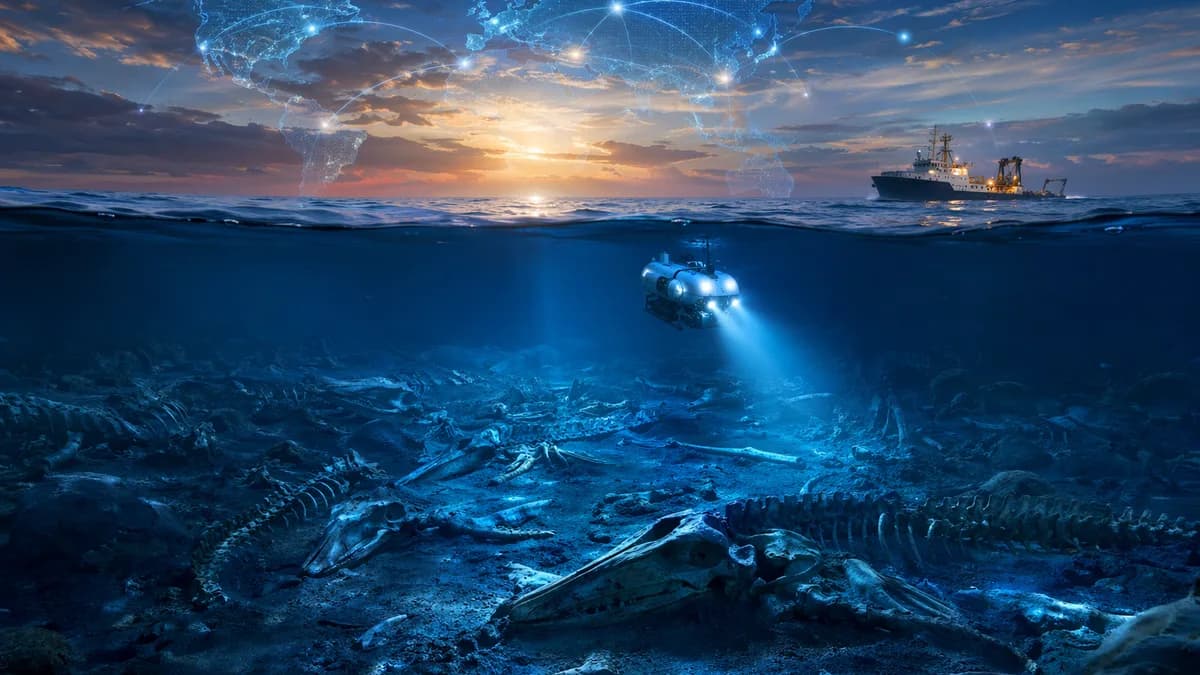
A whale graveyard stretching about 1,200km (745 miles) across the southeastern Indian Ocean has turned a remote slice of seafloor into one of the most important marine fossil sites scientists have seen.
Global TrendsJune 10, 2026· 10 min read· By XOOMAR Insights Team
Whale Graveyard Rewrites Indian Ocean's Deepest Past
Updated on June 10, 2026
XOOMAR Intelligence
Analyst Take
59/ 100
4 sources analyzedLow confidenceTrend10Freshness98Source Trust92Factual Grounding92Signal Cluster20
The site sits about 7km (four miles) deep in the Diamantina fracture zone, a seafloor range of ridges and trenches, according to BBC World. Researchers from China, Italy and New Zealand found remains dating back as far as 5.3 million years, alongside active whale falls that are still feeding deep-ocean life.
"Discovering a necropolis of this scale was completely unexpected," said Xiaotong Peng of the Chinese Academy of Sciences.
"The size of distribution, the depth and the age range were far beyond anything we had imagined."
That quote is the signal. This isn’t a single dramatic skeleton on the abyssal plain. It’s a fossil field large enough to suggest repeated whale deaths, preservation, scavenging and seafloor stability across an immense span of time.
Why a five million year old whale graveyard changes the Indian Ocean map
The immediate shock is scale. During 32 dives, explorers collected samples from 485 whale-fossil sites and active whale falls, the BBC reported. That moves the discovery from curiosity to archive.
Whale graveyards matter because they preserve several records at once:
- Evolution: skulls, jaws and vertebrae can identify extinct whales and show how ancient lineages relate to modern species.
- Food webs: whale carcasses create dense feeding zones in a part of the ocean where large food inputs are rare.
- Seafloor history: bones, sediment and surrounding organisms can show whether the site was calm, disturbed, oxygen-poor or repeatedly supplied with carcasses.
- Biogeography: the location may help explain how whales moved through the ancient Indian Ocean.
The site also contains living clues. The BBC says the area is teeming with organisms and species that "may be new to science", citing Nature. Jellyfish, worms and crustaceans are among the creatures now living off the spread of carcasses.
That makes the discovery valuable in two directions. The fossils point backward, toward extinct whales and ancient ocean conditions. The active whale falls point sideways, toward how deep-sea communities form around sudden bursts of organic matter.
XOOMAR analysis: the most important feature isn’t just age. It’s continuity. A place with both fossilized remains and active whale falls lets scientists compare the end state of ancient carcasses with the biological process still happening today.
What researchers actually found in the Diamantina fracture zone
The find is centered on the Diamantina fracture zone, a deep seafloor structure in the southeastern Indian Ocean. Related reporting from Scientific American describes it as a zone running west from the southwestern tip of Australia into the Indian Ocean along a rift valley that formed about 50 million years ago, when Australia split from Antarctica.
The whale remains include both old fossils and recent carcasses. The BBC reports one fossilized skull belonged to Pterocetus benguelae, a beaked whale dated to 5.3 million years old. Researchers also uncovered a new species named Pterocetus diamantinae, after the site.
The largest carcass reported was a five-metre long Antarctic minke whale.
A whale graveyard doesn’t necessarily mean hundreds of whales died in one event. In this case, the more likely reading is accumulation. Whales sank at different times, their remains persisted, and the seafloor kept a record rather than erasing it.
| Feature | Active whale falls | Fossil whale remains |
|---|---|---|
| Condition | Recent enough to support living communities | Ancient bones preserved on or in the seafloor |
| Scientific value | Shows how carcasses feed deep-ocean organisms | Shows extinct species, timing and preservation |
| Reported examples | Antarctic minke whale carcass, organisms such as worms and crustaceans | Pterocetus benguelae, Pterocetus diamantinae |
| Main question | Who feeds on whale remains now? | Which whales lived there millions of years ago? |
Detailed work will decide how many individual whales are represented, how many species are present and whether additional bones belong to known or unnamed extinct animals. The public facts so far point to a vast deposit, not a final inventory.
That distinction matters. A fossil site usually changes as researchers map it. Early counts can identify scale. Later work explains pattern.
How whale falls become long-lived seafloor archives
A whale fall begins with a dead whale sinking. At depth, the carcass becomes a rare concentrated food source. Large scavengers strip soft tissue first. Later, worms, bacteria and other organisms work through the remaining material. Oil-rich bones can support specialized life long after flesh is gone.
The Diamantina site appears to capture several points along that sequence. BBC reports both fossil sites and active whale falls. Scientific American adds that several recent falls were found with exposed bones and microbial communities, with animals including bone-eating worms, squat lobsters, spoon worms and jellyfish observed around them.
The preservation question is the crux. Most carcasses disappear. To become fossils, bones must escape total destruction. The supplied reporting points to several possible reasons this site preserved so much material:
- Depth: the site lies around 7,000 meters down, where access is difficult and disturbance is limited.
- Slow sedimentation: Scientific American reports that sediment accumulates slowly at these depths, allowing fossils to remain exposed for thousands or millions of years.
- Bone durability: Gizmodo’s reporting notes that many remains belong to beaked whales, whose dense skull bones may survive biological and chemical breakdown better than more fragile parts.
- Protective coatings: Gizmodo also reports that some bones were coated with ferromanganese oxides, forming a layer that helped isolate them from seawater.
One analogy fits here: the site functions like a deep-ocean archive, except the pages are skulls, ribs, microbes and sediment.
That archive is hard to read. The same depth that preserved the remains also limits access. Stephen J Godfrey of the Calvert Marine Museum wrote in Nature that the site’s limited accessibility still leaves room for many future finds.
"Peng and colleagues' encounter with a vast fossil graveyard is a truly unique discovery," Godfrey wrote.
"Although the site has limited accessibility, it seems likely to hold many other exciting finds, and it will no doubt inspire more submersible dives in similar environments."
What the fossils could reveal about ancient whales and migration
The age range is the scientific accelerant. A 5.3 million year old whale skull doesn’t just identify one animal. It gives researchers a fixed point for comparing anatomy, species distribution and seafloor conditions through time.
Whale fossils can reveal body size, feeding style and evolutionary relationships. A skull can show whether an animal belonged to a known lineage or a newly recognized one. In this case, the discovery of Pterocetus diamantinae already shows that the site is not only preserving known species.
The migration angle is more tentative, but important. If repeated whale remains accumulated across 1,200km, scientists will want to know whether the area sat along a long-running movement route, a feeding zone, or a place where oceanography increased the chances of carcasses reaching and remaining on the seafloor.
Nick Pyenson, a paleontologist at the Smithsonian Institution’s National Museum of Natural History, told Scientific American that the site may not be unique and that similar deposits could exist along stable migration "superhighways." That doesn’t prove Diamantina was one. It frames a testable idea.
XOOMAR analysis: the site’s value rises if the remains include multiple species and age groups. A mixed collection could tell researchers whether this was a recurring passageway for different whales, not just a preservation trap for one lineage.
There is also a climate and ocean-conditions question, but the current public reporting doesn’t answer it yet. Sediment chemistry and associated fossils may help reconstruct water conditions, nutrient availability and the wider food chain around the carcasses. For now, that remains potential, not confirmed result.
A single five-metre whale fall shows how the larger graveyard could grow
Take the reported five-metre Antarctic minke whale carcass as a concrete case.
A whale dies offshore and sinks. Once it reaches the seafloor, scavengers arrive. Soft tissue disappears first. Then the bones remain, still carrying energy in fats and minerals. Worms, crustaceans, microbes and other organisms work through what’s left. The carcass changes from flesh to frame.
If currents scatter the bones, the record weakens. If the bones dissolve or are consumed, the record vanishes. If the seafloor is stable and the bones persist, the whale can become part of the fossil archive.
Repeat that process across centuries, millennia and longer spans, and a graveyard forms without a single mass death. The Diamantina discovery appears to be exactly that kind of accumulation, stretched across distance and time.
This is where the story connects to technology as much as paleontology. Without crewed submersibles, robotic arms, mapping systems and sample recovery, the site stays invisible. Measurement infrastructure decides what can be known. XOOMAR readers see the same principle in other fields, whether a consumer device shifts value at the margin in $100 Cut Puts Apple Watch Series 11 Back at $299 Today, or audit pressure exposes the hidden costs behind Open-Source SIEM Saves Cash, but Audits Bite Back Fast. Tools don’t just collect data. They define the limits of the question.
For the Diamantina site, the tool constraint is severe. Every dive is expensive, slow and selective. That means researchers are likely seeing only part of the deposit.
The tests that can turn bones into a history of the deep Indian Ocean
The next phase is less cinematic than discovery, but more decisive. Researchers will need to connect location, anatomy, chemistry and age into one coherent record.
Several lines of work are likely to matter:
- Dating: confirming the age range of sampled bones and sediments. Scientific American reports that collected fossil samples were dated between 5.26 million and 120,000 years old.
- 3D mapping: recording where bones sit relative to trenches, ridges, currents and other remains.
- CT scanning: examining skulls and dense bones without destroying them.
- Sediment analysis: reading the layers around the fossils for burial history and environmental signals.
- Isotope testing: probing diet, water chemistry and possible movement patterns, where preservation allows.
- Trace analysis: studying tooth marks, boring marks, fractures and organisms attached to bones to reconstruct what happened after each whale sank.
The site map may prove as important as the bones themselves. If skeletons are largely intact, carcasses may have arrived whole and stayed in place. If bones are sorted by size or aligned in patterns, currents or slopes may have moved them. If fossils cluster by age or species, that could point to repeated events under similar conditions.
Godfrey’s reaction captures the scale of what remains unresolved:
"Peng and colleagues' paper reminded me of a trailer for the first in a series of epic movies. I hope that there will be many more of these blockbusters to come."
That’s a useful framing, as long as it doesn’t outrun the evidence. The confirmed discovery is already extraordinary: a deep Indian Ocean whale necropolis, around 1,200km long, with remains reaching back 5.3 million years, including an extinct skull and a newly named species.
The practical implication is clear. Watch the next papers for species counts, dating precision, site maps and biological surveys of organisms living on the active falls. Those results will decide whether Diamantina becomes mainly a spectacular fossil field, or a reference site for how whales, deep-sea life and the Indian Ocean changed together over millions of years.
Why It Matters
- The discovery turns a remote deep-sea region into a major archive of whale evolution and ocean history.
- Its scale suggests whale deaths and preservation occurred repeatedly across millions of years.
- Active whale falls show the site is still supporting deep-ocean ecosystems today.
Scale of the Whale Graveyard Discovery
Research dives
count32
Whale-fossil sites and active whale falls
count485
Sources

Written by
XOOMAR Insights Team
Research and Editorial Desk
The XOOMAR Insights Team pairs automated research with human editorial judgment. We track hundreds of sources across technology, fintech, trading, SaaS, and cybersecurity, cross-check the facts, and explain what happened, why it matters, and what to watch next. We do not just rewrite headlines. Every article is fact-checked and scored for reliability before it goes live, and we link back to the original sources so you can verify anything yourself.
Explore More Topics
Related Articles
 Global Trends
Jay Clayton Wins DNI Job as Intel Trust Fractures in Senate
Jay Clayton won DNI confirmation 51-47, leaving intelligence oversight tangled in Trump loyalty tests and partisan distrust.
Jul 28, 202610 min
 Global Trends
Tariff Detours Crush the US Manufacturing Jobs Pitch
Tariffs haven't sparked a US factory jobs boom. Chinese inputs are taking longer routes, with higher costs and more automation.
Jul 27, 20268 min
 Global Trends
Typhoon Noul Rips Hong Kong Scaffolding Into Street
Typhoon Noul tore scaffolding off a Hong Kong building and cancelled 360 flights before China’s strongest 2026 landfall.
Jul 27, 20265 min
 Global Trends
Trump Tariffs Twist Court Loss into Checkout Tax Fight
Trump recast his tariffs after a court loss. Democrats see an opening, calling them a sales tax on squeezed Americans.
Jul 25, 20269 min
 Global Trends
Trump Tariffs Drag 80 Countries Into Legal Showdown
Trump's new tariffs hit 80-plus countries and set up a fresh fight over presidential power, import costs, and Congress's tax authority.
Jul 24, 20267 min
 Technology
Chinese Humanoid Robot Ban Locks Out New US Machines
Washington is blocking new Chinese humanoid robots before they spread in the US, treating connected machines as a supply chain threat.
Jul 29, 20268 min
 Technology
RT6 Fleet Storms London Robotaxi Race for Lyft, Baidu
Baidu's RT6 test cars put Lyft into London's robotaxi fight, turning a 2027 launch plan into a regulatory and trust test.
Jul 28, 202611 min
 Trading
Gold Price Risks $4,000 Breakdown Before Fed Decision
Gold is slipping near $4,000 as traders wait for the Fed's rate signal, with yields and dollar strength threatening support.
Jul 29, 20268 min
 Technology
Fast Metals Mines Toxic Red Mud for Critical Minerals
Fast Metals raised $4.3M to mine critical minerals from red mud. Now it has to prove the leftover waste is safer.
Jul 29, 202612 min
 SaaS & Tools
Nearly 60 Webinar Tools Expose the Best Webinar Software
Webinar platforms are now judged by pipeline, not polish. Zapier’s 2026 picks show marketers which tools turn attendance into action.
Jul 29, 20268 min
Don't miss the signal
Get our weekly roundup of the stories that matter across tech, fintech, and trading. No noise, just signal.
Free forever. No spam. Unsubscribe anytime.