
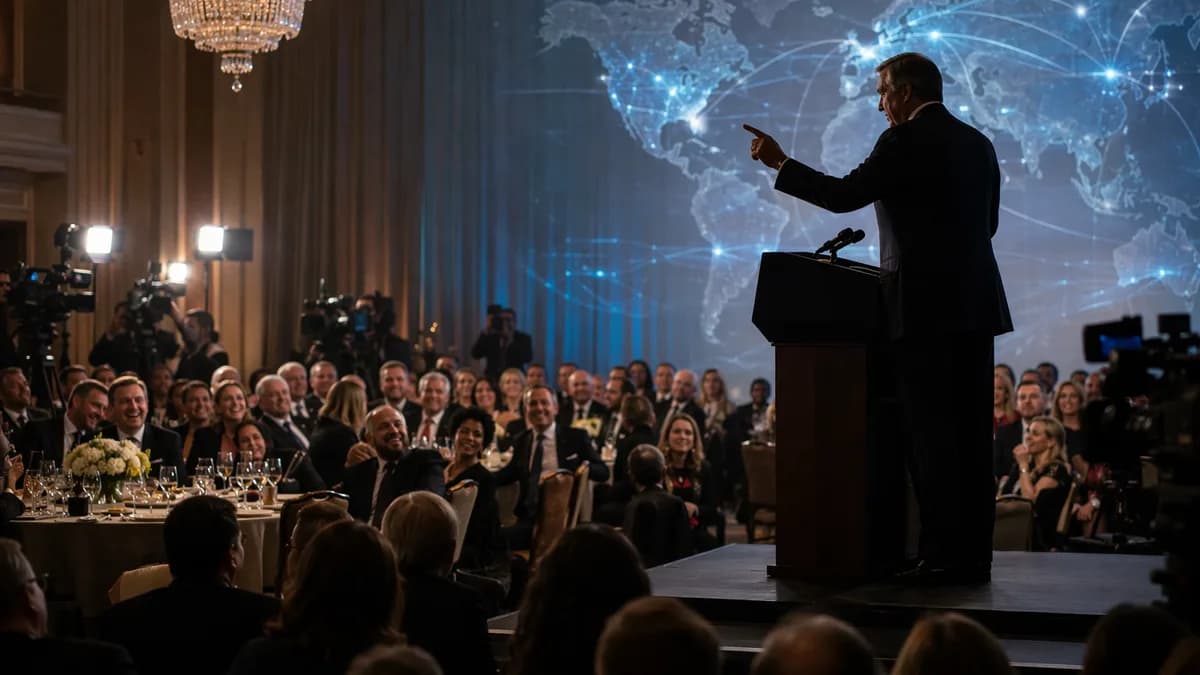
At the White House Correspondents' Dinner, Donald Trump joked about the reporters he battles while the room was still carrying the weight of an April shooting that canceled the first event. That tension matters most for the journalists whose job is to scrutinize him, not flatter him.
Global TrendsJuly 25, 2026· 7 min read· By XOOMAR Insights Team
Trump's Press Jabs Chill White House Correspondents' Dinner
Updated on July 25, 2026
XOOMAR Intelligence
Analyst Take
68/ 100
2 sources analyzedLow confidenceTrend10Freshness96Source Trust92Factual Grounding88Signal Cluster60
Trump attended a White House Correspondents' Association dinner after the earlier event was called off following a shooting, according to BBC World. My view is simple: Trump can crack jokes at the press, and the press should be able to take it. But a president who mocks journalists also has a duty to affirm that their scrutiny is legitimate.
Can a president mock the press and still make clear its scrutiny is legitimate? Yes. But only if the joke punches at performance, not at the basic right to question power.
Trump's press dinner jokes expose a bigger problem with power and accountability
The dinner was not just a room of insiders laughing at one another. It was a staged encounter between the presidency and the reporters who cover it, including outlets Trump has criticized, challenged, and accused of unfair treatment over the years.
That context changes the sound of every punchline.
Trump was described in coverage as mixing a lighter tone with familiar complaints about the media. He leaned into the kind of press criticism that has long been central to his political style, while also appearing in a setting built around journalism, access, and public accountability.
That combination is never neutral.
Humor can lower the temperature. It can also normalize contempt when aimed at institutions that exist to hold power to account. The White House Correspondents' Dinner sits right on that fault line.
The cancelled April dinner gave this press freedom celebration a sharper edge
The April shooting made this dinner feel less like pageantry and more like a public statement of resilience. Even without leaning on every detail of the incident, the basic fact of the cancellation gave the gathering a different moral charge.
That was the center of the night.
The event had to balance ceremony with the memory of violence. It had to let people laugh without pretending that threats against public figures, journalists, and civic institutions are just background noise. That is not an easy balance, and it should not be treated as easy.
How should a joke sound in a room shaped by survival and restraint?
Trump’s strongest possible message in that setting was not personal grievance. It was the idea that political conflict must be handled through speech, questioning, and argument rather than intimidation. That principle deserved the room’s attention. It was the clearest defense of what the dinner was supposed to celebrate.
A president's jokes about reporters land differently when they come from the podium of power
There is a difference between a comedian roasting a newsroom and a president doing it from the head table. One is commentary. The other comes with state power, loyal audiences, security details, and a megaphone no reporter in the ballroom can match.
Who hears the punchline after it leaves the ballroom?
That is the real issue. The jokes were not only for the people in attendance. They also travel outward, stripped of context, to supporters and critics who already view the press through partisan filters.
| Speaker | Same joke, different force |
|---|---|
| Comedian | Tests taste, timing, and room tolerance |
| Reporter | Mocks the powerful from outside the office |
| President | Shapes whether scrutiny is treated as legitimate or hostile |
The security backdrop around the dinner also mattered. After a shooting had already disrupted the earlier event, no one could honestly treat the night as ordinary Washington theater. The setting carried the reminder that political language does not remain sealed inside a ballroom.
That image should stay with us. Political rhetoric does not cause every act of violence. But in a tense civic environment, words from powerful people can either reinforce norms or corrode them.
The White House Correspondents' Dinner still matters when it remembers its purpose
The White House Correspondents' Dinner earns its place only when it puts press freedom ahead of access culture. The awards and public-service rituals matter more than the jokes. The broader message of returning after disruption matters because it says intimidation should not decide whether civic institutions gather.
When does proximity become softness?
That is the dinner’s recurring problem. Reporters need access to officials, but they also need distance from them. A dinner that becomes too comfortable risks making scrutiny look like theater. A dinner that centers safety, accountability, and public service can remind viewers why the press exists at all.
The strongest version of the event looks like this:
- Accountability: Reporters question officials without treating access as a prize.
- Transparency: Newsrooms show their work and correct errors clearly.
- Restraint: Political leaders criticize coverage without branding journalism itself as an enemy.
- Courage: Institutions return after violence without pretending the risk was imaginary.
Readers tracking the wider accountability test around Trump will recognize the same civic demand across many stories: power should answer hard questions, and public institutions should not confuse access with trust.
Trump supporters will say the media deserved the ribbing, and they're partly right
The strongest argument for Trump’s jokes is not ridiculous. News organizations make mistakes. They chase spectacle. They can seem smug, selective, and too impressed with their own rituals. Reporters should not act wounded every time a politician mocks them.
Where is the line between deserved criticism and institutional delegitimization?
It sits between attacking a story and attacking the idea of scrutiny. If a report is wrong, say what is wrong. If a question is loaded, explain why. If a newsroom misses context, show the missing context. That is fair combat.
But branding broad swaths of the press as inherently dishonest or unhinged does something else. It invites audiences to dismiss accountability before the facts arrive.
The answer to bad reporting is better reporting. It is not public contempt for the entire profession.
Trump’s better standard, in a setting like this, is open debate. That is the standard he should hold himself to when the jokes stop.
Trump, reporters, and voters all have work to do after the laughs fade
Trump and other political leaders should criticize coverage sharply without treating journalists as enemies. Newsrooms should earn trust through accuracy, visible corrections, and less performance-driven coverage. Voters should resist the lazy comfort of believing every unfavorable story is bad faith.
What should survive after the laughter fades?
Not the insult. Not the viral clip. The lesson should be simpler and harder: democracy needs tough questions, honest answers, and citizens who won't confuse mockery with truth.
The better test comes after the dinner, in briefings, interviews, investigations, corrections, and the daily friction between power and scrutiny. If the room remembers that, the dinner has a purpose. If it forgets, it’s just another expensive night of applause.
Impact Analysis
- The dinner highlighted the uneasy relationship between presidential power and the journalists tasked with scrutinizing it.
- Trump’s jokes matter because humor aimed at the press can either defuse tension or reinforce hostility toward accountability.
- The canceled April event after a shooting gave the gathering added significance as a statement about press freedom and resilience.
Sources

Written by
XOOMAR Insights Team
Research and Editorial Desk
The XOOMAR Insights Team pairs automated research with human editorial judgment. We track hundreds of sources across technology, fintech, trading, SaaS, and cybersecurity, cross-check the facts, and explain what happened, why it matters, and what to watch next. We do not just rewrite headlines. Every article is fact-checked and scored for reliability before it goes live, and we link back to the original sources so you can verify anything yourself.
Explore More Topics
Related Articles
 Global Trends
Trump Tariffs Mint $151 Billion While Factories Shed Jobs
Trump tariffs raised $151 billion, but factory jobs fell by 89,000, undercutting the factory revival pitch.
Jul 24, 20266 min
 Global Trends
Paramount Snatches Warner Bros. Discovery Sale at $111B
Paramount’s $111B WBD bid beat Netflix’s play, but state lawsuits and a court pause now threaten the Hollywood mega-deal.
Jul 22, 20269 min
 Global Trends
DHS Election Claims Drag Trump’s 2020 Grievance Into Power
DHS gave Trump’s unproven 2020 claims a security-agency megaphone, turning a grievance into a credibility test.
Jul 17, 202613 min
 Global Trends
Girl Airlift Exposes Texas Floods' Deadly Last Resort
Bodycam footage shows a girl airlifted from a wrecked Texas home as floods killed at least two and stretched rescues across central Texas.
Jul 17, 20268 min
 Global Trends
Rape Accusation Imperils Blake Miguez Trump Endorsement
Blake Miguez wants Trump’s backing again after redistricting, but a 2007 rape allegation now hangs over his Louisiana House run.
Jul 23, 20268 min
 Trading
Oil Squeeze Drags Thai Baht Toward 15-Month Dollar Low
The Thai Baht is stuck near a 15-month dollar low as oil prices, US yields and a dovish BoT pile pressure on THB.
Jul 25, 20267 min
 Trading
Fed BoE BoJ Decisions Trap Currencies in 3-Day Test
Three central banks are set to hold rates, but their guidance could whip currencies before GDP, PCE, CPI and Eurozone data land.
Jul 25, 20268 min
 Technology
Amazon Prime Settlement Puts $51 at Stake by July 27
Eligible U.S. Prime users can claim up to $51 before July 27, but Amazon decides if their signup or cancellation flow qualifies.
Jul 25, 20269 min
 Global Trends
$10 Trillion Threat Puts 2026 El Niño Off the Charts
Models put 2026 El Niño beyond recorded history, with potential losses near $10 trillion by 2032.
Jul 25, 20267 min
 Technology
Pervert Glasses Backlash Traps Meta Smart Glasses in Crisis
Meta smart glasses turned effortless recording into Instagram's moderation problem, and the privacy backlash is now a brand crisis.
Jul 25, 20268 min
Don't miss the signal
Get our weekly roundup of the stories that matter across tech, fintech, and trading. No noise, just signal.
Free forever. No spam. Unsubscribe anytime.