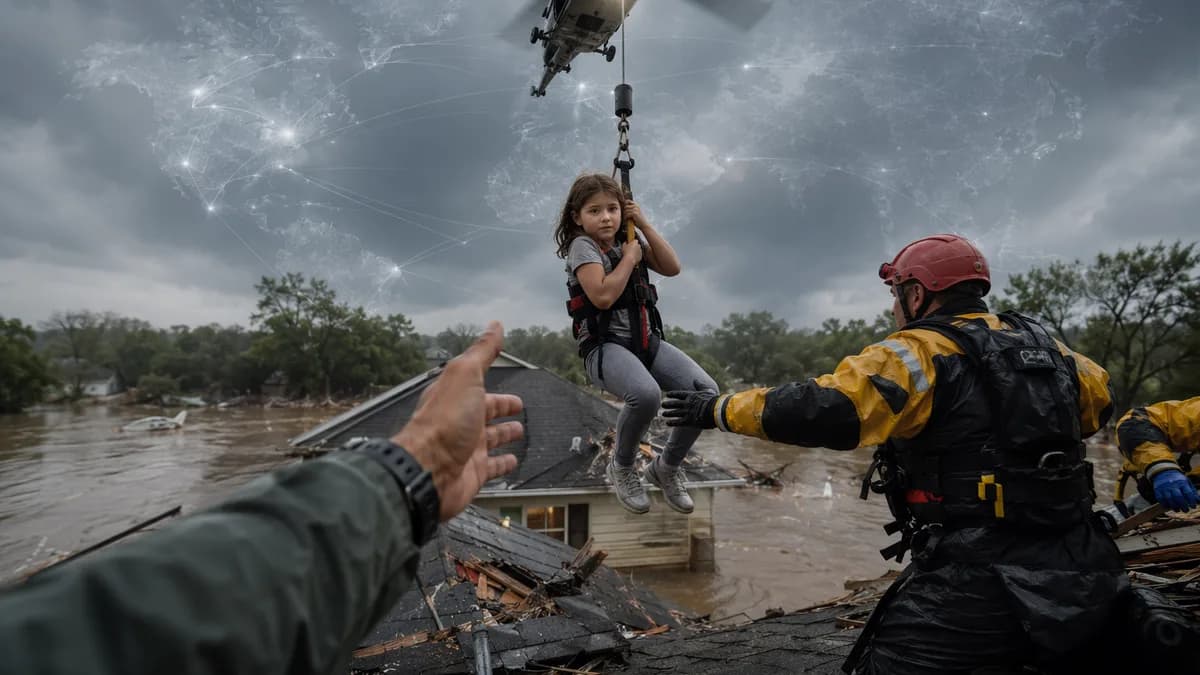
On Thursday, bodycam footage turned the Texas floods into a close-range rescue story: a girl was airlifted from a destroyed home while the rest of her family waited for another helicopter.
XOOMAR Intelligence
Analyst Take
The footage showed a rescuer reaching a family of three and their dogs as floodwater covered parts of Uvalde County, Texas, according to BBC World. The immediate outcome was good: the girl was taken to safety, and the rescuer told the remaining family members another helicopter was coming.
That success should not soften the signal. A household sheltering in a destroyed house is not just a dramatic image. It is evidence of how little margin can exist when fast-rising water overtakes homes, roads, and evacuation decisions.
“At least two people have died in flooding across central Texas,” BBC reported, noting that the same area saw “more than 130 deaths in flash floods last summer.”
Thursday’s airlift shows the Texas floods reaching the point of last resort
The Uvalde County footage matters because it compresses the disaster into a few hard facts: a destroyed house, a stranded family, dogs still with them, and a rescuer arriving by air.
That is the part the public can see. The footage does not prove the full chain that led there. It does not show when the family first faced danger, whether warnings reached them, when local crews were deployed, or whether roads became unusable before the helicopter arrived. Treating the video as a complete explanation would be a mistake.
There is also a location tension in the available reports. The BBC item places the family in Uvalde County. A related AOL report says Texas Game Wardens provided body camera footage of a rescue from a flooded house in Kerrville, while also reporting that Kerr County and Uvalde County were among the hardest hit. The safest reading is that the broader Texas floods affected multiple central and south Texas communities, and that the exact location details around the circulated rescue footage should be handled carefully unless officials clarify them.
For readers tracking the regional sequence, XOOMAR has also covered 16 Inches Swamp Roads as South Texas Flooding Spreads and Texas Floods Trap Guadalupe River Region Again, 1 Dead. Those reports sit in the same unfolding flood story: water rising faster than communities can comfortably absorb.
Between 9:45 a.m. and 3 p.m., the Guadalupe River data sharpened the warning
The strongest numbers in the source material come from the related AOL report. It said the National Weather Service recorded more than 28 inches of rain in parts of the Texas Hill Country over the previous three days.
That same report said the Guadalupe River rose more than 47 feet between 9:45 a.m. and 3 p.m. on Thursday. That is the kind of number that changes the meaning of “wait and see.” A river rise of that scale inside one afternoon gives households, local officials, and rescue crews very little room for delay.
The report also said nearly 150 people had been rescued across the Hill Country, and more than 80 evacuations had been ordered, citing the Texas Game Wardens. Gov. Greg Abbott confirmed two deaths, according to the same report: a man near Comfort, Texas, and a person in Uvalde, Texas whose vehicle was swept off the roadway. The Kerr County Sheriff’s Office identified the man in that county as a 65-year-old whose mobile home was swept away by floodwaters overnight, the AOL report said.
| Verified detail | Reported figure or fact | Source context |
|---|---|---|
| Rainfall in parts of Texas Hill Country | More than 28 inches over three days | Related AOL report citing NWS |
| Guadalupe River rise | More than 47 feet from 9:45 a.m. to 3 p.m. Thursday | Related AOL report |
| People rescued | Nearly 150 | Related AOL report citing Texas Game Wardens |
| Evacuations ordered | More than 80 | Related AOL report citing Texas Game Wardens |
| Confirmed deaths | At least two | BBC and related AOL report |
XOOMAR analysis: these numbers explain why individual rescues can become multi-agency events so quickly. The source material does not provide road closure maps, emergency call volume, staffing levels, or exact deployment timelines. So it would be wrong to claim this rescue happened because a specific road failed or a specific warning did not arrive. The data does support a narrower conclusion: water rose fast enough, and across enough communities, to force large-scale rescue operations during a compressed window.
Bodycam footage reveals urgency, but not the full emergency timeline
Bodycam video is powerful because it strips away the polished language of official updates. It shows proximity. It shows a rescuer at the house. It shows the family still there. It shows the child being moved first.
That makes the footage useful, but also dangerous if overread. A bodycam clip can show what a rescuer encountered. It cannot, by itself, establish every earlier decision made by the family, forecasters, dispatchers, county officials, or aviation crews.
The key visible sequence, based on the BBC description, is narrow:
- Location: Parts of Uvalde County were flooded.
- People affected: A family of three and their dogs were sheltering in their destroyed house.
- Rescue action: A rescuer reached the family and airlifted a girl to safety.
- Next step: The rescuer told the rest of the family another helicopter was on the way.
- Wider toll: At least two people died in central Texas flooding.
That narrowness matters. It keeps the analysis honest. The rescue should be praised without converting it into unsupported claims about communications failure, household error, or county preparedness.
Last summer’s death toll hangs over this week’s rescue
The BBC’s most chilling context is not the video itself. It is the comparison to last summer.
Central Texas, the BBC said, is the same area that saw more than 130 deaths in flash floods last summer. The related AOL report put that figure at 135 people, including several girls and counselors at Camp Mystic’s summer camp.
That prior death toll changes how Thursday’s footage reads. A helicopter lifting one girl out of floodwater is a successful intervention. It is also a reminder that this region has recent memory of flood disaster on a scale far beyond property damage.
XOOMAR analysis: the repeat geography is the concern. The sources do not support a broad claim about climate trends, building codes, insurance gaps, or infrastructure decay in this case. But they do support scrutiny of whether warnings, evacuation orders, rescue assets, and public behavior are improving fast enough in a region that has already paid a severe price.
The right question is not whether responders acted bravely. The footage suggests they did. The harder question is whether the next family can leave before the rescue has to happen from the air.
For families in flood-prone Texas, the lesson is practical rather than political
The family in the video should not become a target for hindsight. The available reporting does not say why they remained at the house, what warnings they received, or whether they had a clear route out.
Still, the Texas floods point to practical household decisions that matter when water rises quickly:
- Alerts: Rely on official weather and emergency channels, not just visible conditions outside.
- Routes: Know more than one way to reach higher ground before water covers low areas.
- Timing: Treat rapid river rises and evacuation orders as action signals, not background noise.
- Vehicles: The reported Uvalde death involved a vehicle swept off a roadway, according to the related AOL report.
For officials, the test is different. The public evidence now includes bodycam footage, rainfall totals, river data, rescue counts, evacuation orders, and deaths. That creates a factual record that can be compared against future after-action reviews, if local or state agencies release them.
The next decision point is whether Texas treats air rescues as success or warning
More bodycam and aerial footage will likely shape public understanding of flood response because it arrives faster than formal reviews. That can help. It can also flatten a complicated emergency into a single heroic clip.
The next useful evidence will be specific: official timelines, warning issuance and delivery records, evacuation order maps, rescue deployment details, and clarified locations for the circulated footage. Those facts would show whether Thursday’s airlift was an unavoidable rescue under extreme conditions or a case where earlier action could have reduced the risk.
The girl’s rescue deserves credit. But the stronger benchmark is not whether helicopters can reach stranded families. It is whether the next family in the path of the Texas floods has enough warning, access, and confidence to get out before the house is surrounded.
The Stakes
- The rescue shows how quickly flooding can leave families trapped with evacuation routes cut off.
- At least two deaths in the current flooding underline the danger facing central Texas communities.
- The reference to more than 130 deaths last summer shows the region remains highly vulnerable to flash floods.
Reported Texas Flood Death Toll Context
Primary Sources & Disclosures

Written by
XOOMAR Insights Team
Research and Editorial Desk
The XOOMAR Insights Team pairs automated research with human editorial judgment. We track hundreds of sources across technology, fintech, trading, SaaS, and cybersecurity, cross-check the facts, and explain what happened, why it matters, and what to watch next. We do not just rewrite headlines. Every article is fact-checked and scored for reliability before it goes live, and we link back to the original sources so you can verify anything yourself.