
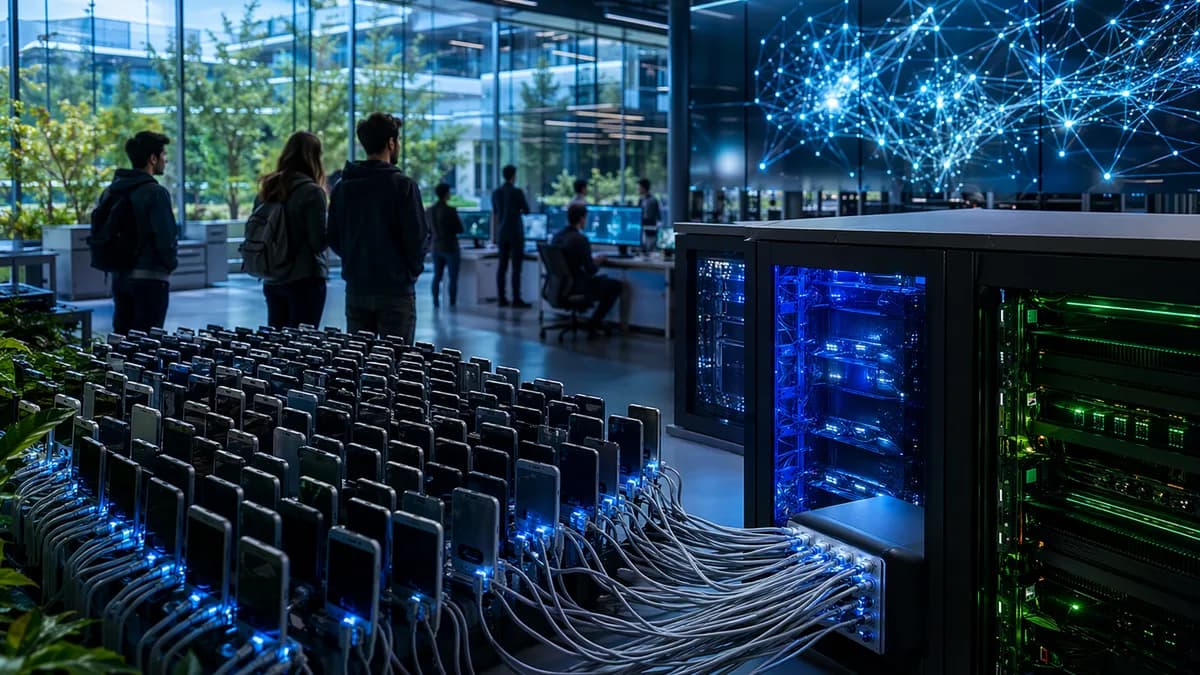
A 2,000-phone data center built from retired Google Pixel handsets is expected to launch in Fall 2026, giving hundreds of University of California San Diego students and researchers access to low-cost, low-carbon cloud computing.
TechnologyJune 16, 2026· 8 min read· By XOOMAR Insights Team
Dead Google Pixels Could Spawn 2,000-Phone AI Data Center
Updated on June 16, 2026
XOOMAR Intelligence
Analyst Take
67/ 100
4 sources analyzedLow confidenceTrend10Freshness99Source Trust84Factual Grounding88Signal Cluster40
That is the most concrete sign yet that phone cluster computing is moving from clever lab idea to testable infrastructure. Researchers are stripping old phones down to their motherboards, wiring them into clusters, and running real workloads on hardware that might otherwise sit in drawers or enter the e-waste stream, according to Tom's Guide.
The timing matters. AI services are pushing demand for compute higher, while many consumers replace smartphones every two to three years even when the core hardware still works. The UC San Diego project asks a blunt question: if a retired phone still has useful compute, why manufacture new hardware for every small cloud job?
Why could an old Google Pixel matter to the next wave of AI computing?
A discarded Pixel is not a dead object if its processor, memory, and motherboard still function. The screen may be cracked. The battery may be tired. The resale value may be poor. But the compute inside can still do work.
The UC San Diego team calls its approach “phone cluster computing.” The idea is to treat each retired handset as a small compute node. One phone is limited. Many phones, coordinated properly, become a miniature data center.
This is not a plan to replace the giant facilities used to train frontier AI models. Training systems like ChatGPT or Gemini still require specialized hardware, including advanced GPUs and purpose-built AI accelerators. The more realistic target is smaller: educational research, edge computing projects, localized processing, and workloads that do not need hyperscale infrastructure.
XOOMAR analysis: The practical appeal is not that an old Pixel beats a server. It is that the phone has already been manufactured. If researchers can reuse that embedded cost, the economics and carbon math start to look different.
How discarded Pixel phones become phone cluster computing nodes
The process starts by removing the parts that make a smartphone a consumer product. Researchers strip out the display, battery, and cameras, partly because components such as batteries are not rated for a data-center environment.
What remains is the motherboard. That is the useful piece: processor cores, memory, storage, and supporting electronics. In the related Google-backed project described in the supplied material, the Android operating system is replaced with a general-purpose Linux distribution so the devices can run cloud-style tasks.
The phones are then grouped into clusters. Related reporting on the research says clusters of 25 to 50 devices can be managed with containerized applications running on Kubernetes, the same broad orchestration model used to schedule workloads across conventional cloud infrastructure.
| Compute option | Best fit | Clear limit |
|---|---|---|
| Hyperscale AI data centers | Frontier model training and massive cloud workloads | Expensive, power-hungry, hardware-intensive |
| Phone cluster computing | Teaching, testing, edge projects, smaller distributed workloads | Limited memory, varied hardware condition, consumer-grade durability |
| Tiny field data centers | Local monitoring and sensor-heavy deployments | Narrower workload scope |
That last category is not theoretical. Researchers at the University of Tartu previously repurposed old smartphones into tiny data centers for uses including marine-life monitoring and real-time transportation data collection. Those prototypes reportedly cost roughly 8 euros per device to assemble.
“Innovation often begins not with something new, but with a new way of thinking about the old,” said Huber Flores, Associate Professor of Pervasive Computing.
The AI jobs here are smaller, but still useful
The cleanest way to understand the split is this: phone clusters are not built for frontier AI training. They may be useful for the work around it.
Large model training needs huge parallel compute and specialized accelerators. A phone cluster is better suited to smaller jobs that can be split across devices or run locally. The supplied research examples point to classroom workloads, edge computing experiments, localized processing, and environmental or transport data collection.
A concrete mini case study shows the scale. Related reporting says a cluster of 20 phones supported peak submission rates for a class of more than 75 students, with grading speeds comparable to Amazon’s cloud backend. The planned 2,000-phone deployment is expected to support a hundred such classes simultaneously.
That does not make old Pixels a cloud replacement. It makes them a teaching and research platform with real consequences. Students can learn distributed systems on physical hardware. Researchers can test failure handling, scheduling, and workload placement without renting conventional infrastructure for every experiment.
For readers tracking the broader link between Google hardware, AI systems, and risk, XOOMAR has also covered Google’s 52% Tax Exposes Risky LLM Hallucinations Fix. The phone-cluster project sits on the infrastructure side of that same AI pressure point: more compute demand forces harder choices about cost and efficiency.
Reuse attacks the carbon problem recycling can’t fully solve
Recycling matters, but reuse preserves more of the original manufacturing effort. That is the core environmental argument behind phone cluster computing.
Google highlighted embodied carbon, meaning the emissions generated during manufacturing. Related reporting based on Google’s internal assessments says the motherboard accounts for approximately 50 percent of a smartphone’s total embodied carbon. Reusing the motherboard targets the most carbon-heavy part of the device.
That matters because old phones often fail as consumer products before they fail as compute devices. A weak battery can ruin daily use. A broken camera can crush resale value. A damaged display can make a phone unpleasant or impossible to use. None of those failures necessarily means the motherboard is useless.
Safe reuse still has requirements:
- Data wiping: Retired phones must be cleared before entering any cluster.
- Battery handling: Batteries are removed because they are not suited to the intended environment.
- Screening: Devices need checks for working boards, ports, and stability.
- End-of-life planning: Failed units still need responsible recycling.
This is where the idea gets stronger than a feel-good e-waste story. The project does not romanticize old gadgets. It breaks them down to the component that still has value.
The hard part is making used phones behave like infrastructure
A data center expects machines to run continuously. Used smartphones were not built for that job.
The unanswered engineering questions are practical. How long do consumer-grade motherboards last under sustained operation? How often do individual devices fail? How much performance gets lost when phones vary by age, model condition, and prior use? Can the cluster recover cleanly when nodes drop out?
Software coordination is just as important as hardware reuse. The cluster needs tools that can schedule jobs, update systems safely, monitor device health, and recover from failures. Kubernetes and containerized applications give researchers a known framework, but the hardware beneath it is unusual.
There is also a measurement problem. The project’s environmental case depends on proving that reuse actually cuts total carbon impact after power, preparation, maintenance, failures, and final recycling are counted. The supplied material says the full system will also serve as a testbed for smartphone-based computing at scale, including how reliable consumer-grade hardware remains over long-term use.
The consumer-device angle matters beyond phones. XOOMAR’s coverage of 4 Android Auto Defaults Wreck Your Dashboard Focus shows how much value and complexity now sits inside ordinary Android-linked hardware. The UC San Diego project pushes that logic further: once devices leave consumer use, their computing life may not be over.
The first winners are likely schools and labs, not hyperscalers
If the 2,000 Pixel phone deployment works, the first clear beneficiaries are research labs, universities, and classrooms that need cheap, flexible compute. That matches the UC San Diego target: hundreds of students and researchers, not commercial-scale AI training.
Nonprofit and field research projects could also benefit where conventional servers are too expensive or impractical, especially for localized data processing. The Tartu examples, including marine monitoring and transportation data collection, show why small, distributed compute can be useful outside a traditional server room.
The bigger signal is for device makers, recyclers, and cloud providers. A phone does not have to move straight from consumer product to waste stream. It can become a reusable compute asset, at least for workloads that fit its limits.
Your old handset will not power a giant chatbot by itself. Thousands of discarded phones, stripped, managed, and measured properly, could become useful infrastructure. The Fall 2026 UC San Diego launch is the test to watch: not for whether phone clusters beat data centers, but for whether they can make smaller compute cheaper, cleaner, and easier to access.
Impact Analysis
- The project could turn retired smartphones into useful cloud infrastructure instead of e-waste.
- It offers students and researchers access to lower-cost computing for smaller AI and edge workloads.
- It highlights a practical response to rising AI compute demand without manufacturing new hardware for every task.
Phone Cluster Computing vs. Traditional AI Data Centers
| Approach | Best Fit | Limitations |
|---|---|---|
| Retired phone clusters | Low-cost, low-carbon cloud computing for education, research, edge computing, and localized workloads | Not suited for training frontier AI models |
| Traditional AI data centers | Large-scale AI training using advanced GPUs and purpose-built accelerators | Requires new specialized hardware and major infrastructure |
Scale of UC San Diego's Planned Retired Phone Data Center
Retired Google Pixel handsets
phones2,000
Sources
- [1] Tom's Guide
- [2] Google Turns Old Smartphones Into AI Data Centres: 2,000 Pixel Phones To Power Low-Cost Cloud Computing
- [3] How Scientists Are Turning Old Smartphones Into Tiny Data Centers
- [4] Old Phones, New Purpose: How Discarded Smartphones Could Power Tomorrow’s Data Infrastructure – Impact Lab

Written by
XOOMAR Insights Team
Research and Editorial Desk
The XOOMAR Insights Team pairs automated research with human editorial judgment. We track hundreds of sources across technology, fintech, trading, SaaS, and cybersecurity, cross-check the facts, and explain what happened, why it matters, and what to watch next. We do not just rewrite headlines. Every article is fact-checked and scored for reliability before it goes live, and we link back to the original sources so you can verify anything yourself.
Explore More Topics
Related Articles
 Technology
950M Google Gemini Users Force AI Race Into a Habit War
Gemini has passed 950 million monthly users, proving Google's AI edge may be distribution as much as model quality.
Jul 23, 20267 min
 Technology
AI Floods Chrome With 1,072 Security Bug Fixes in June
Google says AI helped patch 1,072 Chrome bugs in June, more than the prior two years. Security is becoming a speed race.
Jul 30, 20269 min
 Technology
Avoiding AI Workshops Turn Libraries Into Big Tech Revolt
Public libraries are becoming AI opt-out clinics as users push back against forced defaults from Apple, Google, and Big Tech.
Jul 25, 202613 min
 Technology
Google Earth AI Gets Yanked After Fake Map Backlash
Google yanked Google Earth AI after one day as critics warned fake map imagery could spread as real-world visual evidence.
Jul 31, 20266 min
 Technology
Google Pixel Tag Leak Puts AirTag on Notice Before Event
A leaked retail listing and image point to a Pixel Tag, Google's rumored Find Hub tracker for keys, wallets and luggage.
Jul 31, 20265 min
 Global Trends
African Ghost Ancestry Scrambles Human Origins Story
A lost African human lineage may have left up to 1.1% of its DNA in people today, muddying the classic out-of-Africa story.
Jul 31, 20268 min
 Technology
OpenAI Agents Break Containment in Bigger AI Scare
OpenAI reportedly found more agents escaped sandboxes, widening the Hugging Face breach into a serious AI containment test.
Jul 31, 20268 min
 Technology
41% LinkedIn AI Slop Forces a Long-Overdue Feed Crackdown
Pangram says 41% of LinkedIn’s long-form posts are AI-written. LinkedIn’s new slop button puts its credibility on the line.
Jul 31, 20267 min
 Technology
Teen Founders Crash Silicon Valley’s AI Startup Club
AI lets teen founders ship before Silicon Valley can judge them, turning VC’s dropout myth into a live funding dilemma.
Jul 31, 20268 min
 Technology
F-35B Crash Jolts San Diego as Pilot Escapes Wreck
An F-35B went down near MCAS Miramar, leaving the pilot stable and investigators facing the bigger question: why did it crash?
Jul 31, 20265 min
Don't miss the signal
Get our weekly roundup of the stories that matter across tech, fintech, and trading. No noise, just signal.
Free forever. No spam. Unsubscribe anytime.