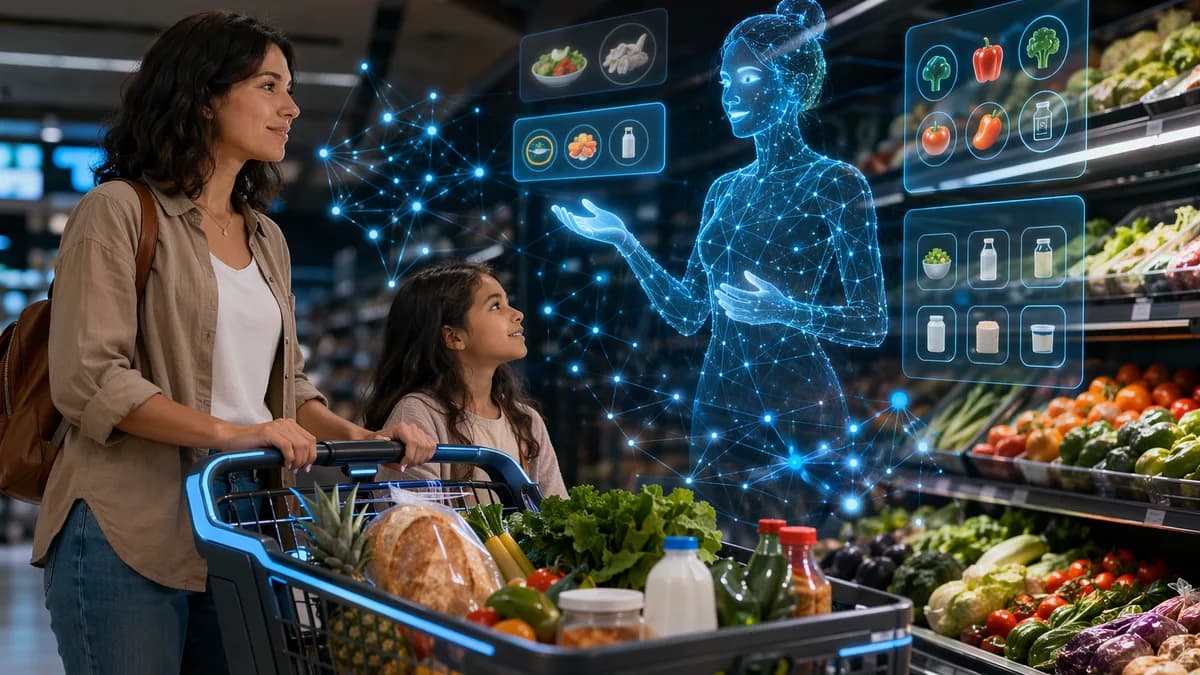
1.6 billion lifetime grocery orders explain why the AI mom assistant may matter more than another office chatbot: the weekly list is where family logistics, budgets, preferences and time pressure collide.
XOOMAR Intelligence
Analyst Take
Sarah Dooley, founder of AI-Empowered Mom, told PYMNTS that families are starting to use AI for the “invisible work” of household management, from meals and calendars to purchases and budgets. Her thesis is sharper than the product category sounds. Consumer AI may earn trust first by handling mundane chores, not by acting futuristic.
“The mental load is really all of that invisible labor or ghost labor,” Dooley said. “The cognitive labor that has to happen to keep a household running.”
1.6 billion grocery orders show why the list is AI’s home base
The grocery list looks trivial until it becomes a control point. It encodes what a household eats, what it can spend, what it already has, what it forgot last week and what it needs by tonight.
That’s why the AI mom assistant concept is not just a parenting app idea. It sits near commerce. Instacart says its AI shopping assistant is built on more than 1.6 billion lifetime orders and live inventory data from nearly 100,000 stores across North America, according to Instacart. The company says the tool can turn a natural-language request, a photo of a handwritten grocery list or a prompt like “easy weeknight dinners for four” into a ready-to-buy cart.
That matters because meal planning is not a single task. It’s a chain. Decide dinner. Check ingredients. Fit preferences. Watch budget. Build cart. Handle substitutions. Confirm checkout. AI becomes useful when it compresses that chain without forcing the parent to supervise every step.
From office copilot to household coordinator, the value is fewer open loops
Dooley founded AI-Empowered Mom after applying AI productivity techniques from her technology consulting career to family life. Her product, Em, is in beta testing and is designed to help families plan meals, organize calendars, manage household reminders and research products before purchases.
The value proposition is not novelty. It’s load shedding.
A household assistant that only generates recipes is a toy. One that remembers the calendar, builds a list, checks reminders and helps research purchases starts to resemble a home operating layer. That’s the shift from workplace AI to family AI.
Dooley’s framing is careful. She does not describe AI as a replacement for human judgment. She describes it as a way to protect time and attention for higher-value family decisions.
“I hope that just in the same way that I’m working hard to create more space for humanity in my life, that companies will do that,” she said.
XOOMAR analysis: that phrasing matters. The successful AI mom assistant will not be the most talkative chatbot. It will be the least annoying coordinator, the one that removes decisions during the busiest parts of the day.
83% dinner stress creates a narrow but real opening
Instacart cites an Instacart-commissioned Harris Poll survey of more than 2,000 U.S. adults finding that 83% of Americans say deciding what to make for dinner causes stress. Nearly a third said the hardest part is deciding what to make, not cooking. More than two in three said they would be interested in an AI-powered assistant for meal planning or grocery shopping, while just 8% currently use AI for those tasks.
That gap is the market opening. The interest is there, but use is still low.
Instacart also says early testing showed orders placed with its AI assistant are, on average, larger than its typical basket. The company gives its average order value as $113. It does not provide the exact uplift, so the signal should be read cautiously. Still, larger baskets suggest AI-assisted planning may push users toward fuller weekly shops rather than one-off item searches.
| AI use case | What the source supports | Commercial implication |
|---|---|---|
| Meal planning | Recipe suggestions with shoppable ingredient lists | Moves demand earlier in the decision process |
| List upload | Photo of a list becomes a cart | Cuts item-by-item search friction |
| Deals prompts | Users can ask what’s on sale or set budget-style prompts | Connects planning to promotions |
| Household memory | Instacart cites order history and preferences | Personalization improves if trust holds |
This is where consumer AI touches payments and commerce. If software helps decide the list, it can influence the basket before the shopper reaches checkout.
500+ downloads hint at a niche forming, but trust is the real bottleneck
A separate Busy Moms Assistant AI Google Play listing shows how quickly the category is filling in. The app lists 500+ Downloads, in-app purchases and features including shared calendars, smart shopping lists with Instacart integration, cycle tracking, daily affirmations, gift finder and premium AI features such as voice assistance, mental notes and an event scanner.
That feature bundle also shows the privacy problem. The listing says the app may collect data types including personal info, health and fitness and other categories, and may share data types including location, photos and videos and others with third parties. It also says data is encrypted in transit and that users can request deletion.
The trade-off is obvious. A useful household AI needs context. Context can include children’s routines, food preferences, calendar events, spending patterns and photos of school flyers. The more useful it gets, the more sensitive it becomes.
Dooley’s own trust language is blunt. She teaches her children to treat AI as “a thinking machine,” not a companion.
“It can be an assistant or something that helps us, but it’s not a part of our family. It’s not our friend,” she said.
That distinction should guide product design. Family AI that pretends to be emotionally intimate risks crossing a line. Family AI that is transparent, limited and accountable has a better shot.
Banks and FinTechs have a trust advantage if they think in households
Dooley argues that banks and FinTechs may be better placed than unfamiliar AI platforms because they already have consumer relationships. She also says financial products are too often designed for individuals, even though many decisions happen at the family level.
“I think financial institutions can stand to really benefit from thinking more broadly about the family instead of just the individual,” she said.
Her caution is equally important:
“There is a big trust deficit that AI is gonna have to make up before we really hand over the wallet or the purse strings and let AI make those purchase decisions,” she said.
XOOMAR analysis: this is the boundary line. Families may accept AI help with planning, reminders and product research before they accept AI-controlled spending. A grocery cart is a safer test than autonomous purchasing. The user still reviews before checkout, which Instacart says its assistant requires.
The product sprawl risk is real too. If every bank, grocery app and parenting platform adds a separate assistant, families get more interfaces instead of less work. That tension echoes the AI product design challenge we covered in Microsoft Copilot App Merger Exposes Its AI Sprawl Problem. The family version has even less patience for clutter.
Recipe cards, calendars and delivery apps all point to the same missing layer
Parents already use tools for pieces of the problem: calendars, notes, delivery apps, recipe sites and reminders. The missing layer is coordination.
Smart assistants and grocery apps can answer commands. The harder job is understanding context across tasks. A school event affects dinner timing. A dinner plan affects the grocery cart. A grocery cart affects the weekly budget. A budget may affect substitutions.
That is why the AI mom assistant category is more demanding than it sounds. It has to combine memory, personalization, commerce and restraint. Too little context and it becomes generic. Too much autonomy and it feels invasive.
For readers tracking how AI performs in group decision settings, our related analysis, 277 Americans Put AI Collective Intelligence on Trial, is useful context. Household AI will face a similar test: can software improve decisions without overriding the humans who live with the consequences?
The winner manages the weekly list without asking for too much trust too soon
The next phase should be measured by behavior, not demos.
Evidence that would strengthen the AI household thesis includes higher repeat use for meal planning, larger or more complete grocery baskets with user approval, lower setup friction and clear disclosure around where AI is used in decisions. Evidence that would weaken it includes abandonment after trial periods, complaints about bad recommendations or user resistance to sharing household data.
The commercial prize is clear enough. Grocery planning can sit upstream of carts, promotions, delivery choices and budgeting. But Dooley’s warning should shape the category: families won’t hand over the wallet quickly.
The assistant that wins will not be the flashiest chatbot. It will be the one trusted enough to manage the list, surface the trade-offs and leave the final call with the household.
The Bottom Line
- AI assistants may gain consumer trust by solving everyday chores rather than showcasing futuristic features.
- Grocery lists are a high-value entry point because they combine budgets, preferences, timing and household needs.
- Instacart’s order history and store inventory data show how commerce platforms could turn AI prompts into ready-to-buy carts.
Consumer AI Grocery Assistants vs. Office Chatbots
| Category | Primary Use | Why It Matters |
|---|---|---|
| AI mom assistant | Manages household logistics such as meals, grocery lists, calendars, purchases and budgets. | Targets the recurring “mental load” of family life where trust can be built through practical utility. |
| Office chatbot | Supports workplace tasks and productivity. | May feel less immediately essential than tools that solve daily household chores. |
Instacart AI Shopping Assistant Data Foundation
Primary Sources & Disclosures

Written by
XOOMAR Insights Team
Research and Editorial Desk
The XOOMAR Insights Team pairs automated research with human editorial judgment. We track hundreds of sources across technology, fintech, trading, SaaS, and cybersecurity, cross-check the facts, and explain what happened, why it matters, and what to watch next. We do not just rewrite headlines. Every article is fact-checked and scored for reliability before it goes live, and we link back to the original sources so you can verify anything yourself.