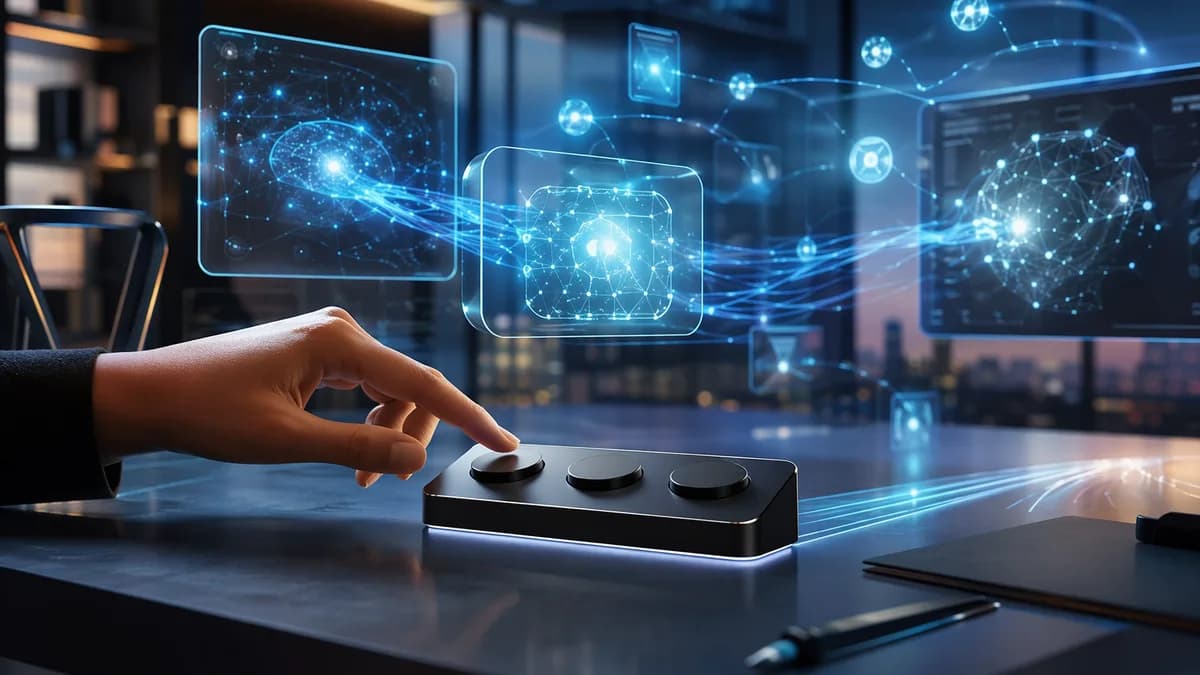
Aina AI agent hardware is betting that the next AI device should press buttons for you, not just listen to your life.
XOOMAR Intelligence
Analyst Take
The Bengaluru and San Francisco startup Aina, founded by former Ultrahuman hardware VP Apoorv Shankar, has raised $5.5 million to build devices for controlling and invoking AI agents, according to TechCrunch. The round was led by Redstart Labs and 360 ONE, with participation from MIXI Global Investments, Antler, and Blume Founders Fund.
Individual backers include newly appointed WhatsApp head Kunal Shah, Razorpay co-founders Harshil Mathur and Shashank Kumar, and Scribd founder Tikhon Bernstam.
Aina raises $5.5 million for AI agent hardware that acts, not just records
Aina, previously known as Project Mirage, is entering a crowded race to define the next human-computer interface for AI agent hardware. The company’s pitch is sharper than another always-on recorder: build hardware that helps users trigger workflows, direct agents, and control software in the moment.
That distinction matters. TechCrunch lists a field packed with devices trying to capture what users say and do, including Sandbar ring, Plaud’s AI pin and desktop notetaker, Pocket’s credit card-sized pucks, Bee, Friend, Meta Ray-Bans, and Even Realities smart glasses.
Aina’s first shipping focus is Dune, a three-key, context-aware macro keyboard, meaning a small keypad that runs pre-set shortcuts. Dune can control the mic and camera in a meeting and run shortcuts or scripts based on the app a user is viewing.
“I left Ultrahuman last year because I was just super curious about the space of AI interfaces,” Shankar told TechCrunch. “Devices like Rabbit and Humane Pin had launched, and I had my own disappointments with them. However, I was just excited that we are seeing interfaces being a thing now. And as an engineer turned product designer, this was the hottest thing I could imagine myself building.”
The near-term milestone is not a mass launch. Aina plans to begin testing an unrevealed new device with a small group of select users in the coming weeks.
Aina AI agent hardware starts with a keypad because users picked it
Aina built three devices before choosing what to ship first. Early testing pushed the company toward Dune, not because it was the flashiest form factor, but because users appeared to prefer it over Aina’s other prototypes.
| Aina device | Form factor | Stated function | Status from source |
|---|---|---|---|
| Dune | Three-key keypad | Controls meeting mic and camera, runs shortcuts or scripts based on the app in view | Most popular in early testing, selected to ship first |
| Radiance | Tabletop remote | Adds a dial for volume and buttons for mic, camera, AI notetaker, voice modulation, and joining meetings | Features may feed into later products |
| Shift | Single-tap button | Triggers an AI agent to carry out a repeated task, connects to a phone | Features may feed into later products |
That choice says something about Aina’s thesis. The company is not starting with a ring, pin, or glasses form factor. It is starting with a control surface that sits closer to work habits already built around keyboards, meetings, and apps.
Shankar’s hardware background gives the effort credibility, but not a free pass. Before founding Aina, he ran LazyCo, a hardware interface design startup that built gadgets including a ring for controlling devices like a smartphone. Ultrahuman later acquired LazyCo, bringing him in-house before he left to start Aina.
Aina’s name means “mirror” in Hindi. The more useful clue is its product direction: reflect context, then turn it into action.
Control beats passive context capture, if the workflow is real
Aina’s clearest strategic break is with passive “context capture” devices. Shankar told TechCrunch the company’s next device will not be the kind of always-listening ring or Plaud-style meeting notetaker that only records what’s happening around the user.
“I think you have enough context, you have in your phone and your laptop all the time, and we haven’t even started using that well. We are building an action-oriented device that will use the context to help you control and trigger workflows,” he said.
That is the core bet behind Aina AI agent hardware: users may not need another device to gather context, because phones and laptops already hold plenty of it. They may need a faster, more intentional way to tell agents what to do.
XOOMAR analysis: This is the right pressure point. A device that only records can feel redundant next to a phone or laptop. A device that reliably turns one press into a useful action has a cleaner reason to exist. The hard part is proving the action is valuable enough to become muscle memory.
The privacy tension does not disappear. Dune’s stated functions include controls for microphones, cameras, AI notetakers, and scripts tied to what app a user is viewing. Any device that sits near meetings, work apps, voice, or agent workflows will have to convince users that control does not become surveillance by another route.
Hardware also gets judged by boring constraints. That has been a recurring theme across XOOMAR’s device coverage, from wearable friction in 15-Day Battery Turns Ultrahuman Ring Pro Into a Chore to form-factor trade-offs in Starlink V5 Shrinks the Dish, But Speed Takes a Hit. For Aina, the same rule applies: a clever interface still has to survive daily use.
The pilot will test whether AI agents need their own buttons
Aina’s pilot has a clear job: prove that a dedicated AI agent device deserves space beside the phone and laptop.
The challenge is obvious. Smartphones already have microphones, cameras, apps, notifications, and AI assistant hooks. Laptops already sit at the center of meetings and work. Aina must show that a separate device makes agent control faster, clearer, or more reliable than existing inputs.
The most important signals will be practical:
- Usefulness: Do users trigger workflows they actually repeat?
- Speed: Does the hardware reduce friction compared with app menus or voice commands?
- Accuracy: Do agents perform the intended task without repeated correction?
- Privacy controls: Can users see and manage what context the device uses?
- Habit formation: Does the device become part of the desk or pocket routine?
Aina enters as OpenAI has released a custom keypad for Codex with Work Louder, while other options range from keyboard makers to DIY macro controllers, according to TechCrunch. Reports cited by TechCrunch also say OpenAI is developing a smart speaker with a built-in AI assistant, while Rabbit R1 has positioned itself as another device for invoking AI agents. Qualcomm says it is experimenting with more than 40 devices to interact with AI.
No form factor has won. Ring, pin, glasses, keypad, and speaker are all still in contention.
For Aina, the next few weeks matter because the company is about to leave pitch territory and collect real usage feedback. If testers use the device to command agents rather than merely admire the concept, Aina will have a sharper story than most AI hardware startups. If they don’t, the lesson may be just as valuable: AI agents might need better software interfaces before they need new objects on the desk.
The Bottom Line
- Aina is positioning AI hardware around action and control rather than passive recording.
- The $5.5 million round shows continued investor interest in new AI interface devices despite a crowded market.
- Dune’s macro-keyboard approach could appeal to users who want practical AI workflows instead of always-on surveillance gadgets.
Aina’s approach vs. AI recorder devices
| Category | Aina Dune | AI recorder-style devices |
|---|---|---|
| Primary purpose | Trigger workflows, direct AI agents, and control software | Capture what users say and do |
| Form factor mentioned | Three-key context-aware macro keyboard | Rings, pins, pucks, smart glasses, and desktop notetakers |
| Examples named | Dune by Aina | Sandbar ring, Plaud devices, Pocket pucks, Bee, Friend, Meta Ray-Bans, Even Realities glasses |
Aina seed funding raised
Primary Sources & Disclosures

Written by
XOOMAR Insights Team
Research and Editorial Desk
The XOOMAR Insights Team pairs automated research with human editorial judgment. We track hundreds of sources across technology, fintech, trading, SaaS, and cybersecurity, cross-check the facts, and explain what happened, why it matters, and what to watch next. We do not just rewrite headlines. Every article is fact-checked and scored for reliability before it goes live, and we link back to the original sources so you can verify anything yourself.