
The question behind Apple’s $5 trillion moment is sharper than the market-cap headline: can a company this large make its next home hardware push matter enough to justify the scale?
TechnologyJuly 28, 2026· 7 min read· By XOOMAR Insights Team
Apple's $5 Trillion Bet Puts Its Smart Home on Trial
Updated on July 28, 2026
XOOMAR Intelligence
Analyst Take
72/ 100
4 sources analyzedMedium confidenceTrend10Freshness99Source Trust88Factual Grounding92Signal Cluster20
Apple is reportedly preparing a bigger move into smart home products and software just as it briefly became the second company ever to reach a $5 trillion market capitalization, according to PYMNTS. Those two developments belong together. One shows Wall Street still paying up for Apple’s future. The other shows where Apple may try to prove that future has room beyond its familiar device lines.
This roundup has one connecting thread: Apple’s $5 trillion valuation turns every product ambition into a test. A new smart home hub, a refreshed HomePod mini, a new Apple TV box and a more capable Siri AI are no longer just product updates. At this market value, they become evidence.
Can Apple’s $5 trillion market cap survive contact with product reality?
Apple reached the $5 trillion mark Tuesday morning, though PYMNTS, citing Bloomberg, reported that the valuation slipped back below that level within two hours. The milestone still matters. Apple became only the second company ever to touch that figure, after Nvidia, which closed at a record $5.7 trillion in May.
Forbes reported that Apple shares rose as much as 1.8% to $342.89 shortly after the open, pushing the company above the threshold before gains faded. It also said Apple ranked ahead of Nvidia at $4.7 trillion, Alphabet at $3.9 trillion and Microsoft at $2.9 trillion by market value at the time of publication.
That scale changes the product math. A useful smart speaker or a better set-top box won’t move the narrative by itself. For Apple’s $5 trillion valuation to look durable, new hardware has to support a larger argument: that Apple can keep finding categories where its devices, software and AI features reinforce each other.
The market has already seen how quickly these rankings can swing. PYMNTS noted that Nvidia has since shed around $1 trillion in valuation after its May record. Apple is now the largest company in the S&P 500 Index, but the lesson is blunt: even trillion-dollar leaders don’t get much time to coast.
Why is Apple putting Siri AI at the center of the home now?
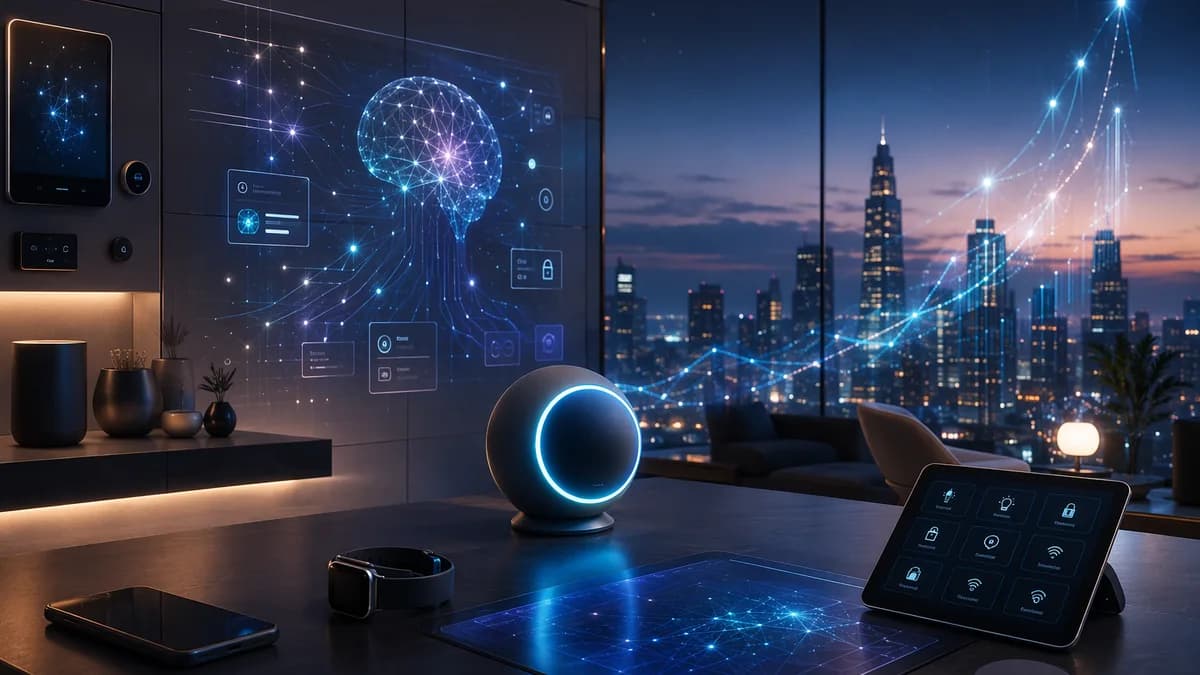
The reported smart home push starts with a hub device built around the new Siri AI assistant. Bloomberg’s sources, via PYMNTS, said Apple is also preparing a new TV set-top box and refreshed HomePod mini, with launches possible between October and early 2027.
That timing matters because Apple debuted the long-awaited Siri AI in June. The pitch was not just voice commands. Apple said the assistant can answer questions from the web and surface relevant information from a user’s messages, emails and photos.
“With access to broad world knowledge for up-to-date answers on virtually any topic, along with onscreen awareness and personal context understanding, Siri AI can help users take action across apps more naturally than ever,” Craig Federighi, senior vice president of software engineering at Apple, said in a news release.
The smart home angle gives Siri AI a clearer job. A hub in the home puts the assistant in a shared physical space, where voice, screen context and device control have to feel fast and obvious. That’s a harder test than a demo.
It also puts Apple closer to Amazon’s Echo Show and Google’s Nest Hub, products PYMNTS says Bloomberg identified as competitive benchmarks. The smart home market is being reconfigured around AI advances, but Apple’s challenge is narrow and practical: make the assistant useful enough that the hardware feels necessary.
Why hasn’t Apple’s home business already become a core pillar?
Apple has been in the home for years, but the results described in the source material are modest. PYMNTS, citing Bloomberg, said Apple has struggled to generate revenue from home products. The HomePod smart speaker is eight years old, and the Apple TV set-top box is almost two decades old, yet both have posted only modest sales.
Most revenue in Apple’s wearables, home and accessories division comes from AirPods and Apple Watches, not home devices. That detail is the clearest reason this reported push matters. Apple isn’t entering a category where it already dominates. It’s revisiting one where its brand and hardware skills have not yet translated into the same kind of commercial weight.
| Apple area | Source signal | XOOMAR read |
|---|---|---|
| HomePod | Eight-year-old smart speaker with modest sales | Apple has shipped home hardware, but not a breakout category |
| Apple TV | Almost two decades old, also with modest sales | The living room remains unfinished business |
| AirPods and Apple Watch | Main revenue drivers in wearables, home and accessories | The division’s strength is not yet centered on the home |
| Siri AI hub | Reported device designed around the new assistant | Apple is trying to make AI the organizing layer |
Analysis: the home push only becomes meaningful if Apple changes the role of these products. A refreshed HomePod mini and Apple TV can’t just be better versions of familiar devices. They need to make the hub and Siri AI feel like the center of a connected Apple experience, not an accessory shelf update.
What does Apple’s iPhone leasing move say about the same pressure?
Forbes also reported that Apple announced U.S. customers would soon be able to lease an iPhone for up to two years starting at $17.99 per month through Upgrade, a program offered with Klarna at Apple’s physical and online stores.
That doesn’t prove anything about the smart home plan. It does show Apple making another move around how customers enter and stay inside its device portfolio. XOOMAR covered that shift in Apple Upgrade Turns iPhone Price Shock into Klarna Rent and Apple Upgrade Grabs Control of Your Next iPhone Cycle.
The connection is pressure, not proof. At $5 trillion, Apple’s market story depends on more than one product event. A reported smart home hub, Siri AI, refreshed home devices and a new iPhone leasing option all point to the same commercial question: how does Apple keep its hardware base active when each new growth claim has to be measured against an enormous valuation?
The bigger picture: can Apple turn scale into a home platform people actually buy?
Apple’s brief $5 trillion market cap and reported smart home push signal the same strategic reality. Scale is now both Apple’s advantage and its burden. The company has the brand, installed base and software control to make a more serious run at the home, but the source material also shows why investors should stay skeptical until products ship.
The cleanest watch item is Siri AI. If Apple’s assistant can make the reported hub, new Apple TV box and refreshed HomePod mini feel genuinely useful, the home could become a stronger extension of Apple’s device portfolio. If it can’t, this risks becoming another round of capable hardware in a category where Apple has already produced only modest sales.
For decision-makers, the takeaway is simple: don’t treat Apple’s smart home push as a side story to the valuation milestone. Treat it as one of the first tests of what Apple’s $5 trillion era actually demands.
The Bottom Line
- Apple’s $5 trillion milestone raises pressure for new products to deliver meaningful growth.
- A smart home push could help Apple extend its ecosystem beyond phones, Macs and wearables.
- Investor expectations are high, making execution in AI, Siri and home hardware more important.
Market Values Cited in the Article
| Company | Market Value / Milestone | Context |
|---|---|---|
| Apple | Briefly reached $5 trillion | Second company ever to touch the $5 trillion mark |
| Nvidia | Closed at a record $5.7 trillion in May | First company cited as reaching that scale |
| Nvidia | $4.7 trillion | Market value at time of Forbes publication |
| Alphabet | $3.9 trillion | Market value at time of Forbes publication |
| Microsoft | $2.9 trillion | Market value at time of Forbes publication |
Company Market Values Mentioned
Apple peak
$T5
Nvidia record
$T5.7
Nvidia current
$T4.7
Alphabet
$T3.9
Microsoft
$T2.9
Sources

Written by
XOOMAR Insights Team
Research and Editorial Desk
The XOOMAR Insights Team pairs automated research with human editorial judgment. We track hundreds of sources across technology, fintech, trading, SaaS, and cybersecurity, cross-check the facts, and explain what happened, why it matters, and what to watch next. We do not just rewrite headlines. Every article is fact-checked and scored for reliability before it goes live, and we link back to the original sources so you can verify anything yourself.
Explore More Topics
Related Articles
 Technology
MacBook OLED Risks Apple's Touch Bar Mistake Again
MacBook OLED could headline Apple's next Pro laptops, but a rumored touchscreen may turn a clean upgrade into another Touch Bar fight.
Jul 26, 20268 min
 Technology
$1B Google Search Fine Threatens Its Ranking Machine
The EU's $1B Google fine goes after search placement and Play Store control, not just a one-off antitrust penalty.
Jul 26, 20267 min
 Technology
No-Repair Moon Trial Tests Nvidia Moon GPU This Year
Nvidia’s Jetson chips are headed for a Lunar Outpost rover, making the Moon a brutal testbed for off-world edge AI.
Jul 23, 20268 min
 Technology
Apple Maps Seizes Ford EV Dashboards in $30K Truck Bet
Ford will bake Apple Maps into 2027 EVs, making navigation, charging and battery prep part of its $30K electric truck push.
Jul 23, 202611 min
 Technology
Apple Maps Grabs the Wheel in Ford's $30,000 EV Bet
Ford will put Apple Maps inside its 2027 EV platform, starting with a $30,000 electric truck that still has to prove it can scale.
Jul 23, 20267 min
 Trading
Bitcoin Fed Meeting Threatens to Crack $65K Calm This Week
Bitcoin held near $65,000 after Nvidia's slide, but Fed week will test whether BTC's calm is real demand or just a macro pause.
Jul 27, 20268 min
 Cybersecurity
Nvidia AI Security Alliance Leaves OpenAI Off Roster
Nvidia's 37-member AI security push puts open tools against closed labs, with OpenAI, Anthropic and Google missing from the launch.
Jul 27, 20267 min
 Fintech
Apple Upgrade Turns iPhone Price Shock into Klarna Rent
Apple is using Klarna leases to soften iPhone, Mac and iPad price shock without cutting prices or loosening its upgrade grip.
Jul 28, 20268 min
 Trading
Judge Freezes Minnesota Prediction Market Law 4 Days Early
A federal judge froze Minnesota's felony prediction market law, keeping Kalshi and Polymarket live as the preemption fight heats up.
Jul 28, 20266 min
 Fintech
Western Union Digital Bank Forces Users Into 2-Month Exit
Western Union Digital Bank is shutting down, giving users two months from their notice to move funds, save records and reroute payments.
Jul 28, 20266 min
Don't miss the signal
Get our weekly roundup of the stories that matter across tech, fintech, and trading. No noise, just signal.
Free forever. No spam. Unsubscribe anytime.