
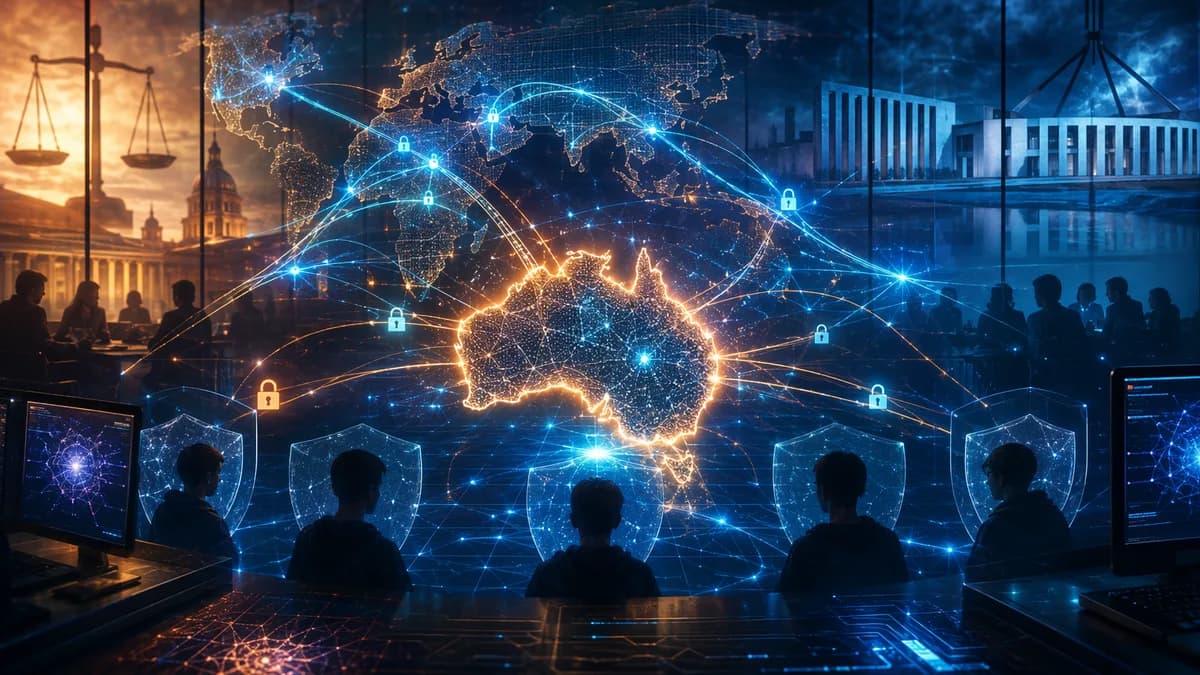
A$99 million is the number that turns Australia’s under-16 social media ban from a child-safety policy into a cross-border legal fight over how far Canberra can reach into global tech companies.
TechnologyJuly 30, 2026· 8 min read· By XOOMAR Insights Team
A$99M Fines Throw Australia Social Media Ban Into Fight
Updated on July 30, 2026
XOOMAR Intelligence
Analyst Take
57/ 100
4 sources analyzedLow confidenceTrend10Freshness96Source Trust88Factual Grounding92Signal Cluster20
X has told Australia’s parliament that proposed enforcement powers for the ban are “highly invasive” and could interfere with foreign law, according to Wired. The platform’s argument is sharper than a standard compliance complaint. X says Australia could compel documents and data from people outside the country merely because they are connected to a company covered by the rules.
That moves the dispute beyond age gates. Australia wants platforms to prove they are keeping children under 16 off major social networks. X says the proposed proof mechanism is legally overbroad, unfair, and short on safeguards for confidential or commercially sensitive information.
Musk previously wrote that the ban “Seems like a backdoor way to control access to the Internet by all Australians.”
XOOMAR analysis: the core question is no longer whether Australia can set a minimum age for social media inside its borders. It is whether enforcing that rule requires powers that foreign platforms, most of them U.S.-based, will treat as extraterritorial discovery.
A$99 million penalties make the Australia social media ban a jurisdiction fight
Australia’s law barring accounts for under-16s took effect last December, according to Reuters reporting republished by U.S. News. The country is now considering tougher enforcement powers, including wider document discovery rights for the eSafety Commissioner and a doubled maximum fine of A$99 million, roughly $69 million.
X’s submission says the amendments would:
“compel any person outside Australia ... to provide information and documents merely because they are ‘affiliated’ with a company”
The company described that as being “in clear conflict” with international legal principles and warned of a “severe impact on international comity.” In this context, international comity means the respect one country’s legal system gives to another’s authority.
That phrase matters. X is not just saying the rules are burdensome. It is arguing that Australia’s enforcement model may collide with the legal boundaries other countries recognize.
Australia’s answer, through the regulator’s own submission, is that weak discovery powers make enforcement depend too heavily on what platforms say about themselves. eSafety told the inquiry its limited power to compel documents is out of step with other regulators and leaves it reliant on “representations from providers about their own compliance.”
The weak link is proof, not the age limit itself
The Australia social media ban shifts responsibility away from parents and children and onto platforms. The covered services must take “reasonable steps” to stop under-16s from holding accounts.
The University of Sydney says the restrictions apply to major platforms including TikTok, Snapchat, YouTube, Reddit, Instagram, Facebook, Kick, Twitch, Threads, and X, and that the law came into effect on 10 December 2025.
Enforcement is where the policy gets messy. Reuters reported that YouTube and TikTok told the inquiry there is no known failsafe method to weed out and block underage users. eSafety also said it lacks power to compel documents from third-party age assurance providers hired by platforms, creating “significant” barriers to investigations.
That is the practical contradiction at the center of the law:
| Actor | Core position in the supplied record | Main risk they emphasize |
|---|---|---|
| X | Proposed powers are invasive, unfair, and potentially in conflict with foreign legal principles | Cross-border document demands and confidential data exposure |
| eSafety | Current powers leave it dependent on providers’ own compliance claims | Weak enforcement and limited access to evidence |
| DIGI | Existing enforcement powers are extensive and not fully tested | Overreach without clearer limits |
| YouTube and TikTok | No known failsafe age-blocking method exists | Technical uncertainty around age assurance |
XOOMAR analysis: Australia can write a clean age rule. It cannot enforce that rule cleanly unless platforms either collect stronger age signals or accept broader audits. Both paths create political and legal costs.
The $463,000 fine shows this fight was already live
This is not X’s first clash with Australia’s online safety regulator. In May, Australia ordered X to pay a $463,000 fine for failing to comply with child safety measures, Wired reported. eSafety first issued the fine in 2023, saying X did not respond sufficiently to a request for information about how it was tackling the spread of online child sexual abuse content. That request was submitted one month before Elon Musk took over Twitter, now X.
X has criticized Australia’s “excessive” penalty regime before. In its latest submission, it called a proposal to increase penalties against individuals “entirely unjustified and disproportionate.”
The escalation from a $463,000 dispute to potential A$99 million penalties changes the incentives. A fine at the lower level can be treated as a regulatory fight. A fine near A$99 million becomes a board-level compliance risk, even for global platforms with far larger revenue bases.
For readers tracking Canberra’s broader push into tech and safety enforcement, XOOMAR has covered related Australian pressure points in Australia Hauls Telegram to Court Over Terror Videos and the public-safety technology questions raised by AusAlert Test Jolts Cinemas but Leaves Phones Silent.
Experts split the rights question from the document-demand question
The strongest criticism of the ban does not come only from X. Stefania Di Stefano, a researcher in international law and technologies, told Wired that blanket age bans raise human rights concerns.
“For me, the complete ban from social media on children and minors is problematic from an international human rights perspective,” says Di Stefano. “It is disproportionate with respect to the right of children to exercise their right to freedom of expression, their right to access information, their right to association, and so on and so forth.”
But Di Stefano did not identify the information-gathering powers as the main problem. That distinction weakens X’s attempt to make the document issue stand in for the whole rights debate.
Julia Hörnle, a professor of internet law at Queen Mary University of London, was more skeptical of X’s submission.
“A regulator in Australia ordering X to disclose a document in relation to their business activities in Australia, that’s perfectly fine,” she tells WIRED. “From all the data in the possession of the social media company, they can distinguish between Australian and non-Australian children, and therefore keep regulation to Australia.”
XOOMAR analysis: the legal fight may turn on scope. A demand narrowly tied to Australian users and Australian business activity looks easier to defend. A demand reaching broadly into affiliates, overseas personnel, or global compliance systems gives X more room to argue overreach.
Australia’s model is being watched because it targets access directly
Australia is the first country to adopt such broad age restrictions for social media, according to the University of Sydney. That is why the dispute carries more weight than the Australian market alone.
Professor Terry Flew, Co-Director of the Centre for AI, Trust and Governance, described the law as a signal to other governments:
“The introduction of the social media minimum age framework is a pathbreaking measure by the Australian Federal Government. While Australia is the first to adopt such restrictions, it is unlikely to be the last. Many governments around the world are watching how the power of Big Tech was successfully taken on and are considering their own measures to address the adverse consequences of platform power.”
Reuters also reported that a U.S. congressional committee has asked the eSafety Commissioner to testify, accusing her of imperiling American free speech. Separately, Wired noted Musk called Spanish prime minister Pedro Sánchez a “tyrant” and “true fascist totalitarian” after Sánchez announced similar measures in February of this year.
The political signal is clear. Australia’s under-16 social media ban is no longer only a domestic child-safety experiment. It has become a test case for whether national governments can force global platforms to enforce local age rules at scale.
The next fight is over evidence, limits, and whether X narrows the bill
The Senate committee is due to deliver its findings on August 25, after hearings, according to Reuters. Parliament has not yet passed the bill for greater enforcement powers.
The most important next evidence will be specific, not rhetorical:
- Scope: Whether document demands are limited to Australian users and Australian business activity.
- Age assurance: Whether platforms can show “reasonable steps” without a failsafe verification method.
- Third parties: Whether eSafety gains power to compel documents from age assurance providers.
- Penalties: Whether the proposed A$99 million maximum fine survives intact.
- Legal shields: Whether X can turn foreign law and international comity into practical limits on Canberra’s reach.
XOOMAR analysis: Australia is likely to keep pressing for stronger proof because the ban means little if platforms can self-certify compliance. But the policy will stand or fall on restraint. If Canberra can demand targeted evidence tied to Australian activity, X’s sovereignty argument narrows. If the final law reaches broadly into overseas affiliates and sensitive internal systems, the Australia social media ban becomes exactly the kind of cross-border fight X wants to litigate.
Impact Analysis
- Australia’s child-safety rules could become a test case for how far national internet regulation can reach across borders.
- X argues the proposed enforcement powers may conflict with foreign law and expose overseas personnel or data to Australian demands.
- The A$99 million maximum fine gives global platforms a major financial reason to challenge or reshape compliance obligations.
Australia’s Enforcement Push vs. X’s Objections
| Issue | Australia’s proposal | X’s concern |
|---|---|---|
| Age restriction | Keep under-16s off major social networks | Proof mechanism is overbroad and unfair |
| Enforcement powers | Wider document discovery powers for the eSafety Commissioner | Could compel documents and data from people outside Australia |
| Penalties | Maximum fine doubled to A$99 million | Raises cross-border legal and compliance risks for global platforms |
Proposed Maximum Fine for Violations
Maximum fine
A$ million99
Sources

Written by
XOOMAR Insights Team
Research and Editorial Desk
The XOOMAR Insights Team pairs automated research with human editorial judgment. We track hundreds of sources across technology, fintech, trading, SaaS, and cybersecurity, cross-check the facts, and explain what happened, why it matters, and what to watch next. We do not just rewrite headlines. Every article is fact-checked and scored for reliability before it goes live, and we link back to the original sources so you can verify anything yourself.
Explore More Topics
Related Articles
 Technology
Australia Hauls Telegram to Court Over Terror Videos
Australia seeks up to A$54.6m from Telegram over alleged extremist content failures. Telegram denies the claims.
Jul 30, 20266 min
 Technology
Big Tech Fight Pulls Trump Into EU Digital Rules Clash
Sixteen lawmakers want Trump to punish EU digital rules as a trade barrier, turning the Big Tech fight into a transatlantic showdown.
Jul 21, 20269 min
 Technology
Robot Dogs, Solar Inverters Face FCC Humanoid Robots Ban
The FCC is blocking new foreign-made humanoids, robot dogs and inverters unless they clear national security review.
Jul 29, 20268 min
 Technology
Chinese Humanoid Robot Ban Locks Out New US Machines
Washington is blocking new Chinese humanoid robots before they spread in the US, treating connected machines as a supply chain threat.
Jul 29, 20268 min
 Technology
Meta Splits Facebook Marketplace Sellers Into New App
Meta is spinning frequent Facebook Marketplace sellers into a dedicated Seller app and adding free verification across key Facebook features.
Jul 25, 20266 min
 Fintech
Musk Turns Paid X Users Into X Money App Banking Test
X Money is live for paid U.S. subscribers, turning Premium users into Musk’s first real test of banking inside X.
Jul 28, 20268 min
 Global Trends
Gillard Turns Jacinta Allan Ouster into Sexism Fight
Gillard says Allan faced vile sexism, complicating Carroll's reset and Victorian Labor's construction crackdown.
Jul 29, 20267 min
 Cybersecurity
FCC Robot Inverter Ban Locks Foreign Tech Out of U.S.
The FCC blocked new foreign-made mobile robots and connected power inverters from U.S. approval over national security risks.
Jul 29, 20266 min
 Trading
Bitcoin Fed Hawkish Hold Traps Bulls as Yields Jump
Bitcoin held near $64,000 after a hawkish Fed hold, but analysts split on whether liquidity pain hits now or at September’s meeting.
Jul 30, 20269 min
 SaaS & Tools
$30M Bet Throws Encore AI Into AI Sales Agent Race
Encore AI raised $30M to turn proven customer-call tactics into AI agents, with banks and insurers leading its enterprise push.
Jul 30, 20266 min
Don't miss the signal
Get our weekly roundup of the stories that matter across tech, fintech, and trading. No noise, just signal.
Free forever. No spam. Unsubscribe anytime.