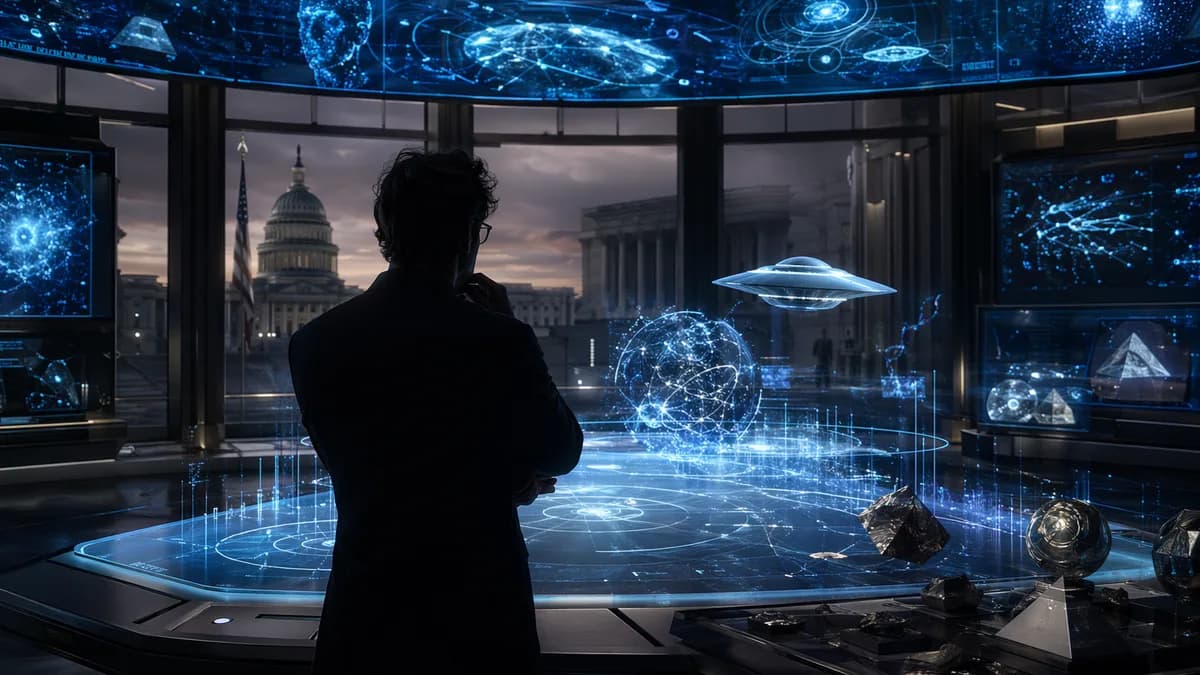
The White House has put Harvard astrophysicist Avi Loeb, one of academia’s most polarizing alien-technology voices, in charge of a new science advisory group for UAP.
XOOMAR Intelligence
Analyst Take
Loeb will head the UAP Science Advisory Council, which was established by the White House, the Pentagon, the Office of the Director of National Intelligence, the FBI, and “the intelligence community,” according to The Verge. The group will produce scientific reports and advice for the UAP Governing Board as officials try to “resolve the nature of UAP,” or unidentified anomalous phenomena.
Avi Loeb will chair the White House-backed UAP science council
The Avi Loeb UAP council appointment puts a famous, credentialed scientist at the center of a government process that has to sort evidence from noise. It also puts UAP officials in a credibility fight before the council has issued a public finding.
The council’s formal job is narrow: provide scientific reports and advice to the UAP Governing Board. The broader political and public burden is heavier, because UAP cases are tied to national security questions, military reports, and years of speculation around UFOs, now often referred to as UAP.
The immediate question for officials is simple: can a council led by Loeb keep the process evidence-first when its chair is already associated with alien explanations?
CBS News reported that Loeb’s team reports to a new White House panel focused on UFOs and that the effort is part of President Donald Trump’s push to declassify more information about the issue. The Office of the Director of National Intelligence oversees the UAP Governance Board, which CBS said met for the first time in June.
After its first meeting last month, Loeb’s team sent a request to the Pentagon asking for more than 50 videos, images and other documents tied to known UAP incidents, CBS reported. The group meets behind closed doors, but Loeb has said he plans to brief the public and create a website for findings.
“If they were sure, confident that these objects are human-made, they would file these cases as classified reports within the Pentagon, within the intelligence agencies,” Loeb told CBS Boston. “The fact that they open up to the scientific community implies that there is a chance that perhaps one or more of these objects might be not human-made, in which case it would be the biggest discovery ever made by humanity with huge implications for the future.”
For readers tracking federal decisions around high-stakes technology and security, XOOMAR’s related coverage includes White House Relents, OpenAI GPT-5.6 Launch Breaks Free and FBI Tip Triggers Russian Hacktivist Arrest in Spain. The common thread is not subject matter. It’s how government institutions handle technical claims under public pressure.
Scientists on the panel inherit Loeb’s alien-technology baggage
Loeb’s resume gives the White House-backed effort instant scientific stature. He is a Harvard astrophysicist, a cosmologist who studied black holes, and, according to CBS, served as head of Harvard’s astronomy department until 2020.
His public profile, though, now rests heavily on alien-hunting claims. The Verge notes that Loeb has made questionable claims about alien life since at least 2015, and is best known for arguing that Oumuamua may have been an alien probe rather than an exo-comet, and that small metal spheres recovered from the ocean could be wreckage from an alien spacecraft.
That record makes the Avi Loeb UAP council a reputational gamble. Loeb brings visibility and ambition, but critics will read his appointment as a sign that the process may be tilted toward extraordinary conclusions before ordinary explanations are exhausted.
The council’s membership appears designed to broaden the lens. The Verge reports that it includes not only physicists, but also a pathologist, a computer scientist, a philosopher, a psychologist, and the founding publisher of Skeptic magazine.
| Stakeholder | What they gain | What they risk |
|---|---|---|
| UAP officials | A high-profile scientist willing to engage the topic publicly | A council that critics may dismiss before findings arrive |
| Scientists on the panel | Access to government-linked UAP material and a formal advisory role | Association with claims many peers view as thinly supported |
| The public | A potential channel for reports, briefings, and data standards | More spectacle if findings are framed before evidence is tested |
| Defense and intelligence agencies | Outside scientific review of unresolved cases | Pressure to release material that may remain classified or incomplete |
The hardest question for the scientists around Loeb is whether the panel can make its work look independent of its chair’s most famous theories.
Steve Desch, an Arizona State University astrophysicist who has challenged Loeb’s theories, told CBS that Loeb uses flawed methods to reach extreme conclusions about alien life. Desch was blunt about the appointment.
“I don’t know what’s going to come of this, but we’re not going to get any closer to answering these questions with him in charge,” Desch said.
Loeb has dismissed criticism of his approach. Asked about detractors last year, he told CBS Boston: “I don’t really care what people think.”
“Science is not about us lecturing the public what’s right and wrong,” Loeb said. “It’s about the process by which we all learn together.”
Public credibility now depends on evidence before extraterrestrial claims
The Avi Loeb UAP council now faces a basic evidentiary test: rule out sensor errors, classified aircraft, drones, atmospheric effects, and other human-made explanations before reaching for alien technology. The source material does not show that the council has produced findings yet.
That absence matters. The council has a mission, a chair, and a request for records. It does not yet have public evidence resolving any UAP case.
Loeb has said he will start from a national security perspective and assume UAP are human-made, according to CBS. That stance matters because it gives the council a testable starting point rather than an extraterrestrial premise.
The public-facing question is whether Loeb’s reports will separate probability from possibility.
XOOMAR analysis: The appointment creates a sharp incentive problem. Loeb’s celebrity comes from entertaining alien explanations, but the council’s credibility will come from showing its work, discarding weak cases, and being plain about uncertainty.
A rigorous process could still be valuable even if it never points to extraterrestrial technology. Better data collection, clearer standards for reviewing sightings, and less confusion around unresolved military reports would all be practical outcomes grounded in the council’s stated mission.
A sloppy process would do the opposite. If the council becomes a stage for dramatic claims without transparent evidence, critics won’t need to disprove every case. They’ll dismiss the forum.
Loeb wanted a seat at the center of the UFO debate. Now he has one. The next thing to watch is whether the council’s first public outputs read like science reports, or like arguments looking for a discovery.
Impact Analysis
- A polarizing scientist now has a formal role in shaping U.S. government analysis of UAP evidence.
- The council’s credibility will depend on whether it can separate national security concerns from alien speculation.
- Requests for more than 50 UAP-related files could influence what information officials eventually declassify.
Primary Sources & Disclosures

Written by
XOOMAR Insights Team
Research and Editorial Desk
The XOOMAR Insights Team pairs automated research with human editorial judgment. We track hundreds of sources across technology, fintech, trading, SaaS, and cybersecurity, cross-check the facts, and explain what happened, why it matters, and what to watch next. We do not just rewrite headlines. Every article is fact-checked and scored for reliability before it goes live, and we link back to the original sources so you can verify anything yourself.