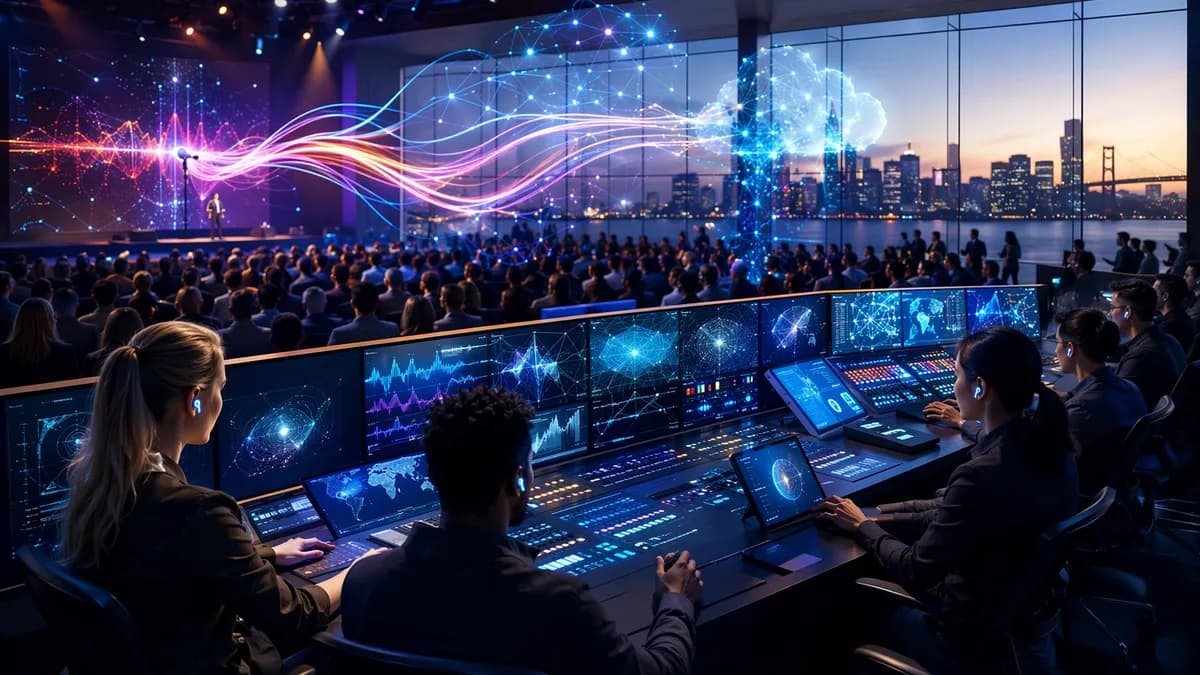
Nearly 50% of the U.S. Fortune 500 are already DeepL users, and the DeepL Mixhalo acquisition shows the German Language AI company now wants translation to move from documents and meetings into rooms full of people, phones, noise, and live pressure.
XOOMAR Intelligence
Analyst Take
DeepL is acquiring Mixhalo, a San Francisco-based real-time audio startup, to expand into live-event audio streaming and translation, according to TechCrunch. The deal also gives DeepL a new San Francisco office, tightening its U.S. presence in what the company calls its fastest-growing market.
DeepL is chasing the hardest translation moment: live audio in crowded rooms
DeepL has long been strongest in text translation. But live speech is a different problem. A document can wait. A keynote cannot.
At conferences, TechCrunch notes, attendees often try to capture distant speech through phone translation apps when speakers use languages they don’t understand. That experience can fail quickly if the audio is weak, the room is loud, or the speech moves faster than the app can follow.
XOOMAR analysis: That is the real target of the DeepL Mixhalo acquisition. DeepL is not just adding another voice feature. It is trying to turn translation into live infrastructure for conferences, sports, concerts, enterprise events, and meetings where the user experience depends on timing as much as AI accuracy.
Mixhalo gives DeepL a venue-native layer. DeepL brings translation. Together, the pitch is clearer: capture live audio, translate it, and send it back to people fast enough that they keep listening.
“For us, Mixhalo will work as a solution and also a marketing use case. The platform will allow us to show how DeepL’s tech works in real-time and in environments like conferences where people are present on the ground,” DeepL CEO Jarek Kutylowski told TechCrunch.
That quote matters. DeepL wants Mixhalo to be both product and proof.
Mixhalo gives DeepL a delivery layer, not another translation model
Mixhalo was founded in 2016 by Incubus guitarist and songwriter Mike Einziger, violinist Ann Marie Simpson-Einziger, and Vik Singh, who is now CEO. Its original pitch was better audio for concert attendees. Over time, it moved into real-time audio for sports and live events.
The startup raised over $39 million from investors including Fortress Investment, Founders Fund, Defy Partners, and Cowboy Ventures.
That history makes the acquisition strategically different from buying another AI model company. DeepL is buying deployment muscle: live audio workflows, event use cases, and a team that has worked on getting sound to many people at once.
| Piece | What DeepL brings | What Mixhalo brings |
|---|---|---|
| Core product | Language AI, text and voice translation | Real-time live audio delivery |
| Existing role | Translation provider | Event audio platform |
| Expansion target | Meetings, documents, business workflows | Conferences, sports, concerts, large venues |
| Main challenge | Accuracy, fluency, reliability | Latency, synchronization, live deployment |
Mixhalo already relied on DeepL as its primary translation provider, according to TechCrunch. Singh said the acquisition talks grew from an existing customer relationship.
“The DeepL conversation was very organic. Mixhalo has been a long-time DeepL customer, and I attended a customer dinner and ended up seated next to Sebastian, DeepL’s CTO. We just got to talking, and the more we talked, the more obvious the overlap became across the event space, the API, and the application layer, whether that is voice for meetings, document translation, or live event.”
The product challenge is brutal. Live translation has to feel instant, accurate, and natural enough that attendees don’t abandon it after a few minutes. DeepL’s own announcement says Mixhalo’s technology is aimed at “ultra-low latency audio,” and Singh said Mixhalo launched to deliver live audio “all within 20 milliseconds.”
The numbers behind DeepL’s U.S. push
DeepL says the acquisition brings the team and technology behind Mixhalo into DeepL and expands DeepL Voice into larger and more complex settings, including major events, conferences, customer support, and business workflows, according to DeepL’s announcement via PRNewswire.
The company is using several numbers to frame the deal:
- 200,000 business teams use DeepL’s Language AI platform.
- DeepL has more than 900 employees.
- Nearly 50% of the U.S. Fortune 500 are DeepL users, according to the company.
- DeepL launched voice-to-text translation in over 33 languages in 2024.
- In April, it launched a voice-to-voice translation suite for use cases like multilingual meetings.
- DeepL cites a 2026 independent Slator assessment showing DeepL Voice with a 96.4/100 quality score and a 4% fail rate versus a 17% market average.
No acquisition price was provided in the supplied source material.
XOOMAR analysis: The business logic is straightforward. Document translation is broad and repeatable. Live-event translation is messier, but it can attach DeepL to high-value enterprise and event workflows where translation is visible, urgent, and harder to replace with a generic text box.
This is also where the U.S. office matters. DeepL says its U.S. customer base includes NVIDIA, Cisco, and Nasdaq. A San Francisco presence gives the company a closer commercial base for customers, partners, and developers tied to AI products. That fits with broader enterprise software buying patterns covered in XOOMAR’s LLM Platforms for Business That Slash Busywork in 2026, where workflow fit matters as much as model quality.
San Francisco puts DeepL nearer to customers and rivals
The DeepL Mixhalo acquisition lands DeepL in the Bay Area through Mixhalo’s San Francisco base. Kutylowski told TechCrunch that DeepL is opening an office in the Bay Area to expand its U.S. operations.
The competitive field is already active. TechCrunch names Wordly AI and Seven Seven Six-backed Palabra as Mixhalo competitors. DeepL’s own announcement also compares DeepL Voice against Microsoft Teams, Zoom, and Google Meet in the Slator assessment it cites.
That comparison reveals the risk. Translation can be a standalone product, but it can also be bundled into platforms people already use for meetings and collaboration.
XOOMAR analysis: DeepL’s defense is specialization. If buyers believe DeepL’s language quality and reliability are better, the company can justify sitting beside existing platforms rather than disappearing inside them. But the product has to work in live settings, not just controlled demos.
Reliability will decide whether enterprises trust this for customer-facing events. That is a familiar enterprise software issue, even outside AI, as XOOMAR has covered in June Windows Update Breaks Some Microsoft Office Launches. For DeepL, the parallel is simple: business users don’t grade tools on ambition. They grade them on whether they work when needed.
Event organizers, enterprises, and attendees will judge different failures
DeepL and Mixhalo have already brought combined technology to market, according to DeepL, with the DeepL Voice API powering real-time translation across Mixhalo’s live-audio platform. The teams are also piloting customer support use cases through integrations like Amazon Connect.
That points to multiple buyer groups, each with a different scorecard.
- Event organizers: They will care about whether live translation works at scale and can be shown clearly to attendees.
- Enterprise customers: They will focus on integration into meetings, customer support, conferences, and business workflows.
- Attendees: They will judge the product instantly. If translation lags or misses key meaning, they stop trusting it.
- DeepL: It gets a public showcase for its voice technology in rooms where failure is obvious.
DeepL says audiences will be able to see the technology at GITEX Europe 2026 at the end of June, where DeepL will serve as official translation partner and power live German-to-English captions on the main stage. It also plans to showcase voice AI at upcoming U.S. events including Databricks Data + AI Summit, Esri User Conference, and Salesforce Dreamforce.
DeepL’s Mixhalo bet will be tested on latency, quality, and distribution
The clearest read on the DeepL Mixhalo acquisition is that DeepL wants real-time multilingual communication to become a product layer, not a one-off feature. First came text. Then voice-to-text. Then voice-to-voice. Now comes live event delivery.
The near-term test is not whether the idea sounds useful. It does. The test is whether DeepL can deliver translated speech and captions in environments where speed, clarity, and reliability are exposed to every person in the room.
Evidence that would strengthen DeepL’s thesis includes repeat deployments at named conferences, broader use of the Mixhalo layer in enterprise workflows, and visible adoption of DeepL Voice beyond meetings. Evidence that would weaken it would be customer reluctance, limited event usage, or stronger bundling from platforms already sitting inside enterprise communications.
For now, DeepL has made a focused bet: the next frontier for translation is not another document upload. It is the live room.
The Bottom Line
- DeepL is pushing translation from static text into real-time live-event experiences.
- Mixhalo gives DeepL venue audio infrastructure that could improve translation in noisy, crowded settings.
- The deal strengthens DeepL’s U.S. presence with a new San Francisco office in its fastest-growing market.
DeepL vs. Mixhalo in the acquisition
| Company | Core strength | Role in deal |
|---|---|---|
| DeepL | Language AI and text translation | Adds live-event audio translation to expand beyond documents and meetings |
| Mixhalo | Real-time venue audio streaming | Provides live audio infrastructure for conferences, sports, concerts, and enterprise events |
DeepL adoption among U.S. Fortune 500
Primary Sources & Disclosures

Written by
XOOMAR Insights Team
Research and Editorial Desk
The XOOMAR Insights Team pairs automated research with human editorial judgment. We track hundreds of sources across technology, fintech, trading, SaaS, and cybersecurity, cross-check the facts, and explain what happened, why it matters, and what to watch next. We do not just rewrite headlines. Every article is fact-checked and scored for reliability before it goes live, and we link back to the original sources so you can verify anything yourself.