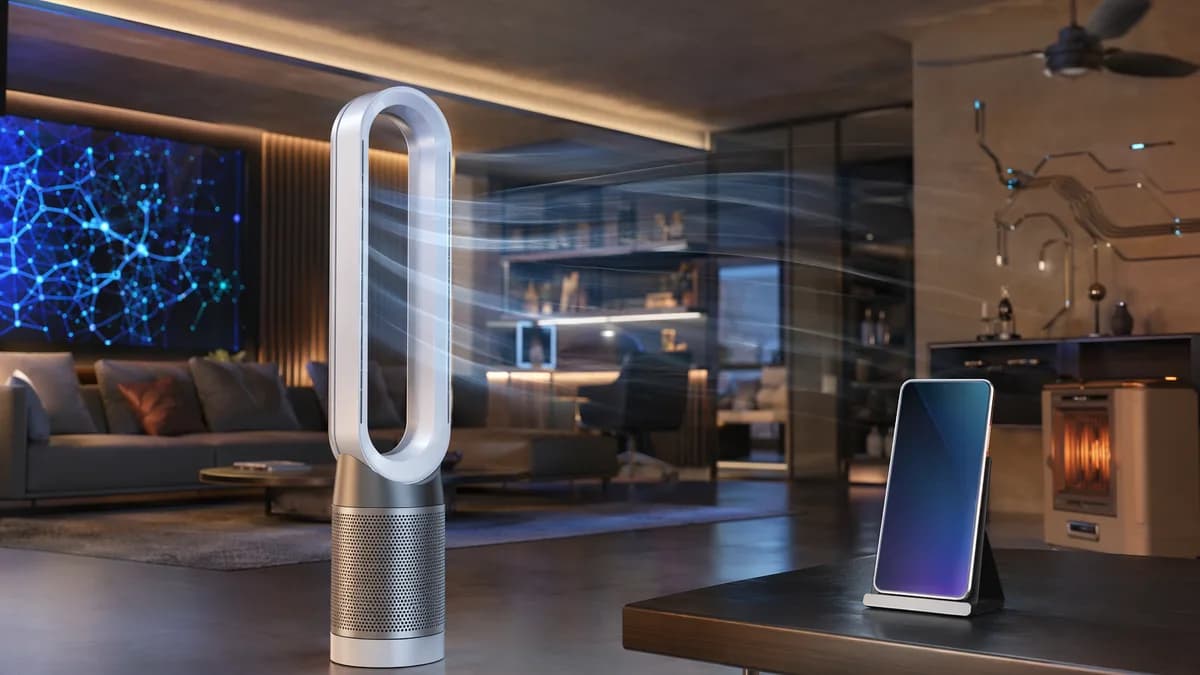
The Dyson Hot+Cool HF1 is the rare smart appliance whose best argument is subtraction: one $499 device can replace the seasonal shuffle between a ceiling fan and a space heater, without turning comfort into another gadget chore.
XOOMAR Intelligence
Analyst Take
That’s the case made in Aisha Malik’s three-month test for TechCrunch, where the Dyson unit was provided for review and will be returned to the manufacturer. The facts matter here. The Hot+Cool HF1 heats in winter, works as a high-powered fan in summer, runs quietly enough for bedrooms and offices, and can be controlled by onboard buttons, an included remote, or the MyDyson app.
“After three months of testing, the HF1 was a game changer for me, and not just because it replaced two appliances.”
I’m usually allergic to that kind of phrase. Here, the product earns some of it.
The Dyson Hot+Cool HF1 makes single-season comfort appliances feel outdated
The thesis is simple: the Dyson Hot+Cool HF1 exposes how clumsy most home comfort gear has become. A fan comes out when the room gets stale. A heater appears when the room gets cold. Both take up space, collect dust, need separate controls, and usually look temporary even when they sit in the same corner for months.
The HF1’s pitch is not that it does something mysterious. It’s that it combines the two jobs people already keep around: cooling airflow in warmer months and heating in colder ones. The source review describes the tester’s previous setup as a ceiling fan for summer and a space heater for winter. The HF1 replaced both in daily use.
That matters because the best consumer hardware often wins by removing friction, as with distraction-free reMarkable Paper, not by adding a new screen. The HF1 has one footprint, one control scheme, and one object to move from room to room. At 23 inches tall and just under six pounds, it is light enough to reposition without treating it like furniture.
Here’s the useful contrast:
| Daily comfort problem | Separate fan and heater setup | Dyson Hot+Cool HF1 |
|---|---|---|
| Seasonal use | Fan in summer, heater in winter | Heating and cooling airflow in one unit |
| Controls | Separate devices, separate habits | Onboard controls, remote, and MyDyson app |
| Cleaning | Blades or grilles can trap dust | Bladeless design, quick wipe with a cloth |
| Storage | One device often gets stored away | Designed to stay useful year-round |
Quiet airflow is the Dyson HF1 feature that changes the room fastest
Noise is where comfort appliances often fail. A fan or heater that constantly announces itself becomes another presence in the room. You don’t just feel it. You negotiate with it.
The TechCrunch test says the Dyson HF1 is quiet enough for bedrooms and home offices. In Sleep mode, it operates at 26 decibels and automatically dims its display. That is not a cosmetic detail. If a device is meant to run near a bed or desk, noise is not secondary to performance. Noise is performance.
The reviewer also says they are a light sleeper who prefers complete silence at night and were able to adjust the fan noise quickly. That detail is more persuasive than a spec sheet because it gets to the daily reality of these products. Comfort that makes concentration harder is bad design. Warmth that arrives with a distracting hum is still a compromise.
The HF1 also has adjustable tilt and oscillation at 15, 40, or 70 degrees, which gives it more placement flexibility than a basic fixed fan. That doesn’t mean it will recreate every room’s ceiling fan experience. It does mean the airflow can be aimed and widened without dragging out another appliance.
Bladeless design turns the Hot+Cool HF1 into furniture instead of clutter
Dyson’s bladeless design is often treated as a visual signature. With the Hot+Cool HF1, it also changes the maintenance burden.
The source review is blunt: a quick wipe with a cloth removes dust, and there are no grilles or blades to clean. That’s the kind of small advantage that compounds. If a device is annoying to clean, people delay cleaning it. If it looks like a cheap seasonal tool, it ends up shoved into a closet when the weather changes.
The HF1’s design gives it a different role. It can plausibly stay in the room year-round without looking out of place. That matters in smaller homes and workspaces where every object has to justify its square footage.
Safety is part of the design story too. The bladeless build removes exposed blades that could catch curious hands or paws, according to the review. The unit also automatically shuts off if tipped over. There is one caveat: the metal casing around the front can get slightly hot to the touch in heating mode. That does not kill the case for the product, but it does mean “safer” should not be read as “carefree.”
Simple controls give the Dyson Hot+Cool HF1 an edge over overbuilt smart home gear
The Dyson Hot+Cool HF1 gets the smart-appliance balance mostly right because the app is useful without becoming mandatory.
You can use onboard controls. You can use the remote. You can use the MyDyson app to turn the unit on or off from a phone, set timers, adjust oscillation, and create schedules. The reviewer found it especially convenient to control the HF1 from another room and schedule it to turn on automatically.
That is what connected hardware should do. It should reduce small daily interruptions. It should not force you through app rituals just to make a room warmer.
This is also where the HF1 lands in a broader technology argument. XOOMAR has pushed the same discipline in less domestic corners of tech, from hardware-heavy AI claims in Altman Shreds Space Data Centers as AI Valuation Bait to funding narratives around software automation in $130M Round Crowns Emergent AI Coding Startup Unicorn. The test is always the same: does the technology remove friction, or does it just add another layer to manage?
For the HF1, the answer looks favorable. The controls map to repeated daily actions. Turn it on. Change the angle. Set a timer. Schedule heat or airflow. That’s enough.
The case against the Dyson HF1 starts with price and room fit
The strongest counterargument is obvious: $499 is a premium price for something many households currently solve with cheaper separate appliances. If all you need is occasional heat under a desk or airflow in one corner, the HF1 is probably more machine than you need.
There is also a hard limit in the cooling story. The HF1’s cooling mode is a high-powered fan, not an air conditioner. It circulates air. It does not lower the room’s temperature. Anyone expecting AC-like cooling will be disappointed, and Dyson’s design language does not change the physics.
Room fit is the other open question. The TechCrunch review supports the claim that the HF1 worked well for the tester’s use over three months, but it does not establish that one unit will satisfy every household, every room size, or every layout. A ceiling fan moves air from above. A portable appliance directs airflow from wherever you place it. Those are different experiences.
Still, the case for the HF1 holds for a specific buyer: someone who values quiet operation, clean design, smart scheduling, easy maintenance, and fewer seasonal objects sitting around the home. The value is not only heat plus fan. It is heat plus fan plus less mess.
Year-round appliances should earn their floor space the way the Dyson Hot+Cool HF1 does
The Dyson Hot+Cool HF1 points to a better standard for everyday hardware: if a product lives in your space all year, it should work all year.
Appliance makers should compete harder on quieter operation, better industrial design, easier cleaning, and fewer single-purpose boxes. The HF1 is not perfect. Its cooling is fan-based. Its front casing can get slightly hot in heat mode. Its price will push some buyers away. Those are real limits, not footnotes.
But the direction is right. Seasonal clutter has become too normal. A home should not need a rotating cast of ugly, noisy devices just to stay livable.
What would prove this argument wrong? A cheaper product that matches the HF1’s quiet operation, safety features, cleaning ease, app controls, and year-round usefulness. Until then, Dyson has made the sharper bet: comfort hardware should do more, take up less, and stop asking to be hidden when the season changes.
Key Takeaways
- The $499 Dyson Hot+Cool HF1 aims to replace both a fan and a space heater with one device.
- Its appeal is reducing clutter and seasonal appliance swapping rather than adding complexity.
- Multiple control options and quiet operation make it practical for bedrooms and offices.
Dyson Hot+Cool HF1 vs. seasonal fan-and-heater setup
| Category | Dyson Hot+Cool HF1 | Ceiling fan + space heater setup |
|---|---|---|
| Primary role | Heats in winter and works as a high-powered fan in summer | Uses separate appliances for cooling airflow and heating |
| Controls | Onboard buttons, included remote, and MyDyson app | Separate controls for each appliance |
| Space and portability | One footprint; 23 inches tall and just under six pounds | Two devices that take up space and may need seasonal swapping |
| Review context | Tested for three months; unit provided for review and returned to Dyson | Tester’s previous daily-use setup |
Primary Sources & Disclosures
- [1]TechCrunch
- [2]I Don’t Have AC, and This One Appliance Replaced My Fan, Heater, and Air Purifier - AOL
- [3]Dyson Hot+Cool HF1 replaces space heater and ceiling fan with year-round comfort
- [4]I tested the new Dyson Hot+Cool air purifier for a month, and it left my kitchen free of cooking smells in seconds

Written by
XOOMAR Insights Team
Research and Editorial Desk
The XOOMAR Insights Team pairs automated research with human editorial judgment. We track hundreds of sources across technology, fintech, trading, SaaS, and cybersecurity, cross-check the facts, and explain what happened, why it matters, and what to watch next. We do not just rewrite headlines. Every article is fact-checked and scored for reliability before it goes live, and we link back to the original sources so you can verify anything yourself.