Can a children’s phone succeed by making communication less available, not more?
XOOMAR Intelligence
Analyst Take
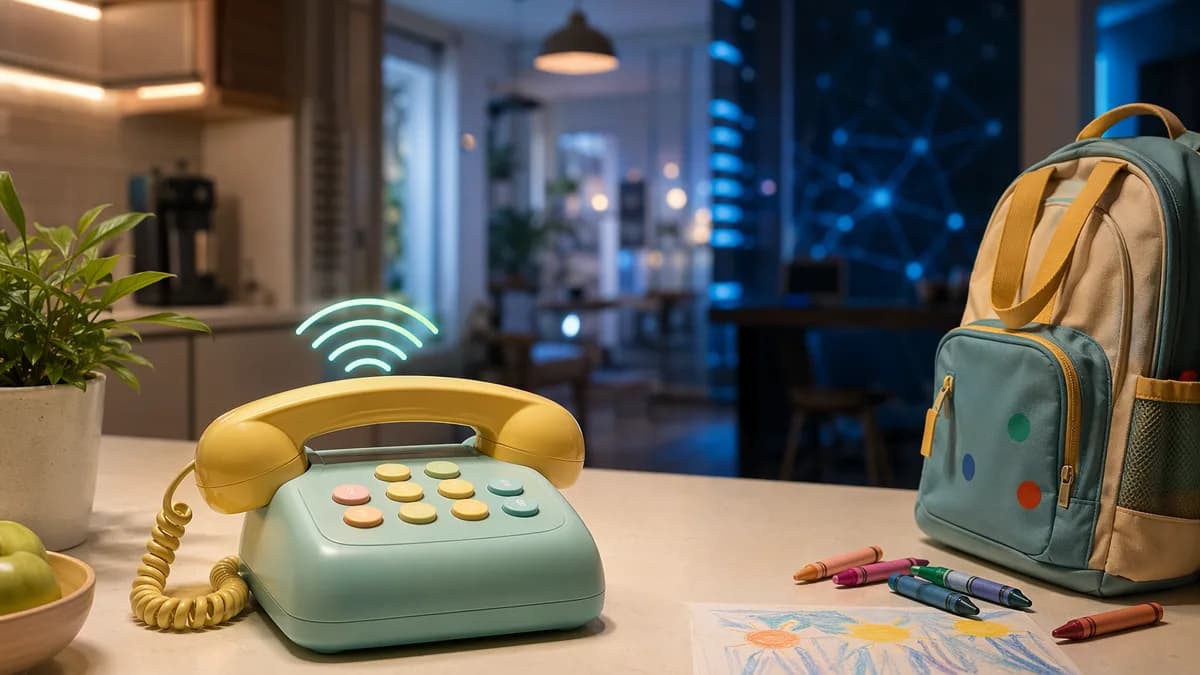
That is the real question behind Pinwheel Home, a retro-inspired landline phone for kids that gives children voice calls without handing them apps, feeds, cameras, texts, games, or social media. Pinwheel announced the device Tuesday, positioning it for children ages 5 to 10 as a first step before a smartphone, according to TechCrunch.
The thesis is simple. Pinwheel isn’t selling nostalgia. It’s selling boundaries in the shape of hardware.
Can Pinwheel Home make “less phone” feel like more freedom?
Pinwheel Home looks backward, but the product logic is current. Parents want children to be reachable. They often don’t want the full smartphone bundle that comes with reachability: apps, notifications, infinite feeds, private messaging, and a device that follows the child everywhere.
Pinwheel is trying to split that problem in half. The child gets independence, but only for voice calls. The parent gets control, but without having to turn a personal smartphone into a supervised family device.
The phone runs over Wi-Fi, so it doesn’t need a phone jack. That matters. This is not a revival of the old landline infrastructure. It’s a controlled communications endpoint with an old household form factor.
“Parents have been asking for a modern take on the ‘home phone,’ landline experience we all grew up with – a way to connect with friends and family, or even call 911 in an emergency – without having to turn over their adult smartphones to children,” Pinwheel CEO and founder Dane Witbeck said in the company’s earlier launch material.
XOOMAR analysis: the visible, shared nature of the device is the product. A phone sitting in a kitchen, hallway, or child’s room changes the rules. It makes communication available, but not constant. That’s a sharper proposition than another locked-down mobile device.
Where does a Wi-Fi landline fit among kid phones and watches?
Pinwheel already sells kid-friendly smartphones and launched a smartwatch last year. Pinwheel Home sits below those devices in the age ladder.
It’s aimed at the “pre-phone” years, when a child may be ready to call grandparents, a friend, or a parent, but not ready for a private screen. That makes it different from a restricted smartphone, which still looks and feels like a smartphone, and different from a watch, which stays attached to the child.
| Device type | Core use | Built-in tradeoff |
|---|---|---|
| Pinwheel Home | Voice calls at home | No mobility outside the house |
| Pinwheel smartphones | Older-child phone use with guardrails | Still a screen-based device |
| Pinwheel Watch | Wearable communication for older kids | More personal and always-carried |
| Tin Can | Wi-Fi-enabled landline for kids | Similar screen-free calling model |
The closest named rival in the source material is Tin Can, a $100 Wi-Fi-enabled landline that lets parents manage approved contacts through a companion app. Pinwheel is entering a niche, but not an empty one.
The stronger question is whether parents want another device in the home. Pinwheel’s answer is that this device removes more problems than it adds.
That is a familiar product strategy in consumer tech: win by subtracting instead of adding. We’ve seen the same restraint-first logic in other categories, including our analysis of Uber Product Strategy Bets on Hotels Without App Bloat. Pinwheel is applying that idea to children’s communication hardware.
Do the prices make Pinwheel Home a gadget or a family service?
The pricing tells a more complicated story than the retro shell.
TechCrunch reports two models: Spark, starting at $68, and Classic, priced at $79. Spark comes in white, black, blue, and purple. Classic includes a retro-style handset and customizable stickers, with pink, black, and white color options.
There is also a service layer.
Calls between Pinwheel Home devices are free through Pinwheel Circle. Families that want calls to standard phone numbers can choose plans starting at $6.99 per month for up to five approved contacts, or $9.99 per month for unlimited calling. TechCrunch notes that Tin Can device-to-device calls are also free, while its friends and family plan costs $9.99 per month.
One sourcing caveat matters. Earlier Pinwheel launch material framed Pinwheel Home as scheduled for an official launch in April 2026, with hardware at $99 and second phones in the same order at $49. The current TechCrunch launch report gives the newer model lineup and lower starting prices. Readers should treat the TechCrunch figures as the current launch details, while recognizing that the company’s pre-launch positioning changed.
XOOMAR analysis: the monthly plan is the bigger business clue. Pinwheel Home is not just a cute handset. It is an entry point into a managed family communications account.
Are parents buying safety, speech practice, or relief from screens?
Pinwheel’s pitch blends all three.
Parents manage the device through Pinwheel’s Caregiver Portal, where they can approve contacts, block unknown callers, spam, and robocalls, and set calling schedules and time limits. Speed dial and voicemail are available.
The company also says future updates will add three-way calling and link Pinwheel Home with its watches and smartphones, so children can use the same phone number across devices while limiting screen time at home.
The screen-time argument is the emotional center of the launch. TechCrunch cites broader parental concern over technology’s impact on child development, including studies linking excessive screen time with emotional, behavioral, and social challenges. It also cites recent University of Georgia research finding that children who spend more time on social media tend to show weaker vocabulary development over time, including more difficulty recognizing and pronouncing words.
That doesn’t prove Pinwheel Home will improve vocabulary. The source does not provide evidence from Pinwheel users. But it explains why a voice-only phone has a clearer story than another screen with better controls.
Australia has restricted social media access for children, and the U.K. has announced plans for similar measures, according to TechCrunch. Pinwheel’s product arrives in the same pressure zone: parents, companies, and governments are all trying to separate useful communication from addictive design.
Who benefits from a stationary kids phone, and who outgrows it fast?
For parents, the appeal is obvious: approved contacts, known schedules, blocked unknown callers, and no open-ended screen. A child can call without borrowing a parent’s phone.
For younger kids, the device may feel grown-up without being fully private. The retro handset and stickers help. So does the fact that it belongs to the child, even if parents set the rules.
For older kids, the limits may become the problem. Pinwheel positions Home for ages 5 to 10, and that range is doing real work. A 6-year-old calling a grandparent is a clean fit. A 10-year-old who wants texting or group coordination may see the device as training wheels.
The weakness is built into the form factor. A stationary phone helps at home. It does not solve communication during sports, custody handoffs, school pickup, or other situations where the child is away from the house. Pinwheel’s planned integration with watches and smartphones is meant to cover that gap, but the source says those updates are still future features.
This is where hardware charm can become a liability. We’ve covered that risk in products built around novelty and desire, including Viral Nopia Synth Turns Hype Into a £550 Launch Bet. A device can be delightful on day one and still fail if it doesn’t become part of a routine.
Is Pinwheel Home a smartphone alternative or just a bridge?
It is best understood as a bridge.
Pinwheel itself frames Home as an introduction to phones before children are ready for a smartphone. That’s the right framing. It avoids the overclaim that a Wi-Fi landline can replace every communication use case.
The better household fit is narrow but real:
- Elementary-age children: Old enough to call, not old enough for a private smartphone.
- Family check-ins: Calls to parents, grandparents, approved friends, and caregivers.
- Screen-limited homes: Families that want contact without texts, games, or feeds.
- At-home routines: Bedtime calls, weekend calls, after-school conversations, and simple phone etiquette.
The device also forces a useful distinction. Not all “screen time” is the same. A school assignment, a video feed, a message thread, and an emergency call do different jobs. Pinwheel Home strips communication down to one job: talking.
That may be the product’s best insight.
Which evidence will show whether screen-free kids phones have staying power?
The strongest confirmation would be simple: families keep paying for service after the novelty fades.
Other signals would help. Do parents buy more than one device? Do children use voicemail and speed dial regularly? Do future integrations with Pinwheel watches and smartphones make the same-number setup useful, or does it complicate a product whose main virtue is simplicity?
The weakness case is also clear. If children ignore the handset, if parents still hand over smartphones for convenience, or if the device works only as a nostalgic gift, then Pinwheel Home stays niche.
Still, the direction is meaningful. Pinwheel is betting that the next wave of children’s tech won’t win by adding more features. It will win by removing the right ones. For families trying to delay the first smartphone, Pinwheel Home gives restraint a physical form.
Key Takeaways
- Pinwheel is targeting parents who want kids to be reachable without giving them a full smartphone.
- The device reframes the landline as a modern Wi-Fi safety and communication tool.
- Its success could signal demand for child-focused hardware that limits access by design.
Pinwheel Home vs. a Smartphone for Kids
| Feature | Pinwheel Home | Smartphone |
|---|---|---|
| Core use | Voice calls only | Calls plus apps, texts, feeds, cameras, games, and social media |
| Connectivity | Runs over Wi-Fi | Typically mobile and app-connected |
| Parent appeal | Reachability with boundaries | Reachability with more supervision challenges |
| Device role | Shared home-based phone | Personal device that follows the child |
Primary Sources & Disclosures

Written by
XOOMAR Insights Team
Research and Editorial Desk
The XOOMAR Insights Team pairs automated research with human editorial judgment. We track hundreds of sources across technology, fintech, trading, SaaS, and cybersecurity, cross-check the facts, and explain what happened, why it matters, and what to watch next. We do not just rewrite headlines. Every article is fact-checked and scored for reliability before it goes live, and we link back to the original sources so you can verify anything yourself.