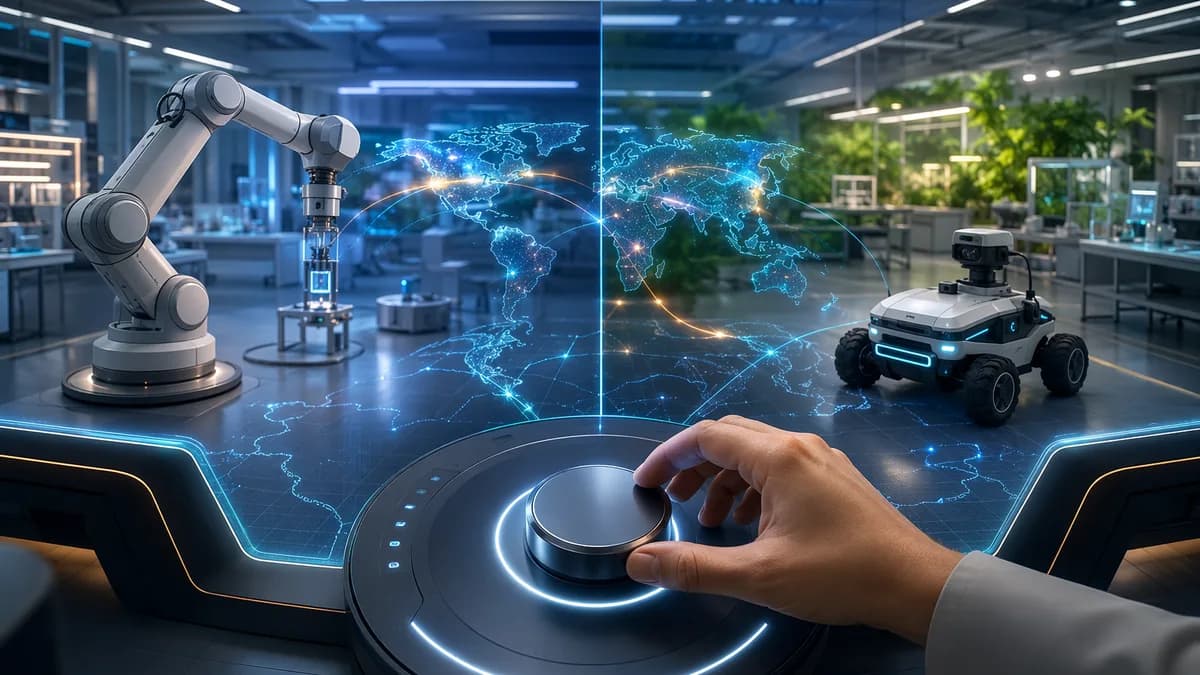
On Monday, Enigma is coming out of stealth with a $70 million seed round and a bet that Enigma robot control can become as natural as turning a volume knob.
XOOMAR Intelligence
Analyst Take
The round was led by Index Ventures and Ribbit Capital, with participation from Sarah Guo of Conviction Partners, TechCrunch reported. For a less-than-one-year-old robotics research lab, the financing gives Enigma unusually deep room to test a hard thesis: the next leap in robotics may come from changing how humans communicate with machines, not only from making the machines stronger.
Monday stealth launch pairs Enigma robot control with a $70M seed
Enigma is positioning itself around a simple frustration: even capable robots can become useless if people have to explain every step in painful detail.
Co-founder Jonathan Jacobi told TechCrunch the company wants human-robot interaction to feel effortless. His example was domestic and blunt: if a person needs 15 minutes to explain dish placement to a robot, they give up and do it themselves.
“Right now, everyone is at that point — even with the most capable models,” Jacobi said.
That is the core of the Enigma robot control pitch. The company is not just showing off a robotic arm. It is trying to discover the interface that makes a robot respond in the way a person expects, without turning every instruction into a technical exercise.
XOOMAR analysis: This is a UX-first robotics bet. Enigma appears to be treating control as the bottleneck. If that read is right, the company’s most valuable product may not be a single robot, but the interaction model that tells robots what people actually mean.
The public experiment starts with more than 100 robots in Israel and California
Enigma’s first big test is not a closed lab demo. The company is launching an online experiment that lets anyone in the world interact with more than 100 proprietary AI robots.
Those robots are housed in hangars in Israel and California. TechCrunch reported that they can draw pictures with a paintbrush, fight each other with swords, and run simple chemistry experiments by picking up and mixing flasks with liquids.
The company claims it built both the robotic arms and their underlying models from the ground up.
That matters because Enigma is trying to collect interaction data, not just task-completion clips. The experiment is designed to test how people prefer to communicate with robots: typed commands, audio, video examples, or direct manipulation through tap, drag, and drop.
“We’re going to learn a lot about what is the right way to interact with robots,” Jacobi said. “Do we want to just talk to them over text or audio? Do we want to show them an example as a video? Or maybe do we want to tap, drag, and drop?”
Here is the split between Enigma and other robotics AI efforts described in the source material:
| Robotics AI approach | How it tries to improve robots |
|---|---|
| Web video training | Studies large volumes of online video to learn tasks |
| Simulation | Trains or tests behavior in computer-generated environments |
| Sensor gloves | Collects motion data from humans performing tasks |
| Enigma robot control | Studies live human interaction with robots to find better interfaces and training signals |
The volume knob thesis: make the command obvious before the robot moves
Jacobi’s volume knob analogy is the clearest window into Enigma’s thinking.
Users do not want to set a car’s audio level by guessing percentages, then checking whether the result is too loud or too quiet. They turn a knob and adjust by feel. Enigma wants robot operation to move closer to that kind of interaction.
That does not mean robots become easy overnight. The tasks in Enigma’s public test are constrained, and Jacobi admitted the experiment is open-ended. But the company’s premise is sharp: if robots are going to work in real settings, the control method has to match human habits rather than force people to think like programmers.
XOOMAR analysis: The online experiment could produce two kinds of value. The obvious one is interface data: which input methods people choose and where they struggle. The deeper one is training data for Enigma’s foundational AI model, because failed or messy interactions may reveal what the model needs to learn next.
The sectors Enigma has named so far are healthcare, logistics, and entertainment. Jacobi declined to share specific use cases, according to TechCrunch, so the commercial path remains deliberately broad.
Index’s bet centers on outsiders attacking robotics from the interface up
Enigma was co-founded by Jonathan Jacobi and Gal Niv, longtime friends who met while competing in hacking contests as young teens. They later served together in Israel’s Unit 8200, where they conducted cybersecurity research.
Jacobi has an unusual resume. TechCrunch identified him as Microsoft’s youngest-ever employee, recruited by Wiz founder Asaf Rappaport during Rappaport’s time there.
The founders did not come from robotics. That is part of what Index Ventures says it likes.
“There are a lot of robotics industry insiders participating in the next wave of embodied intelligence, but Jonathan and Gal are outsiders — they’re not roboticists. It affords them more room for originality,” said Shardul Shah, partner at Index Ventures. “Someone who’s an insider may start with the capability of teleoperation or dexterity, but Enigma is starting from a very different place: ‘What’s the ultimate experience?’”
Enigma has built a team from Israel’s tech community, including alumni from top AI labs, math Olympiad winners, and people persuaded to leave PhD programs, Jacobi told TechCrunch.
XOOMAR analysis: The investor mix is telling without needing to overstate it. Index Ventures, Ribbit Capital, and Conviction Partners are backing a company that sits across AI models, robotics hardware, and human interface design. The risk is also clear: robotics development consumes capital, and a clever interface still has to survive physical-world constraints.
The next proof point is whether the experiment turns into real deployment logic
Enigma’s immediate milestone is the public test: can large numbers of people generate useful signals by controlling robots remotely?
After that, the harder question is whether the company can turn those interactions into systems that partners in healthcare, logistics, or entertainment find useful. Jacobi said Enigma is already partnering with companies in those sectors, but he did not give TechCrunch specific applications.
That leaves the company with a clean but demanding challenge. A volume knob is valuable because it gives instant, predictable control. Enigma now has to show that its version of intuitive robot control can do the same when tasks become less playful than sword fights and paintbrush drawings.
The watch item is not whether Enigma can produce a flashy demo. It already has a large experiment built around that. The real test is whether the data from those sessions points to an interface, and eventually a model, that makes robots easier to direct when the instructions, environment, and human expectations get messy.
The Bottom Line
- Enigma’s $70 million seed round signals strong investor belief that robot usability is a major unsolved bottleneck.
- The company is betting that better human-robot interaction could matter as much as stronger hardware or AI models.
- Its public test with more than 100 robots could reveal whether everyday users can control robots without technical instruction.
Primary Sources & Disclosures

Written by
XOOMAR Insights Team
Research and Editorial Desk
The XOOMAR Insights Team pairs automated research with human editorial judgment. We track hundreds of sources across technology, fintech, trading, SaaS, and cybersecurity, cross-check the facts, and explain what happened, why it matters, and what to watch next. We do not just rewrite headlines. Every article is fact-checked and scored for reliability before it goes live, and we link back to the original sources so you can verify anything yourself.