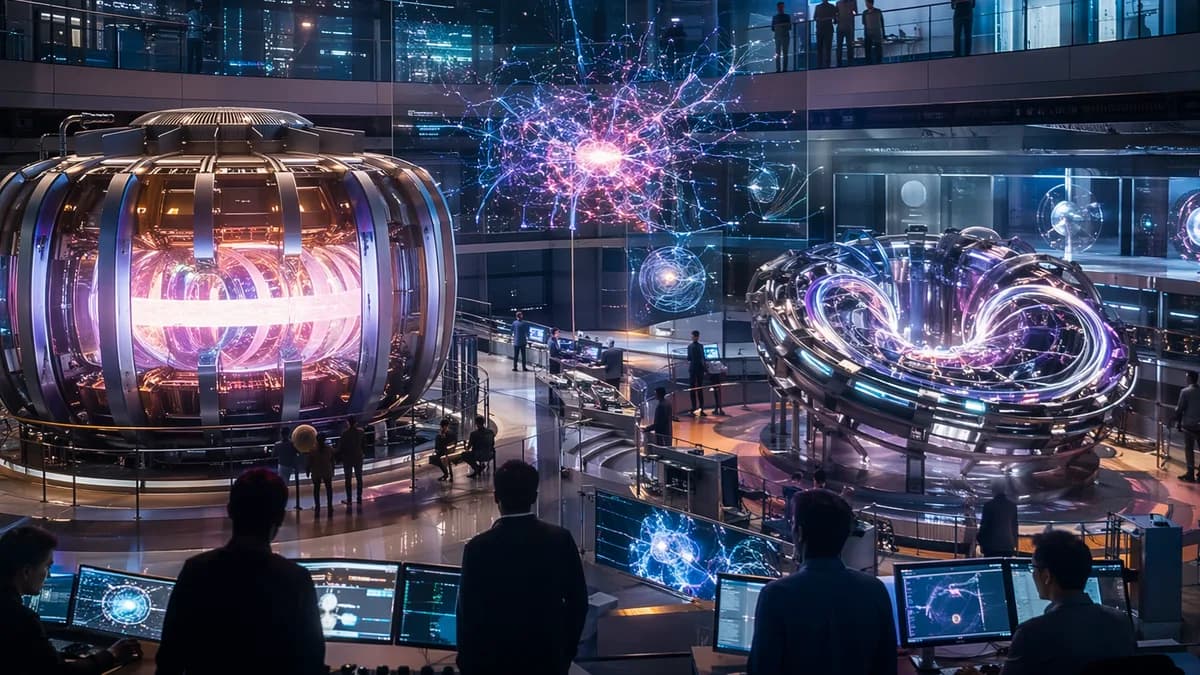
What happens when $7.1 billion of private fusion money concentrates into a short list of fusion startups that don't even agree on what a power plant should look like?
XOOMAR Intelligence
Analyst Take
That is the useful question behind the latest funding map. Fusion startups have raised $7.1 billion to date, with most of that capital flowing to a handful of companies, according to TechCrunch. The cutoff matters. In fusion, $100 million isn't vanity capital. It's the price of magnets, lasers, pulsed-power systems, neutron facilities, fuel targets, machine shops, and years of failed tests before anything looks like a power plant.
The market is no longer making one bet. It's underwriting a portfolio: tokamaks, stellarators, Z-pinches, field-reversed configurations, laser fusion, projectile fusion, and neutron businesses that can earn revenue before selling electricity. That also makes fusion startup funding a cleaner test of startup discipline than most sectors. Cap tables, investor rights, and financing structures matter when machines take years to build, as we covered in Carta and Pulley Clash over Cap Table Tools for Startups and Equity Crowdfunding Platforms Can Drain Startup Cash.
Why are fusion startups clustering around a few very expensive technical bets?
The funding pile is large, but it isn't evenly spread. Commonwealth Fusion Systems, TAE Technologies, Helion, Pacific Fusion, and SHINE Technologies account for a heavy share of the reported totals.
The reason is brutal: fusion hardware punishes half-measures. A credible company needs enough capital to build devices that can test physics, not just pitch decks. The U.S. Department of Energy milestone at the end of 2022, when a lab produced a controlled fusion reaction that crossed scientific breakeven, pulled more investors toward the sector. But scientific breakeven only means the reaction produced more power than the lasers imparted to the fuel pellet. It is still far from commercial breakeven, where the full facility produces more power than it consumes.
| Company | Reported capital marker | Main approach |
|---|---|---|
| Commonwealth Fusion Systems | Near $3 billion | Tokamak with high-temperature superconducting magnets |
| TAE Technologies | $1.79 billion | Field-reversed configuration |
| Helion | $1.5 billion | Pulsed field-reversed configuration |
| Pacific Fusion | Series A above $1 billion | Inertial confinement with electromagnetic pulses |
| SHINE Technologies | $1 billion | Fusion neutron applications |
| General Fusion | $612 million | Magnetized target fusion |
| Tokamak Energy | $336 million | Spherical tokamak and magnets |
| Zap Energy | $327 million | Z-pinch |
| Type One Energy | $269 million | Stellarator |
| Focused Energy | $400 million private capital | Laser inertial fusion |
Can Commonwealth Fusion Systems turn SPARC into the sector's proof point?
Commonwealth Fusion Systems is the best-funded private fusion company in the group. Its latest round, closed in August, added $863 million, bringing its total raised near $3 billion. That came four years after its $1.8 billion Series B.
CFS is building SPARC in Massachusetts. The reactor uses a tokamak design, a doughnut-shaped machine that confines superheated plasma with powerful magnets. Its edge is the high-temperature superconducting tape developed with MIT, where co-founder and CEO Bob Mumgaard worked on fusion reactor designs and high-temperature superconductors.
CFS says SPARC is intended to produce power at “commercially relevant” levels.
CFS expects SPARC to be operational in late 2026 or early 2027. After that comes ARC, a planned 400 megawatt commercial plant near Richmond, Virginia, where Google has agreed to buy half the output. That is the sharpest commercial marker in the field, and it puts more pressure on CFS than any press release could.
Does TAE's long run prove patience or expose fusion's timeline problem?
TAE Technologies, formerly Tri Alpha Energy, has been around since 1998. It spun out of the University of California, Irvine under Norman Rostoker and uses a field-reversed configuration. In its design, two plasma shots collide in the middle of the reactor, then particle beams help keep the plasma spinning in a cigar shape.
TAE has raised $1.79 billion, according to PitchBook. The deeper story is endurance. TAE has strategic backers including Google, Chevron, and New Enterprise, and it raised $150 million in June from existing investors. Longevity gives TAE credibility. It also reminds investors that fusion timelines stretch even for companies with deep capital and serious technical teams.
Is SHINE proving that fusion can make money before grid power arrives?
SHINE Technologies belongs in the roundup because it doesn't wait for a fusion power plant to sell something. The company is building businesses around neutron testing, medical isotopes, and radioactive waste recycling.
That makes SHINE one of the more pragmatic names in the group. It hasn't picked a future reactor approach, instead saying it is developing the skills needed for that later stage. According to PitchBook, SHINE has raised $1 billion.
Its latest round was $240 million in February, led by NantWorks, with participation from Deerfield Management, Fidelity Management & Research Company, Oaktree Capital Management, Pelican Energy Partners, and Sumitomo Corporation of Americas. SHINE's message is simple: commercialize parts of the fusion stack now, then chase electrons later.
Can Helion's Microsoft deal survive contact with the machine?
Helion has one of the boldest timelines in the sector. The Everett, Washington company plans to produce electricity from its reactor in 2028. Its first customer is Microsoft.
Helion uses a field-reversed configuration reactor shaped like an hourglass. Plasma is spun into doughnut shapes at each end and fired toward the center at more than 1 million mph. When fusion occurs, the plasma's magnetic field induces current in the reactor's coils, which Helion says can be harvested directly as electricity.
The company raised $465 million in June in a Series G that valued it at $15.5 billion. Its prior round, announced in January 2025, totaled $425 million. Helion says it has raised $1.5 billion from investors including Sam Altman, SoftBank Vision Fund 2, Reid Hoffman, KKR, BlackRock, Mithril Capital Management, and Capricorn Investment Group. The commercial test is no longer attention. It's delivery.
Why did Pacific Fusion's Series A reset expectations for early fusion funding?
Pacific Fusion came out with a Series A above $1 billion, which is extraordinary even in this capital-heavy sector. The company uses inertial confinement, but not the laser route associated with the National Ignition Facility. Instead, it plans to use coordinated electromagnetic pulses.
The technical demand is severe. Pacific Fusion needs 156 impedance-matched Marx generators to produce 2 terawatts for 100 nanoseconds, with pulses converging on the target at the same time. CEO Eric Lander, who led the Human Genome Project, and president Will Regan are steering the company.
There is one financing detail investors should watch. Pacific Fusion's money is paid in tranches when milestones are hit, a structure TechCrunch notes is common in biotech. That makes the headline number powerful, but also conditional.
Can General Fusion keep magnetized target fusion alive after its cash crunch?
General Fusion was founded in 2002 by physicist Michel Laberge and has raised $612 million, according to PitchBook. Its approach is magnetized target fusion, where pistons compress a liquid metal wall around plasma until fusion occurs. Neutrons heat the liquid metal, which can then feed a heat exchanger and turbine.
The company hit a rough patch in spring 2025 while building LM26, its device aimed at breakeven in 2026. It laid off 25% of staff after a milestone, and CEO Greg Twinney wrote an open letter seeking funding. Investors later put in $22 million in a pay-to-play round.
One investor called the $22 million round “the least amount of capital possible” to keep General Fusion afloat.
In November, Canadian securities filings showed $51.1 million in SAFE notes from nearly 70 investors, the Globe and Mail reported. In January, General Fusion said it would go public through a reverse merger with a SPAC, potentially bringing in another $335 million if the deal closes.
Is Zap Energy's simpler Z-pinch machine a cost breakthrough or a control problem?
Zap Energy rejects two expensive staples of fusion hardware: huge superconducting magnet systems and giant lasers. It uses electric current to create a magnetic field that compresses plasma to about one millimeter, where ignition would occur.
That simplicity is the pitch. The Everett, Washington company has raised $327 million, according to PitchBook, from backers including Breakthrough Energy Ventures, DCVC, Lowercarbon, Energy Impact Partners, Chevron Technology Ventures, and Bill Gates as an angel.
Zap also announced a partial pivot in April toward a hybrid power plant using both nuclear fusion and fission. It hired Zabrina Johal as CEO, citing her fission industry expertise. XOOMAR analysis: the pivot is a practical revenue story, but it also signals that fusion-only commercialization remains hard to time.
Can Tokamak Energy make compact spherical tokamaks more than a UK specialty?
Tokamak Energy is one of the leading UK private fusion companies. It takes the tokamak shape and compresses it toward a sphere, aiming to reduce the amount of magnet material required.
The Oxfordshire startup uses REBCO high-temperature superconducting magnets. Its ST40 prototype generated a 100-million degree C plasma in 2022. The next machine, Demo 4, is under construction to test magnets in “fusion power plant-relevant scenarios.”
Tokamak Energy raised $125 million in November 2024 and has raised $336 million in total, according to PitchBook. In April, it said it would supply magnets for the UK's STEP Fusion program. That magnet business gives the company a second path if full power plant development takes longer.
Does First Light Fusion still have the clearest inertial fusion shortcut?
First Light Fusion represents the projectile-driven branch of inertial fusion in the supplied materials. Its pitch is that fuel targets can be compressed without building a conventional tokamak or relying only on massive laser systems.
The commercial question is cadence. A power plant doesn't need one impressive shot. It needs repeatable shots, durable hardware, and target economics that don't collapse under operating conditions.
The available source material around First Light is thinner than for CFS, Helion, or TAE, so the useful takeaway is narrower: it sits in the nine-figure fusion startup conversation because investors are still funding non-magnetic confinement routes.
Can Type One Energy make stellarators practical at utility scale?
Type One Energy is betting on stellarators, magnetic confinement machines that twist plasma paths instead of forcing them into the simpler tokamak geometry. The appeal is steady-state operation, if the machines can be built at practical cost.
Type One plans to build a fusion reactor at a retired Tennessee Valley Authority coal power plant site. The device is expected to generate 350 megawatts, and the company hopes to bring it online by the mid-2030s.
Its business model also differs. Type One plans to sell key technology to organizations like TVA, letting them build, own, and operate the equipment. The company has raised $269 million, including an $87 million equity round ahead of a $250 million Series B it is raising.
Why are laser fusion startups getting another investor look?
Inertia Enterprises and Focused Energy show how the National Ignition Facility milestone is spilling into private company formation. Inertia emerged from stealth in February with $450 million in Series A funding led by Bessemer Venture Partners, with GV, Modern Capital, Threshold Ventures, and others participating.
Its founding team includes Annie Kircher, chief scientist of the National Ignition Facility experiment that surpassed scientific breakeven, plus Mike Dunne and Jeff Lawson. In April, Inertia signed three agreements to commercialize technology developed at NIF.
Focused Energy, based in Germany, also traces its lineage to NIF. It raised an oversubscribed $240 million Series A in June, bringing private capital raised to $400 million, and has received $200 million in grants. The hard part is not inspiration from NIF. It's mass manufacturing fuel targets at a rate of nearly 1 million per day, which is the task assigned to chief strategy officer Debbie Callahan.
Are Proxima Fusion, Marvel Fusion, and Energy Singularity widening the race outside the U.S.?
Proxima Fusion is one of the clearest European challengers in the supplied source material. It raised a €130 million Series A, bringing its total to more than €185 million, with investors including Balderton Capital and Cherry Ventures. Like Type One, it is betting on stellarators.
The case for stellarators is stability. They twist and bulge to match plasma behavior, which could help plasma remain stable longer. The trade-off is manufacturing complexity.
The supplied outline also identifies Marvel Fusion in Germany and Energy Singularity in China as nine-figure private fusion names. The available materials here do not provide enough detail to rank their exact funding totals against the leaders. XOOMAR analysis: that gap itself matters. Western startups dominate disclosed venture totals in the source material, but the private fusion race is no longer only a U.S. story.
The bigger picture: which fusion startup makes repeatable power look boring?
The $100 million club is the serious contender list for now, not the winner's circle. Fusion startups have moved from single-path science bets into a crowded hardware race that includes tokamaks, stellarators, field-reversed configurations, Z-pinches, electromagnetic pulse systems, lasers, projectiles, and neutron businesses.
Capital concentration cuts both ways.
Best-funded companies can build larger machines, hire deeper teams, secure suppliers, and make utility-scale promises. Smaller technical paths can still win if they prove cheaper, faster, or easier to maintain. The next phase won't be judged by fundraising alone.
The practical scorecard is getting harsher:
- Net energy: Not just scientific breakeven, but facility-level economics.
- Durability: Magnets, walls, optics, pistons, and targets must survive repeated operation.
- Fuel strategy: Companies need credible plans for the fuels their machines require.
- Construction cost: A reactor that works but costs too much still loses.
- Customer proof: Power purchase agreements and utility partnerships need operating machines behind them.
The fusion startup funding boom has turned physics into a balance-sheet test. The company that matters most won't be the one with the biggest round. It'll be the one that makes repeatable power look routine.
The Bottom Line
- Private fusion funding has reached $7.1 billion, showing investors are backing multiple paths to commercial fusion.
- The $100 million cutoff highlights how expensive credible fusion hardware development has become.
- Capital is concentrated among a small group of startups, raising the stakes for technical execution and financing discipline.
Where Private Fusion Funding Is Concentrating
| Category | Article Detail |
|---|---|
| Largest named funding recipients | Commonwealth Fusion Systems, TAE Technologies, Helion, Pacific Fusion, and SHINE Technologies account for a heavy share of reported totals. |
| Technical approaches being funded | Tokamaks, stellarators, Z-pinches, field-reversed configurations, laser fusion, projectile fusion, and neutron businesses. |
| Funding threshold | $100 million is treated as the cutoff for serious fusion hardware development. |
Private Fusion Funding Scale
Primary Sources & Disclosures

Written by
XOOMAR Insights Team
Research and Editorial Desk
The XOOMAR Insights Team pairs automated research with human editorial judgment. We track hundreds of sources across technology, fintech, trading, SaaS, and cybersecurity, cross-check the facts, and explain what happened, why it matters, and what to watch next. We do not just rewrite headlines. Every article is fact-checked and scored for reliability before it goes live, and we link back to the original sources so you can verify anything yourself.