
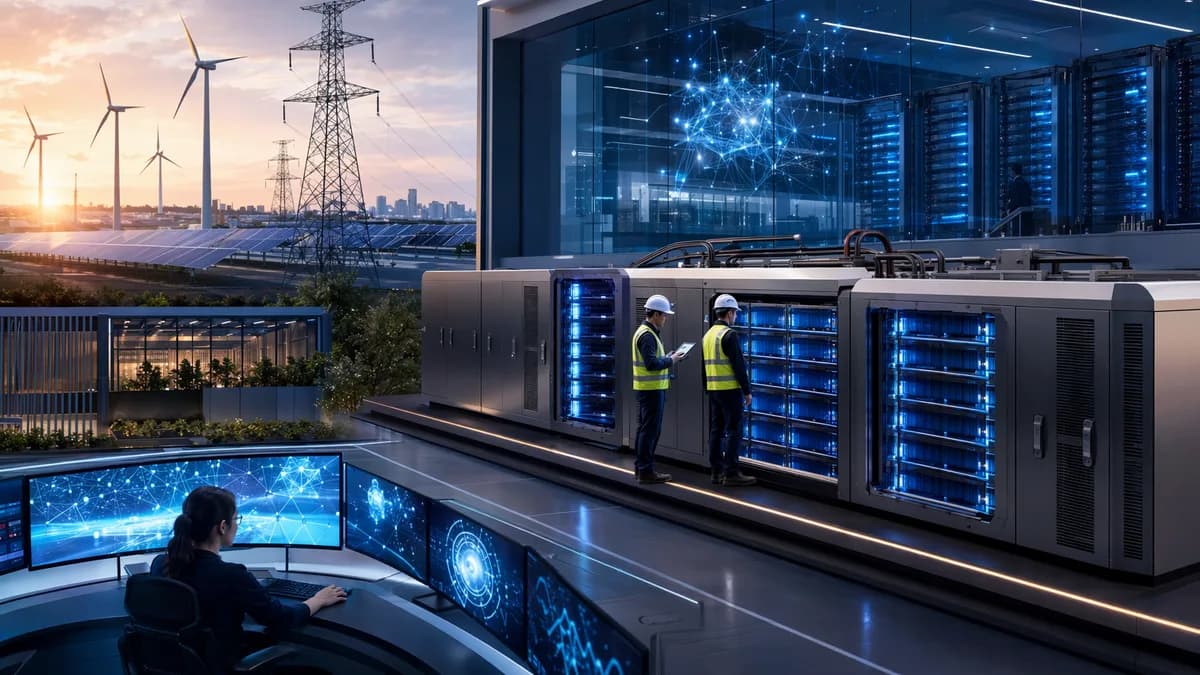
GM has committed $900 million to commercialize new battery chemistries, and one of its biggest bets is not aimed at cars first. It’s aimed at AI data centers, factories, and the grid.
TechnologyJune 9, 2026· 8 min read· By XOOMAR Insights Team
GM Turns Sodium-Ion Batteries on AI’s Power Crunch
Updated on June 10, 2026
XOOMAR Intelligence
Analyst Take
63/ 100
3 sources analyzedLow confidenceTrend10Freshness100Source Trust90Factual Grounding92Signal Cluster60
The automaker is developing an entirely new sodium-ion battery chemistry with energy storage startup Peak Energy, according to TechCrunch. The first GM sodium-ion cells are expected to enter trial production at the company’s Battery Cell Development Center in 2028, which means this is not a near-term product launch. It’s a strategic land grab.
The logic is blunt. AI infrastructure needs dependable power. Automakers have battery factories, battery engineering teams, and a growing need to prove those assets can serve markets beyond mass-market EVs. GM is now trying to turn that overlap into a battery storage business.
Why AI data centers and GM investors should care about sodium-ion now
The race to power AI data centers has moved beyond utilities and cloud companies. Battery companies and automakers are now trying to sell into the same bottleneck: reliable electricity close to compute.
TechCrunch frames GM’s move as part of a wider shift. Redwood Materials has already connected used EV packs to a Crusoe data center in Nevada. Ford has said it is repurposing some battery manufacturing capacity for grid-scale batteries. GM is now entering with a more ambitious plan: develop a new chemistry for stationary storage.
That matters because storage is becoming part of the physical AI stack. Software teams can improve model deployment, as XOOMAR covered in Build an ML CI/CD Pipeline That Won't Fail in Production, but no pipeline runs if power availability becomes the constraint. Model releases such as Claude Fable 5 Unlocks Mythos, With AI Safety Cuffs keep attention on capability. GM’s bet points to the less glamorous layer underneath: electricity management.
For GM investors, the signal is also clear. The company is not treating batteries as a single-use EV component. It wants cells to serve cars, factories, data centers, and grid storage.
“The way we’re getting into the market is the easy way, through ESS,” Kurt Kelty, vice president of battery and sustainability at GM, told TechCrunch. “The performance characteristics are just what is needed in that market.”
What GM is actually building with Peak Energy
GM’s new partnership with Peak Energy centers on sodium-ion cells designed for energy storage systems, not vehicles. GM plans to sell sodium-ion cells to Peak, which will integrate them into its storage products.
The chemistry choice is the story. Sodium-ion batteries operate in a broadly similar way to lithium-ion batteries, but they swap out key materials. TechCrunch reports that this can make the cells cheaper, longer lasting, and less prone to overheating.
The tradeoff is equally important. Sodium-ion batteries need to be larger and heavier to store the same amount of electricity. That makes them a poor fit for applications where every kilogram matters. A car needs energy density. A stationary battery beside a factory or data center can tolerate size and weight if the economics work.
GM is also giving itself a development shortcut. TechCrunch says the company expects its new Battery Cell Development Center to cut about one year from the commercialization process for sodium-ion batteries, while also reducing costs.
Still, this is not a 2026 revenue story. The first trial production is expected in 2028, and commercial production remains years away.
Sodium-ion’s pitch: fewer cooling parts, lower maintenance pressure
Peak Energy has already been designing storage systems around sodium-ion behavior. That matters because battery chemistry and system design are linked. A cell that carries less overheating risk can change the entire architecture around it.
TechCrunch reports that Peak’s grid-scale batteries do not use cooling systems or fire suppression systems because of the lower overheating risk. GM says that reduces upfront costs and should also cut maintenance.
“This is the manifestation of the hardest part to engineer is no part at all,” Paul Menson, director of energy storage commercialization at GM, told TechCrunch. “Eliminate the part, eliminate the problem.”
Here’s the practical comparison:
| Battery type | Strength in this story | Main tradeoff |
|---|---|---|
| Lithium-ion | Higher energy density, already used widely in EV packs and storage | More thermal-management complexity in many systems |
| LFP | GM will sell lithium iron phosphate cells to LG Energy Solution for energy storage before sodium-ion is ready | Still lithium-based and not the long-term sodium-ion bet |
| Sodium-ion | Cheaper, longer lasting, less prone to overheating, according to TechCrunch’s reporting | Larger and heavier for the same stored electricity |
XOOMAR analysis: sodium-ion does not need to beat lithium-ion everywhere. It only needs to win in places where weight barely matters and system cost, safety, lifetime, and maintenance matter more.
How GM batteries could fit into AI data centers
The clearest data center use case in the source is not long-duration seasonal storage. It’s power smoothing.
Redwood’s system at the Crusoe data center in Sparks, Nevada, uses second-life packs in a 12 megawatt / 63 megawatt-hour microgrid. Cal Lankton, Redwood’s chief commercial officer, told TechCrunch that data centers may use batteries nearly continuously to absorb power fluctuations from GPUs.
That is a very specific kind of demand. AI hardware can pull hard and unevenly, and operators care about keeping compute running. Batteries can sit between the grid and the server halls, absorbing volatility and providing resilience when power supply gets messy.
GM’s sodium-ion plan could eventually target that same pattern, but with new cells built specifically for stationary storage instead of retired EV packs. If Peak’s architecture removes cooling and fire-suppression components as reported, the business case would depend on whether lower system complexity translates into lower installed cost and fewer service headaches.
The limit is just as important. Batteries don’t create electricity. They shift and stabilize it. Data centers still need generation, grid access, and power contracts. Storage helps manage the shape of demand. It doesn’t erase the demand.
GM’s factories are the first proving ground
GM is not waiting for sodium-ion cells to mature before using storage in its own operations. The company said it is buying a 7.2 megawatt-hour Redwood system for one of its plants in Michigan, and estimates it will save around $3 million over its lifetime.
That installation uses Redwood’s second-life battery model, not GM’s future sodium-ion cells. GM already sends Redwood scrap from battery factories and used EV packs. TechCrunch reports GM has a pipeline of around 10,000 packs going to Redwood.
The factory use case differs from the data center use case. Lankton told TechCrunch that industrial sites are more likely to use batteries to shave peaks in power demand, lower monthly power bills, and provide backup power during outages.
Kelty framed it in operational terms:
“The factory is really excited because now we’ve got a more reliable factory,” Kelty said. “Ultimately, we’ll be having similar installations like this at all of our factories. It just makes good economic sense.”
That quote explains GM’s internal flywheel. Use storage at its own plants. Gather operating data. Prove savings and reliability. Then sell into outside infrastructure markets with a stronger story.
The unresolved test: bankable chemistry, not battery hype
GM’s near-term storage business will lean on LFP cells sold to LG Energy Solution, which already works with GM through the Ultium joint venture. That bridge matters because sodium-ion is still years from production.
The sodium-ion bet will be judged on a short list of hard metrics:
- Timing: Trial production is expected in 2028, but commercial scale is not yet dated.
- Cost: GM has not disclosed how much it is investing specifically in this energy storage effort.
- Reliability: Stationary storage buyers will care about lifespan, uptime, warranty terms, and maintenance.
- System design: Peak’s no-cooling, no-fire-suppression approach must satisfy customers and safety reviewers.
- Manufacturing: GM has to prove it can make sodium-ion cells consistently, not just develop them in a lab.
The practical implication is simple. GM does not need sodium-ion to become the best EV battery chemistry for this plan to work. It needs sodium-ion to become credible infrastructure hardware.
If trial production in 2028 shows the chemistry can deliver lower cost, lower maintenance, and acceptable performance at stationary scale, GM gets a second battery market beyond vehicles. If it slips, the company still has LFP partnerships and Redwood deployments, but the sodium-ion story becomes another long-dated promise in a sector already full of them.
The Bottom Line
- GM is positioning its battery expertise beyond EVs as AI data centers create new demand for reliable power.
- Sodium-ion batteries could become attractive for stationary storage where cost and supply chains matter more than vehicle range.
- The 2028 trial production timeline shows this is a long-term strategic bet rather than an immediate product launch.
Automakers and battery firms targeting stationary storage
| Company | Approach | Target use case | Status or timing |
|---|---|---|---|
| GM | Developing new sodium-ion battery chemistry with Peak Energy | AI data centers, factories, and the grid | Trial production expected in 2028 |
| Redwood Materials | Using repurposed EV battery packs | Crusoe data center in Nevada | Already connected |
| Ford | Repurposing some battery manufacturing capacity | Grid-scale batteries | Announced plan |
GM commitment to commercialize new battery chemistries
GM battery chemistry investment
$M900

Written by
XOOMAR Insights Team
Research and Editorial Desk
The XOOMAR Insights Team pairs automated research with human editorial judgment. We track hundreds of sources across technology, fintech, trading, SaaS, and cybersecurity, cross-check the facts, and explain what happened, why it matters, and what to watch next. We do not just rewrite headlines. Every article is fact-checked and scored for reliability before it goes live, and we link back to the original sources so you can verify anything yourself.
Explore More Topics
Related Articles
 Technology
1.9M Power Bank Recall Pushes Gel Batteries Into Spotlight
Gel batteries are beating true solid-state to market as recalls expose the fire risk inside everyday lithium-ion gear.
Jun 14, 20268 min
 Trading
Low Spread vs Commission Brokers Hide the Real Cost
Headline spreads lie. The real forex cost is spread plus commission, execution, rollover and trade size.
Jun 17, 202618 min
 Trading
Execution Fight Splits MetaTrader vs cTrader Camps
MetaTrader wins on ecosystem and broker reach. cTrader stands out for cleaner charts, market depth, and execution transparency.
Jun 17, 202622 min
 Trading
Ledger vs Trezor for DeFi Reveals a Costly Signing Gap
Ledger wins on app coverage and mobile ease. Trezor leans on open source, privacy and recovery flexibility.
Jun 17, 202621 min
 Cybersecurity
Hackers Pounce on Fortinet FortiSandbox Bugs After Patches
Three critical FortiSandbox flaws are being exploited after patches landed, leaving slow-moving Fortinet shops exposed.
Jun 17, 20265 min
 Trading
DEX vs CEX Trading Puts Your Crypto Control on the Line
DEXs give control and DeFi access. CEXs win on speed, liquidity, and fiat rails. The right choice depends on the trade.
Jun 17, 202620 min
 Trading
Collateral Rules Make DeFi Lending Platforms a Riskier Bet
APY is only bait. Liquidity, collateral rules, and liquidation mechanics decide which DeFi lender fits your risk.
Jun 17, 202624 min
 Trading
Hardware Wallet vs MPC Wallet Exposes Crypto Trader Risk
Hardware wallets win on offline custody. MPC wallets win when traders need recovery, approvals, and faster DeFi access.
Jun 17, 202621 min
 Trading
Best Options Trading Apps That Expose Greeks Risk in 2026
The best 2026 options apps don't just show Greeks. They reveal how Delta, Gamma, Theta, Vega and IV can change a trade before entry.
Jun 17, 202623 min
 Trading
Broker APIs That Can Make or Break Algo Trading Bots
No broker API wins every strategy. The right pick depends on assets, data, order types, rate limits, and testing tools.
Jun 17, 202622 min
Don't miss the signal
Get our weekly roundup of the stories that matter across tech, fintech, and trading. No noise, just signal.
Free forever. No spam. Unsubscribe anytime.