
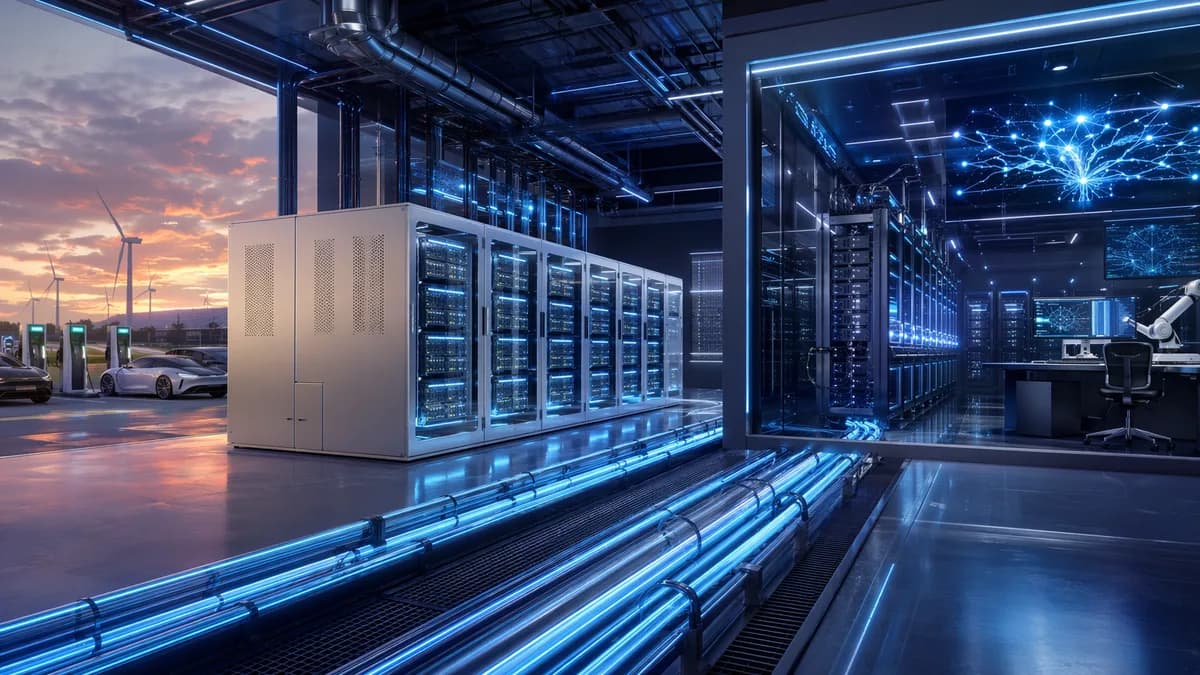
If AI data centers make electricity the choke point of the next computing cycle, who gets paid to store the power?
TechnologyJune 10, 2026· 8 min read· By XOOMAR Insights Team
AI Power Crunch Pulls GM and Ford Into Energy Storage
Updated on June 10, 2026
XOOMAR Intelligence
Analyst Take
76/ 100
4 sources analyzedLow confidenceTrend10Freshness95Source Trust90Factual Grounding92Signal Cluster100
That question explains why GM, Ford, and Tesla are crowding into energy storage while U.S. EV sales have stagnated. Large stationary battery sales have doubled in the past two years, and the Solar Energy Industries Association expects annual installations to exceed 110 GWh per year by 2030, about double today’s level, according to TechCrunch.
The deeper signal is sharper than “automakers want a new business line.” Cars taught these companies how to buy cells, manage battery supply chains, and sell electrified hardware. Now the AI boom is turning those same capabilities into a claim on the grid.
Why are automakers suddenly chasing stationary batteries?
Because stationary storage now looks more attractive than the car business on margin and growth.
TechCrunch reports that 57 gigawatt-hours of energy storage were installed last year, and Tesla’s battery business accounted for 82% of those installations. Tesla’s energy generation and storage revenue has doubled since 2023, driven largely by Megapack and Powerwall deployments. The segment’s gross profit is around 30%, about double Tesla’s EV margin and at least three times higher than typical automaker margins. GM’s gross margin over the last 15 years averaged just over 11%.
That margin gap is the whole story in miniature.
| Company | Current storage posture from the source | Strategic read |
|---|---|---|
| Tesla | Took 82% of last year’s 57 GWh installations | Already proved storage can be a major profit pool |
| Ford | Named by TechCrunch as one of the automakers pursuing the market | Following the battery-to-storage path Tesla opened |
| GM | Developing sodium-ion cells for stationary storage | Choosing chemistry differentiation over a fast lithium-ion repackaging move |
GM’s own executives are not hiding the opportunity.
“There’s a lot of potential for this market,” Kurt Kelty, vice president of battery and sustainability at GM, told TechCrunch.
XOOMAR analysis: GM’s move says automakers no longer see batteries only as vehicle components. They’re becoming energy infrastructure products, and the buyer may be a homeowner, a data center operator, or a company trying to keep electrified operations online.
This is the same strategic thread behind our earlier look at GM’s sodium-ion AI battery push: the chemistry choice matters because the storage market doesn’t have the same constraints as cars.
Why is AI power demand pulling companies outside the utility playbook?
Because demand is rising faster than the old procurement rhythm can comfortably absorb.
TechCrunch says data center energy demand is expected to nearly triple by the end of the decade. AI is the most visible driver, but GM’s Kelty said the trend is broader.
“Data centers are a big part of the growth, but even without data centers, it started to really pick up,” Kelty said.
Transportation, manufacturing, and HVAC are also being electrified. That matters because the storage market isn’t riding on a single demand source. If AI construction slows, the broader electrification trend still creates a need for batteries that can absorb, store, and release power.
Storage becomes strategic because it gives companies another tool besides waiting for more generation or grid capacity. Batteries can support backup power, shift demand, and make renewable-heavy systems more usable. The source doesn’t provide interconnection timelines or utility approval data, so the narrow supported point is this: the convergence of AI data centers and electrification is expanding the addressable market for large stationary batteries.
That’s why startups are raising serious money too. Base Power raised a $1 billion Series C in October to expand beyond Texas. Lunar Energy raised $232 million to sell batteries to homeowners. Lightship, originally an electric RV manufacturer, is now selling a mobile battery for job sites and other temporary power needs.
AI adoption also carries infrastructure consequences beyond model selection. We’ve covered the enterprise side in AI Writing Tools Can Leak Data. These Pass Compliance, but the physical layer is now just as important: more AI use means more compute, and more compute means more pressure on power systems.
Why is GM waiting for sodium-ion instead of repackaging EV cells?
Because GM doesn’t want to steal capacity from a possible EV rebound.
TechCrunch reports that GM’s first major storage product, based on sodium-ion cells, won’t be ready until later this decade. That looks slow next to Tesla’s lead. But GM’s reasoning is straightforward: it is still bullish on EVs and doesn’t want to redirect lithium-ion output from its gigafactories.
“It’s one thing to build cells when there’s excess capacity,” Andy Oury, business planning manager at GM, told TechCrunch. “It’s another thing when we return to a high-growth mode and every new battery you want needs a new plant.”
GM is betting that sodium-ion is better matched to stationary storage. Kelty’s team points to cheap and abundant materials, no need for an active cooling system, and the ability to withstand many more charge-discharge cycles than lithium-ion batteries. There is also a supply-chain angle.
“It gives us a path towards supply chain resilience and low-cost materials,” Oury said. “Sodium-ion is very much in its infancy with the opportunity for the supply chain to grow anywhere people want to invest in it.”
The China point matters. TechCrunch notes that China has not cornered sodium-ion materials the way it has with other chemistries. Nearly all of the world’s cobalt, for example, is processed by Chinese companies.
GM is also working on lithium-manganese-rich, or LMR, chemistry for EVs. It is set to debut in 2028 and promises most of today’s range while cutting the cost of a new EV by about 10%. If LMR helps push EVs closer to parity with fossil fuel vehicles, GM may want every lithium-ion-adjacent production option it can keep.
Who wins if stored electricity becomes a business line?
The obvious winners are battery makers and storage developers. The less obvious winners are companies that can package hardware, software, financing, and customer access into one energy product.
Tesla already has the clearest proof point. It sells EVs, home batteries, and utility-scale storage. GM appears to be aiming at a different entry point: a storage-specific chemistry with lower material cost and supply-chain flexibility. Ford is also in the field, though TechCrunch gives fewer details on its current storage strategy.
For customers, the promise is practical rather than futuristic:
- Homes: Backup power and battery systems can become part of the EV ownership decision.
- Businesses: Stored power can help manage electrified operations and temporary power needs.
- Data centers: Storage can support reliability as AI demand pushes electricity consumption higher.
- Automakers: Batteries can create a recurring revenue opportunity beyond vehicle sales.
XOOMAR analysis: the tension will come from control. If automakers own the battery, software, and customer interface, they move closer to territory historically occupied by utilities and energy retailers. The source doesn’t show utility pushback or regulatory battles, so that remains a watch item rather than a reported fact.
Could sodium-ion move from grid storage into cars?
GM isn’t ruling it out.
Chinese automakers have already begun experimenting with sodium-ion EV packs, according to TechCrunch. The trade-off is clear: sodium-ion packs are heavier and offer less range, but they are cheaper, less prone to catching fire, and may charge rapidly.
Kelty framed the automotive future cautiously.
“Is this the right play for EVs in the long run? That’s yet to be decided,” Kelty said. “It does give us the advantage that if we want to go that direction, it’ll be very easy for us because we’re going to be right doing a lot of research on this anyway. We’re not ruling it out.”
That optionality is important. GM can justify sodium-ion on stationary storage alone, but the research may create a path into lower-cost EVs later. If that happens, energy storage becomes more than a side market. It becomes a chemistry proving ground.
What would prove this is more than an AI-cycle trade?
The risk is obvious: AI data center construction could slow, and GM could arrive after the fastest growth phase.
GM’s Paul Menson, director of energy storage commercialization, argued that product quality matters more than market timing.
“No market grows indefinitely forever,” he said. “That’s why you have to have the best product. Because if you have the best product, it doesn’t really matter what happens in the market contraction because you still have the best product.”
Kelty still wants speed.
“We’re actually exploring other ways to get in the market faster,” he said. “We’re definitely going to try and go as fast as possible.”
The next evidence to watch is concrete: GM’s sodium-ion timeline, whether it finds a faster route to market, whether Tesla keeps its storage share, and whether annual installations track toward the 110 GWh per year by 2030 forecast.
If those pieces hold, the AI boom will have done more than boost demand for chips and servers. It will have pushed electricity management into the center of corporate strategy, with automakers among the first unlikely companies to admit where the profit pool is moving.
The Bottom Line
- AI data centers are making electricity storage a strategic bottleneck.
- Stationary batteries offer automakers higher margins than the EV business.
- Battery supply-chain expertise is becoming valuable beyond cars and into the grid.
Automakers' Push Into Stationary Energy Storage
| Company | Storage posture | Strategic read |
|---|---|---|
| Tesla | Accounted for 82% of last year's 57 GWh of energy storage installations | Has already turned storage into a high-margin profit pool |
| Ford | Named as one of the automakers pursuing stationary storage | Following the battery-to-storage path opened by Tesla |
| GM | Developing sodium-ion cells for stationary storage | Seeking chemistry differentiation for grid-scale storage |
U.S. Energy Storage Installations
Last year
GWh57
2030 forecast
GWh110
Sources

Written by
XOOMAR Insights Team
Research and Editorial Desk
The XOOMAR Insights Team pairs automated research with human editorial judgment. We track hundreds of sources across technology, fintech, trading, SaaS, and cybersecurity, cross-check the facts, and explain what happened, why it matters, and what to watch next. We do not just rewrite headlines. Every article is fact-checked and scored for reliability before it goes live, and we link back to the original sources so you can verify anything yourself.
Explore More Topics
Related Articles
 Technology
Apple Maps Seizes Ford EV Dashboards in $30K Truck Bet
Ford will bake Apple Maps into 2027 EVs, making navigation, charging and battery prep part of its $30K electric truck push.
Jul 23, 202611 min
 Technology
Cash Burn Clouds Tesla Q2 Earnings After $28.2B Haul
Tesla's revenue rebound beat expectations, but a $1.1B free cash flow loss leaves investors with a spending problem.
Jul 26, 20267 min
 Technology
Tesla Robotaxi Miles Crash 36% as Expansion Backfires
Tesla expanded robotaxis, but paid miles fell 36%. The autonomy growth story now has a usage problem.
Jul 23, 20269 min
 Technology
Ford’s $30,000 Electric Truck Forces a Hard EV Reset
Ford’s $30,000 electric truck is its EV reset, a smaller pickup built to prove affordability and profit can coexist.
Jul 20, 202610 min
 Technology
Big Tech Fight Pulls Trump Into EU Digital Rules Clash
Sixteen lawmakers want Trump to punish EU digital rules as a trade barrier, turning the Big Tech fight into a transatlantic showdown.
Jul 21, 20269 min
 Global Trends
Houthi Attacks Turn Saudi Oil Escape Route Into Trap
Houthi attacks are squeezing Saudi Arabia’s Red Sea oil route just as Hormuz falters, raising the risk of wider supply shocks.
Jul 26, 20268 min
 Global Trends
Tariff Detours Crush the US Manufacturing Jobs Pitch
Tariffs haven't sparked a US factory jobs boom. Chinese inputs are taking longer routes, with higher costs and more automation.
Jul 27, 20268 min
 Trading
Brent Crude Sinks 7.5% on US-Iran De-Escalation Bet
Brent crude plunged 7.5% as traders priced a US-Iran pause, not peace. Hormuz is still shut, so the relief trade looks fragile.
Jul 27, 20266 min
 Cybersecurity
App Store Crypto Scam Drags Apple Into $1.8M Fight
Apple faces a lawsuit after users say a fake Sparrow Wallet on the App Store drained $1.8M in Bitcoin, testing its safety pitch.
Jul 27, 20269 min
 Global Trends
Zippy Puppeteer Ronnie Le Drew Dies at 78 After Illness
Ronnie Le Drew, the puppeteer behind Zippy and Labyrinth goblins, has died at 78 after a short illness.
Jul 27, 20266 min
Don't miss the signal
Get our weekly roundup of the stories that matter across tech, fintech, and trading. No noise, just signal.
Free forever. No spam. Unsubscribe anytime.