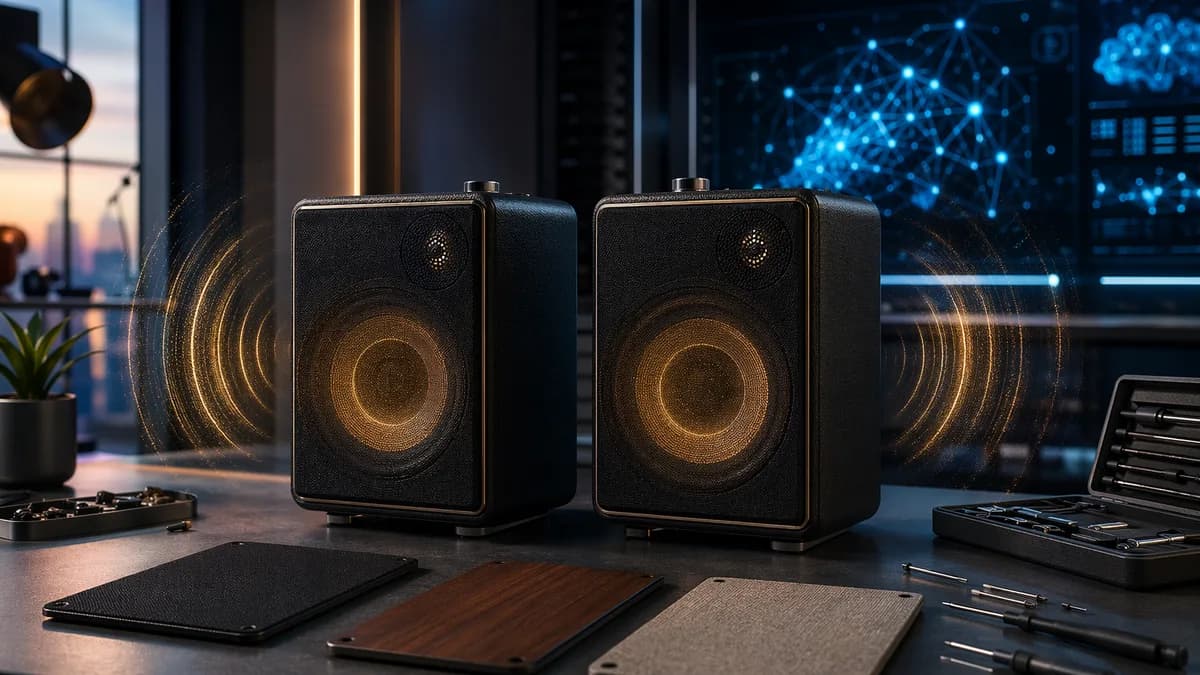
Marshall is making replaceable knobs, feet, and front grilles part of the pitch for the Marshall Acton IV and Stanmore IV, which says as much about premium speaker design as the upgraded bass does.
XOOMAR Intelligence
Analyst Take
Marshall’s repairable Acton IV and Stanmore IV push Bluetooth speakers past the disposable era
The new Marshall Acton IV and Stanmore IV Bluetooth speakers replace models that were four years old, and Marshall is using the refresh to solve a very physical problem: visible damage on a product people buy partly because it looks like a tiny guitar amp. The speakers have upgraded tweeters, redesigned bass ports, and internal acoustic changes meant to fill rooms more effectively, according to The Verge.
The sharper move is repairability. Marshall says the knobs, feet, and front grilles with the Marshall logo can be replaced if damaged. That matters because these are not anonymous cylinders meant to disappear on a shelf. Marshall’s home speakers sell a physical identity: tactile controls, textured cabinets, a front-facing logo, and the suggestion of stage gear shrunk for a living room.
XOOMAR analysis: that makes repairability more than a sustainability line item. On a speaker like this, a broken knob is a functional issue. A dented grille is a visual issue. Worn feet can affect placement. All three can make a premium object feel tired before its electronics fail.
Marshall is still selling sound first. Bigger bass, wider dispersion, and better placement flexibility are the obvious upgrades. But the deeper test is whether buyers start treating serviceable exterior parts as part of the premium audio checklist. If they do, the Marshall Acton IV and Stanmore IV launch could make longevity feel less like an afterthought and more like a spec.
Acton IV and Stanmore IV specs show Marshall tuning for bigger bass and wider rooms
Marshall’s hardware story is direct: upgraded tweeters, redesigned bass ports, and internal design changes meant to improve room-filling sound. The Acton IV is the smaller model. It has a 4-inch woofer and two 0.75-inch tweeters, and it is available through Marshall’s online store for $299.99. The Stanmore IV uses a similar driver setup but steps up to a larger 5-inch woofer and sells for $399.99, per The Verge.
The company says the bass ports now use a “more aerodynamic shape” to produce “cleaner and more powerful bass.” In real listening terms, that claim points to airflow and low-end control. A bass port can help a compact speaker reach lower and sound fuller, but poor port behavior can create boom, chuffing, or smeared bass. Cleaner airflow should, in theory, help the speaker sound bigger without making the low end muddy.
Tweeter upgrades usually target the other end of the listening experience: detail, vocal presence, and the sense that sound is spreading across the room rather than firing from one small box. Forbes reports that both speakers use upgraded tweeters and waveguides for a wider, more evenly dispersed stereo soundstage, according to Forbes.
A useful comparison:
| Speaker | Price | Woofer | Tweeters | Main positioning |
|---|---|---|---|---|
| Marshall Acton IV | $299.99 | 4-inch | Two 0.75-inch tweeters | Smaller home Bluetooth speaker |
| Marshall Stanmore IV | $399.99 | 5-inch | Similar tweeter setup | Larger home speaker with more low-end headroom |
The bottom-mounted power connection is a practical design change. The Verge reports that the power cords now connect underneath rather than on the back, letting the speakers sit flush against a wall. That sounds minor until placement becomes the difference between a speaker that fits a shelf and one that needs awkward clearance behind it.
Specs still don’t guarantee a better speaker. Tuning, cabinet behavior, and DSP choices decide whether those upgraded parts translate into clearer vocals, tighter bass, and more convincing stereo. Marshall’s claim is plausible. Listening tests will decide whether it is meaningful.
The numbers behind Marshall’s new wireless speaker refresh
The launch gives buyers several numbers to work with:
- $299.99: price for the Marshall Acton IV
- $399.99: price for the Marshall Stanmore IV
- 4-inch woofer: Acton IV low-frequency driver
- 5-inch woofer: Stanmore IV low-frequency driver
- Two 0.75-inch tweeters: Acton IV high-frequency driver setup
- Four years: the age of the previous Acton and Stanmore generation being replaced
That four-year gap raises the bar. A minor cosmetic refresh would be thin after that long. Marshall instead bundled acoustic changes, wall-friendly cable routing, Auracast support, Heddon compatibility, and replaceable exterior parts into the update.
Forbes adds more detail on the Acton IV, listing 1 x 60 W Class D Woofer amplification, 2 x 25W Class D Tweeters, a 37Hz to 38kHz frequency response, 95dB SPL @ 1m, and codec support including SBC, MPEG-2 AAC, LC3, and LDAC. The Verge story does not provide the same full technical breakout for Stanmore IV.
XOOMAR analysis: at these prices, Marshall is not competing on raw Bluetooth convenience alone. The buyer is paying for the object, the controls, the room presence, and the promise that this thing won’t become embarrassing after ordinary household wear. That is where replaceable grilles and knobs become more important than they sound on paper.
There are still purchase-critical blanks. The supplied material does not give replacement-part pricing, availability channels, warranty coverage for those parts, or whether owners will be able to perform every swap without service intervention. Those details determine whether “repairable” means meaningfully maintainable or merely less fragile at the edges.
The battery question is simpler: the source material discusses power cords and bottom-mounted cable routing, so these are being presented as always-in-place home speakers rather than portable battery speakers.
Marshall’s guitar amp look becomes a repairability advantage, not just branding
Marshall’s design language gives the repairability push teeth. The Acton IV and Stanmore IV keep the amp-inspired format, with physical controls and a front grille carrying the Marshall logo. Forbes describes the design as including PU leather wrapping, the salt-and-pepper fret, amp-inspired controls, an updated brass control panel, an improved media jog, a Marshall power switch, and a customizable M-button.
That heritage look creates a maintenance problem. If the grille is damaged, the speaker doesn’t merely look scuffed. It loses part of the reason someone bought it. If a knob breaks, the tactile appeal collapses. If the feet fail, the speaker’s placement and stability suffer.
Marshall’s modular exterior parts fit this design better than they would on a sealed minimalist block with no visible personality. The more a product depends on touch and display, the more exterior wear matters. A plain smart speaker can hide some damage. A Marshall speaker wears it on the front.
“Since first launching in 2012, Marshall’s home speakers have evolved while remaining true to our heritage. These always-in-place speakers form the foundation of any home setup, with Acton and Stanmore chosen time and again for their iconic design, premium build quality, rich, powerful sound, and intuitive tactile controls. With our fourth generation, the focus has been on protecting and strengthening these core qualities, building on what people love rather than reinventing it” says Simona Berbec, product manager at Marshall Group.
The quote is revealing. Marshall is not framing Acton IV and Stanmore IV as a radical rethink. It is presenting them as protection of an existing formula. That makes repairability part of brand preservation.
This sits neatly beside a broader consumer-tech maintenance conversation. As we wrote in iFixit Megalodon Driver Kit Invades the Junk Drawer, repair culture often begins with the parts users can actually reach. A replaceable grille or knob is not the same as a fully serviceable amplifier board, but it is a visible step away from sealed-device fatalism.
Auracast and Heddon turn the speakers into a multi-room play
Marshall is also keeping the Acton IV and Stanmore IV tied to its newer wireless setup. Both speakers support Bluetooth Auracast, a Bluetooth feature that allows compatible devices to broadcast audio to multiple receivers. In plain terms, it can help multiple supported speakers play in sync without the old friction of pairing each one like a standalone accessory.
The Verge reports that both speakers also work with Marshall’s Heddon Wi-Fi streaming hub, which launched in January. Heddon can connect directly to services such as Spotify Connect and Tidal. Streaming Apple Music requires a smartphone. The hub can then broadcast audio to the Acton IV, Stanmore IV, or any Bluetooth speaker that supports Auracast.
That matters because Marshall is separating speaker identity from streaming intelligence. The Acton IV and Stanmore IV remain recognizable physical speakers with Bluetooth and analog-style controls. Heddon handles more of the networked audio role.
Forbes reports that the speakers also include RCA and AUX inputs, which keeps them useful for sources outside app-based streaming. It also says the Marshall app can adjust EQ presets, sound customization, and placement compensation.
XOOMAR analysis: this approach reduces the risk that the speaker’s value depends entirely on one app experience. A speaker with physical inputs, Bluetooth, Auracast, and replaceable exterior parts has more paths to stay useful. That’s the practical version of premium design.
Bluetooth device value is often won or lost in the daily details, as our coverage of Apple AirTags Crush $2 Bluetooth Trackers Where It Hurts showed in a very different category. For Marshall, the daily details are not finding lost luggage. They are whether the speaker fits against a wall, survives visible wear, and still works with the audio sources people already use.
Buyers, repair shops, retailers, and rivals all read Marshall’s replaceable parts differently
For buyers, the immediate value is simple. Replaceable knobs, feet, and grilles reduce the penalty for ordinary damage. That can support resale value, preserve the living-room look, and make a $299.99 or $399.99 purchase easier to justify.
The benefit is strongest because these are visible home objects. A speaker that sits on a shelf year after year becomes part of the room. Repairability helps protect that role.
For repair shops and parts sellers, the opportunity is less clear. Marshall has identified replaceable parts, but the supplied material does not say whether replacement components will be widely stocked, what they will cost, or whether the work is owner-serviceable across all parts. If the swaps are limited to easy cosmetic replacements, the service opportunity may stay small.
Retailers get a cleaner sales story. A premium speaker with replaceable exterior parts is easier to explain than one whose design language collapses after damage. The pitch becomes practical: if the grille or feet take a hit, the speaker may not be a total loss.
Rivals should read this as a pressure point. XOOMAR analysis: if a vintage-styled speaker with tactile controls can offer replaceable exterior components, sealed premium designs have to defend their tradeoffs more clearly. The comparison will not be about repairability alone. It will be about whether the product’s price matches its expected life.
Marshall’s Acton IV and Stanmore IV could make longevity a premium audio selling point
The most useful takeaway for shoppers is to stop treating bass as the only upgrade that matters. With the Marshall Acton IV and Stanmore IV, buyers should ask four questions before paying:
- Parts: Which components are replaceable, and where can they be ordered?
- Cost: Are replacement knobs, feet, and grilles cheap enough to make repair realistic?
- Warranty: Does coverage include damaged or failed exterior parts?
- Software: How long will app features, Auracast behavior, and Heddon compatibility remain supported?
Marshall has made the right parts visible in the announcement. The grille, knobs, and feet are exactly the pieces most tied to the product’s identity and day-to-day handling. The risk is that the repairability message looks shallow if replacement parts are expensive, scarce, or limited to a narrow set of cosmetic fixes.
The acoustic claims need proof too. “Cleaner and more powerful bass” is a strong line, but it will have to survive real rooms, wall placement, and direct listening. A redesigned port and upgraded tweeters are promising ingredients, not a verdict.
The scenario to watch: if Marshall makes replacement parts easy to find and reasonably priced, the Acton IV and Stanmore IV can turn longevity into a real premium feature. If parts access is vague, the story falls back to a familiar speaker refresh with better bass and nicer placement.
The winning evidence will be concrete: public parts listings, clear repair instructions, warranty language, and listening tests that show the new acoustic design does more than change the spec sheet. Until then, Marshall has made the right diagnosis. The prognosis depends on execution.
Key Takeaways
- Marshall is making repairability a visible part of premium Bluetooth speaker design.
- Replaceable knobs, feet, and grilles could help speakers stay useful and attractive for longer.
- The launch suggests durability and serviceability may become stronger selling points in home audio.
Marshall Acton IV vs. Stanmore IV
| Feature | Acton IV | Stanmore IV |
|---|---|---|
| Product type | Bluetooth home speaker | Bluetooth home speaker |
| Model refresh | Replaces a four-year-old model | Replaces a four-year-old model |
| Repairable exterior parts | Replaceable knobs, feet, and front grille | Replaceable knobs, feet, and front grille |
| Audio upgrades | Upgraded tweeters, redesigned bass ports, and internal acoustic changes | Upgraded tweeters, redesigned bass ports, and internal acoustic changes |
Primary Sources & Disclosures

Written by
XOOMAR Insights Team
Research and Editorial Desk
The XOOMAR Insights Team pairs automated research with human editorial judgment. We track hundreds of sources across technology, fintech, trading, SaaS, and cybersecurity, cross-check the facts, and explain what happened, why it matters, and what to watch next. We do not just rewrite headlines. Every article is fact-checked and scored for reliability before it goes live, and we link back to the original sources so you can verify anything yourself.