Updated: Final pricing, specifications, and availability details have been added following the product's official launch.
XOOMAR Intelligence
Analyst Take
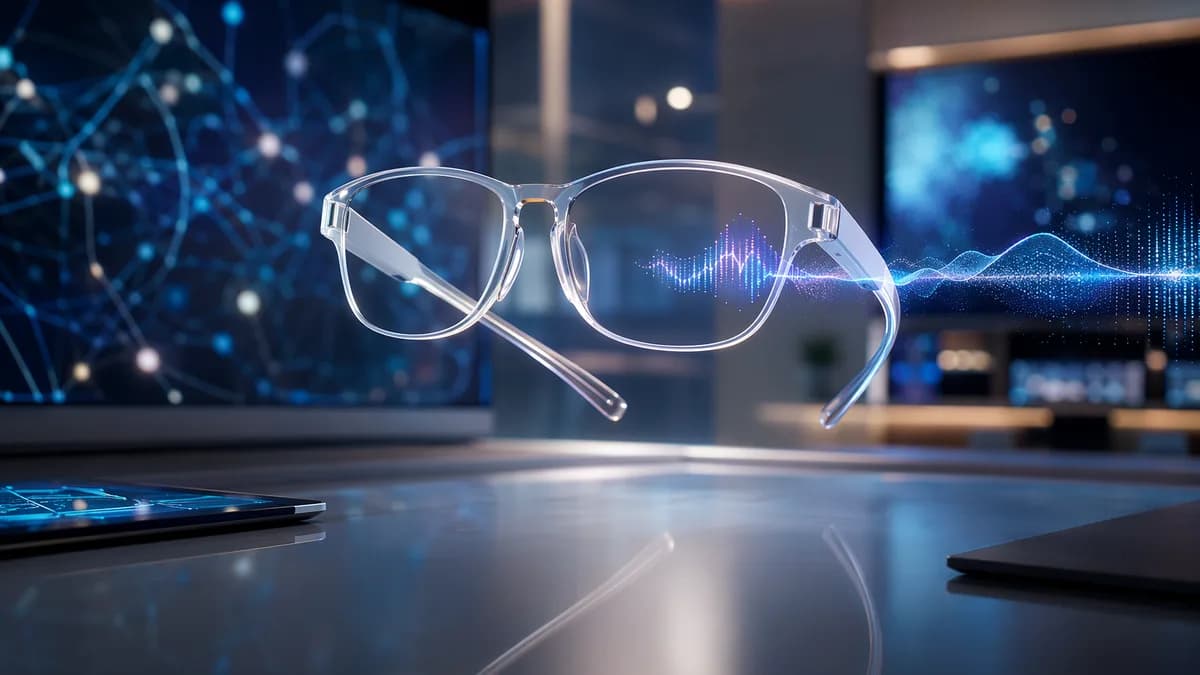
19 grams is the number Solos wants buyers to notice: the new Solos AirGo A6 smart glasses are about half the weight of last year’s AirGo A5 and far lighter than many competing AI glasses.
Solos launched the AirGo A6, a camera-free smart glasses model built around voice access to an AI assistant. The move sharpens Solos’ bet that smart glasses don’t need cameras to be useful, especially if lighter frames make them easier to wear all day.
Solos AirGo A6 smart glasses drop cameras and cut weight to about 19 grams
The biggest change is physical. Last year’s AirGo A5 weighed 36 to 40 grams, depending on frame style. The new AirGo A6 weighs approximately 19 grams.
That reduction comes partly from thinner temple arms, even though those arms still contain speakers, batteries, and other electronics. Solos is trying to make the smart parts disappear into a frame that looks and feels closer to ordinary eyewear.
The tradeoff is blunt: no camera, less bulk. The Solos AirGo A6 smart glasses rely on voice interactions for a hands-free AI experience, including question answering, real-time translations, and calendar reminders.
The glasses support “full prescription lens compatibility,” according to Solos.
That detail matters because prescription support pushes these closer to daily eyewear, not a secondary gadget people swap in only when they want AI features. The A6 is available in multiple designs, including transparent color options that reveal the electronics inside.
The open-ear speakers let users listen to music or take calls while remaining aware of their surroundings. Solos now reports the A6 offers up to 6 hours of continuous AI interaction or talk time and 24 hours of standby time on a single charge.
For readers tracking the broader camera-free eyewear category, XOOMAR has also covered the rise of camera-free smart glasses. The A6 announcement fits that same product logic, but with a sharper weight claim.
Camera-free design gives Solos a lighter alternative to Meta’s AI glasses
Solos is framing weight as the killer spec. The Ray-Ban Meta smart glasses weigh 48 to 54 grams, depending on the frame style.
That makes the AirGo A6 roughly one-third lighter than those Meta frames at the high end. Solos is not matching camera-based features; it is stripping them out.
| Product | Reported Weight | Camera Status | Main Supported Takeaway |
|---|---|---|---|
| Solos AirGo A6 | ~ 19 grams | No cameras | Voice-first AI glasses with lighter frames |
| Solos AirGo A5 | 36 to 40 grams | No cameras | Prior camera-free Solos model |
| Ray-Ban Meta | 48 to 54 grams | 12MP camera & video | Heavier, camera-equipped comparison point |
Analysis: The A6 shows Solos choosing comfort and discretion over capture. That’s a clear product split. If a buyer wants glasses for photos or video, the A6 is the wrong tool. If they want voice AI, calls, translations, reminders, and prescription lenses in a lighter frame, Solos is aiming directly at that use case.
The privacy angle is also hard to ignore, though it should be kept precise. The A6 itself removes the camera entirely. Separately, Solos offers privacy-focused accessories for its AirGo V2 smart glasses, which do have a camera, including a clip-on privacy shield.
That tells you where Solos sees friction. It is not only designing lighter frames. It is also giving camera-equipped users a way to make their glasses visibly less smart when needed.
The same consumer-AI push is showing up in other interfaces too. For related XOOMAR coverage, see Meta Pocket’s AI game tools, which tracks another route companies are taking to put AI into everyday consumer products.
AirGo A6 pricing, release, and key specifications confirmed
The Solos AirGo A6 is now available for purchase directly from Solos. The starting price is $199, positioning it as a more accessible option in the AI glasses market.
Key confirmed specifications include:
- Weight: ~19 grams
- Battery Life: Up to 6 hours of active use; 24 hours standby
- Audio: Open-ear speakers with dual microphones for calls and voice AI
- Compatibility: Works with iOS and Android via the Solos app
- Features: Real-time translation for 20+ languages, hands-free voice AI, music/podcast streaming, and phone calls.
- Options: Available in multiple frame styles with full prescription lens support.
Analysis: These finalized details move the A6 from a promising prototype to a shipped product. The $199 price point and prescription compatibility are significant, making them a viable primary pair of glasses. However, the 6-hour battery life for active AI use will be a key test for all-day practicality, and the voice assistant’s reliability will need to be high to compensate for the lack of visual features.
For now, the clearest takeaway is simple: Solos has taken the smart glasses fight to weight and price. The next watch item is whether real-world battery life and AI performance match the promise of a 19-gram, sub-$200 frame.
Key Takeaways
- The AirGo A6’s 19-gram weight and $199 starting price could make smart glasses more practical for all-day wear.
- Solos is betting that camera-free glasses can address privacy concerns while still offering useful AI features like real-time translation.
- Prescription lens compatibility makes the A6 more likely to function as everyday eyewear rather than a niche gadget.
- The 6-hour active battery life remains the main practicality question for this ultra-lightweight design.
Solos AirGo A6 vs. AirGo A5
| Model | Weight | Notable details |
|---|---|---|
| Solos AirGo A6 | Around 19 grams | Camera-free smart glasses built around voice AI, translations, reminders, and prescription lens compatibility |
| Solos AirGo A5 | 36 to 40 grams | Last year's model; weight varied by frame style |
Solos Smart Glasses Weight Comparison
Primary Sources & Disclosures

Written by
XOOMAR Insights Team
Research and Editorial Desk
The XOOMAR Insights Team pairs automated research with human editorial judgment. We track hundreds of sources across technology, fintech, trading, SaaS, and cybersecurity, cross-check the facts, and explain what happened, why it matters, and what to watch next. We do not just rewrite headlines. Every article is fact-checked and scored for reliability before it goes live, and we link back to the original sources so you can verify anything yourself.