
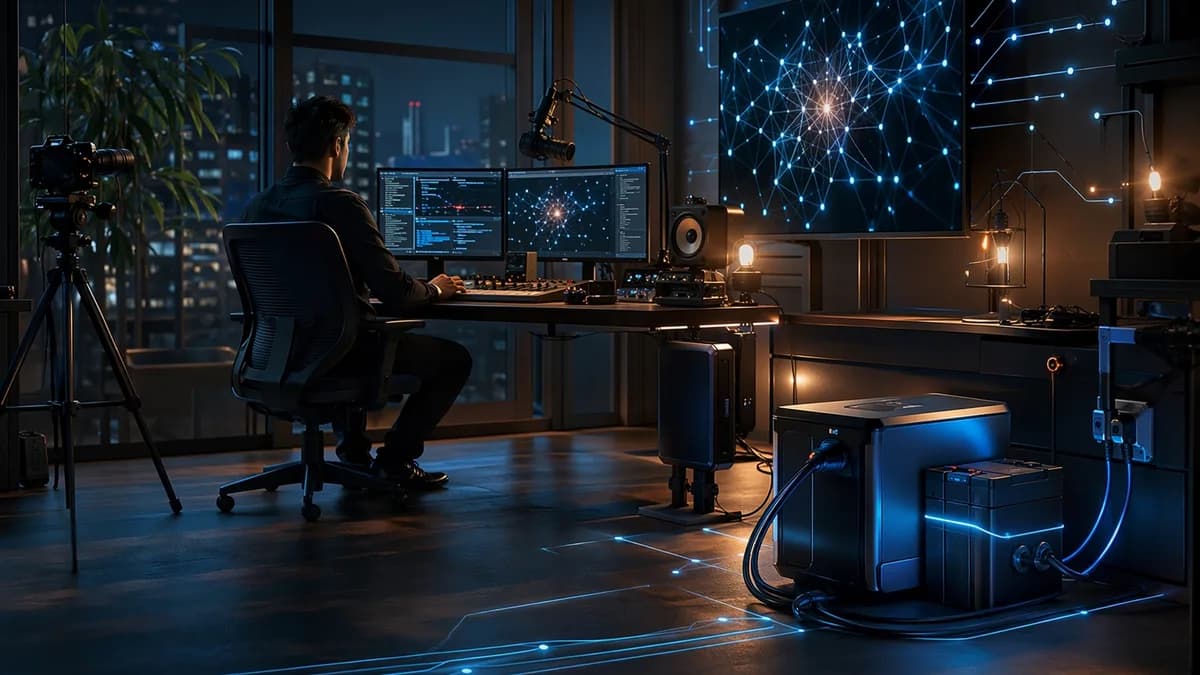
Mike Rugnetta’s most revealing productivity tool isn’t a mic, an app, or a pristine desk setup. It’s reliable electricity. That answer cuts through a lot of creator mythology. Rugnetta’s work suggests that durable creative output depends less on hustle rituals than on systems that keep failure from eating the day.
TechnologyJune 13, 2026· 9 min read· By XOOMAR Insights Team
Reliable Power Wrecks Rugnetta’s Never Post Hustle Myth
Updated on June 14, 2026
XOOMAR Intelligence
Analyst Take
71/ 100
4 sources analyzedMedium confidenceTrend10Freshness100Source Trust88Factual Grounding84Signal Cluster20
Rugnetta, the cocreator and host of Never Post, told The Verge that his most underappreciated tool is “reliable power,” after a winter outage and low-voltage service disrupted his New York studio. For a writer, podcast host, producer, audio engineer, educator, musician, sound designer, TTRPG GM, and father, that’s not a throwaway complaint. It’s the operating truth of modern creative work.
Rugnetta’s sharpest productivity lesson is that boring infrastructure wins
Rugnetta’s schedule reads like a stress test for independent media. He hosts Never Post, GMs Fun City, has hosted two Crash Course series, and hosted PBS’s Idea Channel. The obvious temptation is to ask how someone like that “stays creative.” The better question is how he keeps the production surface stable enough to create at all.
His answer starts with dependable gear. Rugnetta says his RME Fireface UCX II audio interface is the first piece of equipment he turns on every day and the last he turns off. He calls it the second most reliable piece of gear he owns. The first is his Sony MDR-7506 headphones, the same pair he says he’s used for about 20 years.
“I trust them more than some people I’ve known for as long.”
That line is funny because it’s blunt, but it also reveals the deeper point. For serious creators, tools are not accessories. They’re continuity devices. A pair of headphones that tells the truth every day matters because it removes doubt from hundreds of small decisions.
The power problem makes that logic harsher. Rugnetta says normal service is around 122V, while his power conditioner read 114V and often dropped as low as 107V. After the building lost power for over a week, his studio’s minisplit could not run on voltage that low, leaving him without ductless heat or AC for about a month.
“Anyway, long story short: Kiss your reliable power outlets.”
The Verge editors added, “Please do not kiss your power outlets.” Fair. But the sentiment stands.
Never Post turns internet commentary into production discipline
Never Post is a podcast about the internet, but Rugnetta’s comments make clear that the work is not just reacting to feeds. The show sits at the intersection of writing, hosting, research, editing, sound design, and production planning. That matters because internet commentary often looks casual from the outside. In reality, consistency is built in private.
Rugnetta’s background helps explain why. His career spans public-facing educational video, tabletop actual play, music, podcast production, and audio engineering. That mix could become chaotic. Instead, it appears to have pushed him toward process. His pinned tabs include three work email accounts, a personal calendar, and Never Post’s production Airtable. That is not glamorous, but it is how creative range avoids becoming creative sprawl.
This is where Rugnetta’s workflow has a lesson for media teams. A podcast about online life needs intellectual range, but it also needs repeatable execution. A sharp segment loses value if the episode sounds bad, ships late, or feels half-built. Listeners may not see the production Airtable, but they hear the difference between improvisation and preparation.
For teams working on controlled audio distribution, subscriptions, or gated feeds, XOOMAR’s guide to private RSS podcast hosting tools gets at the same operational layer. The product is the episode. The business depends on everything around the episode not breaking.
The hard numbers in Rugnetta’s stack expose the failure points
Rugnetta gives enough numbers to make the infrastructure issue concrete. His studio power should sit around 122V. It was reading 114V during the interview. It sometimes fell to 107V. The building lost power for over a week. He went about a month without ductless heat or AC.
Those are not abstract inconveniences. For audio work, they create cascading risks: interrupted recording, noisy substitute cooling, gear behaving unpredictably, missed editing windows, and lost focus. Rugnetta’s workaround, a window unit, introduced its own problems. He said it was loud, inefficient, connected to the internet even when told not to, and turned on and off randomly.
The table is simple:
| Layer | Rugnetta’s example | Production risk |
|---|---|---|
| Monitoring | Sony MDR-7506 used for about 20 years | Bad monitoring can distort editing and mixing choices |
| Interface | RME Fireface UCX II used daily | Interface failure can stop recording or mixing |
| Power | 114V reading, lows of 107V | Gear instability and loss of heat or AC |
| Workflow | Three work email accounts, calendar, Airtable | Missed coordination when systems are scattered |
| Attention | “Ninety percent” of his job is sitting quietly writing, mixing, editing, or scoring | Interruptions attack the core labor itself |
XOOMAR analysis: This is the creator economy stripped of romance. Lean teams do not have much slack. If the room is too hot, the AC is too loud, or a session collapses, the damage lands directly on the person making the thing.
That has an obvious parallel in larger technology operations, though the scale is different. We’ve covered how power constraints shape infrastructure decisions in AI Power Crunch Pulls GM and Ford Into Energy Storage. Rugnetta’s studio is not an AI data center. The shared lesson is narrower and more useful: energy reliability is not background. It is part of the production stack.
From Idea Channel to Never Post, the web moved from viral explainers to durable trust
Rugnetta’s career also maps a shift in digital media. Idea Channel and Crash Course belong to a mode of internet work where explainers, host voice, and educational framing carried huge weight. Never Post sits in a more platform-weary era, where the subject is often the internet’s own weirdness, exhaustion, and social machinery.
The difference is not only format. Video essays reward visual presence and shareability. Podcasts reward return behavior, trust, and intimacy. Rugnetta’s answer about focus fits that shift. He says 90 percent of his job is sitting quietly, writing or mixing, editing, and scoring. The visible host is only one layer. The unseen operator does most of the work.
His current obsessions also show how the show’s intellectual range feeds production. He told The Verge he was preparing a Never Post episode about Doom, playing through beloved and discussed Doom and Quake mods, WADs, and TCs. A related Never Post episode page describes conversations with game designers, a nuclear physicist, and a sound artist about how Doom became something that runs on many kinds of technology and even biology. That is not casual posting. It is a produced argument.
The stronger counterpoint is that creator interviews can overstate craft. Everyone likes to make their workflow sound intentional. Rugnetta’s case is more convincing because his answers are specific, unflattering, and operational: low voltage, noisy AC, pinned Airtables, limited notifications, average tab counts. He says 10 tabs is average, 20 is a lot, and he had 18 open because of the questionnaire.
Creators, listeners, sponsors, and platforms each see reliability differently
From the creator side, reliable tools protect attention. Rugnetta has stripped phone notifications down to text, email, and work Slack. His studio is separate from his apartment, in the back of the building, off the street, and near a big tree. His clients and coworkers are remote, so business hours are mostly just him, sometimes with his dog.
Listeners don’t care which power conditioner he uses. They care whether the episode arrives with care, clarity, and sound that doesn’t grate. That’s the asymmetry of media production: the audience experiences polish as effortlessness, while the maker experiences polish as dozens of small avoided failures.
Sponsors and platforms read consistency differently again. Predictable publishing creates inventory. Repeatable quality builds trust. Even when a show feels personal or handmade, the commercial side depends on boring reliability.
The skeptic has a point: gear talk can become consumer theater. But Rugnetta’s answers push against that. He is not fetishizing novelty. His favorite headphones are two decades old. His complaint is not that he lacks a shiny device. It’s that the wall power is bad.
Rugnetta’s setup argues against hustle culture with systems, not slogans
The practical lesson for podcasters and creator teams is plain: invest first in anything that prevents avoidable interruption. That might mean backup power, redundant recording, local file backups, shared calendars, episode templates, clear division of labor, or fewer notification channels. None of it looks heroic. That’s the point.
Rugnetta’s comments about getting stuck deepen the argument. He says he usually gets stuck when he is forcing a project to become something it is not, or when there is “Insufficient input.” His fix is not panic. Sometimes it means going back. Sometimes it means walking away. Sometimes it means entertaining himself so he can see what is possible through the work of others.
That is a mature creative process. It treats output as something shaped by constraints, not brute-forced by personality. Sustainable work needs room for revision, family, admin, repairs, and silence.
The next advantage for creators will likely be invisible: cleaner workflows, better backups, less fragile recording setups, and tools that reduce clerical drag without flattening the human voice. Evidence that would confirm this thesis would be more creators talking less about virality and more about repeatable production systems. Evidence against it would be audiences rewarding volume regardless of quality.
Rugnetta’s career makes the stronger case for now. Creativity is not weakened by infrastructure. It’s protected by it.
The Bottom Line
- Rugnetta’s answer reframes creativity as something supported by stable systems, not just personal discipline.
- Reliable infrastructure can be as important to independent media work as talent or software.
- Long-trusted tools reduce friction and help creators make consistent decisions under pressure.
Rugnetta’s Most Valued Creative Infrastructure
| Tool | Why It Matters |
|---|---|
| Reliable power | Prevents outages and low-voltage service from disrupting studio work. |
| RME Fireface UCX II audio interface | The first device he turns on and last he turns off each day. |
| Sony MDR-7506 headphones | His most reliable gear, used for about 20 years. |
Sources

Written by
XOOMAR Insights Team
Research and Editorial Desk
The XOOMAR Insights Team pairs automated research with human editorial judgment. We track hundreds of sources across technology, fintech, trading, SaaS, and cybersecurity, cross-check the facts, and explain what happened, why it matters, and what to watch next. We do not just rewrite headlines. Every article is fact-checked and scored for reliability before it goes live, and we link back to the original sources so you can verify anything yourself.
Explore More Topics
Related Articles
 Technology
OpenAI Acquires NextSlide to Power ChatGPT Presentations
OpenAI has acquired NextSlide, a startup that turns text into presentations, and absorbed its entire team to build the feature directly into ChatGPT.
Aug 10, 20264 min
 Technology
Is This the Last Power Brick You'll Ever Buy?
The Satechi ChargeView 240W desktop charger uses six intelligently distributed ports and a status screen to end the tangle of power bricks on your desk.
Aug 8, 20266 min
TechnologyOpenAI Swallows NextSlide to Sharpen ChatGPT Presentations
OpenAI has acquired presentation startup NextSlide in an acqui-hire, absorbing its team to build structured, polished presentation features directly into ChatGP
Aug 8, 20265 min
 Technology
Killing Creator Payouts, X Promotes Original Content
X will kill its creator revenue sharing program in September, replacing it with a new fund that only pays for original reporting, photos, and analysis.
Aug 8, 20265 min
 Technology
Block Axes 40% of Staff, Code Output Jumps 150%
Six months after cutting 40% of its workforce, Block's radical AI shift is showing results, with the number of code changes per engineer soaring 150% and featur
Aug 6, 20266 min
 SaaS & Tools
Wispr Flow Dumps AI Feature Bloat For Granola-Style Simplicity
Wispr Flow has launched a minimalist Mac meeting notetaker that bets future productivity tools will win on privacy and focus, not an overwhelming feature list.
Aug 9, 20266 min
 Technology
Pentagon Bets $1.4B on China-Free Battery Breakthrough
The Pentagon issued a $1.4 billion loan to Sila Nanotechnologies to build next-generation batteries in the U.S., a direct move to break China's grip on critical
Aug 10, 20265 min
 Global Trends
Powerful 7.4 Quake Collapses Buildings Across Colombia
A 7.4 magnitude earthquake struck western Colombia, collapsing buildings in Cali and damaging regional airports while violent shaking was felt in the capital, B
Aug 10, 20264 min
 Cybersecurity
Ceva Logistics Hack Exposes Millions of Customer Data Records
A cyberattack on global shipper Ceva Logistics has compromised customer name, address, and contact data, rippling out to major clients including banks, luxury r
Aug 10, 20266 min
 Technology
Hall Effect Keyboard Hits Historic Low At $104
Keychron's flagship Hall effect keyboard has dropped to its lowest-ever price of $104, part of a broader trend where premium PC and gaming hardware is becoming
Aug 10, 20265 min
Don't miss the signal
Get our weekly roundup of the stories that matter across tech, fintech, and trading. No noise, just signal.
Free forever. No spam. Unsubscribe anytime.