
Oratomic quantum computer is now a $300 million bet that useful quantum machines may not need million-qubit scale to arrive. The startup, founded by Caltech physicists, raised a massive Series A co-led by ARCH Venture Partners, Spark Capital, and Khosla Ventures, according to TechCrunch.
TechnologyJuly 10, 2026· 6 min read· By XOOMAR Insights Team
Oratomic's $300M Quantum Computer Bet Slashes Qubit Math
Updated on July 10, 2026
XOOMAR Intelligence
Analyst Take
58/ 100
4 sources analyzedLow confidenceTrend10Freshness100Source Trust90Factual Grounding88Signal Cluster20
That money backs a blunt claim: Oratomic says its architecture could produce a useful quantum computer with roughly 10,000 to 20,000 qubits, not the far larger qubit counts often associated with fault-tolerant roadmaps. If that holds, the company is attacking the core economic problem in quantum computing — the kind of hardware economics also dogging AI capex utilization — not just the physics.
Oratomic launches with $300 million to pursue a 20,000-qubit quantum computer
The thesis is simple: Oratomic is skipping the prototype business and going straight for utility-scale quantum computing. The company entered the race earlier this year with a target of developing the first utility-scale quantum computer by the end of the decade, and this week said it raised $300 million to pursue that goal.
The round was co-led by ARCH Venture Partners, Spark Capital, and Khosla Ventures. Participants included Bezos Expeditions, Index Ventures, General Catalyst, Lowercarbon Capital, Bain Capital, and others. That is unusually large backing for a new quantum startup that has not yet proven large-scale commercial hardware in the market.
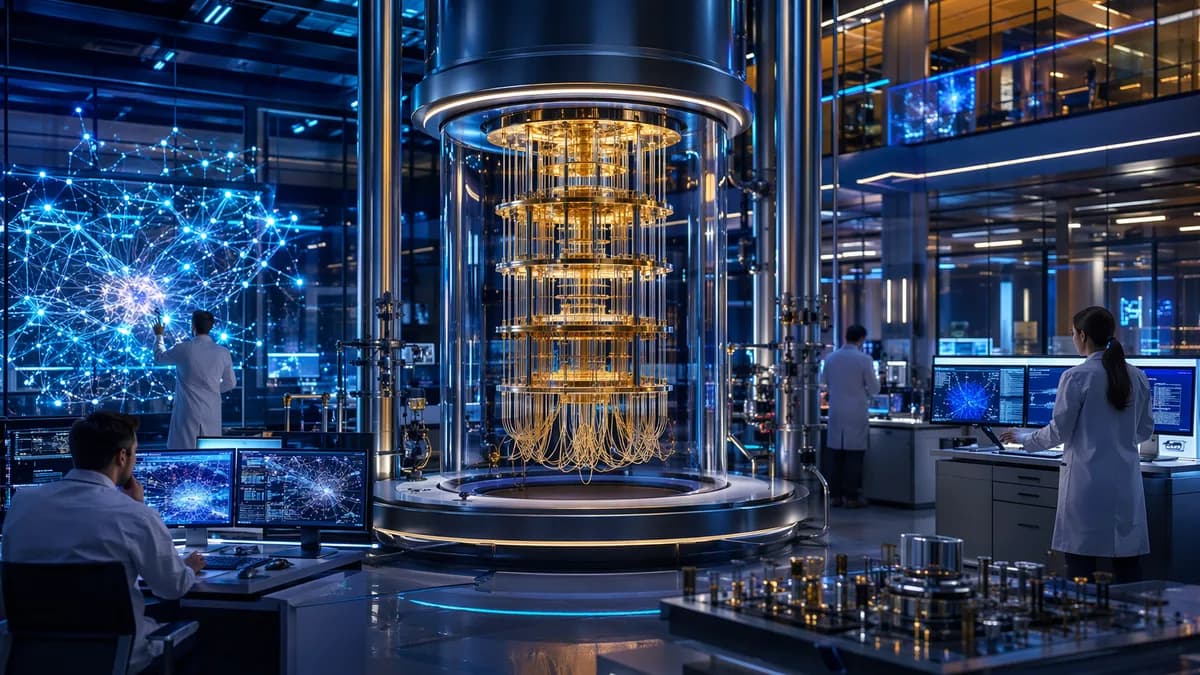
Oratomic’s machine is based on lasers that act as optical tweezers, holding individual atoms in place. The company launched after its researchers concluded that this setup could correct errors using far fewer qubits than they previously believed possible.
“You would have not previously been able to convince any of us to start a quantum computing company, because we just thought it was way too far away,” Oratomic co-founder and CEO Dolev Bluvstein told TechCrunch. “Only when we made this recent breakthrough did we simultaneously all change our minds.”
The strongest counterpoint is obvious. Quantum companies have made bold roadmaps before, and a funding round does not validate the architecture. Still, the size and investor mix give Oratomic room to hire, build, and test at a scale most early-stage hardware companies never reach.
The 20,000-qubit target challenges the cost curve of fault-tolerant quantum computing
Oratomic’s central claim cuts straight into quantum economics: fewer qubits could mean fewer machines, less complexity, and a shorter path to useful workloads. Error correction is the bottleneck because quantum computers are extremely sensitive to noise. A machine that cannot correct errors while calculations run remains a research tool, not a reliable commercial system.
That is why the 10,000 to 20,000 qubit range matters. Oratomic says it has already experimentally demonstrated the core components required for its computer at a slightly smaller scale, according to Bluvstein. The company is not pitching incremental access to today’s noisy systems, it is pitching a direct route to fault tolerance.
“The difference is that we need roughly 10,000 to 20,000 qubits to build a useful computer, and we have already experimentally demonstrated all of the core components required of that computer at a slightly smaller scale,” Bluvstein said.
TechCrunch reported that Oratomic does not plan to develop or sell NISQ systems, the noisy intermediate-scale quantum machines that many companies make available to researchers and corporations. That is a sharp strategic choice. It removes near-term product distraction, but it also removes a path to early customer feedback.
| Company strategy | Oratomic | Broader comparison |
|---|---|---|
| Near-term systems | No plans to develop or sell NISQ systems | Many companies have made noisy intermediate-scale systems available |
| Qubit target cited in source | Roughly 10,000 to 20,000 qubits | No like-for-like target is established in the supplied material |
| Timeline cited in source | Utility-scale quantum computer by the end of the decade | No comparable timeline is established in the supplied material |
| Architecture detail provided | Individual atoms held with laser-based optical tweezers | Varies by company and is not detailed enough here for direct comparison |
The supplied material does not support a detailed valuation, timeline, or qubit-target comparison with PsiQuantum. The safer takeaway is narrower: Oratomic is positioning its approach as fundamentally simpler and potentially less expensive. That remains an argument, not a proven market fact.
ARCH, Spark, and Khosla are funding a quantum hardware race with little room for soft milestones
The $300 million Series A signals that quantum hardware is becoming a capital race as much as a science race. Oratomic has to finance long development cycles, recruit specialized physics and engineering teams, and build hardware infrastructure before it can show whether its architecture survives scale.
Top-tier venture backing matters here because credibility compounds. It helps with hiring, supplier conversations, and research momentum. It also raises the bar fast. A company funded at this level cannot hide behind vague lab progress for long.
Investor enthusiasm around Oratomic is visible in the deal itself: a large Series A, a broad syndicate, and public comments from backers. The supplied materials do not establish broader public-market claims about other quantum companies, so the cleaner point is that private capital is willing to fund another expensive hardware push before commercial proof.
Vinod Khosla framed the bet in unusually strong terms, writing on X that it was his firm’s “largest initial investment yet.” That is not a technical milestone, but it is a signal that Khosla Ventures sees Oratomic as more than a speculative lab spinout.
Separate XOOMAR coverage has tracked other technology financing and AI stories, including Menlo-Led $300M Bet Could Lift Lovable Valuation to $13.2B and Meta Throws Muse Spark 1.1 Into the AI Coding Fight. Oratomic’s case is different in the fact pattern supplied here: the gating risk is not distribution or software adoption, it is whether the physics scales.
Oratomic’s next test is proving its qubits can scale without losing reliability
The next credible proof point is not another funding announcement. It is measured hardware progress. Readers should watch for demonstrations of larger atomic arrays, error rates, logical qubit performance, and clearer roadmap dates from Oratomic.
A viable Oratomic quantum computer will need more than a headline qubit count. It will need software tooling, repeatable manufacturing, stable control systems, usable algorithms, and the ability to keep errors under control as the machine grows. The company’s optical tweezer architecture may reduce overhead, but scale tends to expose weaknesses that small systems can hide.
The biggest open question is transparency. Oratomic says its breakthrough changed the founders’ view of commercial timing, but outside researchers and enterprise buyers will want technical detail behind the 10,000 to 20,000 qubit claim. Without that, the number will remain a provocative target rather than an industry benchmark.
If Oratomic can show that its error correction approach works at larger scale, the Oratomic quantum computer plan becomes one of the more consequential hardware bets in advanced computing. If it cannot, the $300 million round will stand as a reminder that venture capital can fund the race, but it cannot soften the physics.
The Bottom Line
- Oratomic’s $300 million Series A signals major investor confidence in a faster path to useful quantum computing.
- If its 10,000-to-20,000-qubit claim holds, it could dramatically reduce the cost and complexity of commercial quantum machines.
- The startup is challenging the assumption that practical quantum computing requires million-qubit systems.
Quantum Computing Roadmap Comparison
| Approach | Target Scale | Core Claim |
|---|---|---|
| Oratomic architecture | 10,000 to 20,000 qubits | Could deliver useful quantum computing with far fewer qubits |
| Traditional fault-tolerant roadmap | Million-qubit scale | Often assumes far larger systems are needed for utility |
Qubit Scale Targets
Oratomic lower target
qubits10,000
Oratomic upper target
qubits20,000
Million-qubit scale
qubits1,000,000
Sources

Written by
XOOMAR Insights Team
Research and Editorial Desk
The XOOMAR Insights Team pairs automated research with human editorial judgment. We track hundreds of sources across technology, fintech, trading, SaaS, and cybersecurity, cross-check the facts, and explain what happened, why it matters, and what to watch next. We do not just rewrite headlines. Every article is fact-checked and scored for reliability before it goes live, and we link back to the original sources so you can verify anything yourself.
Explore More Topics
Related Articles
 Technology
€91M Bet Pushes QuantumDiamonds Chip Inspection Into Fabs
QuantumDiamonds has €91M in fresh backing to turn diamond sensors into fast chip inspection tools for fabs.
Jul 8, 20267 min
 Technology
Bidbus Says Dealers Can Beat Carvana by $3,000 a Car
Bidbus raised $15 million to make dealers bid for used cars, claiming sellers can beat Carvana offers by $2,000 to $3,000.
Jul 7, 202613 min
 Technology
Xreal A01 Plus Slashes AR Glasses Price in $299 Bet
Xreal’s $299 A01 Plus cuts premium features, but its lighter fit and bright screens may be the AR glasses compromise buyers wanted.
Jul 10, 20267 min
 Technology
Menlo-Led $300M Bet Could Lift Lovable Valuation to $13.2B
Lovable may double its valuation to $13.2B in a reported $300M Menlo-led round, putting Europe's vibe-coding boom on notice.
Jul 8, 20266 min
 Fintech
Nandan Nilekani Drops GP Seat in Fundamentum's $200M Bet
Nandan Nilekani is leaving Fundamentum's GP role as the firm raises a $200M Fund III and tests its brand beyond his name.
Jul 9, 20266 min
 Technology
Half-Empty GPU Utilization Rattles Wall Street's AI Bet
86% of enterprises say their GPUs run at half capacity or less, putting AI capex plans under a harsher spotlight.
Jul 10, 20269 min
 Global Trends
Sinner Crushes Djokovic's 25th Slam Bid at Wimbledon
Sinner erased Djokovic's 25th Slam chase in straight sets and booked a Wimbledon final with Zverev.
Jul 10, 20265 min
 Trading
JPMorgan AI Agents Humble 60/40 in Portfolio Simulations
All eight JPMorgan AI agents beat 60/40 and a rules-based model in simulations. The bank still won't hand them the portfolio.
Jul 10, 20268 min
 Global Trends
Trump Wields Housing Bill in SAVE Act Pressure Play
Trump won't sign the housing bill, but without a veto it can still become law as he pressures the Senate over the SAVE Act.
Jul 10, 20268 min
 Technology
Free Disney+ Tier Threatens Streaming's Paywall Era
Disney+ is weighing free access as YouTube and Tubi eat viewing time, a sign premium streaming's paywall is starting to crack.
Jul 10, 20268 min
Don't miss the signal
Get our weekly roundup of the stories that matter across tech, fintech, and trading. No noise, just signal.
Free forever. No spam. Unsubscribe anytime.