
SpatialAware is the first Philips Hue feature in years that makes color-changing bulbs feel necessary instead of decorative, and it matters most to people who already have a house full of Hue gear.
TechnologyJune 9, 2026· 8 min read· By XOOMAR Insights Team
SpatialAware Rescues Philips Hue Colors From Gimmickry
Updated on June 9, 2026
XOOMAR Intelligence
Analyst Take
73/ 100
4 sources analyzedMedium confidenceTrend10Freshness100Source Trust88Factual Grounding93Signal Cluster20
That’s the real lesson from Jennifer Pattison Tuohy’s Bridge Pro review at The Verge. The hardware upgrade didn’t look urgent when it launched. More capacity, faster response times, and MotionAware sounded useful, but not irresistible. Then SpatialAware arrived in April and changed the case for the hub.
For invested Hue homes, SpatialAware is the upgrade that makes color earn rent
Hue’s color bulbs have always had a strange problem: they’re technically impressive, but in daily life many people drift back to warm white. The novelty of making a room purple, orange, or neon blue wears off fast when the result feels random.
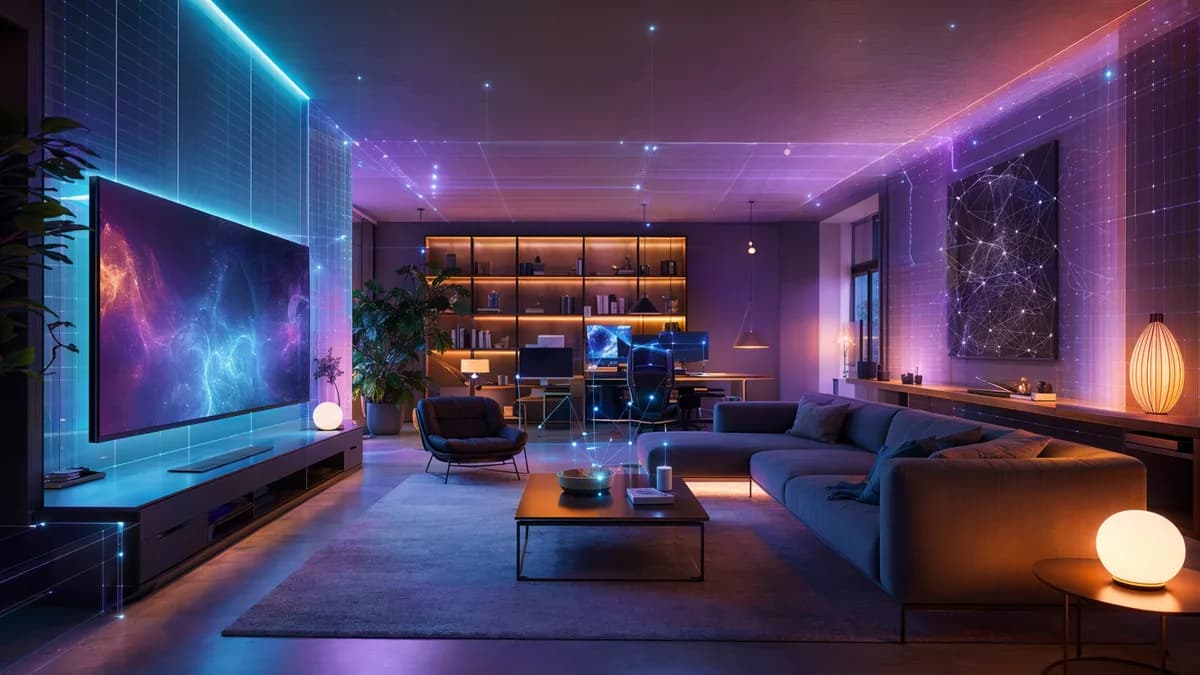
SpatialAware attacks that problem directly. It uses the Bridge Pro and a phone’s AR capabilities to map where lights sit in a room, then distributes compatible Hue scenes across those lights more intelligently. Philips Hue describes the feature as giving the system “a true understanding of your room,” and says it applies lighting design concepts to a home without requiring manual tuning.
“Before SpatialAware, Hue scenes were intelligently applied based on the form, function, capabilities, and configuration of your lights. However, without knowing the exact placement of each light in the room, light distribution could feel somewhat random.”
That word, random, is the whole story. What good is a premium lighting setup if the most expressive feature feels like a party trick?
The Verge’s example is telling. Without SpatialAware, a scene such as Woodland Toadstool could leave one lamp red, another yellow, and a light strip orange. With SpatialAware, the color distribution became subtler and more cohesive, especially when gradient lights were part of the room.
That’s not a spec-sheet win. That’s a usability win.
For Signify, Bridge Pro needed more than capacity and speed
The Bridge Pro had a credibility problem at launch. It was faster and more capable than the standard Hue bridge, but the upgrade case leaned heavily on things many loyal Hue owners could rationalize away.
The numbers are real:
| Feature | Bridge Pro advantage |
|---|---|
| Device capacity | Handles more than 150 lights and 50 accessories |
| Performance | Promises to be up to five times faster |
| Processing | Uses a quad-core processor and 1GB of RAM |
| Exclusive features | Supports MotionAware and SpatialAware |
That’s meaningful if you’re near the limits of a standard bridge. The Verge notes the Pro’s capacity is three times the standard bridge’s limit. But if a user already runs two standard bridges, buying yet another hub can feel less like progress and more like maintenance.
So what makes a hub worth buying again? It has to unlock behavior the old system simply couldn’t do.
SpatialAware clears that bar. It turns Bridge Pro from a capacity upgrade into a design upgrade. It gives existing bulbs new purpose without demanding that every fixture be replaced. In a smart home category full of hardware churn, that’s the better pitch.
For users, room mapping fixes the color-light novelty problem
The strongest argument for SpatialAware is simple: it makes color less needy.
Color scenes usually ask the user to care. Pick a mood. Open the app. Tweak the bulbs. Decide whether the room should look like a sunset, a forest, or a gaming setup. That’s fun for a week. Then real life wins.
SpatialAware makes the room do more of the work. The Verge reviewer found that many scenes looked better after scanning, enough to add some to MotionAware zones so they would activate at certain times of day. Her husband noticed the living room looked better one night, and the only change was the lighting.
That’s the kind of detail that matters. If a smart-home feature has to announce itself, it’s probably already failing. If someone walks into a room and only notices that it feels better, the technology has done its job.
The useful version of color is contextual
The feature is still limited. The Verge says only some scenes support SpatialAware, and it doesn’t work with zones such as Downstairs or Night Lights. Philips Hue says around half of the remastered scenes in the Hue Scene Gallery are already optimized, with more coming over time.
So the obvious question is: does that make SpatialAware unfinished or just early?
My read: early. The limitation matters, but it doesn’t undercut the core breakthrough. Hue finally found a reason for color bulbs that doesn’t depend on novelty. It made color spatial.
For smart-home builders, invisible sensing beats another plastic puck
MotionAware is less convincing, but it points in the same direction. It detects motion by sensing disruptions in Zigbee radio signals between Hue devices. In the Hue app, it behaves like a motion sensor, but without requiring a separate puck on the wall.
That’s appealing. Fewer accessories. Fewer batteries. Less visual clutter.
But The Verge’s testing shows the limits clearly:
- Room layout: MotionAware needs three to four powered Hue lights in a room, and they can’t be arranged in a straight line.
- Speed: In the mudroom/laundry room, lights turned on reliably, but only once the reviewer was halfway down the hall.
- Bedrooms: No weekend setting meant lights turned on at 6AM after movement in bed.
- Office use: Since it senses motion rather than presence, lights could shut off while someone was working.
- Switch problem: If someone cuts power at the wall switch, the feature won’t work.
That last point is classic smart-home friction. The system may be clever, but it still lives in a house where people flip switches.
Does MotionAware replace standalone sensors? Not broadly. The Verge’s conclusion is sharper: it worked best in a large, open-plan living room, but didn’t justify replacing motion sensors elsewhere.
That’s still useful. The best version of Hue’s Pro story isn’t “your bulbs replace every sensor.” It’s “your existing lighting network can reduce how many extra devices you need.”
For XOOMAR readers, this is the same infrastructure mindset we apply across connected systems, including our coverage of 3 Days to Kill Check Point VPN Bug, CISA Tells Feds: the hardware matters less than what the network can reliably do after deployment.
For buyers, the Pro tax is still hard to swallow
The counterargument is strong. Hue is expensive, and the Bridge Pro asks loyal users to pay again for the most interesting new features.
The Verge lists the Bridge Pro at $140 through Philips Hue, while noting it was easier to justify at $98 and could still be found at that price at the time of review. It also costs £89.99 in the UK/EU. That US gap stings.
MotionAware can also feel awkward for early adopters. If you already bought Hue’s standalone motion sensors at $49 each, the pitch that your lights can now act as sensors is less exciting. If you already split your setup across multiple bridges, the Pro may look like another toll booth.
Privacy and reliability concerns also deserve respect, though the source material here is mostly about performance rather than privacy. When lighting becomes sensing infrastructure, users need clear controls and predictable behavior. A bedroom light that turns on at 6AM because someone rolled over doesn’t feel smart. It feels rude.
Still, those concerns don’t erase the significance of SpatialAware. They define the next job for Hue: make context-aware lighting easier to trust, easier to schedule, and less dependent on ideal room layouts.
For rivals, Hue’s lesson is software that makes hardware age better
The smart-lighting lesson here is blunt: stop selling color as spectacle.
The Verge says Govee, Nanoleaf, or Lifx may suit buyers who want super-bright colors and flashier RGB scenes for less money. That’s a fair lane. Hue’s advantage, as described in the review, is dependable everyday lighting, broad product range, strong dimming, and a Zigbee mesh that avoids the reliability issues the reviewer associates with Wi-Fi bulbs.
SpatialAware builds on that advantage. It doesn’t make Hue cheaper. It doesn’t make every room work perfectly. It doesn’t remove the need for standalone sensors in tricky spaces.
But it does something more valuable for serious Hue households: it makes the lights they already own feel newly intelligent.
That’s the practical takeaway for buyers. If you’re deep into Hue, have multiple lights in key rooms, and actually want color scenes to look designed rather than scattered, the Bridge Pro now has a real purpose. If you’re just starting out, the standard bridge remains the saner value.
Color-changing lights finally feel grown up when they stop demanding attention and start quietly improving the room around you.
Key Takeaways
- SpatialAware gives Hue color bulbs a more practical reason to exist beyond novelty.
- The feature makes the Bridge Pro upgrade more compelling for homes already invested in Hue gear.
- Better scene placement could make smart lighting feel more designed and less random.
Hue Lighting Experience Before and After SpatialAware
| Before SpatialAware | With SpatialAware |
|---|---|
| Color scenes could feel random because Hue did not know exact light placement. | Scenes are distributed based on mapped light positions in the room. |
| Color-changing bulbs often felt decorative rather than essential. | Color scenes become more cohesive and useful for invested Hue homes. |
| Users often drifted back to warm white lighting. | Compatible Hue scenes can feel more intentionally designed. |
Sources

Written by
XOOMAR Insights Team
Research and Editorial Desk
The XOOMAR Insights Team pairs automated research with human editorial judgment. We track hundreds of sources across technology, fintech, trading, SaaS, and cybersecurity, cross-check the facts, and explain what happened, why it matters, and what to watch next. We do not just rewrite headlines. Every article is fact-checked and scored for reliability before it goes live, and we link back to the original sources so you can verify anything yourself.
Explore More Topics
Related Articles
 Technology
200B Shorts Views Crown Vertical Video King of Phones
YouTube Shorts' 200B daily views show vertical video has become the default interface for phone attention.
Jul 26, 20268 min
 Technology
AI Reset Cuts Deep as Patreon Layoffs Hit 20% of Staff
Patreon is cutting 20% of staff, framing the move as an AI-era reset while insisting machines aren't replacing workers.
Jul 26, 202611 min
 Technology
Pervert Glasses Backlash Traps Meta Smart Glasses in Crisis
Meta smart glasses turned effortless recording into Instagram's moderation problem, and the privacy backlash is now a brand crisis.
Jul 25, 20268 min
 Technology
Less RAM Stings Framework Laptop 13 Pro Preorder Buyers
Framework has enough RAM for Laptop 13 Pro preorders, but not the right mix, so some buyers may get less memory or new pricing.
Jul 23, 20266 min
 Technology
Substack AI Detector Turns Every Writer Into a Suspect
Substack's AI detector gives readers a scan button for posts and comments, putting writer trust under a microscope.
Jul 21, 20269 min
 Global Trends
Champagne and Bullets Claims Its Cult Bad-Movie Throne
Champagne and Bullets turns failure into spectacle, earning a spot beside The Room and Troll 2 in the bad-movie canon.
Jul 26, 20268 min
 Fintech
Apple Upgrade Grabs Control of Your Next iPhone Cycle
Apple Upgrade would replace iPhone financing with leases, giving Apple and Klarna more control over when customers swap devices.
Jul 28, 20267 min
 Fintech
Upstart Bank Charter Throws AI Lending Into Hot Seat
Upstart won OCC conditional approval, but its bank charter still needs FDIC and Fed signoffs before its AI lending model faces the real test.
Jul 27, 202610 min
 Technology
Outsourced Thinking Triggers Satya Nadella AI Warning
Satya Nadella says companies handing one AI lab their prompts, metadata and memory risk outsourcing the thinking that keeps them alive.
Jul 27, 20268 min
 Trading
6.79 PBoC Fix Traps USD/CNH as Yuan Bulls Stall Again
OCBC says the 6.79 PBoC fix is keeping USD/CNH rangebound, signaling Beijing wants two-way moves without a sharper yuan rally.
Jul 27, 20268 min
Don't miss the signal
Get our weekly roundup of the stories that matter across tech, fintech, and trading. No noise, just signal.
Free forever. No spam. Unsubscribe anytime.