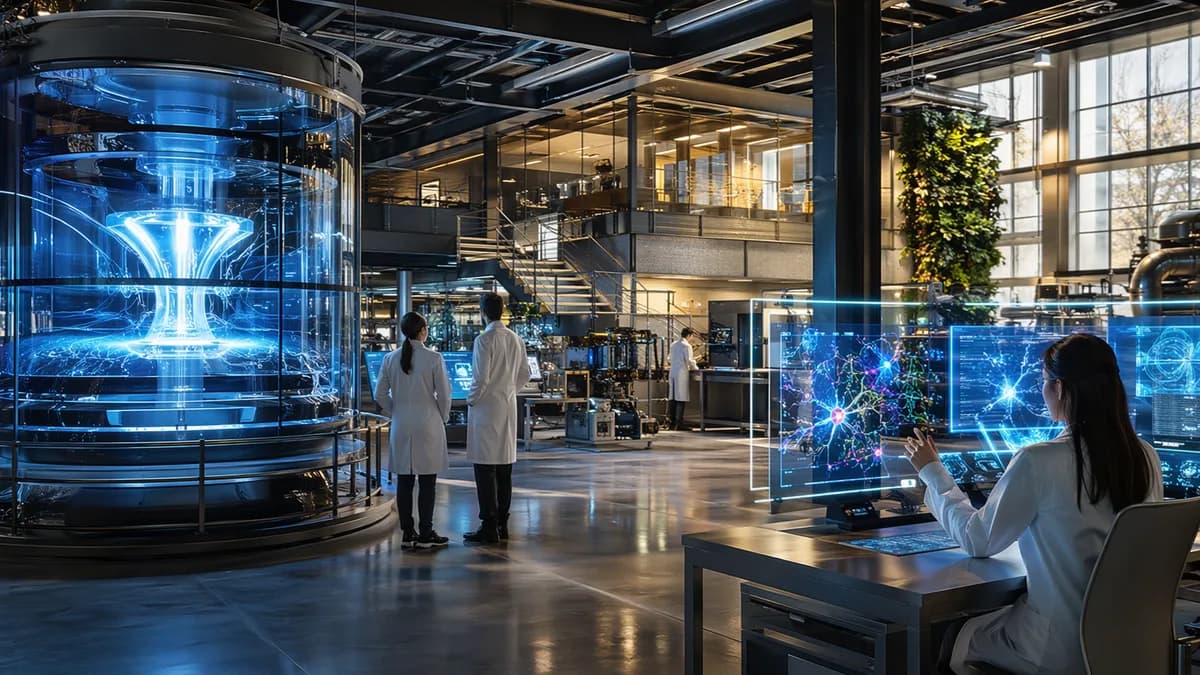
Realta Fusion is getting up to $55 million in Wisconsin and Madison incentives to turn the former Oscar Mayer plant into a fusion R&D hub, a choice that says as much about industrial execution as it does about plasma physics.
XOOMAR Intelligence
Analyst Take
The Madison startup spent two years searching for a site before choosing its own backyard, according to TechCrunch. The facility, called Forge or The Realta Forge in company materials, is slated to create its first plasma in 2029, CEO Kieran Furlong told TechCrunch.
“From sausages to fusion,” Kieran Furlong, co-founder and CEO of Realta Fusion, told TechCrunch with a chuckle.
That line will travel because it’s funny. The harder read is that Realta is trying to prove fusion can move from specialized research settings into old industrial real estate, with local tax policy, workforce pipelines, and factory redevelopment all part of the strategy.
A hot dog plant turns Realta Fusion into Wisconsin’s fusion anchor
The former Oscar Mayer site gives Realta Fusion three things TechCrunch says mattered: ample power, proximity to its existing Madison headquarters, and political support from state leaders.
The political part appears to have sealed it. Furlong told TechCrunch that bipartisan backing from Wisconsin’s governor and legislature pushed the company to stay.
“Wisconsin really decided they want to throw their weight behind fusion,” Furlong said.
That matters because Realta’s decision is unusual in the fusion startup map described by TechCrunch. Most fusion startups have clustered near national laboratories or on the coasts. Another Wisconsin-grown fusion company, Type One Energy, moved to Tennessee in 2024.
Realta is making the opposite bet. It’s trying to become the state champion in a place that wants a fusion identity.
Furlong put the advantage bluntly:
“It’s also advantageous to be the state champion,” he said. “We get the attention of people who matter, who can help us, who want to see Realta succeed and want to see Wisconsin be a major hub for fusion.”
XOOMAR analysis: That’s not just civic boosterism. For a capital-heavy hardware startup, attention from state officials can translate into faster problem-solving, better incentive design, and a clearer public narrative. The risk is that the same visibility raises expectations before the physics and engineering are proven.
Realta is betting on magnetic mirror fusion, not the default coastal playbook
Realta describes itself as the world’s leading magnetic mirror fusion energy company in its announcement, and says it is developing compact, scalable, modular fusion energy systems. The company also says it operates the Wisconsin HTS Axisymmetric experimental fusion machine at the University of Wisconsin-Madison’s Physical Sciences Laboratory.
That university link is central. TechCrunch reports that Realta was spun out of an experiment at the University of Wisconsin-Madison, and that the university graduates talented plasma physicists annually. That gives the company a local talent pool that most industrial redevelopment sites don’t have.
The company’s technical next step is also named: Realta expects to break ground on The Realta Forge before the end of the year and begin building a prototype magnetic mirror fusion machine called Hammir, according to Realta’s announcement.
Realta recently showed it could convert energy from fusion reactions directly into electricity, TechCrunch reported, potentially easing the route toward a commercial power plant. The source material does not provide performance figures for that demonstration, so the significance should be kept in proportion.
XOOMAR analysis: The site decision and the technology choice are linked by one question: can Realta make fusion look less like a one-off science project and more like repeatable industrial hardware? The company’s own language, compact, scalable, modular, is aimed squarely at that question.
The $55 million package changes the factory math
Wisconsin and Madison’s incentive package is the clearest hard-number signal in this deal.
| Incentive source | Amount | Mechanism |
|---|---|---|
| Wisconsin sales and use tax exemptions | Estimated $37.5 million | Fusion project capital expenditure exemption |
| Wisconsin Economic Development Corporation | Up to $15 million | Performance-based enterprise zone tax credits |
| City of Madison | $2.8 million | Tax increment financing for job creation at OM Station |
| Total package | Up to $55 million | State and city support |
The largest piece is the sales tax exemption. TechCrunch reports that Republicans and Democrats backed the fusion industry exemption, which was signed into law in April. Realta’s announcement identifies it as Wisconsin Act 165, described there as the first standalone state legislation in American history to exempt capital expenditures on fusion energy projects from state sales tax.
Realta says the new facility is expected to create over 600 jobs, including technical and non-technical roles. Madison’s contribution is also notable because the company says it is the first time in 10 years that the city has issued tax increment financing to a private company for job creation.
Madison Mayor Satya Rhodes-Conway framed the city’s choice around redevelopment and jobs:
“Madison does not take the decision to provide tax increment financing lightly, but this was the right kind of project for the city to support,” said Mayor Rhodes-Conway. “This is an opportunity to bring hundreds of high-paying jobs in the sustainable energy sector to our community and revitalize a largely vacant property that means so much to Madisonians.”
XOOMAR analysis: For Realta, avoided costs are strategy. Fusion companies are racing against milestones and cash burn, and site economics can shape how much capital remains for engineering rather than concrete, utilities, and delays.
Wisconsin gets a clean-tech story, Madison gets a second act
The stakeholder split is unusually clean.
Realta Fusion gets space, incentives, proximity to its headquarters, university talent, and the soft power of being Wisconsin’s flagship fusion company. Wisconsin gets a high-profile energy technology project tied to research universities and manufacturing. Madison gets a reuse plan for a landmark industrial site that might otherwise remain underused.
Investors will care less about the symbolism and more about milestones. Realta is one of eight companies selected for the U.S. Department of Energy’s Milestone-Based Fusion Development Program, according to the company announcement. That puts execution under a bright light.
Local residents will likely judge the project by jobs, site disruption, public incentives, and whether the former Oscar Mayer property becomes productive again. The supplied materials do not detail safety review, traffic planning, construction timelines beyond expected groundbreaking before year-end, or how many jobs will be filled locally.
The energy backdrop also helps explain why Wisconsin moved. TechCrunch reports that fusion power is rising as electricity demand grows from economy-wide electrification and proliferating AI data centers, and that fusion startups have raised over $1.5 billion this year alone.
That AI power pressure has been showing up across tech infrastructure coverage. For related XOOMAR context, see New York Data Center Moratorium Hits AI's Power Grab and Nvidia Pushes Gradium Voice AI Into a $100M Power Race.
Three tests will decide whether Forge becomes a model or a warning
Realta’s Madison project won’t settle the fusion race. It will test whether a fusion startup can combine science, state policy, and industrial redevelopment without letting any one piece outrun the others.
Technical credibility comes first. Realta needs Forge to produce plasma in 2029 and needs Hammir to advance the company’s magnetic mirror path in a way that convinces investors and public partners the approach is moving toward commercial relevance.
Execution discipline comes next. Turning a former food-industry site into a serious fusion R&D center is not just branding. It requires the company to convert incentives, power access, local support, and university proximity into a working development machine.
Market fit is the final test. Realta says it is building compact, scalable, modular fusion systems, and TechCrunch reports that the company’s direct electricity-conversion work could ease the path to a commercial power plant. Evidence that strengthens the thesis would include on-time construction, visible hiring, clear Hammir milestones, and more detail on how Realta’s systems move from R&D to customers.
Evidence that weakens it would be simpler: delays, cost overruns, vague performance updates, or incentives that produce headlines faster than hardware. The old Oscar Mayer factory gives Realta Fusion a memorable stage. Now it has to make the factory useful.
Impact Analysis
- Realta’s site choice shows fusion startups may be able to reuse legacy industrial real estate instead of building only near labs.
- Wisconsin’s incentives signal a push to make the state a fusion technology hub.
- The project could tie advanced energy development to local jobs, infrastructure, and factory redevelopment.
Wisconsin Fusion Strategies
| Company | Wisconsin Decision | Key Site Move | Timeline |
|---|---|---|---|
| Realta Fusion | Stayed in Madison with state and local backing | Turning the former Oscar Mayer plant into The Realta Forge | First plasma planned for 2029 |
| Type One Energy | Left Wisconsin | Moved to Tennessee | Moved in 2024 |
Wisconsin and Madison incentives for Realta Fusion
Primary Sources & Disclosures

Written by
XOOMAR Insights Team
Research and Editorial Desk
The XOOMAR Insights Team pairs automated research with human editorial judgment. We track hundreds of sources across technology, fintech, trading, SaaS, and cybersecurity, cross-check the facts, and explain what happened, why it matters, and what to watch next. We do not just rewrite headlines. Every article is fact-checked and scored for reliability before it goes live, and we link back to the original sources so you can verify anything yourself.